Last Minute Trip Got Dropped On Me
I’ll be in the air most of the day, and no idea if I’ll have network access at the client this week. Updates as possible.
Words. Pictures. Boom: comics.
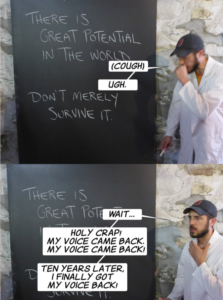
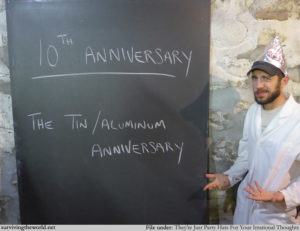
3548 comics, give or take. Ten years and a day. Grad school, industry, academia. Dante Shepherd Lucas Landherr ends Surviving The World on the message he’s always had for us, and while he won’t be watching over us, yea, as a shepherd watches over the flocks, he’ll still be out there making comics to make the world better, smarter, kinder.
And weirder, probably. Dude’s got an appreciation of The Weird.
For those so inclined, as of this writing you’ve got about 70 minutes to get in on the Kickstarter for the one and only print collection of Surviving The World; from here on out if you want to see Landherr’s comics, you’ll have to check out PhD Unknown, or maybe be enrolled in a course of STEM study, or if we’re lucky we’ll find an Easter egg or two in the Crash Course: Engineering series.
Okay, enjoy your weekend, see you again on Monday, and let’s each say one thing that’s good, smart, kind, or weird to one person in Landherr’s honor. And Luke? Kick back, enjoy a tasty and refreshing beverage, enjoy the love of your wife and daughters for a bit. Then it’s back to work — the world won’t be getting better, smarter, kinder, or weirder on its own, and putting down the chalk doesn’t mean you’re off the clock, Sparky.
Good job. Can’t wait to see what’s next.
PS: Speaking of comics that make the world better/smarter/kinder/especially weirder, there’s a new What If? today!
Spam of the day:
Live WebCam ( . )( . )
Man, that just does not work when you apply the quoted text style to it. Looks like the putative naked lady is leaning hard to her left and about to tumble over. Just — somebody steady her, please?
It’s late, there’s lots to talk about, onwards.
I’m not going to say that it’s because of webcomics, but I’m pretty sure the guy will tell you that having a creative¹ outlet is crucial for getting through the rigors of nerd school; for me it was being on the radio, for Dantecus, it’s horrible puns and chalk dust, raptor impressions, and Peanuts dances. He tried to keep his weirdo side on the downlow for a while after he got the teaching gig, but the students found him and embraced him. They’ve taken his weirdness and multiplied it, and will coincidentally take his other lessons out to their careers (and possibly their own students).
It’s a significant legacy, and if you find it inspirational in the slightest², a reminder that tomorrow also marks the end of the Kickstart for the one and only STW print collection. Landherr (for that is his proper name) has future comics and future lessons in him, and it’s time to turn the page on the present³ project in favor of what comes next. Make your chalk always be the dust-free variety may the erasers always clap clean, and may you never lose the lab coat and Red Sox cap, Dr Landherr. Thanks for all the laugh-chuckles along the way.
Congrats to Nolan and Moen — it must feel great to know that five years in, you’re more necessary and more appreciated than ever. Celebrate tonight, be remember that tomorrow you’ve got to produce a book that will blow (heh, heh) everybody’s socks off. Seeing as how you’ve done that repeatedly, I think you’ll manage it again this time.
If you’re at BEA (running in New York at the Javits, through tomorrow), look up Odd Dot at booth 2444 and give Venable a high five (or a hug, if she’s amenable) for me. I couldn’t be happier for all she’s done and is yet to do.
Spam of the day:
My name is Orko
What.
and we are a Video Content creation solution that helps businesses create videos easily. I would like to invite you to please review how you can easily produce quality videos to show or communicate more about Fleen.
Why is He-Man’s faceless dipshit sidekick trying to sell me on content (ew, ick) creation solutions?
_______________
¹ Or weird, if you prefer
² I find it hell of inspirational, even though Shepland insists on cleaving to an objectively inferior form of engineering. Electrical rules, chemical is stinky and gloopy and sometimes glowing green.
³ Want to creep him out? Stare him in the eye and in an overly enthusiastic voice ask the one word question, Presents? Trust me on this.
It’s been a long day, let’s get right to it.
But I digress. I mention Venable today because she’s going to be delivering a webinar for all interested in the construction of graphic novels, sponsored by the Society of Children’s Book Writers & Illustrators, specifically the France region. As of this writing, five slots remain for registration, with the session taking place on Saturday, 30 June at 5:00pm CET / 11:00am EDT. The registration will run you €35 if you’re a member of SCBWI, €50 if not. If you suspect that Venable will be saying very smart things¹, there’s also a 15 minute video feedback session available for another €30, although you’ll have to settle for being on the waitlist.
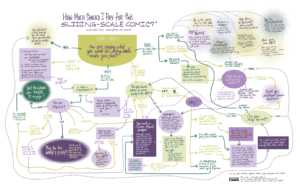
Many of those things she’s done have been freelance, or offered up on a pay-as-you-wish basis, which makes her well acquainted with how people actually decide to pay (or not). To help people who may be confused about how to navigate the question about what they should pay (or if they should²), she’s released a flowchart to help you decide that is both well reasoned and beautiful to look at.
How Much Should I Pay For This Sliding Scale Comic? has been through a number of revisions since it first hit a couple weeks ago, but seems to be in a final-ish form, so I’m pointing you to it now. It’s here, offered up under a Creative Commons Attribution Non-Commercial 4.0 International license, making it free to adapt and share, provided you give proper credit and don’t charge for it. Print it out, laminate it, hang it somewhere in your sightline. It’s cool, just remember to tell yourself that it’s Tran’s work.
In addition to the nominees for Webcomics Creator / Créateur de Bandes Dessinées Web — that would be Boum for Boumeries, Gisele Lagace and David Lumsdon for Ménage à 3, Winston Rowntree for Subnormality, Ty Templeton for Bun Toons, Kelly Tindall for Strangebeard, Rob Walton for Ragmop, and Various for True Patriot Presents #2-6 — you’ve got webcomics types recognized for Writer / Scénariste (Jim Zub), Artist / Dessinateur (Stuart Immonen, Ramón Pérez), and Cartoonist / Auteur (Jillian Tamaki).
The Shuster Awards will be presented at Montreal Comic Con, which runs 6-8 July at the Palais des congrès, Montreal, QC. Fleen wishes the best of luck to all the nominees, there’s not a bad choice in the bunch.
Spam of the day:
Is your girlfriend getting suspicious texts?
If she is, don’t tell my wife.
_______________
¹ She will.
² Spoiler: almost certainly yes.
I know, sports? Just stick with me.
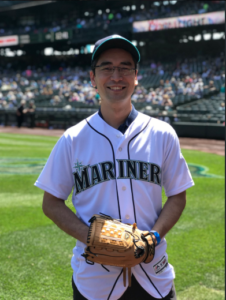
It may be that MLB is recognizing that the jock/nerd dichotomy is a fake idea, it may be that somebody in the front office has a kid who’s a huge Amulet fan, or maybe it’s the team members themselves that can’t wait until Book 8 drops¹. But ultimately, it doesn’t matter. Kibuishi got to suit up and throw a pitch from the mound in his hometown ballpark, and he looked pretty damn happy to be doing so. Here’s hoping that there are even bigger achievements and thrills in store for him the future.
What’s not changing is the fact that all the top rewards (5 @ US$250, you get an original art bookplate; 5 @ US$400, you also get original character sketches; 1 @ US$1000, you get to be in the comic) have been snapped up already; if not for the fact that they were limited, I’m certain that each of those tiers would have ten times the claimants they do now.
For reference, this campaign is already well over the total numbers for the first collection of Check, Please! (1577 backers, just under US$75K), and if we adopt the McDonald Rule², Ukazu is well on her way to eclipsing the second collection³. By tomorrow morning we’ll possibly be able to apply the FFF mk2, but it seems safe to say (especially given all the press and excitement right now around the upcoming release of a combined Year One/Year Two edition from :01 Books) that this will certainly clear the half-million mark.
And, as I observed this morning within that first public hour, I can’t wait the hear the rhetorical knots that the “Diversity is killing comics” bozos will have to twist themselves into to explain about how this doesn’t really count, and how a comic by a Nigerian-American (!) woman (!!) with an ethnically-diverse cast (!!!) about gay (!!!!) hockey players is really a failure. The schadenfreude will be delicious.
Again, as a disclaimer, I’m involved in the process of producing the nominations for these two divisions, but I do not have a vote towards the awards themselves. And, as previously noted, I am a tremendous fan of both Correll’s and Allison’s work and am pleased to see their stellar work recognized.
We at Fleen congratulate the winners as well as their fellow nominees, and note that between the wins for Bad Machinery and Scenes From A Multiverse, and the unprecedented three nominations for Octopus Pie, the reprobates of Dumbrella must be considered some of the best webcomickers ever.
Update to add: At 1447 EDT 29 May, 1370 backers, US$109,726, or 490% of goal.
Spam of the day:
Did you not file with the IRS this year because you owe back taxes?
No, because not filing is literally the dumbest thing you can do. If you owe three bucks, the penalty for not filing will dwarf the penalty for underpaying/paying over time if you owe three thousand (or thirty thousand, for that matter). And geez, you can file for an automatically-granted extension, which gives you more time to get your shit together.
_______________
¹ 25 September, y’all.
² The first three days of funding will represent 1/3 of your eventual total.
³ 5088 backers, just about US$399K raised. Right now, both backer count and total raised are about 27% of what Year Two achieved in 31 days. While we’re here, a note about timing: the campaign was publicized last night for Patreon backers, where it funded in less than half an hour. It hit 300% within an hour of the public announcement.
Well, heck, figured I ought to be clear about your privacy here.
The only time we at Fleen gather information on you (your choice of name, website, email, plus we record your IP address) is when you comment. That’s it. Nothing else is gathered by Fleen (a wholly-owned subsidiary of me), other than what the webhost needs to send the pages in response to your browsing requests. Our version of WordPress is GDPR-compliant.
There are no intrusive ads (Project Wonderful doesn’t allow anything but simple images and links), no tracking, and I’m pretty sure the only cookies are the ones that determine if I’m logged in. We don’t sell anything about you to anybody. You come, you read, you leave, we’re done.
We at Fleen will not contact you unless you mail us (and maybe not even then), or in the course of collecting information for a story — and that’s less “only contact me under these circumstances” and more “hack webcomics pseudojournalism”.
By reading Fleen, you agree to the following privacy policy: We will leave you the hell alone. This is distinctly different from most sites you will visit, but as is established, beats us why most dudes suck. Sure as hell ain’t our scene.
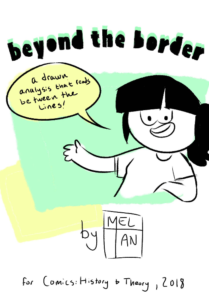
One of the things I love about capital-C Comics (web and otherwise, but hold that thought for a moment) is how they can work on you at a really intuitive basis to convey story and emotion and you don’t need to realize what they’re doing or why for it to work. And then somebody comes along to tell you what they are doing and why it works, and you’re all [mime head blowing up with hand gestures — you know the one¹].
Today, I’d like to point you at two people who get how Comics work, from the perspective of construction and the perspective of reader perception, and how it gives creators (especially of the web variety) tools to make and present comics to tell the stories they want.
She looks first at gutters providing not only a sense of tone and time (which McCloud taught us all about 25 years back), but also Gran’s penchant for using them to convey emotional distance (which I hadn’t seen described before, and which in retrospect makes perfect sense). Also, I’ll note that last page also includes one of Gran’s best-ever panels, with Eve’s lizard brain reacting in a wholly appropriate way. Which, as it turns out, is Melanie’s second area of exploration.
She notes that Gran excels at visual asides representing interior mood, use of in-scene elements to act as impromptu panel borders, and size and placement of speech balloons to convey tension and release. I’ve commented on some of the same pages that Melanie did, but hell if I’d ever noticed that as Park was pushing self-serving bullshit at Eve, his balloons were getting wider and hers were getting smaller.
Beyond The Border is a terrific analysis, and I’d love to see more of Melanie’s thoughts on Gran’s work, and comics as a whole. This could easily grow to be a study of How To Comics that’s as long (or longer) than Understanding Comics.
Likewise, there’s a question at the heart of webcomics these days about how to present work to both reach an audience (getting them to your site is a hell of a lot harder than it used to be; getting four panels into a tweet may get many more eyeballs) and make it easy to read. Seeking input into that very question, Los Angeles resident Dave Kellett asked his readers:
Just out of curiosity: Is it better when I tweet the comics as one big image…or as individual panels to swipe through?
(Note on LArDK’s tweet: the image in question doesn’t include his URL, but does include his Twitter account name; the era of individual sites vs than social media accounts appears to be at an inflection point.)
There was a pretty clear consensus towards swiping, but as it turns out reader preference is only one factor that a creator needs to consider. Enter Keegan Lannon, academic researcher with an interest in comics and how we read them. There’s a payoff at the end that I want to discuss, but to get there, we’re going to have to extensively quote from Lannon’s thread:
So … this is a really interesting question, and I have some ridiculously obsessive thoughts on the presentation of comics. It involves some light narratology and a discussion of directional reading protocols.
The question is about how we read comics. The obvious assumption (though problematic) is that we read comics like we read lines of text: consider each lexical unit in turn, constructing meaning along the way.
[Editor’s note: some really interesting stuff about how we read is omitted here — go check it out.]
A few caveats: reading digitally and reading in print are different, and comics translated from print to digital formats complicates this discussion even further. Mark Waid gave a good talk discussing these issues in more detail than I could here: https://www.youtube.com/watch?v=vPikusZm2As
So, with all of that said, one of the more reliable ways to figure out how we read comics is to make use of eye-tracking software to see where people’s eyes go when they engage with the text. A few years back, @zackkruse gave a paper on just such an experiment.
Granted, it was an incomplete experiment, but the researchers found that when presented with a page of comics readers tend to jump around the page in a loosely diagonal fashion, working from the top-left to the bottom-right, but not purely left-to-right, top-to-bottom.
[Editor’s note: the next three tweets are what you really need to pay attention to.]
Likely, you took in the whole shape of the comic first, giving special attention to the panel with the couch as it is the most visually arresting panel on the page. You might not have taken in the “whole” meaning of the panel, but you certainly jumped to that first.
Presented individually, this would not have been possible. Would the joke still work? Probably. Would it have worked in the same way? Probably not. Seeing the punch line early allows for the reader to read the first three panels in context of that information (however incomplete)
So, I would answer Kellet’s question by saying it doesn’t matter what the reader wants, but more the effect that he wants to create. The different presentations will allow for different narrative effects. [emphasis mine]
That right there? That’s a dissertation in the making², but until it gets written creators will have a lot of experimenting to do. Smart ones will discover a new tool for constructing the stories/gags/emotional context they want in their webcomics. Those who master this means of guiding their audience will be able to exert a level of authorial influence that I don’t think any other medium presently has.
Spam of the day:
sup Gary
Oh, not much, just hangin’ out. Maybe play some video games, buy some Def Leppard T-shirts.
_______________
¹ Vocal sound effects optional.
² Whoever decides to make it, do us all a favor and team up with Melanie.
We’re kind of all over the place today.
If I get it wrong, their argument goes, they’ll call me racist/homophobic/whatever. I’m not! They’re making me that way! Yeah, it’s about this far from the claim that calling out racists makes them become full-bore Nazis, but let’s have a Zublike moment of patience for the argument. Or, better yet, let’s let Guigar do so in a post today at Webcomics Dot Com:
“I’d write more black characters into my comic, but I’m … scared.”
The rest is behind the WDC paywall, but the gist is this: yes, if you write outside your comfort zone, you’ll get it wrong sometimes (likely in inverse proportion to the amount of research and listening you do). People can tell the difference between somebody that tries, gets it wrong, apologizes, and learns, and somebody who’s being disingenuous. As a writer, stretching yourself is something you ought to do. I’d only add one thing to what Guigar wrote, and that’s the value of cultural/sensitivity reviewers, who can tell you where you’re getting things wrong before your work hits the wider world.
It’s a neat refutation of the argument that everybody that’s trying to avoid diversity but I’m not like those haters over there, and the only drawback is that a bunch of those that most need to see it won’t. But then again, Guigar brings back posts for free preview on Fridays, and this would be a great one to include at some point in the future. Either that, or find the diversity-resistant creator you know and convince ’em to drop five bucks for a one-month trial.
I gotta commend @KateDrawsComics @sloanesloane and @kellhound for putting together such a rad anthology and giving us a platform to share our stories Got to read through this antho and man it is an amazing book
That focus on a platform to share our stories wasn’t as visible in the last couple of volumes, and it’s a credit to series editor Kel McDonald (joined this time by Kate Ashwin and Sloane Leong) that she recognized that this makes for a better book and better stories. The Kickstart runs until 13 July (about a week shorter than the 60 days McDonald usually runs, but the 20th would run into SDCC and nobody needs that complication).
Basically, this is your chance to get an entire book with the sensibilities of that corgi shapes poster, which is pretty much guaranteed to make anybody happy. The campaign runs until 21 June, with rewards expected by December aka the gifting season, hint, hint.
Spam of the day:
Can your idea survive the Shark Tank?
You’re looking for inventions you can rip off and exploit? May I point you at a dude that is literally giving ideas away?
I first noticed things yesterday at the twitterfeed of the Center For Cartoon Studies, who teach a lot of folks How To Comic; the announcement was for a particular workshop with a universally-regarded creator:
CCS Summer Workshop: Creating YA Graphic Novels, July 30-Aug 3. @yalsa award winning author @JoKnowles teams up with Ignatz winner and Eisner-nominated cartoonist @TillieWalden ’16 to teach this incredible five-day workshop: https://www.cartoonstudies.org/summer-workshops-2/ … #comics #graphicnovel
But here’s the thing — this is just one of a whole stack of summer sessions at CCS! If you follow that link, you end up at a page full of workshops:
CCS 2018 SUMMER WORKSHOPS
So in addition to Tillie Walden (who’s spent the past 18-24 months exploding onto the comics scene, with Spinning being just the most visible of her work), you’ve got Melanie Gillman (whose As The Crow Flies has been tearing up the critical acclaim and award nominations since it hit print with Iron Circus) from the general realm of Webcomics.
As an aside, one of the hallmarks of a good educational institution is when people stay associated with it after graduation; Walden is a 2016 graduate, Jarad Greene got his MFA at CCS before taking a job in the admin arm, Beth Hetland also took an MFA before joining the faculty of the School of the Art Institute of Chicago, Luke Howard got yet another MFA before joining the CCS faculty.
Add in the expertise of the workshop leaders (Hilary Price has been awarded Best Newspaper Strip by the NCS four times; Longstreth and Howard are Ignatz winner and nominee respectively; Karasik has an Eisner), and you’ve got some high value being shared. The tuition varies from US$600 – US$1000, with an option to extend Karasik’s workshop for eight weeks only (an additonal US$1200), and options to get college credits for an additional fee.
Yeah, it’s a lot of money, but if you want to up your game rapidly, a four-day intensive correction of your trajectory as a creator could be worth as much as a year or two of self-discovery. Only you can determine if the investment in your skills is worth the money, but at the very least it’s a pretty spot to spend a working vacation.
Spam of the day:
Name, We may be able to help you pay off your credit cards
That placeholder only works if it’s properly parameterized and you supply a list of values to substituted in. Come on, spammers, it’s not like we didn’t get taught how to do this in Mail Merge 25+ years ago!
You know I probably could have broken up all the news into several posts, but I couldn’t bear to not talk about any of the stuff that’s on deck today. My apologies in advance is this is more than you wanted to read, or if a scarcity of news in the coming days means there’s not much to discuss later in the week.
Additionally, I received a copy of Be Prepared by Vera Brosgol (previously received and reviewed here), which means I now have an extra. Which means that one lucky reader is going to get a copy of Be Prepared in the mail, with the sole requirement that they ensure at least one age-appropriate reader (say, a kid from 9 up) gets to read it when you’re done. Pass it on, loan it out, whatevs … just make sure kids get to read it.
If you want to be considered, send an email to me (that would be gary) who is the editor at this blog (Fleen), which is a dot-com. You have until I wake up on 1 June 2018 to get your entries in. Be aware, you may set the book down more than once because of feelings and or cringes of recognition. These are not bad things.
Eight inmates — all lifers, which means we’re meant to understand they are the worst of the worst — have responded by asking to create a hospice program so that their fellow inmates don’t have to die alone. They aren’t approved yet, but if there’s any sanity in the prison-industrial complex, this will be approved and spread to other facilities yesterday.
Therapy Comics is tackling the problems that arise when mental care services (in this case, in England) rely on a baseline level of literacy and facility in English; whether because those in need of services speak other languages, or because whatever prompts the need for mental health care keeps them from communicating effectively, comics can help provide interventions without relying on language.
The practitioner behind Therapy Comics, Michael Safranek, has so far provided resources for improving sleep hygiene, dealing with panic disorders, and learning progressive muscle relaxation. Safranek’s asking for feedback, so if you think you could use some help in any of these areas, or if you’re well-versed in how to build effective comics, give them a good reading and let him know your thoughts.
It mostly boils down to a small — but crucial — bit of empathy at the beginning: We only have a little time, so I’m going to talk about what I see that needs improvement in your work, but that doesn’t mean everything is wrong. Show me your best, tell me what kind of work you’re seeking, who do you emulate or look to for inspiration? The rest is a set of principles that Lieber applies to himself as he looks through the portfolio, and it’s deeply insightful. If you work with others in any kind of creative fashion, this is worth your time.
On the one hand, it’s a little sad that more people will see Stevenson’s work because of a legacy IP than for her groundbreaking comics. On the other hand, a generation of kids will be influenced by the stories, the designs, the message that she gets to set into their eyeballs. And heck, her comics ain’t going anywhere, they’re still right there on my bookshelf and will be until the bindings fall apart from overuse.
Congrats to Stevenson, and whether the next big thing you work on is more She-Ra, the Nimona adaptation, or something completely new, we’ll be here to snap it up.
Spam of the day:
Record and Download Any Video from Netflix, Hulu, Amazon, HBO, The CW, NBC, CBS, FOX, ABC, and More. This is a Limited-Time Offer.
Wow. You get a one-time payment of US$39.99, I get infringement grief from at least nine famously litigious and massive corporations. I think your business model may not be skewed to my advantage.
_______________
¹ Every publishing house in the English-speaking world is mentally re-evaluating how well they’ve treated their key people; when Gina gets to hiring, you’re going to see the absolute best in the business go to work for her.
Likewise, I imagine every graphic novel imprint is frantically looking at their most lucrative creators, wondering if they can sneak in a contract extension a year early; when Gina gets to signing talent, you’re going to see some seismic shifts.