The webcomics blog about webcomics

Continuing The Brief Items

The countdown to pie is go, repeat, GO.

Kickstarter Alert #1: The folks at Cloudscape Comics (including but by no means limited to my favorite comicking engineer¹) do regular print anthologies of the best of British Columbia cartoonists. They’re great! But the latest anthology, on the topic of music, meant to be the 10th anniversary anthology, is lagging a bit in its funding. As of today, they’re at about the 23% mark, and not quite halfway through the funding period. Don’t sleep on this one, and if you don’t believe me, listen to your Auntie Spike. Pledge!

Kickstarter Alert #2: Just launched on the Kicker, Habibi: A Muslim Love Story Anthology. This one looks seriously interesting, and from a POV that’s broadly underrepresented in comics at the moment. The names of the contributors aren’t familiar to me, but that’s kind of great? There’s nothing like an anthology for getting exposed to a bunch of creators you wouldn’t otherwise see, and a couple of them will be great and your new favorites. For US$15 (early bird) or US$20 (regular), you can’t miss the discovery value. The anthology is being based on an extremely modest estimate of 350 copies in the first print run, so this is likely your one shot at getting a copy.

Once In A Long Damn Time Alert: I don’t recall ever seeing Raina Telgemeier put original art up for sale previously, but she’s done so now to support the Southern Poverty Law Center. Seventeen pieces are now up at eBay, with the auctions running another eight days. Want a complete set of Raina, her parents, and her sister Amara? Maybe Cat, Maya, Carlos, and Uncle Jose from Ghosts? Five members of the Baby-Sitters Club? The cast and crew of Drama? This is your shot.

Averted Crisis Alert: John Allison told us back in April that he was wrapping up Tackleford and all the comics that take place there. Over the summer at SDCC, he told me that it would happen at the end of the year. If not all-Desmond, all the time, it looked at the very least like we’d be getting some Robert Cop and that’s all right. But plans sometimes take a backseat; when your brain wants to stay on its current course, you listen, and thus there’s an announcement at the top of the page over at Bad Machinery:

IMPORTANT ANNOUNCEMENT: Scary Go Round has been un-cancelled. Stories will now continue in 2018. Danger averted.

For the record, I have zero problem with this.


Spam of the day:

This guy reveals how to get a ?rock hard? boner in less than two weeks

Really? I can usually manage in no more than 3-4 hours. This is not to brag

_______________
¹ Sorry Keen Soo, Jorge Cham, and Dante Shepherd. Y’all are great, but Angela’s got swords, corgis, and moustaches.

It’ll Probably Be A Sparse Week

What with it being American Thanksgiving this week, making for an abbreviated work week, in which a full tranche of work must be done, in addition to plans for the big meal om Thursday. Cranberries must be cooked down, birds brined, bread baked, and pies prepared. Pies, people. Let’s do this.

  • The Creators For Creators grant was announced in April 2016, with applications open for about six months that year, and was first awarded this past March. It looks like the timing of the 2018 grant is going to be a little different, as applications just went live and will run until 31 March 2018. No word yet on when the decision will be made, but one thing’s for sure: it’s worth US$30,000 for a creator or writer/artist team to make a graphic novel. Details at the site.
  • Speaking of just went live: Minna Sundberg and Hiveworks launched the Kickstarter for book 2 of Stand Still, Stay Silent around midnight EST and cleared goal around ten hours later. In fact, the nearly 640 backers (as of this writing) are rapidly approaching stretch goal #2, at the US$50,000 mark. We’ll give this until tomorrow morning and see what the FFF mk2 has to say, but for now it appears that come May, I’ll have a handsome hardcover matching book 1 on my shelves.
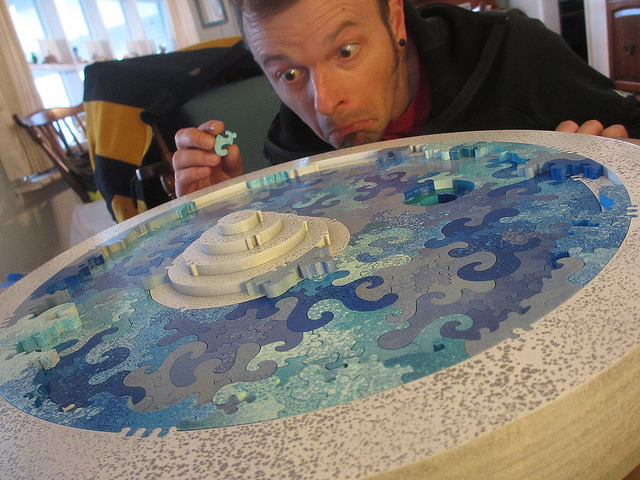
  • And while it technically happened yesterday, it was pretty darn recent, so speaking of it also: Chris Yates has emerged from his madness place with the four-friggin’-thousandth of his Baffler! puzzle series. 958 pieces, eight levels, difficulty level 9.95¹, it can be yours for a cool US$2695 and honestly? It’s worth every.

    last.

    penny.

    All of Yates’s previous Big Round Number Baffler!s has been snatched up by one of his dedicated puzzle-collecting fans, and I suspect that #4000 will be gone in short order. In the meantime, enjoy the photos of what it took to construct the 5.4 kg behemoth².


Spam of the day:

The world’s top influencers in media, technology, and finance use Nuzzel to save time and stay informed. Nuzzel Media Intelligence uses data from thousands of influencers to show you what important people in your industry are talking about, in real time.

You named your very serious company Nuzzel? That’s not the name of a media intelligence company (whatever that is), that’s the name of a tissue, or a fabric softener, or maybe a tissue infused with fabric softener to make it even softer for all your tender bits.

_______________
¹ Yates once told me that the difficulty scale is logarithmic.

² Shown here with a life-sized Yates for comparison.

Oh Good Glob, There Goes My Sanity

[Header image below the cut to contain the horror]

Hussie, Green, and (motherfucking) Dril collaborating on a Sweet Bro & Hella Jeff project? I just got over the flashbacks from the last one.

(more…)

All The Feels

Today, I bring you news that the Becky Beaton cancer fundraiser has cleared CDN$126,000, which is friggin’ amazing; I’m certain that the entire Beaton family thanks you. For some added context about what a bastard this particular cancer is, Kate shared the story of a friend of Becky’s with the same diagnosis at the same time and about the same age. Becky’s still with us, and if 2474 donors (and counting) have anything to say about it, she will be for some time.

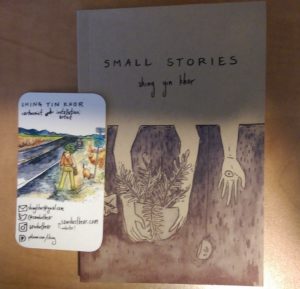
I also bring news that Shing Yin Khor’s Small Stories collection (which I tweeted about here, and I stand by every word), containing the superlative Desert Walk and nine other stories of feelings, arrived today. I think I’ll be spending a lot of time on this one. It’s a good time to feel what it’s like to be somebody else. More on this one tomorrow.

The world is kind of terrible, so let’s do our best to not make it worse.


Spam of the day:

MEET HOT RUSSIAN WOMEN

Then there’s these assholes, trying to get my attention by trafficking mail-order brides. Did you not see my heartfelt plea about not making things worse? Sheesh.

Family Redux

Yes, yes, I know, toutes les bandes dessineés is buzzing about the new Patreon-alike from Kickstarter, and how it’s going to both compete with and compliment other funding platforms, and early adopters, and how it will change everything or maybe nothing¹. It’s very important. But it’s not the most important story today; it’s not even the second most important.

  • This page has, for years beyond reckoning², been in the bag for Kate Beaton and her uniquely hilarious/touching look at … well, everything. Literature, history, ponies, personal biography, and family. To paraphrase Rich Stevens, there’s only one place in the world that bakes the perfect little cookie that is a Beatonesque comic, and that’s Kate’s brain. Nobody else is like her. Except that’s not quite true.

    As her comics starring her family (especially her mom, which makes them momics) show, Beaton is very much the product of her upbringing — the particular place (Nova Scotia) and the particular people (all of whom exhibit not exactly her sensibilities and personality, but were clearly made according to the same rules). Kate’s Mom, Kate’s Dad, and her sisters have been featured in so many quick and delightful comics, they feel like we know them.

    We don’t, of course. But Kate’s made those scraps of paper and jittery lines feel like we grew up with them, know how they’ll react in a given situation, breathe and live and laugh next to us. Which is why when Kate (and by her explicit assent, Becky) shared the news last Christmas, for those of us that followed the Beatons from a distance, it was a punch in the gut.

    But Becky got better. Until she didn’t.

    Hello my friends. There is no easy way to put this out there. This is my sister Becky. Since two years ago, everything has changed in our family. We are asking for help now, we love her more than I could ever tell you. youcaring.com/beckybeaton-10 …

    Remission became recurrence, and she’s reached the limit of what chemo and radiation can safely do; the medical term for this is incurable. Because the Beatons have the good fortune to live in Canada, getting to this stage has not bankrupted them. There are clinical trials and experimental treatments to explore, but they are predominantly in the United States, which means that the family is facing a daunting charge for the privilege of participating in treatments that are still experimental and which may afford the possibility of not dying. The first estimate is CDN$150,000.

    The Maritimes breed hardy souls — self-reliant, sturdy, people that stand on their own two feet with pride. It can’t have been easy for Kate to consider making something as intimate as her sister’s mortality public, to ask for our help. But the Maritimes breed something else, and that’s community; in a place where everybody knows everybody for the past half-dozen generations, you wouldn’t need to ask for help because it would be offered without hesitation.

    We don’t know Kate and her family, not really … but sometimes, the internet approximation is almost as good. Since the appeal went out yesterday, Becky’s Rally Against Cancer has raised nearly ninety-five thousand goddamned dollars. It’s not a cure, it’s not a guarantee, but it’s enough to allow for a fighting chance, and that’s all any Nova Scotian ever needed to move the world.

    Over the next while, I am going to be telling you about her a bit every day. So that you know who you are helping.

    That’s what Kate told us after she asked for help; we don’t know Becky, not really, but we’re going to get the chance to. There are cartoons, remembrances, photos, funny stories, little moments that Kate’s carried with her of the sister she’s known all her life.

    There will be more, and even after all of them we won’t really know Becky — not really — but we’ll be closer. Kate’s sharing her sister’s life with us; we’re all going to share the joy and the hurt in return. We haven’t met her, most of us never will, but I think we can all trust Kate will tell her for us, Becky, because we know the Beatons are no strangers to colorful idiom: fuck cancer. We love you.

  • And yet, in this strange, sometimes wondrous, sometimes broken family called webcomics, we must make time to welcome another who has seen fit to join us:

    Introducing Quentin Malcolm Gruver Sung, born 11/13/17 (the first three two-digit primes). Baby and mom are happy and healthy; I’ve already changed 5+ diapers and am therefore ready to handle ANYTHING

    Also he met some Snoopies

    I’ve been asked about Quentin’s stats, sorry to neglect this vital info:

    Weight: 6lb 13oz
    Length: 20.67″
    Sign: Scorpio with knife
    Alignment: Neutral good
    Warp field output: 5.01 kilocochranes

    That from Jon “Ferocious J” Sung, as fine a man as ever has been and I’ll fight anybody that says different. Young Quentin will know the joys and embarrassments of growing up with an ubernerd for a father, who will surely never let him forget every late-night feeding and how many diapers barely contained warp core breaches.

    You’ve gone and done something amazing by being born, Q³ — you’ve engaged in an act of supreme optimism, joining us here in a world that’s frequently stupid and determinedly so. We’ll try to make it better by the time you’re old enough to notice; if we fail, I have every faith that you’ll pick up from us and see the job done. With your lineage, I know you’ll settle for nothing less than the establishment of a post-scarcity, egalitarian, technological, spacefaring utopia. Quentin, you have the conn.


No spam today. They aren’t family.

_______________
¹ One thing I haven’t seen mentioned — Kickstarter has a more global footprint than other services, so I wonder if this becomes a more global alternative to Patreon.

² It’s about ten years. Sorry for the hyperbole.

³ I see what you did there, J.

From The Saint-Malo Comics Festival, Part The Third

We wrap up the coverage of the Quai des Bulles comics festival in Saint-Malo, courtesy of Fleen Senior French Correspondent Pierre Lebeaupin, with an intriguing look at a boundary-breaking comic. This looks really, really good and I can’t wait for somebody in the Western Hemisphere (are you listening, :01 Books?) to grab the reprint rights.

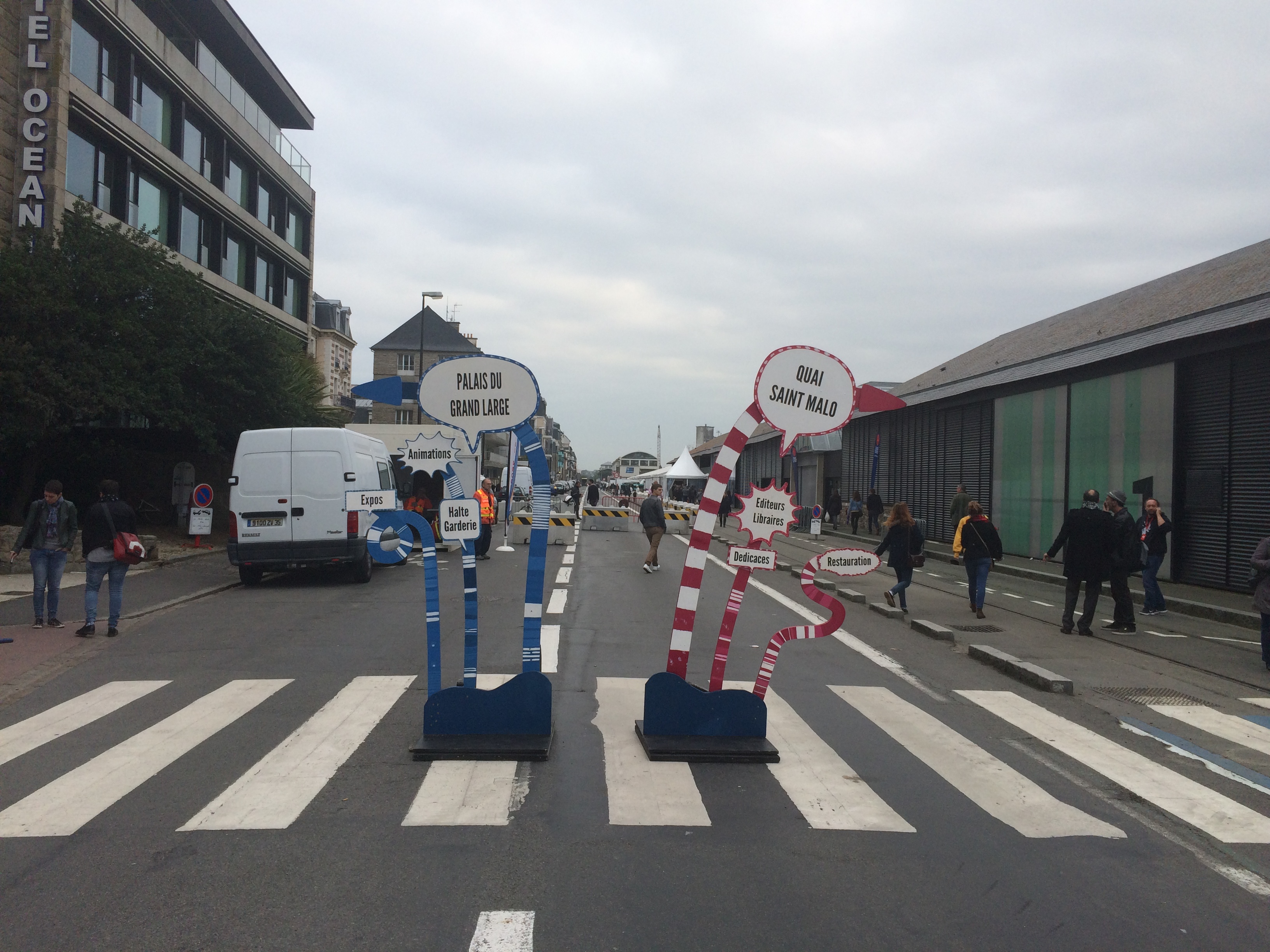
Except for a few offsite events (for which you had to rely on the plan to get to, no signage), Quai des Bulles is quite concentrated around the Palais du Grand Large, a proper convention center with theater, auditorium, enclosed floor space for exhibitions and the like, a bar for refreshments, etc. Meanwhile, on the other side of the road (thankfully closed to traffic for the duration), a large tent housed the exhibitors: all major French-Belgian publishers (plus Urban i.e. DC) and most minor ones were there with their wares and table space for creators to sign at. Under the tent as well were booksellers specialized in original and historical editions of comics, art schools, publishers of youth books (not just comics), as well as Asmodee, because why not play a board game in between two signings?

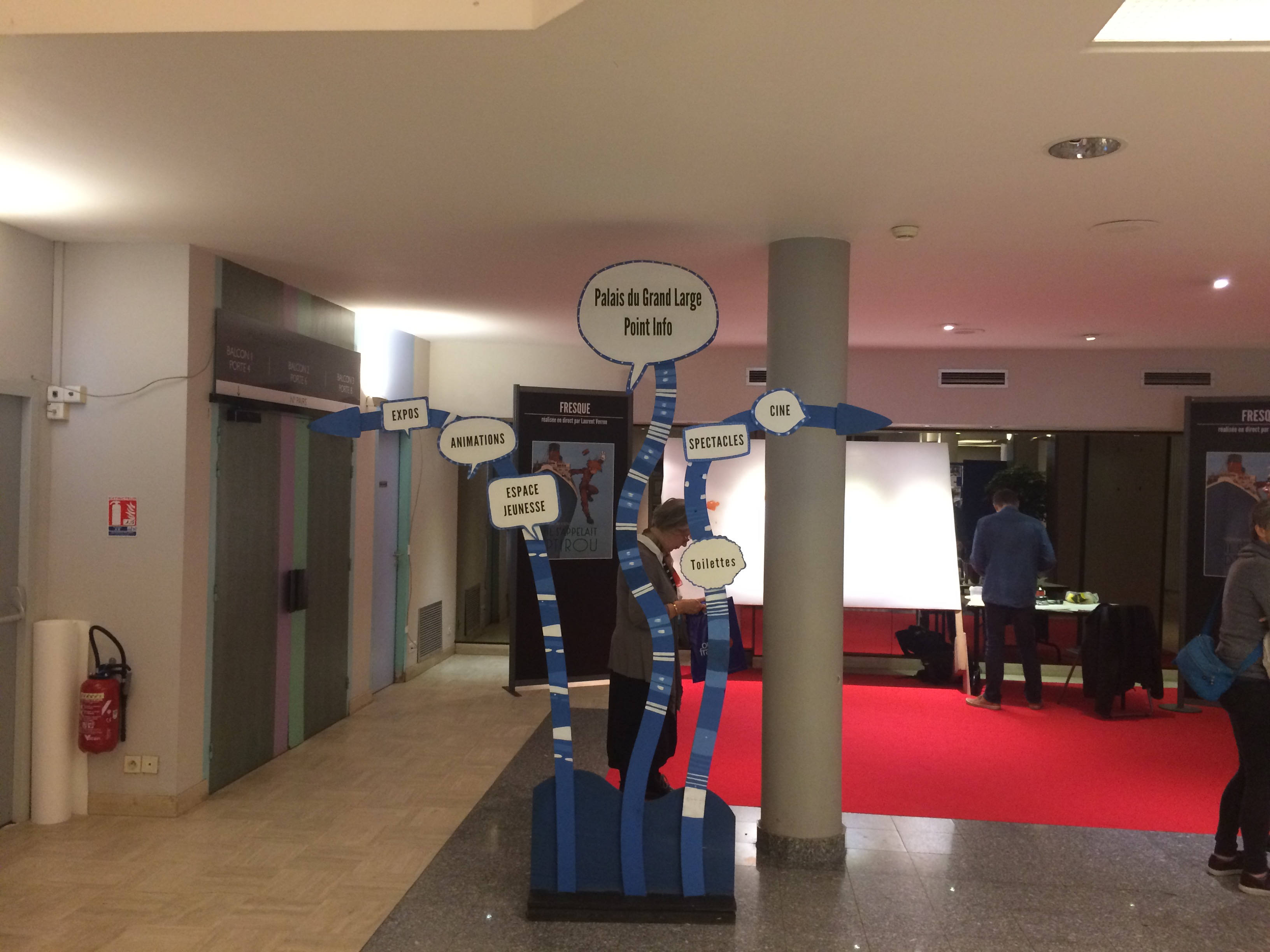
And in order to find one’s way between all that, they featured interesting signage, here on the road between the tent and the convention center, or here once inside the convention center to further determine where to, etc. The convention in general was well run, though I did not get to interact with convention staff (other than the people checking tickets upon entry, etc.) given they required professional journalist proof to give accreditation, so I did not manage to get accredited. That did not hamper me in covering the convention from start to finish, however.

Highlights of the day:

  • A meetup with Pascal Jousselin set up (again) by N Masztaler. It was even more conversational than the previous day’s with Marie Spénale, not to mention in an Irish pub¹ (which did not lend itself to the deployment of the Fleen French Mobile Newsdesk, i.e. an iPad and wireless keyboard), so it was not transcribed; but of note from his background was the fact he was part of a comic project with fellow creator Brüno where they would each draw a page and send it to the other for him to continue, and they set up a mailing list for the public to follow the project, before it was eventually published on paper.

    Currently, he works on Imbattable (unbeatable), which he introduces as the first real comics superhero. How so? Well, best let Editions Dupuis show you, and observe how you hardly need to understand what is being said in these pages (and he notes that it is hardly a good investment for his publisher, given it won’t ever be able to cash in on that sweet, sweet movie or animation adaptation money²). I did get the book (volume two and three are in preparation), and a review is in order.

    I first heard of Imbattable on Twitter (via Boulet, most likely), and I then got to see a few more pages since they were part of the exhibition around the work of Scott McCloud that I covered as part of Lyon BD: how best to show how comics reading works than by showing examples of how it can be broken? Still, I was skeptical: I was afraid such tricks would turn into an easy way out of situations (think Tex Avery), so an entire comic book around that? But I was wrong: not only it is brilliant, but in fact it has to obey twice the constraints as usual, as the reading has to make sense whether you follow Imbattable’s sequence, or the regular sequence; each page is a marvel of construction.

    And they spared no expense: at some point an action seemed not to make sense … until I exclaimed: “Oh come on, he could not possible have dared to do that, no way, no how!”

    I lifted the page to check.

    Turns out, he did dare.

    I won’t spoil it; I will just note that the printer must have hated Jousselin and his publisher for it (that, or they comfortably billed for the additional printing pass).

    Furthermore, while it started out as a gag a day week whenever³ without necessarily a book as the goal, after a few pages it became obvious there was something there and (in a process that webcomics often follow as well) Jousselin started expanding both the setting and in some cases the page count of each story. And while keeping the original concept as well as some aspects that harken back to the early days of comics when everything seemed possible, he did manage to insert some meaningful stories, such as the unusual way the one who will become his sidekick is first introduced, or the hardly black and white situations Imbattable ends up finding himself in (though Jousselin mentions Imbattable is a bit on the naive side).

    And all the while, Imbattable manages to remain accessible to the youngest readers. Jousselin told the first book did not publish as soon as the pages were ready, as the sales team got stuck on how to market it, and initially thought going towards a connoisseur market, which I found silly: while it is true that classic creators such as Pétillon, Gotlib, Fred, Greg, Hergé (in Quick Et Flupke), or Windsor McCay if I remember correctly have used approaching techniques, so have children magazines in the less distant past, which shows children easily get it. To me this work joins the lowbrow and the highbrow (remember its presence in the McCloud exhibition), the new and the experienced readers, the young and the old. Buy it.

  • Watching the Atelier Mastodonte perform its show; in fact they did one each day around noon where they would first invoke the names of Franquin, Bagieu, Achdé, etc. so as to get help with their tendinitis, impending tax reform (not a U.S.A.-exclusive concern), etc., then give each other drawing challenges, challenge the public with quizzes (in relation to comics of course) such as “for each of these words, it is the name of a comics creator, or an onomatopoeia … or possibly both!”, or give silly conferences such as Hergé’s last message, where Lewis Trondheim would claim to have found the secret message for the future of comics that Hergé hid deeply in his Tintin books but left clues for. It felt like standup, especially as they were simply on a podium with an audience made of the people eating at the tables of the bar built in the convention center.

    Atelier Mastodonte is also a comic in Spirou from the same people where the members each draw an update before another draws the next, either building off the previous one or starting something else; it purports to tell the story of the creators themselves working together in a studio. Of course, in true autobioish fashion they actually work in their own respective cities rather than a studio in Marcinelle (Dupuis’ headquarters), but Jousselin, who is part of the atelier, noted during the meetup that he ends up spending more time on the internal blog/discussion board where scripts are coordinated than he does discussing with his actual studiomates in Rennes … even if it is not available on the web, Atelier Mastodonte is in a way an online creation.

  • In the last few hours of the show, murdering my wallet with sweet, sweet comics loot.

Spam of the day:

Tinder [incomprehensible Cyrillic script]

Oh, right, I totally forgot that I signed up for a hookup app in a language I neither read nor speak.

_________
¹ Special mention to the lady who, upon discovering the setup (a side room of the pub with only bar tables, no “real” table), told the person she was with: Ah he’s not doing a signing, let’s go elsewhere.” within earshot of everyone.

² Though after someone asked how it could work anyway, we brainstormed and your correspondent mentioned how in Mel Brook’s Spaceballs the titular Spaceballs try and look into future events by watching the VHS tape of their own movie, and others mentioned how in Looney Tunes or Tex Avery shorts the characters would sometimes peer into the future of the film roll, or escape it, or even possibly cut it out entirely to escape a gruesome fate.

³ Before they get published in books, Imbattable stories are published one by one in the Spirou weekly periodical, and Jousselin has an agreement with his publisher that they come whenever they are ready, without any set schedule: he wants the idea to be right each time without repeating himself.

From The Saint-Malo Comics Festival, Part The Second Subpart The Second

Fleen Senior French Correspondent Pierre Lebeaupin has finished transcribing the discussion panel mentioned yesterday, and it’s an extensive, illuminating look at the present and future of making/publishing French-Belgian comics. Dig in and enjoy.

The meetup began by an introduction of Spénale: her blog, and her first book, Heidi In Spring, which is already in the selection for an award, to which Spénale reacts that this is big for a first book.

Why start a blog?
When she was a teenager it was all the rage, and she opened one in her last year of junior high (ca. 2004-05), and it became the means through which she got contacts; and by now it is necessary to have at least an Internet presence. Today she mostly uses Instagram, and Facebook like (most) everybody else; Twitter only for completeness. She still keeps the blog for longer pieces. She does have a YouTube channel, though it is still an experiment.

Is it easy to make a YouTube video?
It is difficult because she has to learn everything as she goes along (framing the shot, editing, sound recording with a phone, etc.). She feels the need to comment her drawing process, so it takes time to create.

Does the fact she publishes these drawings change the way she draws and what she decides to draw?
A bit, but not fundamentally: she also draws full-time as an illustrator so it has a limited influence.

Is it worthwhile given the time spent on it?
Facebook killed the blogs in a way, so she had to get on social networks. It takes time, but since she would draw those anyway, just posting them takes little time; now on to whether it is worthwhile …

So what is it useful for?
It gives a visibility, which is always useful, but it does not bring anything to her work proper; however professionally it serves to grow her contact list an an illustrator, and in particular allows potential clients to discover new sides of her rather than have them always ask the kind of drawings she already provides professionally. You have to be careful not get carried away chasing “likes”. Not everything is published on social networks, and that includes personal drawings she keeps for herself.

Did her online activities help her getting into professional networks?
It is important to have a place to show one’s work, but are social networks the best for that? Blogs remain important for that purpose. However social networks matter to stay in contact. They matter as well as to get peer recognition.

Is the blog only a display window?
In the beginning she would tell random stuff, with a lot of experimentation; now that she’s read by clients and colleagues, she has polished what she publishes, indeed it is mostly a display window. But it remains important as a potential outlet to express herself.

She does not limit her instructional comments to her videos: she showed the making-of of Heidi In Spring on her blog, and it also sometimes shows how client illustrations are made step by step. Are those important for her?
It something she both loves to make and loves to see from others; a finished illustration is boring by itself, she wants to show more.

Is the instructional work she does useful for her own illustration work?
Not directly, but as a youth illustrator she often draws instructional pieces, even if she does not write them, so that helps there. She is not interested in comics reporting per se.

Does she work digitally? (Yes) But she does publish traditional media pieces (watercolors, etc.), is it a way to maintain her skills?
Digital is a work requirement, and a computer also helps to create very clean artwork for best legibility, but hand drawing is possible in more places… and is more photogenic. And she occasionally has whims, such as watercolors.

What hardware does she use, and how?
A 16″ Wacom Studio Pro; Manga Studio for most drawing work, including the initial sketches, and Photoshop for colors. It is not very transportable, but the screen is top of the line: beforehand she used a model with quite thick glass protection, the current model has a much thinner “gap” as well as smooth surface where the pen slides, which make her feel like she really is drawing. Photoshop is a bit slow but it works OK.

So she had to give up on Inktober this year; does the Internet facilitate experimentations with its immediate feedback?
Indeed, it allows to gauge crowd reaction. Heidi In Spring started on Instagram, then she started going What if I told small scenes?; people were asking for more of those and she deduced there was something there, which she materialized in a book some time later.

What is the makeup of her following, age-wise?
Many teenagers follow her on Instagram, especially when Cyprien links to her. Hard to tell beyond that.

Has she had any rights issues with her work?
Twitter and Instagram would seem to be reserving more and more rights for content posted there, and it is unclear what they could do; it might be better not to post there … but it would seem difficult for them to actually take advantage of it. And of course third parties are not allowed to repost her content without her prior permission, some do but that is illegal.

How did the book itself come about?
The intent was there from the beginning, but the pages themselves were rearranged and redrawn anyway. She showed the project to Yannick Lejeune (who also managed Festiblog/WeDoBD [Author’s note: the demise of which your correspondent laments every day]), who had already seen some of her work: could we see each other for a project? The tone changed a bit: it became sort of an [initiation], so it was not necessarily obvious to tell what it would become solely from the project or the blog. The blog was mostly useful to get that first meeting.

Is it a risk for her activity as youth illustrator do be doing explicit work?
She does not feel that way, in fact it might even be in continuity with her own work. But of course she warns on social networks when potentially adult content is posted.

And what was the goal?
Roughly, to take a character who is a sort of childhood icon, and show she has to become an adult at some point.

What did the blog bring on the writing side?
The blog was pretty much her starting point to do comics work: she is confident in her illustration skills, but she would never have dared to propose doing a full story without her blog experience under the belt.

Is she censoring herself on the Internet?
Not really, no.

How much research did she have to do on the teenage stage? Did she have to get back to her own teenage years?
Of course, but she also read a lot of psychology (such as Françoise Dolto), which helped for the general framework of the book: when she was experimenting on Instagram Heidi lived short stories but otherwise lived in a status quo, now how to have a scenario that leads to a proper end? All her reading allowed her to create an evolution by better understanding how a teenager works. She also came back to the original novel and researched on all adaptations of Heidi. There is a bit of her, but she intended it to be universal. And she gets to begin it from a known situation: that from the novel.

And what were her goals with regard to Heidi’s sexuality?
The goal is foremost the emancipation of Heidi, sexuality is a mean among others towards this end, which is necessary of course: Heidi has desires. But it is only part of the goal.

There is something of a “likes” culture among teenagers today; are they more egocentric now?
She does not know, but she met an 11-year old boy who wanted to draw and was feeling the pressure as if grown-up expectations were put on him, this has always existed but tends to be magnified by social networks. But Internet also means even teenagers in remote areas have access to an immense wealth of resources. And on the other hand, being this much in contact means there tends to be a concentration towards a few drawing styles (one being for instance the influence of Steven Universe).

So everybody is watching each other, are some chasing “likes” as an activity?
Yes, not necessarily among French-speaking creators, but yes: some creators make a living solely from content on social networks and Patreon. Aside: she does not want to open one, as she gets the feeling only her family would tip … these creators tend to play to their audience, and tend to format their content: “feel-good” cartoons, staying on the formula that worked before, etc.

Is there a risk for Tipeee/Patreon to bring about dictatorship of the public, detrimentally to the artist’s vision?
She considers that the creators who take that into account are not creating auteur works in the first place.

What about chasing for likes?
There is some risk of a bubble, but it will probably blow over.

What if Heidi had had Facebook?
Not sure what that would have changed, however if Heidi had had Tinder, that would be another story …

Is she interested in Turbomedia, etc?
She likes animation and tries to train herself, but she does not want to use digital gadgets solely for the purpose of using digital gadgets: she feels the need to respect sequential art. She finds Summer to be interesting, even if the music and animations are probably superfluous in her opinion, the concept is very interesting. But she can’t help but note it ended up being published on paper in the end …

How does she see the possibility of publishing French-Belgian comic books on tablets? To which this correspondent added: Beyond the obvious size issues. [Author’s note: A4 is simply unreadable on anything smaller than a 12.9″ iPad Pro]
Even if the traditional 48 pages A4 format is not suited, there is worthwhile content to read, such as reporter comics; if it does not sell, it means readers are not convinced.

If Delcourt had rejected the project, how would she have published Heidi In Spring?
She wanted to work with a publisher, especially for her first book, so she would have tried harder to find a publisher, and eventually switched to another project if she couldn’t have managed to find one: self-publishing is an enormous amount of work … maybe eventually she will consider it. Doing so requires pleasing a public in order to have a sufficiently large community for that, though, which represents a loss of liberty somewhat.

On that matter, she signed very early in the project: it was barely developed at that point, and she was left to develop it with a lot of freedom from the publisher, even if he did bring an indispensable help as an outside observer: he can tell her The page does not make sense to me, which is hard to see on one’s own work.

How is she managing her social presence? In order to be more visible, etc.
Some tricks work better than others: front pose rather than a side shot, a girl [drawing or painting] rather than a boy, pretty rather than ugly, watercolors, staging the sheet of paper improves things too .. but that is not the goal. She has a community based on [involvement]: Here is something just for you. She answers comments from time to time, but maybe she shouldn’t: it is a huge time sink.

What is the French-Belgian comic book of the future?
There is a trend in the French-Belgian world today towards knowledge/non-fiction/reporter books, but maybe it’s only a temporary trend. Maybe one day French-Belgian digital comics will be viable, but that day has not come. Maybe things won’t change and the French-Belgian comic book of the future will simply have a pretty cover.

Now you know why we waited a day to run this panel report! Thanks as always to FSFCPL for doing yeoman’s work in keeping all of us on this side of the Atlantic up to date in bandes dessineés. I was particularly surprised — although perhaps should not have been — to learn about the influence that Steven Universe has on non-anglophone artists. Now I have to wonder how difficult it is to translate all of those songs that are so critical to their respective stories.


Spam of the day:

Who Is Hotter, Vlada Or Victoria? If you.. arent able to take-in the C0MMERCIAL-Adv-ertizement due to images not loaded? You’ll need-to Touch here

Yes, I am so eager to see purported Russian mail-order brides that I will click on your entirely not-sketchy link. Right.

From The Saint-Malo Comics Festival, Part The Second Subpart The First

What’s better than transatlantic comics coverage? Nothing! Fleen Senior French Correspondent Pierre Lebeaupin continues his reportage from Saint-Malo, with the first part of Day Two coverage, with more to come.

Saint-Malo is not a big city; if you’ve never heard of it before, one of its claim to fame is that it was the home harbor for famed corsairs such as Robert Surcouf. And it is because the Falklands were often visited by sailors from there that in France we call them: les îles malouines (which is why the Argentinians call them the Malvinas).

But Quai des Bulles is big. They claim to be the second biggest French-Belgian comics festival, and I have no trouble believing them: just look at that program, list of expected creators, and exhibitors floor plan. And let me tell you, after a while the sheer number of people meant the ambiance under the tent was quite warm, even though it was cold outside.

There were not many webcartoonists present; for instance, this year Lapin had no booth. But this was more than compensated for by excellent programming which will be covered in the highlights.

  • Catching a glimpse of Maester, who came to sign for one hour even though he is still recovering from a stroke that left his left side paralyzed. Kudos, master.
  • A fairy tale (East Of The Sun And West Of The Moon, if my references are correct) performance with professional conductor and musician, with scenes drawn live by Obion.
  • A “conference” by “Prof” Bernstein and James on the art of the joke … which was itself silly, or at least ostensibly so: it is true that context and timing matter a lot for joke delivery for instance. It took place in the same auditorium (the amphitéatre Maupertuis in the Palais du Grand Large) as the Montaigne event from the previous day, and I must thank the designers of that auditorium for including a power outlet and a folding tablet for each seat, greatly facilitating this hack pseudojournalism activity. [Editor’s note: I didn’t make him say that, but it makes me very, very happy.]
  • A meetup with Marie Spénale set up by N. Masztaler on the matter of new publishing means [Editor’s note: transcription coming soon; the translation on this one is tricky]; in attendance was only a small cohort of about a dozen people where everyone could ask questions, and many did (your correspondent included). It ended up going over the planned hour for it by half an hour, though no one (least of all your correspondent) seemed to mind.
  • A memorial exhibition for Michel Plessix, local creator who created the poster image for this year’s festival before his untimely death in August of this year. While he had a varied career (as recounted by that exhibition), he was best know for his comics adaptation of Kenneth Grahame’s The Wind In The Willows (that is his representation of Toad that can be seen in the poster). The exhibition included, as customary, a number of tribute pieces (written or drawn) from many fellow comics creators and professionals.
  • Finally, a drawn concert with Volo (musical instruments) and Grégory Panaccione (drawing instruments).

We’ll continue with Day Two coverage tomorrow, as FSFCPL brings us the details on panel on new methods of publishing. Small audience discussions yield the best questions, but boy are they a pain to transcribe, much less translate. As always, we at Fleen are grateful for FSFCPL’s extensive efforts.


Spam of the day:

Hey guys!!!
designs and builds specialty lines of lead oxide production equipment, material handling systems, battery related process machinery, parts, and accessories for the battery, pigment, glass, and chemical industries.

I am haunted by the missing start of that sentence. Who designs and builds these lines of lead oxide production equipment? I must know!

From The Saint-Malo Comics Festival, Part The First

Fleen Senior French Correspondent Pierre Lebeaupin has been out committing acts of journalism¹, this time from the Saint-Malo Comics Festival. He shares with us his report from Day One below.

Friday, day one of Quai des Bulles, the Saint-Malo comics festival, was not a professional day: everyone could come, though of course that included a lot of children (it was a school holiday) since not everyone can afford to take a day off work. While the day started slowly (not much was scheduled in the morning), it had very interesting programming:

  • One hour with Marion Montaigne, an interview by Arnaud Wassmer, on the topic of her latest project In The Space Suit of Thomas Pesquet, which is entirely transcribed below.
  • An interesting panel on the latest developments of knowledge/world discovery comics. In fact one of the panelists, Anne-Lise Combeaud, the author of Philocomix, told she came from the blogs BD world, and that influenced how she created the comic (trying to experiment within the constraints of the page in particular), and we were able to discuss that experience in the signing that followed at the publisher’s booth (Rue de Sèvres).

One Hour With Marion Montaigne
After introducing Montaigne, Thomas Pesquet, and the project, it took the form of an interview:

Who came up with the idea?
Around September 2015 Montaigne was busy on the Prof Moustache animated project as well as with its latest collection, and wanted to escape this character a bit; and at the same time she wanted to deal more with space matters and for this purpose started meeting with people working for CNES (France space agency), such as the teams who have instruments on the Mars Curiosity rover … or the people in charge of answering UFO sighting mails.

And in particular, astronaut coaches. And it turns out the training to become an astronaut is quite hard. Then Pesquet came up in the conversation, and it turned out he had commented once on one of her notes to confirm that it reflected his experience. Let’s invite him! After a first missed connection, he was able to come to her studio, about one year before he was to take off, which means he was already intensely preparing for it.

The book itself: how can the whole experience be rendered on paper?
Montaigne got to travel and watch the training in Cologne (where the ESA, European Space Agency, training center is located), she had to go to Russia as well, etc. And then have it be proofread. Her aim is to give back to the public what she was told or able to witness: the astronauts through their experience.

Was it a pedagogical intent from Pesquet as well?
He has, by contract, to explain what he does. And while it is not obvious to shoot (staging for film is hardly compatible with the training realities, e.g. when in a centrifuge), and even documentaries have a tendency not to show some unglamorous realities, such as showing classroom time or Russian revision time, comics have no such limitations: they can more easily show more down to Earth aspects that are an important part of daily life.

Is it a childhood obsession?
It is clear this is a job for which you have to have incredible motivation. And And this preparation takes up their whole life, even for those who end up being rejected in the end, which represents most candidates. Not to mention space life represents but about 1% of the total time on the job.

Are the test designers as sadistic as seen in the book?
Both Montaigne and Pesquet came up with this representation; but it has to be said the tests themselves are weird: the version shown in the book is in fact when it is still easy! And the psychological tests are designed not have any discernible logic so as to be unsettling.

One collective test, not shown in the book, involved candidates from multiple nations trying to solve a math problem: a boat in low tide has to rely on a ferry to load cargo, but at the same time the tide rises so conditions change, then there is the matter of the trains that take up the cargo … the result is that after 20 minutes they had not made any progress, and the aim was not to see who could take the lead, because that is not necessarily the kind of player they want in the teams.

So, they are not looking for astronauts with a devil-may-care attitude and an oversized ego …
Don’t get her wrong, Pesquet is on the level. But it is true the prototype of the 60s astronaut (usually the best Air Force test pilots) who left for one or two days by themselves is no longer what they are looking for. Here they have to live in reduced space with five other people for six months: they can’t very well go out for a walk. So they are looking for people who are confident in themselves but easy going with others, and with conflict resolution skills. For instance, they practice with serious video games which have simultaneous competitive and cooperative aspects.

How to represent tests?
One of the issues is showing the time scale of the tests: they take place over months, even years, there are cutoff stages, and they do not necessarily know which tests they will be training for next.

How about the way they learn Russian?
They go in space in a Russian rocket, so they have no choice but to learn the language in the course of a year. They do so in an old mining town about one hour away from Cologne, and they, about 35-40 years old, end up in the same classroom as the local students.

Is the vision of NASA as space’s Hogwarts really Pesquet’s vision?
Everyone has a vision of NASA as that mythical institution, which to be honest they maintain themselves with museums for instance. While there, she was able to see space suit testing rooms, as well as the gigantic pools where astronauts train on different modules for space work.

Which makes sense, because everything has to be relearned in space.
Including the most insignificant, such as the fact they have to wear diapers, and since their bodies will be put to the test in space, they have to be put to the test on the ground and sometimes it is their bodies that fail them.

While NASA feels like Top Gun, for the Space City in Russia the imagery is rather that of Gagarin.
Indeed, in there Gagarin is Serious Business. Russians are in general very superstitious and so have a number of rituals, from the watching of an old, boring documentary The White Dawn, up to urinating one last time at the side of the road just where Gagarin is said to have done so just before leaving for space.

Pesquet first participated in missions where he was a backup.
Indeed, the others from his class where chosen as main participants before him, up until 2014 where he was selected as main for a future mission that ended up taking off in 2016.

And so he joined the club of those who cannot wait but take off again.
Well, maybe not right the day after he landed, but indeed there is something of an elite sportsman in them, in that they see these as challenges to do again or even do once better.

Let’s talk about the centrifuge.
It is used to prepare for takeoff and landing, which are the two most dangerous phases, and so the most anguishing ones, they have to manage the buttons while being subjected to enormous accelerations (up to ten times normal gravity), or sometimes just a joystick when they can’t lift their arm any more; sometimes they use a stick.

He told the story of an astronaut he personally knew: following a bad separation her capsule had a slightly incorrect reentry angle, resulting in them taking 10G of acceleration and a landing rough enough that their capsule burned a field in deep Kazakhstan … so they have to be prepared for the worst.

So the artist has to show the reality behind the communication.
More generally render their personal experience: spinning seat, centrifuge, etc. That they take as a sports challenge.

And there is the matter of learning how to move in in microgravity.
Movies tend to show a misleading image of that: you can go quite fast in microgravity! So they have to deliberately pace themselves. Nevertheless they go through a learning phase when they hit walls, etc.

And how is it to represent that for the artist?
It’s interesting, you have a number of interesting situations, such as the collective meal where they are all eating at the table, and some are around, and some are shown below and above it.

And what about the contents of mission itself?
Many photos, but it is only a slight portion of their work: they work a lot, but during the weekend they play and don’t have a lot to do. So he ends up sending his photos with the captions over the weekend and they are published all through the week by the public communication teams while he is in fact working. It’s about the only interesting thing they can do …

The mission itself ends up not taking a lot of space in the book.
First of course Montaigne couldn’t take up very much of his time while he was there (and of course no way to go there for a documentation trip), and besides the work is quite routine and ends up compressing well.

Did his photos help for documentation?
Indeed, and in fact he is not the only one who takes them; he has to work sometimes.

So explain how the artist tried here to render one of his vehicular exits.
The aim was to try and render the experience of a vehicular exit with in particular the immense scale of the station. Not directly represented is the fact it turns out spending time (about seven hours) in the space suits is far from ideal: the decreased pressure means they end up releasing gas, they sweat a lot, etc. And of course his fellow astronauts omitted to tell him about it beforehand …

And here we see them back on Earth
When they are back on Earth they are really white, he was not that badly out of shape but they do take some punishment in the landing phase, which they compare to a car crash (flips, etc.); once on land they compare their state to a hangover to the tenth power … and meanwhile all the cameras are on them.

Did he recognize himself and his experience in the book, in the end?
He does have a sense of humor, or he would not have accepted in the first place … he meant for these kind of issues (important or not) to be represented.

No self-insertion?
No, that was not the matter, as there is already a lot to tell, and it was not obvious how to do so anyway: which way to put herself? So rather than directly retelling how she herself was informed, might as well build a narrative.

Did the author have to remove sensitive information, e.g. top secret stuff?
No, she did not have to remove anything of the sort, she assumes she was not told of such things in the first place. Some intimate aspects where not told, but that’s it.


Spam of the day:

Life Insurance Rates Quicker

Are you trying to tell me something?

_______________
¹ He journalised.

Of Note On This Friday Afternoon

One recap, three things coming up, then the weekend.

Recap! The Ignatz Awards took place last month at SPX, and they were taped. I didn’t realize that they video had been released for nearly a week, so thanks to Jess Fink’s tweet, which pointed to Rob Clough’s tweet, which pointed to the video. One great thing about the Ignatzen, apart from the high caliber of nominees and winners? Brevity. Over and done in a little more than an hour so the attendees can get down to the dance party and chocolate fountain.

This weekend! (Unfortunate Half) Nidhi Chanani has been on tour in support of Pashmina; this weekend she was scheduled for Third Place Books in Seattle (tomorrow) and Half Price Books in Dallas (Sunday). I say was because she’s been down with a nasty bug for the last couple of days, and is unfortunately unable to travel. What’s most important is that she get better, and secondarily that she be able to make later commitments (like the YALSA conference in Kentucky at the end of next week). Feel better, Nidhi! Everybody drop her a line of good wishes, and go read Pashmina because it’s really, really good.

This weekend! (Fortunate Half) Abby Howard does great comics — funny comics, creepy comics, smart comics, and true comics — but in my mind is becoming ever more associated with comics about dinosaurs. She’s probably the best-educated-about-dinosaurs cartoonist we have right now, not to mention the most cartoon-skilled general paleontologist¹. She’ll be running a workshop of dinosaur illustration at the Boston Public Library tomorrow at 3:00pm.

Now, there’s a lot of libraries in Boston with a lot of events (especially considering Boston Book Festival is on), but for this event, you want the Central Library at 700 Boylston (that’s Copley Square), in the Johnson Building, the Rey Room (that’s the Children’s section). Go draw some dinosaurs.

Next week! The fourth (Fourth? That can’t be right, but it is. Fourth!) volume of Erika Moen & Matthew Nolan’s Oh Joy, Sex Toy releases on 14 November, and to celebrate there’s gonna be a release party². Day after Halloween, y’all, at Books With Pictures, 1100 SE Division Street in Portland. Nolan and Moen will talk about OJ,ST and there will be snacks, drinks, and signing starting at 7:00pm and running to 9:00pm. If you go, give newly minted American citizen Nolan a high five for me.


Spam of the day:

FaceRig releases fun Halloween avatars and multiuser tech

I have no idea what any of this means, and the attached press release doesn’t really tell me. Weird.

_______________
¹ To clarify: Mark Witton does amazing art and is an actual working paleontologist, with a scientific and artistisc focus centering on pterosaurs. Great artist, but not a cartoonist. No stories.

² Quit snickering, this is serious.