The webcomics blog about webcomics

Camp 2018, Part Five
The Egg Situation at Breakfast on Monday is off the hook; it’s a scramble/caprese deal, more delicate and loved that even Ray Smuckles would manage.

The structure of the programming has loosened; yesterday, a considerable number of games were conducted, role-playing and otherwise, and space in the schedule is being made so that people can improvise. Scott C talks about how to find inspiration while Sophie Lager (a local artist and musician, and all-around awesome lady) shows me how to cast yarn onto needles. I spend the rest of Camp adding knit stitches into something that nothing in particular, letting the physical work allow my mind to drift¹. I suspect Scott C’s journey through art and artists that inspire him will always come to mind when I have needles in my hands.

When I first mentioned to Dylan Meconis at last year’s Camp that I wanted to learn to knit, she immediately declared that I’d be great at it. It’s all just math, Gary she told me. Now I can see the geometry of the yarn hangs together, and I’m reminded of ropework that I’ve practiced in my habit of rock climbing. I’ll eventually abandon the mutant first project (Meconis told me to pick a skein of wool in a color I didn’t care about, so I wouldn’t be precious about unraveling as needed) and start a second practice work: 20 stitches wide, careful counting, uniform slack. It’s got about 1000 stitches in and I haven’t picked it up for nearly two weeks, but I’ve got flights for work next week and I suspect it’ll be in my carry-on. Eventually, I may even learn a second stitch.

I learn a bit later that as long as I keep my hands within my peripheral vision, I can knit and use language; brains are funny things — I learned from a decade of work commuting that I can’t listen to podcasts or music and talk or read or fill in a crossword, but I can do sudoku. Likewise, knitting and conversation flow together when Lucy Bellwood hosts a conversation on how to sustain a [creative] career. Bellwood’s rightly known for her large personality and adventurous nature, but she’s also the perfect moderator of a discussion that deals with smaller, quieter issues — emotional stability, worries about money, confidence in your work and place. The leap she took in sharing her little jerk and speaking about him honestly has made her a center in this quirky culture.

The sense of community is more powerful than I recall from last year, maybe because this year I’m a little more in control of my impostor syndrome. It’s revivifying to be around people who are insanely creative, innately good-hearted, willing to let down their hard-earned defenses (remember, most of them make their living in large part on the friggin’ internet, and a majority of this year’s attendees are women), to talk honestly about their ambitions and their own little jerks.

I’ll tell you that this discussion took place, for this block of time on Monday afternoon and throughout the rest of the weekend. That’s all I’ll tell you. But I will urge you — if you haven’t already — to find a similar intentional community within your own geographic/professional/whatever circles and to allow yourselves the same sort of discussions. I said it more than once to friends since I first attended, but I’ll say it now for public consumption: for me, attending Comics Camp is better than a year’s therapy.

Part of that is because Pat Race (and he’s far from the only person that makes Comics Camp run, but he’s the heart and soul of it) is very, very aggressive about soliciting and acting on feedback. He wants to know about how we’ve experienced the logistics and arrangements, the activities and scheduling, both before and during Camp. He talked about how school the visits worked, about how after three years the students finding continuity; he asks our opinions on the Library show and the involvement of the community at all stages. It’s universally agreed that everybody loved what Lily and Ishmael Hope shared with us, and would like to see more exposure to local culture in future.

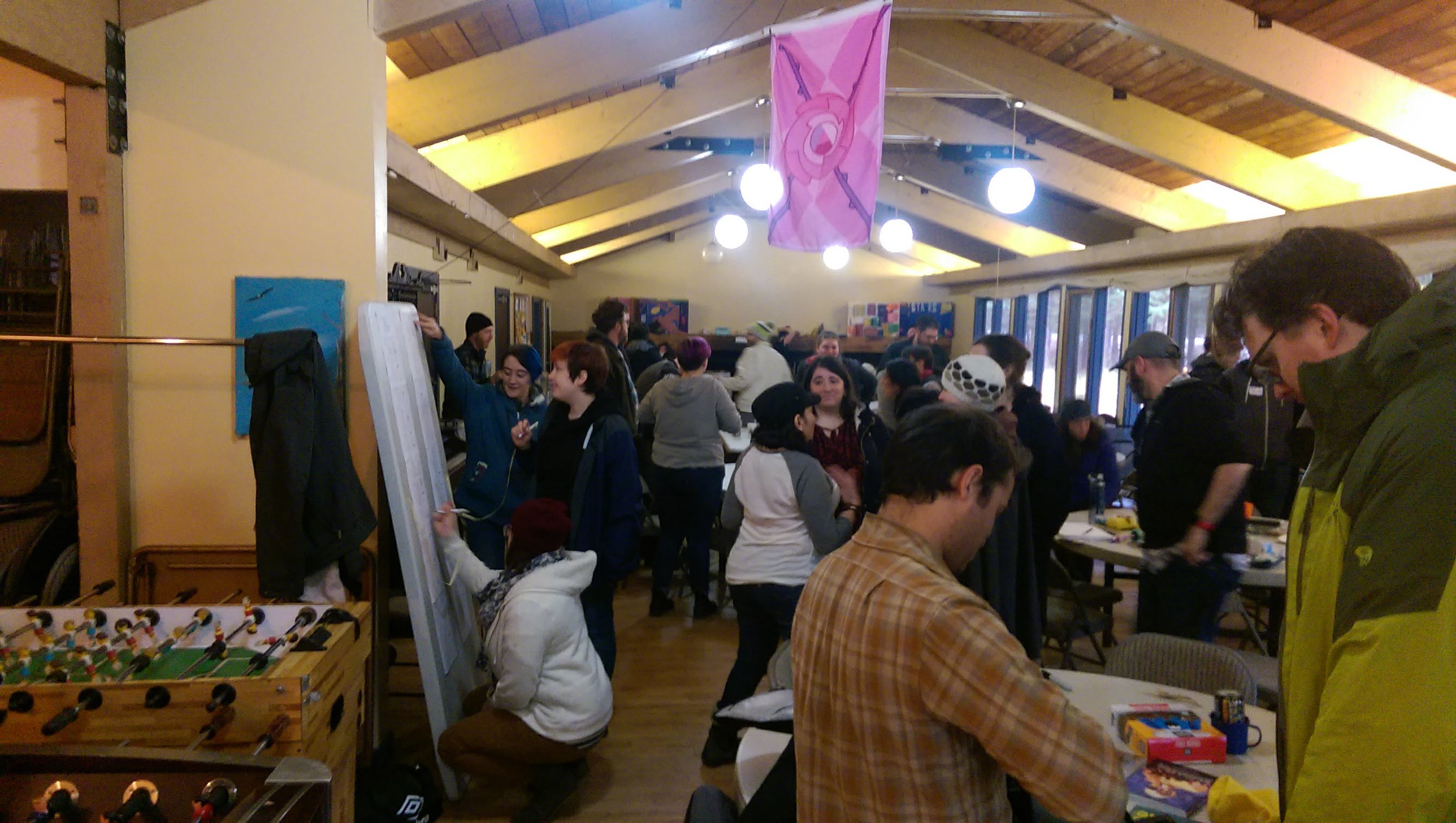
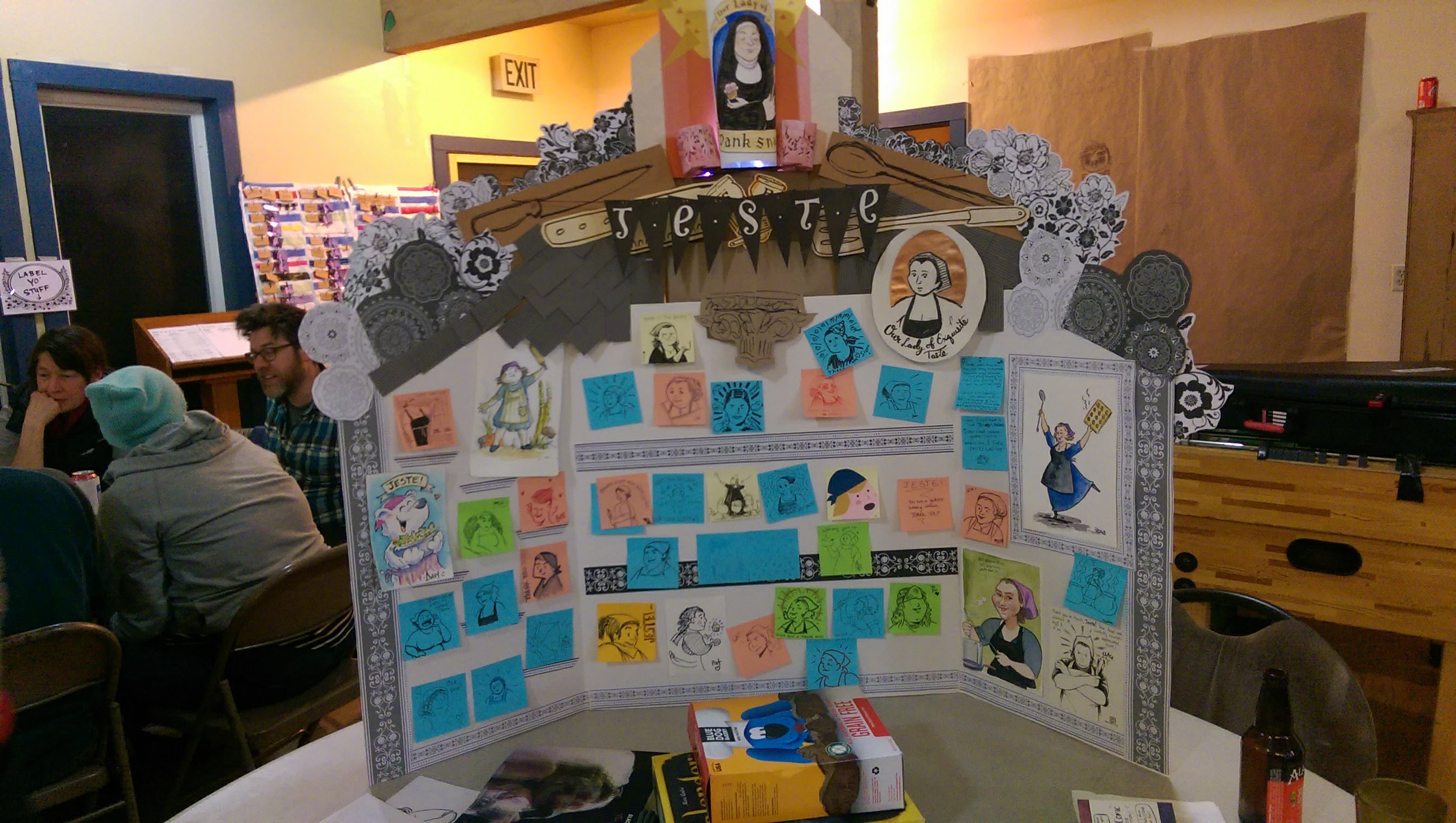
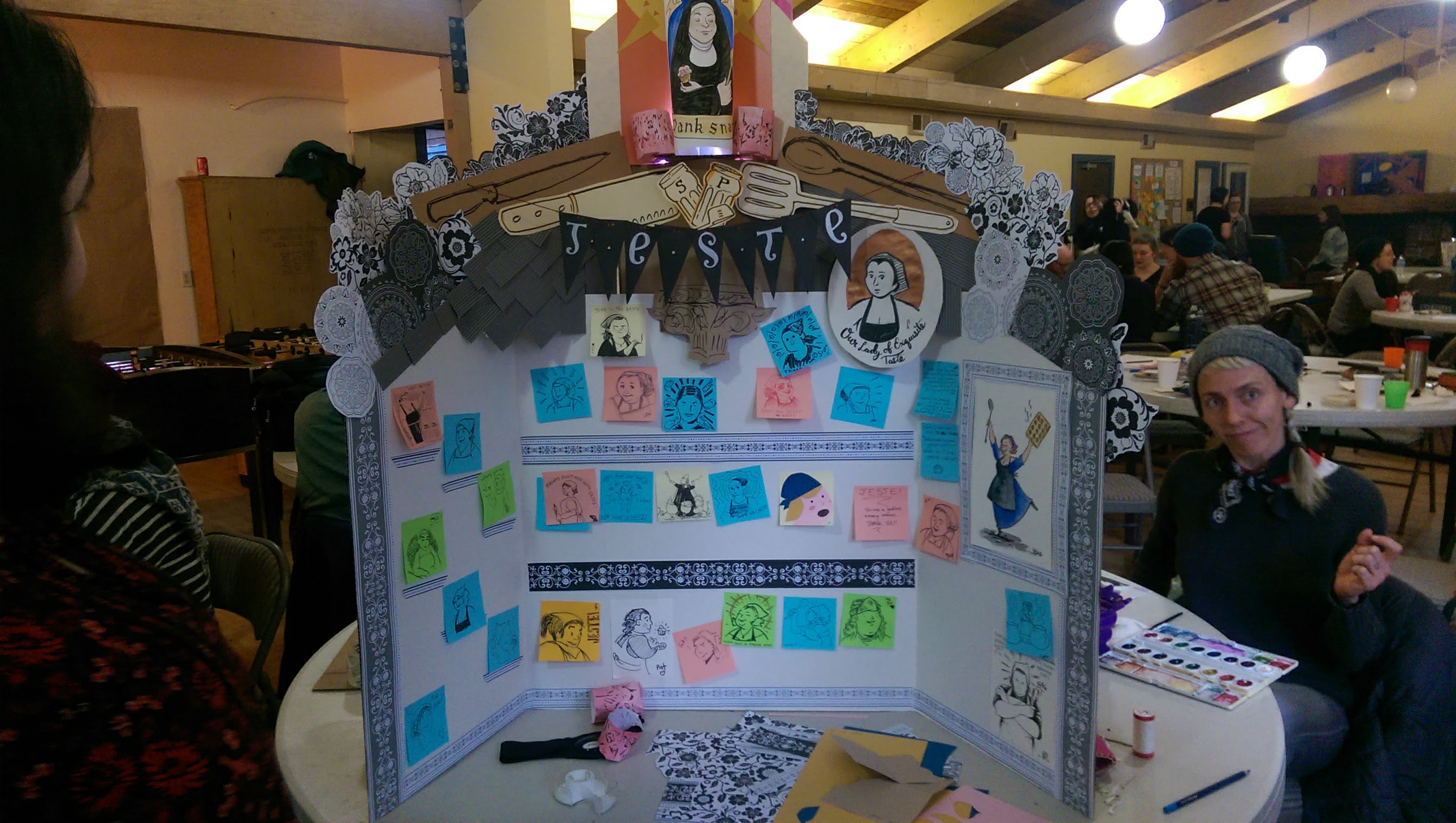
Maybe it’s because it’s the last day, but the main lodge seems to hold more people than any time since arrival; our banner is hoisted, POoOP Number Two voting continues, people circulate in ever-changing swirls. After dinner, there’s a rundown of how Tuesday morning will go — breakfast, followed by cleanup, and a bus departure for those on the cartoonist-heavy flight to Seattle at lunchtime. And there’s a special presentation to Jeste. You may recall that when introduced to us, Jeste announced she had a requirement. You’re all cartoonists, she declared, and nobody’s drawn me yet.

Well. Let it not be said that cartoonists are not up to a challenge.

Over the weekend the Jeste Shrine takes form; from the high altarpiece — it reads Our Lady Of Dank Snax — which lights up to the many, many portraits, it continuously grows and changes. Each time I take a picture, it has a new representation of Jeste that needs to find room for inclusion. I think my favorite is by Vera Brosgol, who’s drawn Jeste like one of the summer camp kitchen ladies in Be Prepared. She’s a bomb-ass chef, she fed us better than anybody would expect from a summer camp kitchen, and she is beloved.

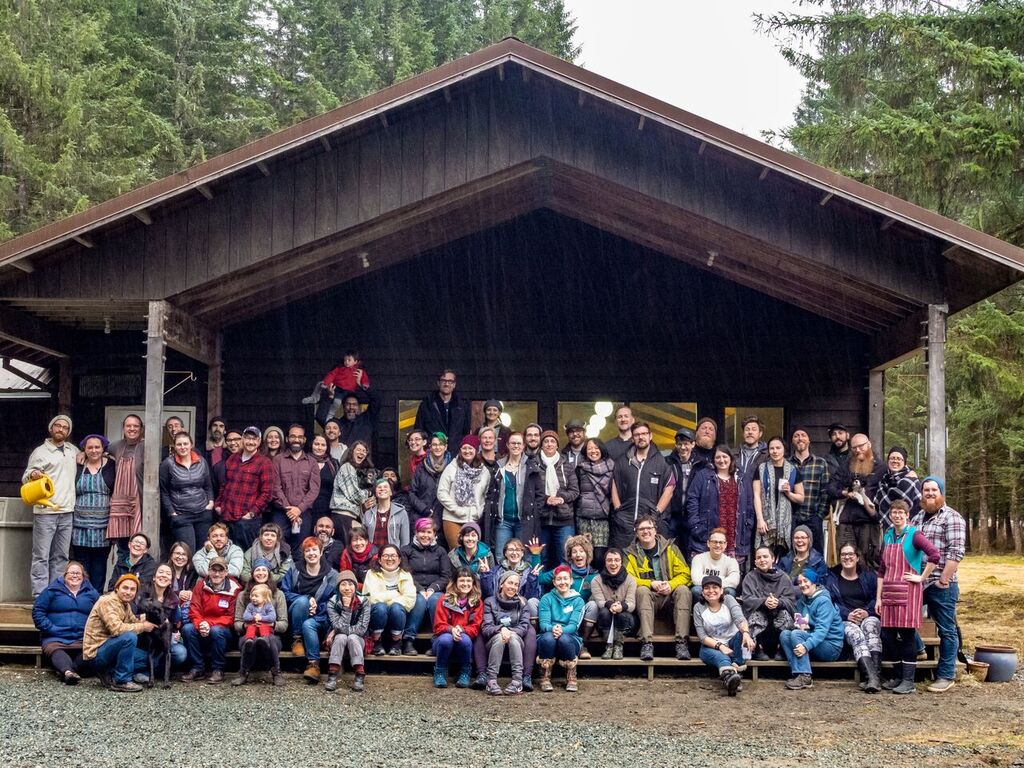
Tuesday morning passes quickly, but not before a drizzly group photo; my flight isn’t until stupid early on Wednesday; others will be around until late afternoon or evening. Those of us not on the early bus spend a little extra time cleaning the lodge and kitchen, before making our way back to town. Shing Yin Khor and I have Mexican, then are called over to the local distillery for delicious gin drinks by Marian Call.

That night, I end up going to see The Avengers: Infinity War with Call, Race, and some of the other local Juneau folks, a reintroduction to the machinery of mass culture after days of being away. I’d started tapering off my email checking and Twitter habit before heading into the woods, and the lack of cell signal means I went into the movie entirely devoid of spoilers. The trip home and the days following will see me slowly reintroduce my regular life.

I love Camp, I love the people there, I love Juneau. I couldn’t live there, partly because I’ve made my home in the place that feels like home, but partly because living in Juneau would make the place start to feel ordinary. It’s where I can go to reset, to spend some time (never enough) with an intentional community of my people, to take what I learn from them home. I know that’s sounding distinctly Campbellian, and I’m no journeying hero².

Juneau gets to be my Rivendell because it’s a journey away; the people I meet there are sometimes in my neck of the woods, and their welcome in my home is perpetual. It’s not for everybody, particularly in this very cynical age³, but if it’s in your means, I urge to you visit the Mini-Con as you are able, or apply to attend the Comics Camp, or to build your own intentional (if intermittent) community in a similar vein. It’s not a time or a place, it’s a process and a commitment to each other. Join ours, or build your own, but in a world that seems out of control, take a step back and seek out a bit of re-creation.

One final thing before we go: Aud Koch (who I’d not met before, and who was a fellow inhabitant of my very polite cabin) has shared some pieces from her sketchbook. They’re really pretty.

_______________

Pictures:

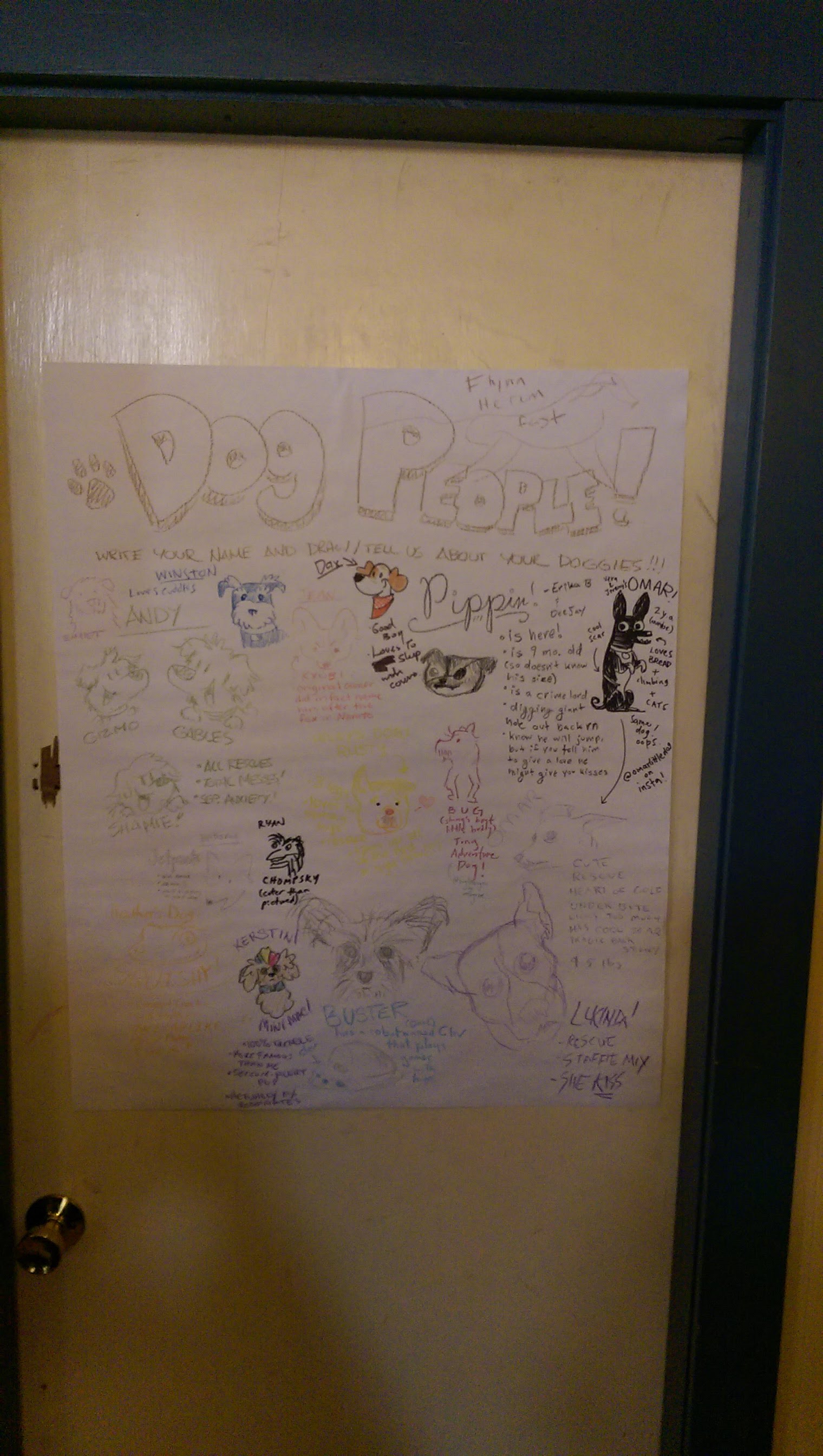
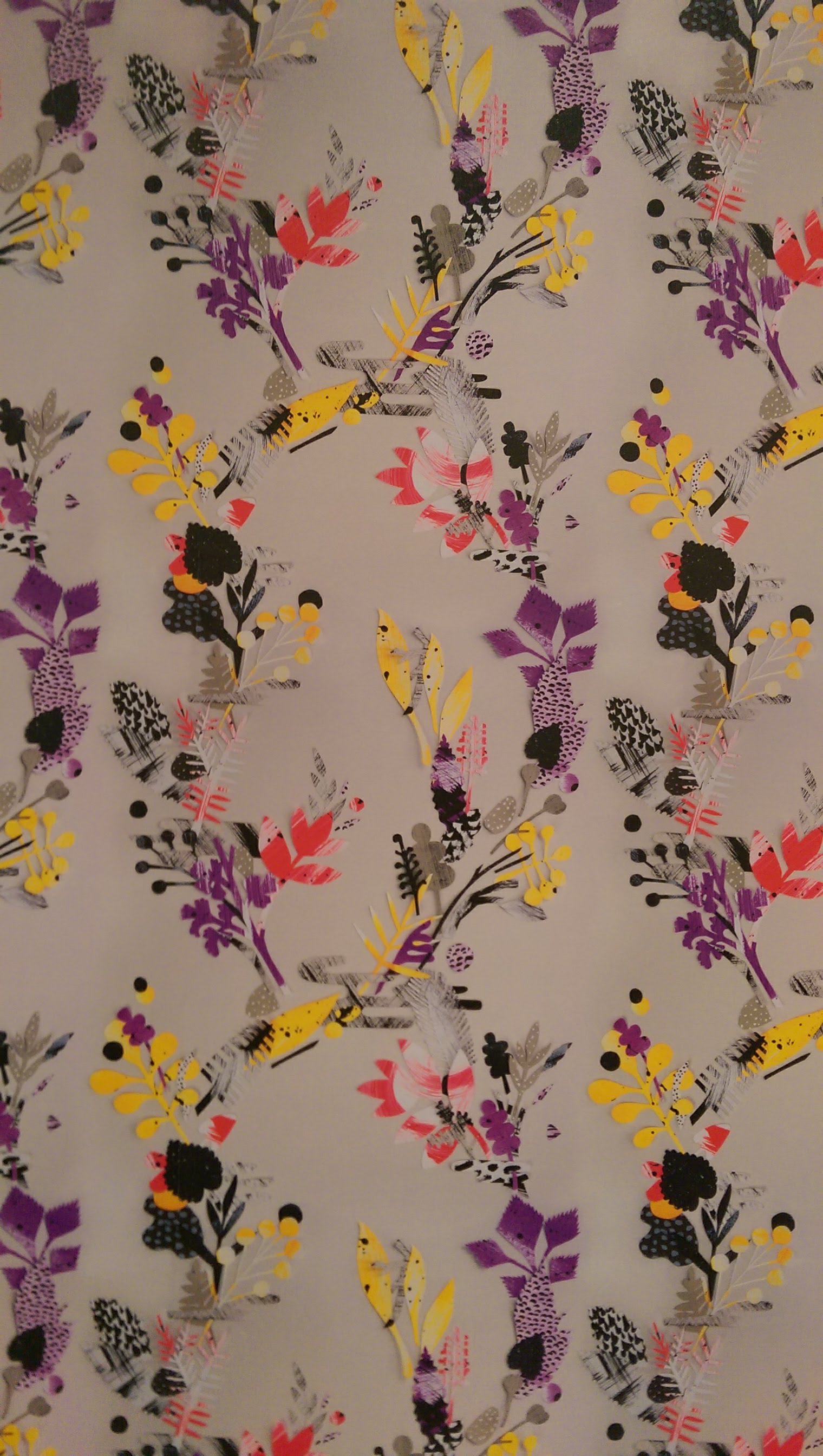
    Pack out always has a bit of confusion, cartoonists love doggos, and Amalga Distillery has the Portland International Airport carpet of wallpaper.

    _______________
    ¹ Which may explain that what started as a 15-stitch wide swath of yarn eventually turns into a 28-stitch wide swath of yarn. I’m not sure how I managed to make things wider (or why I didn’t notice earlier), but Sophie assures me it’s an advanced technique that I’ve stumbled on to.

    ² Mostly because the hero doesn’t get to return to the land of wisdom and peace on a yearly basis, as I plan to.

    ³ And I am a very cynical man, but Comics Camp is enough to make me declare my allegiance to sincerity.
    Camp 2018, Part Four

    Sunday at Comics Camp always means one thing: in the morning, newcomers discover that last night’s dinner — sandwiches and such — were just for convenience. Jeste is bringing the tasty at full speed with heaps of sliced fruit, oatmeal, stuff to put in oatmeal, sticky buns, and an enormous hotel pan of migas; breakfast will not lack for tasty eggs and it’s just going to get more impressive as she takes the measure of her helpers.

    There’s a split in the first programming block, with each of the two sessions having an upper limit due to materials constraints; on the one hand, you can learn to do accordion binding and build a notebook (Erika Moen does one that’s an absolutely gorgeous tribute to her beetlings), on the other hand, you can learn Ravenstail weaving. Having come to Camp determined to learn to knit (a decision I made last year and am only now acting on), I opt for the weaving.

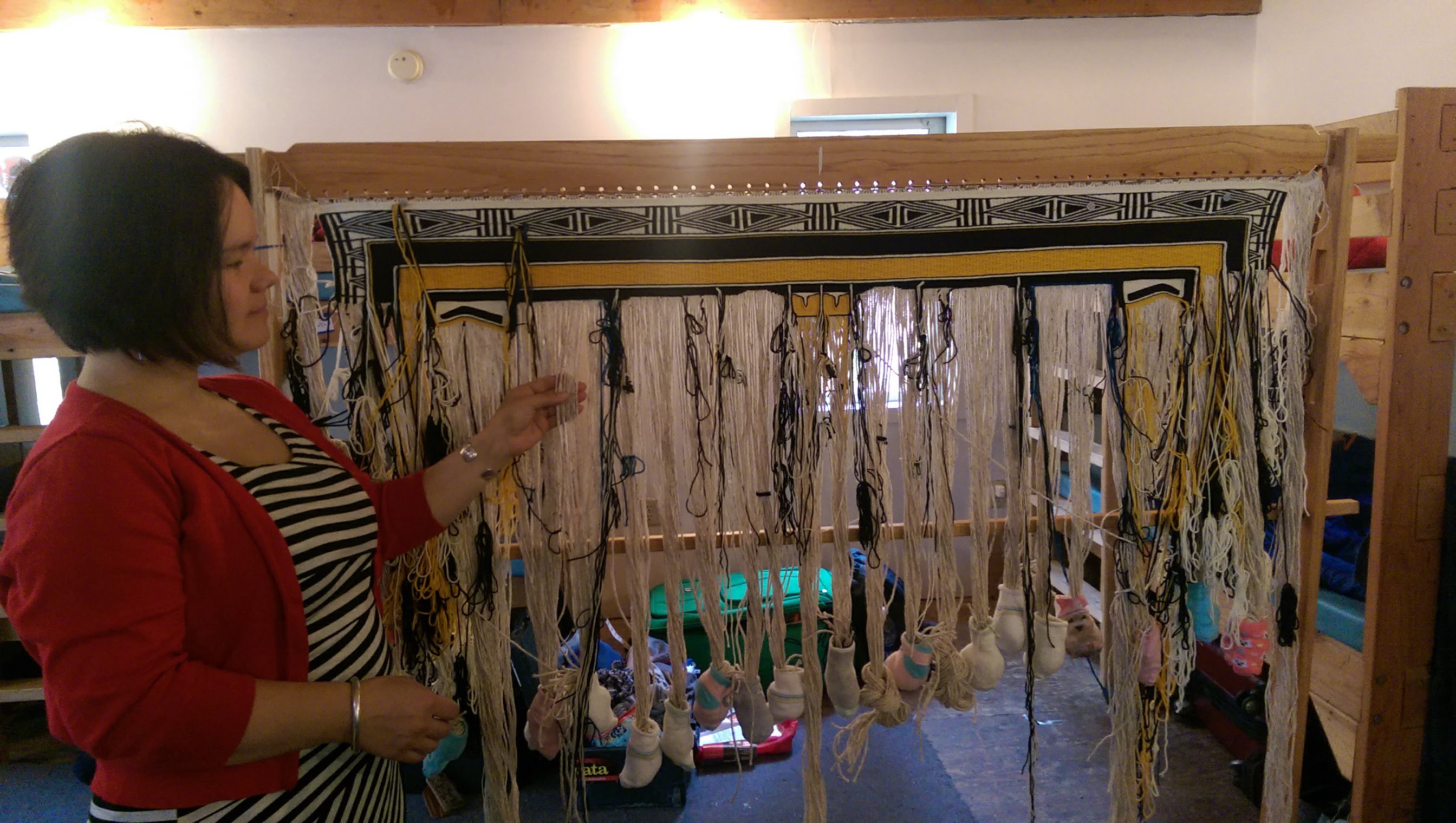
    Lily Hope is a Tlingit weaver, who learned from her mother, who learned in turn from one of a handful of surviving master weavers; there are a dozen or two people in the world that can do what she does, which is to make the warp and weft threads dance and to tease the geometric, always-symmetric designs from wool. She sets up a standing loom that contains the starting portion of a ceremonial shawl (as she describes it, it’s sort of a shoulder throw or shawl, and good thing too or it might never be finished), the result of three months hard work. An accomplished weaver, she tells us, can do about one square inch of design in three hours.

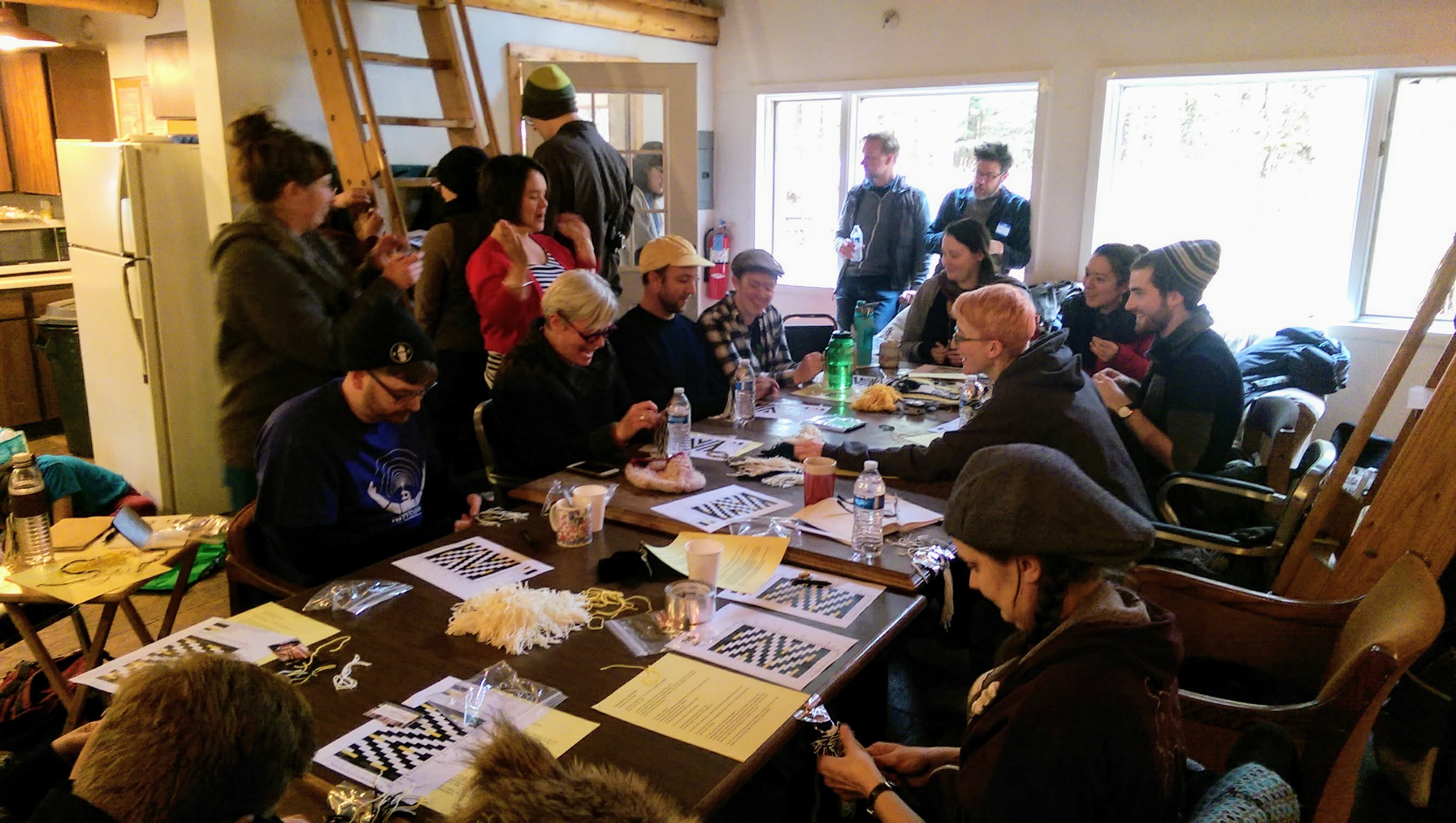
    She sets us up with key rings tied with warp bundles and a pair of weft threads strung about them as starters, and two sets of instructions (one written, one visual) before walking us through the basics: tie two threads together, one in front of the warps (always an even number), one behind. Drop the behind weft, thread the front weft behind the next bundle of warps, bring the behind thread in front. Repeat across the warps and tie it as best you can at the right side (Ravenstail weaving is always left-to-right, and the design always rides on the front of the piece only). Repeat with the next pair of wefts; don’t let the warps tangle, don’t let the wefts slip, don’t miscount, don’t tie off too tight or too loose, don’t let the tails get in a snarl.

    We move our fingers clumsily, slowly improving as she talks about the differences between Ravenstail and Chilkat weaving (Chilkat is adapted from the aesthetics of formline carvings found in house screens and totems), about the traditions of gifting across clan boundaries, and the meaning in the work. Human figures in the weaving are never shown with five-fingered hands, because it ties the work to a particular person, she says; the intent isn’t to say I was here, but instead to say A person made this, and who is less important than the people that person came from.

    That idea isn’t always easy to get across; she’s had commissions from people that love the blankets and robes she produces and insist on the making designs as authentic and traditional as possible. She has to explain that the most authentic work must reside with the clan; to make a piece that’s appropriate for ceremony but that won’t be used in ceremony, that will hang on the wall of a collector in the Lower 48, can’t be done. If they want authentic, they need to talk about donating the piece to a clan that will make use of it; if they want to keep it, she’ll put in elements that are meaningful (representations of her family and her children), but which are not traditional designs. It’s a conversation about what makes your culture special and gives it meaning, and how far that meaning can be transported to other places and people.

    She watches as we make our way through work that can be frustrating; I’m pretty good at the right-side knotting, but my warps keep tangling. My mind drifts to ideas of how I could add mechanical aids to the process (just a small bit of weight at the bottom of the warp would be helpful; I’ve seen it done by weavers of everything from Bruges lace to Shinto shrine decorations). I also consider that getting frustrated at a difficult task that takes a lifetime to master after about 20 minutes is also not a good look¹; she takes that time to tell us that we’re all doing very well and we’re really focusing on task much better than her usual students. Then again, her usual students are fourth graders, so….

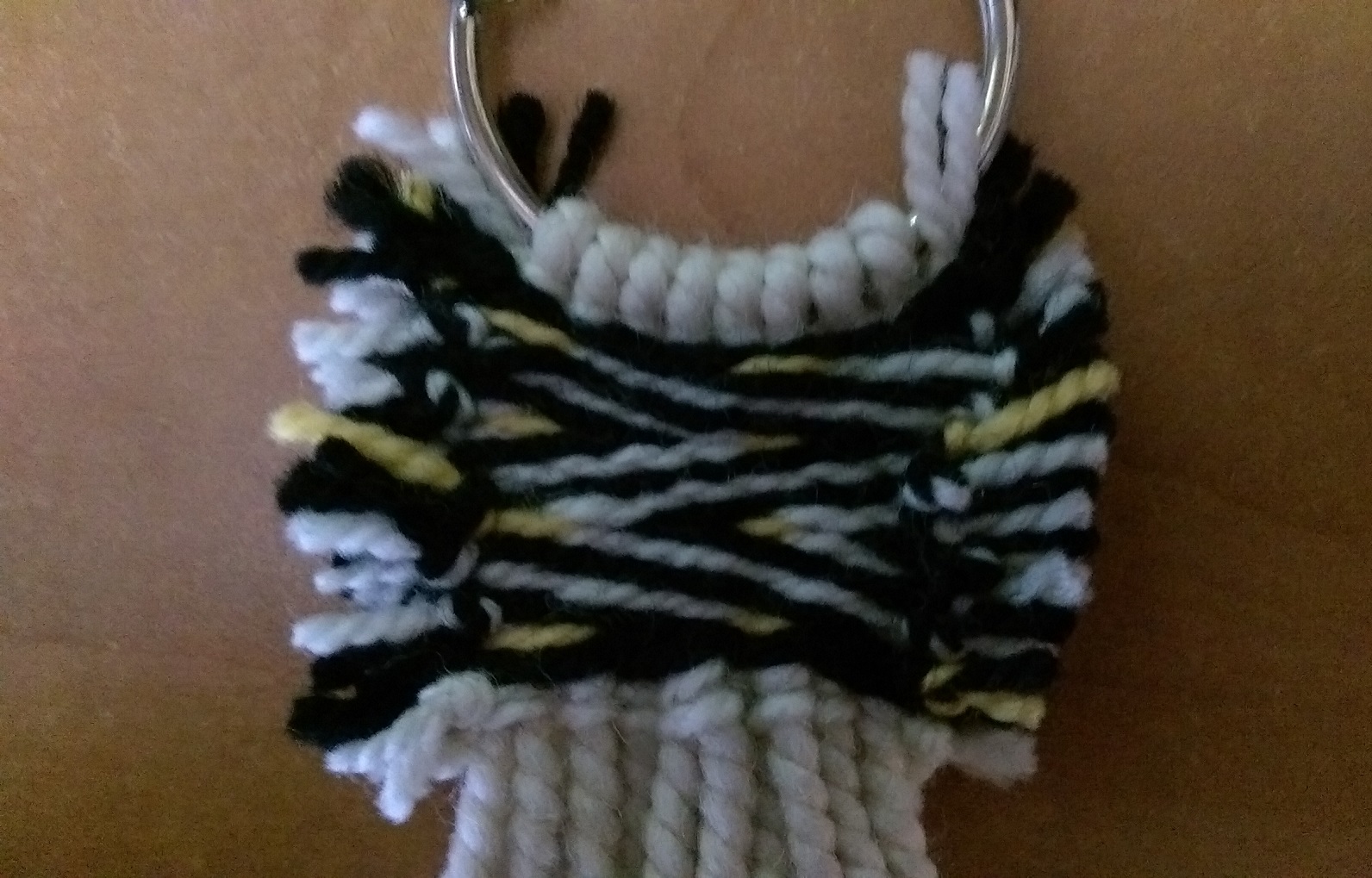
    The 90 minutes goes by and I’ve got about ten rows done; I’m keeping my elbows in close like I’m told, and I’ll spend much of the rest of the day completing this one small set of black and white chevrons with yellow accents. It’s still in my lap as we head back to the main lodge for the best-attended session of Camp. Lily’s husband, Ishmael, is going to talk about how indigenous stories and traditions can be brought into modern contexts without losing their meaning.

    Ishmael is a poet, storyteller, writer, videogame producer, and steeped in the tales of his Tlingit and Inupiaq heritage. He talks about how a culture can’t be window dressing in a story, a game, a movie — the concerns of the people that live it must be given primacy if there’s to be the authenticity that the outsiders (who asked for input, after all) claim to want. He tells the story of a young boy taken by the Salmon People to learn the value of the food that he turned his nose up at; his storyteller rhythms are hypnotic, lulling; his voice conjures images in your mind. At night around a fire, the shadows would dance into shapes to illustrate his words.

    There’s a lilting musicality to his story that fades as he speaks prose again; I’ve not woven a thread in an hour, but the design appears to be more recognizable than it was before.

    Georgina Hayns teaches soft sculpture — two pieces of fabric, a design drawn in mirror image on them, representing the front and back of character, which will be stitched together and stuffed into a flat pillow shape. Whales, horses, blobfish, T-Rex (one guess who made that one), and a Scott C nightmare rabbit are among the designs that are painted, then stitched up and eventually stuffed. I watch, but have no character that I want to create; I continue weaving as the pillowcritters take shape (most of which will be finished over the next day; the paints need to dry, after all).

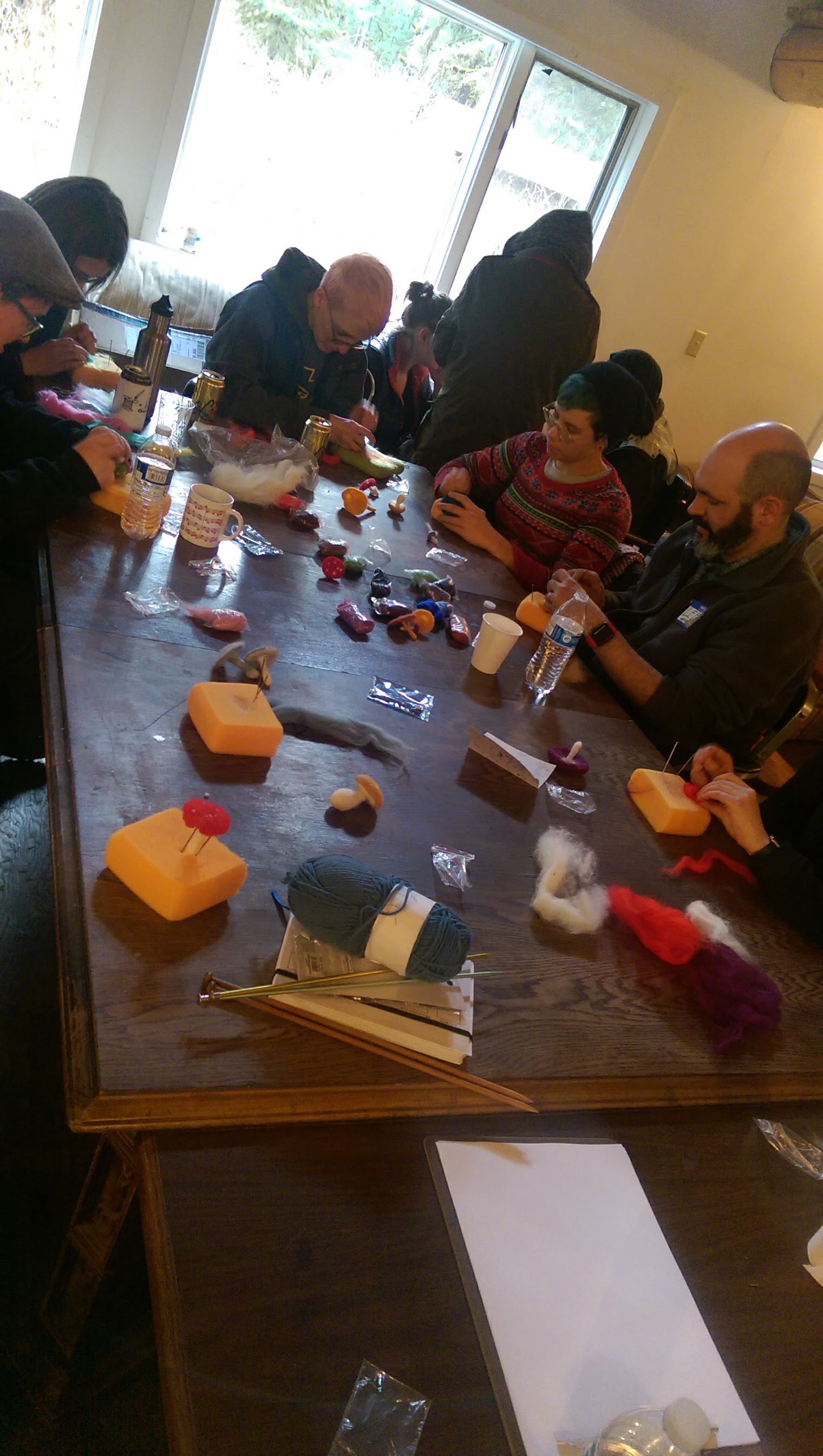
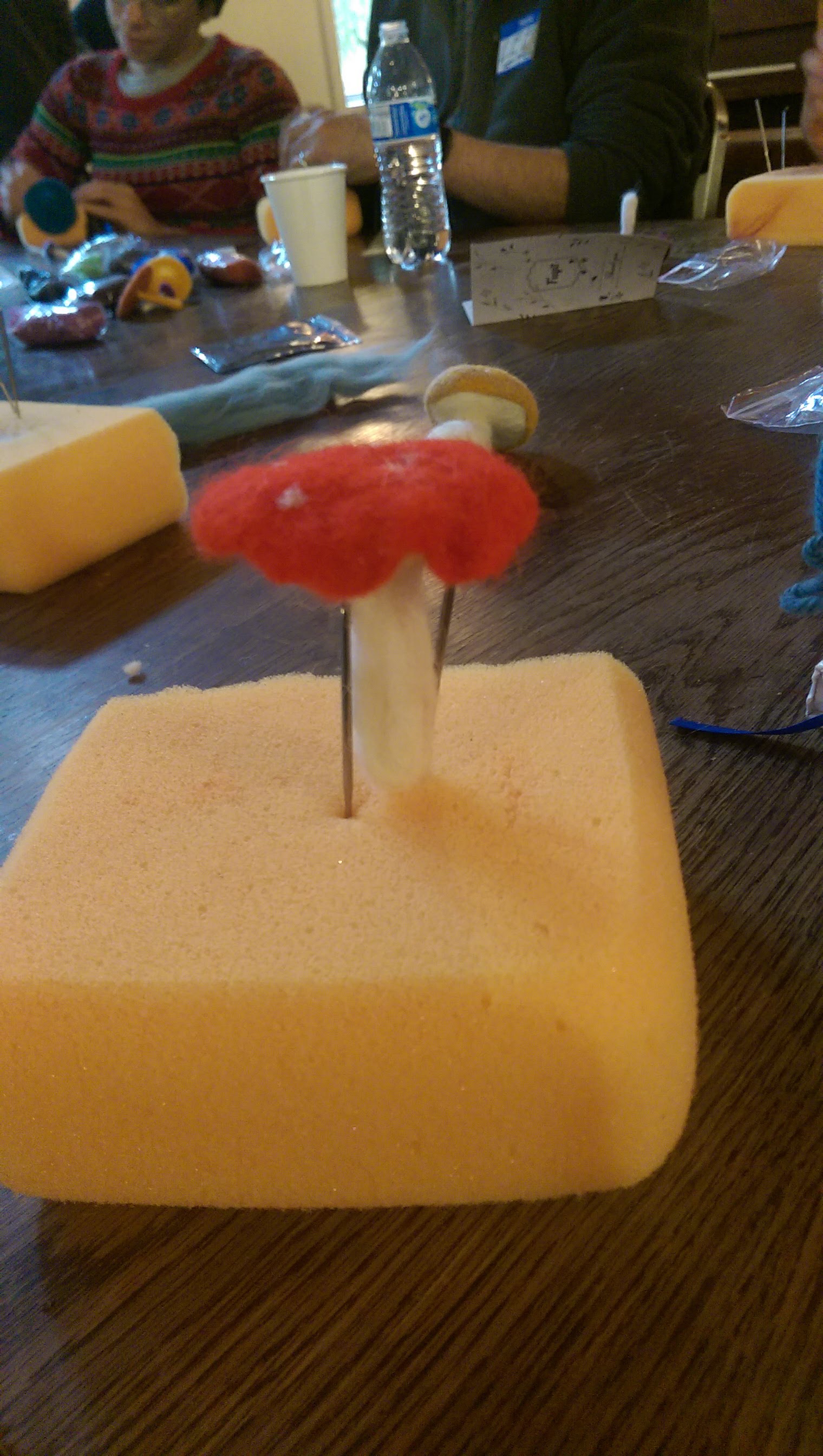
    After lunch, Vera Brosgol teaches fabric arts for the homicidal: needle felting! You take a pile of wool over here, mush it up into a rough shape over there, and then you stab stab stab stab stab with a special barbed needle until it compresses and sculpts into the desired shape. More stabs allow you to connect different bundles of wool together. If you’re smart, Brosgol says, you stab not against a pile of wool held in your hand, but one that’s resting on a dense sponge; she asks casually if we’re up to date on our tetanus shots, but does not ask if we’re smart. In the end, only two people stab themselves and only one draws blood, so yay.

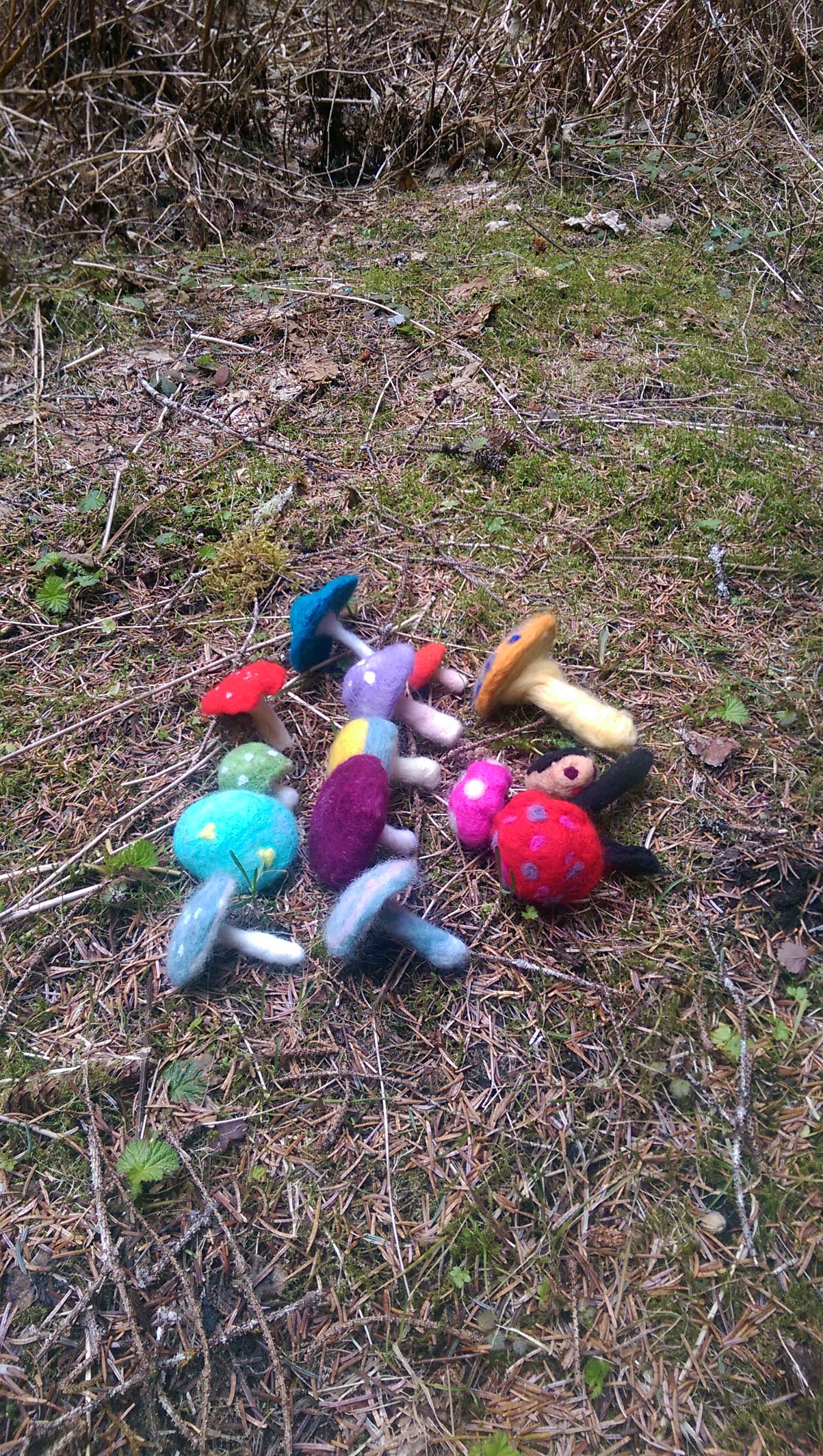
    The Stabatorium is filled with aggression release as most of us make mushrooms (a relatively simple beginner project); Ryan North makes a small head that’s meant to be David Malki ! and Nikki Rice Malki’s year-old son. Jeremy Spake makes a little guy that looks remarkably like the old Henson coffee advertising Muppets, Wilkins and/or Wontkins. I decide that a pile of red wool will make a nice Amanita, the deadly mushroom genus responsible for more deaths than any other; I mention that Amanita‘s mycotoxin works by melting your liver, which would ordinarily be responsible for removing the toxin from your system. Sneaky buggers, them shrooms.

    I do my turn in the kitchen on dinner prep — many veg are cut, salmon in a green curry sauce is prepped with a multi-veg slaw; it’s terrific, and I see how improvisational Jeste’s cooking is; she knew the salmon was going to be the centerpiece, but the rest of the meal came together over the 90 minutes or so that we were at work. She asks Georgia Patton, my fellow kitchen helper, if she’s ever worked in a professional kitchen before. You’re competent, Jeste says; this is high praise from any chef.

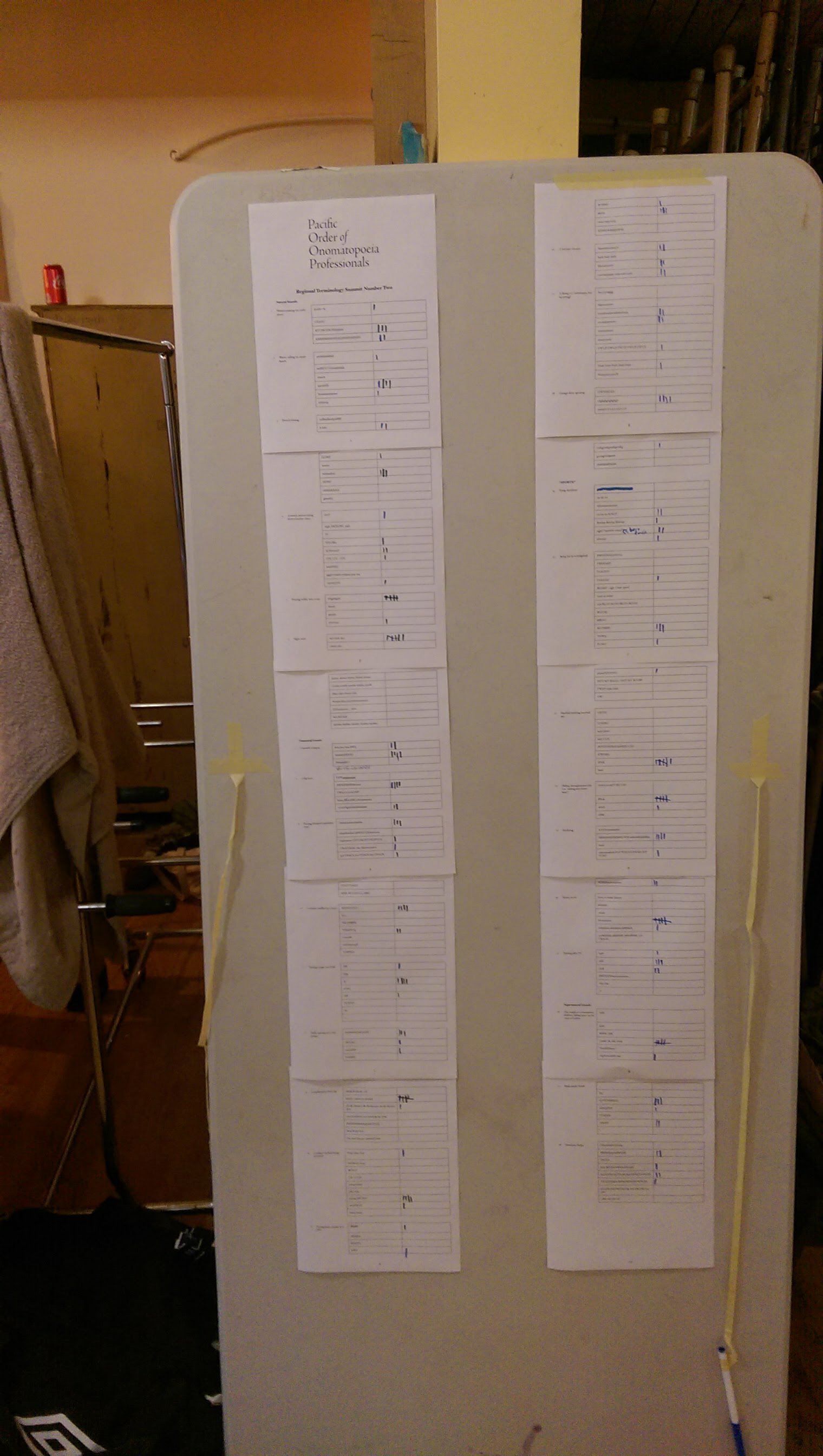
    After dinner, the Pacific Order of Onomatopoeia Professionals reconvenes for the first time since last year’s First Annual Regional Terminology Summit. When POoOP president Tony Cliff announced that this year’s meeting would in fact take place, I spent the best part of a week trying to come up with an appropriate backronym for the event. Then Raina Telgemeier casually dropped the perfect label: Number Two.

    I may have come up with a winner with the sound of people making out with tongues: le kiss. The results will be compiled by the estimable Mr Cliff soon enough, and as with last year’s FARTS, will be binding. Cliff, by the way, brought two copies of his soon-to-be-released third Delilah Dirk book, and there was not a single time that either of them was not being read. He’s pretty great at creating comics, and has lots of impressive onomatopoeia inside (even more impressive, I just spelled that word correctly on the first attempt for the first time in my life).

    My weaving is done, some five hours of work in total; I’m surprised at my dive into the work of fabric, then surprised that I’m surprised. Over the past couple of years I’ve realized that the very male realms of engineering (in general) and making (in particular) greatly undervalue the textile arts. The draping of a garment from a 2D pattern to a 3D person, with a soft medium that changes with temperature, humidity, wind, and gravity, that behaves differently depending on how it’s cut and constructed — fashion is the most hardcore materials engineering discipline there is.

    In retrospect, the tactile crafting going on this first day (Jason Alderman decided to attempt a full stuffed animal rather than a 2D+ pillow form; I saw him sketching out gussets), a buffer from the real world before we get into the deeper feelings in another day. Andy Runton and I catch up on years of not seeing each other; he’s been too absent from the new releases list for too long and his return will be welcomed by many, not the least me (my youngest nieces and nephews all got the Owly books; now the oldest are having their own kids, and I’m just saying that a new edition of them would be well received over the next couple of years, publishing industry).

    Yarn, thread, needles, wool, books, stories — the tangible (and the made tangible by force of words) have stitched us together on this first full day.

    _______________

    Pictures:

      Lily Hope is one of maybe ten, maybe fifteen people in the world that can do what you see here, and it took her three months. The little baby socks keeping the bundles of warp threads organized are a nice touch. The pattern that we’re weaving can be seen in the pixelized design maps; I really cannot overstate the degree of concentration that was required to make progress.

      George’s horse looked great! Everybody else was a day or so away from their ravens, whales, T-Rexes, blobfish, and scary-ass rabbits. Felting, by contrast, is simple; just stab stab stab until things come together and then you have a pile of mushrooms and also Young Master Malki !.

      Balloting for new official terms would continue for approximately 30 hours; you can’t quite read what the candidates are, but Cliff should be releasing the results in a week or two, and we’ll share them then. In the meantime, here’s last year’s again.

      _______________
      ¹ Then again, she casually mentions that if any of us are engineers who can design her a loom that can collapse in a connected fashion instead of having to be completely disassembled when she wants to move it to a different place, she’d be grateful. Tradition and technical advancements can be compatible.

      Camp 2018, Part Three

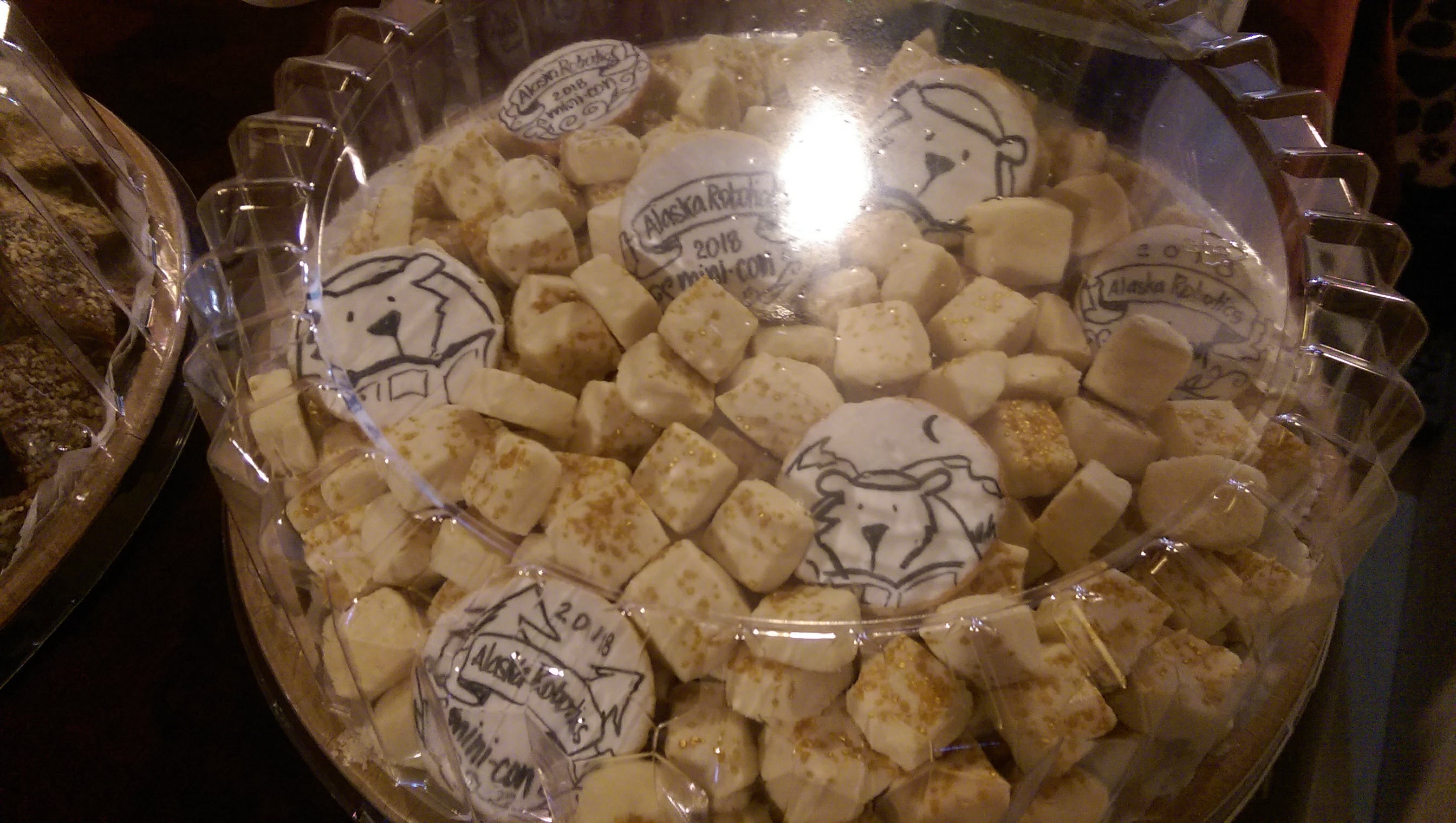
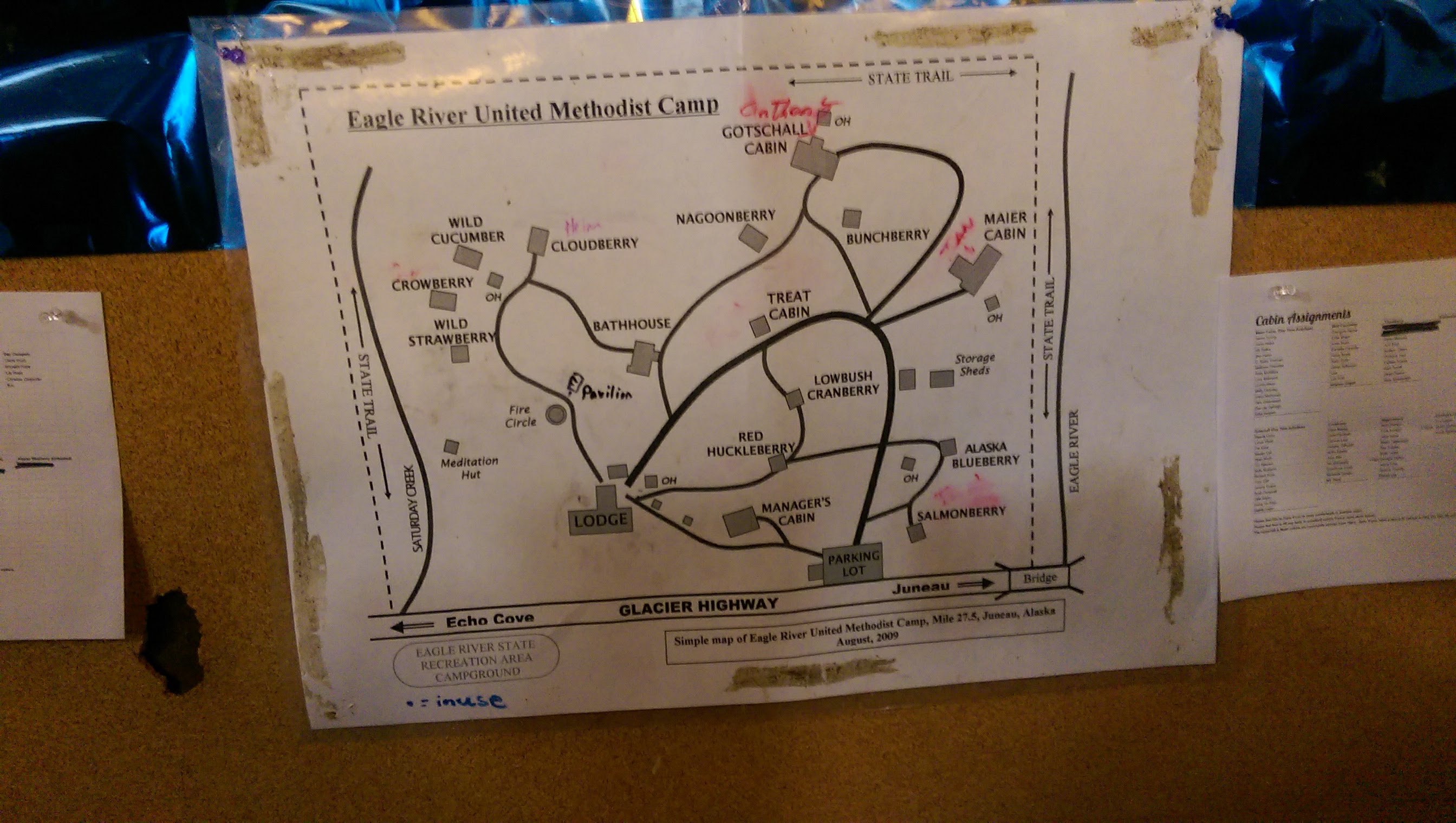
      I feel I should say that one of the neatest things that Pat Race did with respect to the Mini-Con this year was to have his little logo bear redrawn by an indigenous artist in a traditional style; it’s a small thing, but it’s meaningful. Not sure it would have fit on the cookies, though.

      I also feel I should say that if you can start your day (a very busy one, packing up your hotel room an delivering them to a U-Haul; setting up, conducting, and tearing down a convention; traveling to a campsite) by having tea and yogurt parfaits with a pair of very skilled (and colorfully coiffed) creators, you should do it; it even better if one of them can tell you all about power tools and her plans to construct a killer Halloween haunted house.

      Thus fortified for the day, we made our way to the Juneau Arts & Culture Center on a somewhat overcast, somewhat brisk day. The weather was fortunate — last year Mini-Con feel on the first really gorgeous day of the year, sending a large portion of Juneauites into the Great Outdoors for recreation; a slightly blah day increased the turnout in our corner of the Great Indoors.

      Speaking of which, if you ever get the chance to exhibit at Mini-Con, take it; the JACC features a nice green room away from the con floor for when you’re feeling like you need a break or a snack. If you really need isolation for a little while, there’s even a recording studio, so there’s a place that completely soundproof to hide from the hurly burly. Setup ran smoothly (it is, after all, a small space), and the Snack Castle rose once again under the watchful stewardship of Jason Alderman.

      It occurs to me I didn’t mention Snack Castle last year, and neglected to take any pictures of it either year … Alderman, tasked with running the snack sales, built a castle out of scrap cardboard. It had turrets, battlements, crenelations, murder holes, and a working drawbridge. This year, there was talk of converting it to a Snack Mastaba¹, in honor of the Egyptian pyramid precursor that Spike taught us about the prior night at the library. Alderman kept all who would have sacked the Snack Castle at bay and oversaw peaceful trade, save for when he was sketchnoting (more on that below).

      In addition to the vendors on the floor and the regular signings at the Alaska Robotics table, there was a steady stream of programming across the road in the meeting rooms of public broadcaster KTOO. Jon Klassen, Michaela Goade, and Andy Runton spoke about making children’s books; Ben Hatke and Lucy Bellwood argued over whether longbows (bows!) or tall ships (boats!) are better²; Molly Ostertag, Spike, and Ryan North talked about achieving social change in (and via) comics.

      Raina Telgemeier and Vera Brosgol talked about their autobio comics; Georgina Hayns and Jeremy Spake talked about puppet fabrication; Dik Pose and Tony Cliff MacGuyvered together a Mac, a webcam, and a chair to make a stop-motion animation rig; Molly Lewis lead a uke jam session; unstructured hangout sessions were held where attendees drew (with Ostertag and Dylan Meconis), talked publishing (with Spike David Malki !, and Anne Bean), wrote songs (with Seth Boyer and Marian Call), drew some more (with Hatke and Scott C), and talked writing (with North and Molly Muldoon). What I’m saying is, if there was some aspect of creativity that struck your fancy, you either got to listen to very accomplished people talk about it, or got to hang with them and do it; it’s a very street-level kind of convention.

      And in the middle of it all, a platter magically appeared in the green room, filled with local jerky and salmon spread and crab dip. And lo, the cartoonists did descend upon it, scooping great swaths up into their hungry maws. Weirdly, the amount of crab dip never seemed to diminish, but instead fed them all. And they left the green room saying A miracle occurred here.

      Okay, probably not and I don’t really like crab, but I’m assured that the dip was delicious.

      Back on the floor, Raina spent well over her allotted hour doing portrait sketches in support of a local bookstore on Independent Bookstore Day; her line eventually was cleared, and a bunch of kids went home with pictures of themselves all Raina-style. Dylan Meconis was doing watercolors of pets and OCs, because she’s been that kid wandering the con floor, working up the nerve to approach a creator, and will always pay back the kindness she was shown. Story times were held in the local branch of the library, with Klassen, C, and Brosgol reading from their books to assembled families.

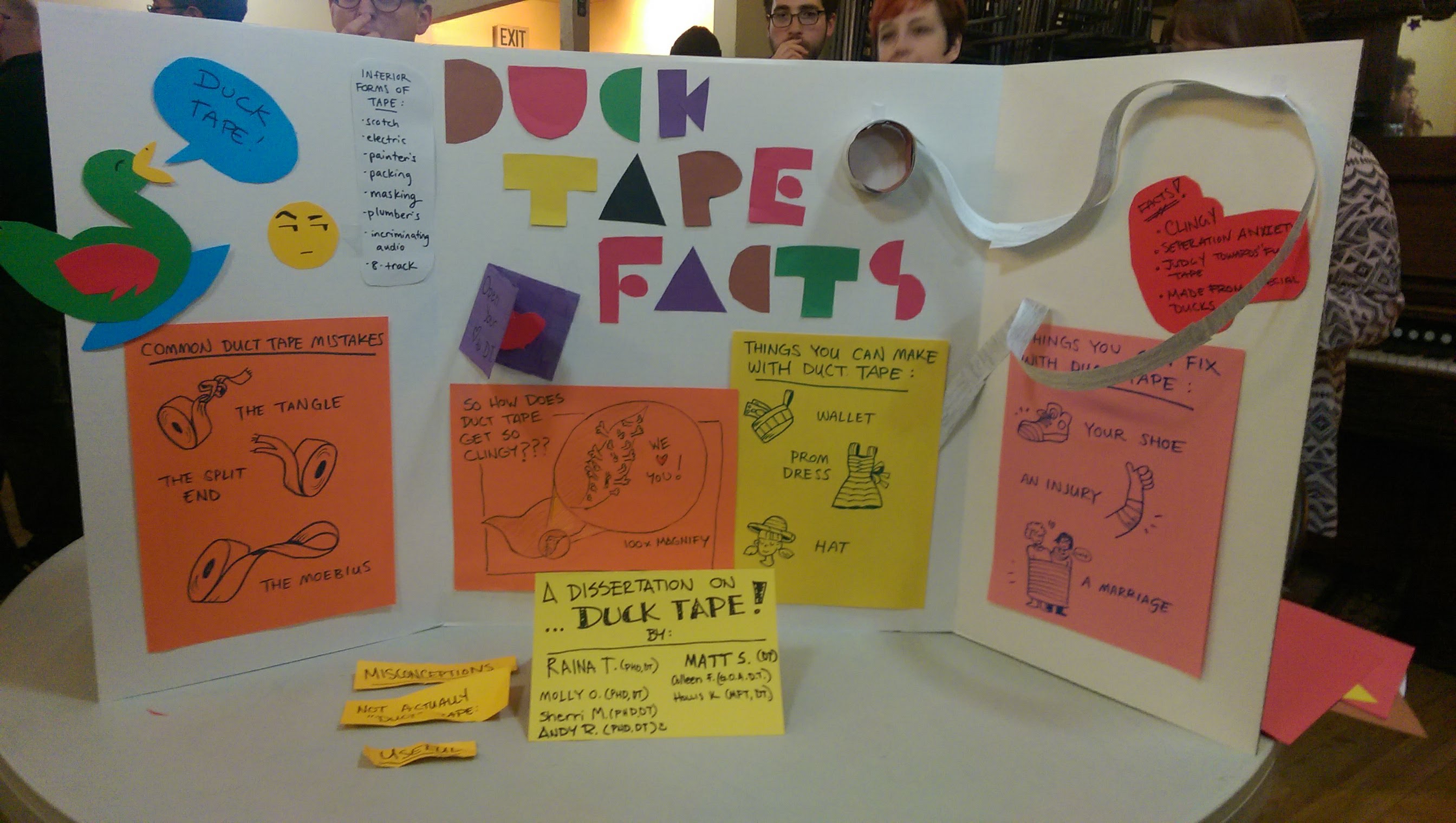
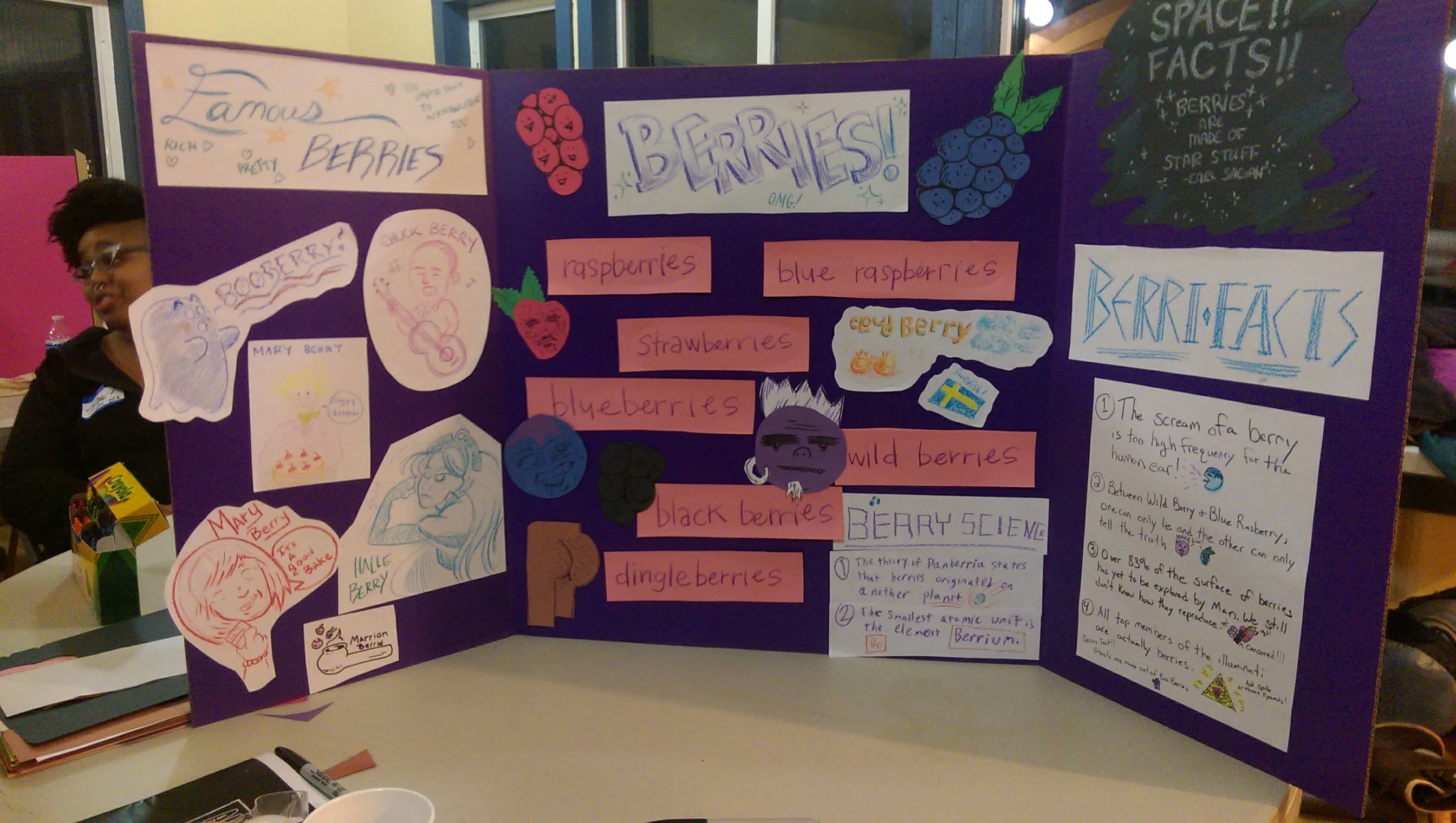
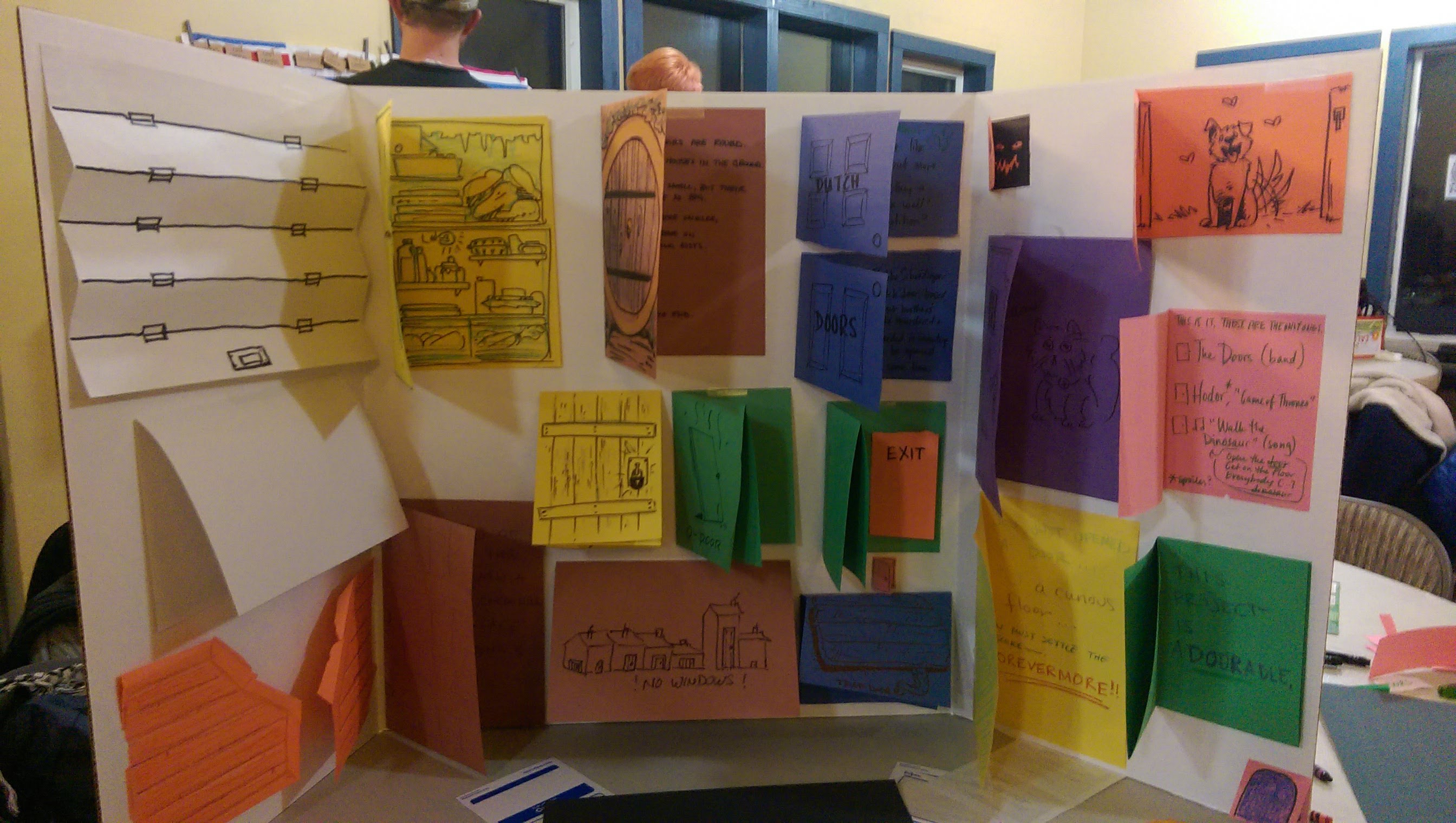
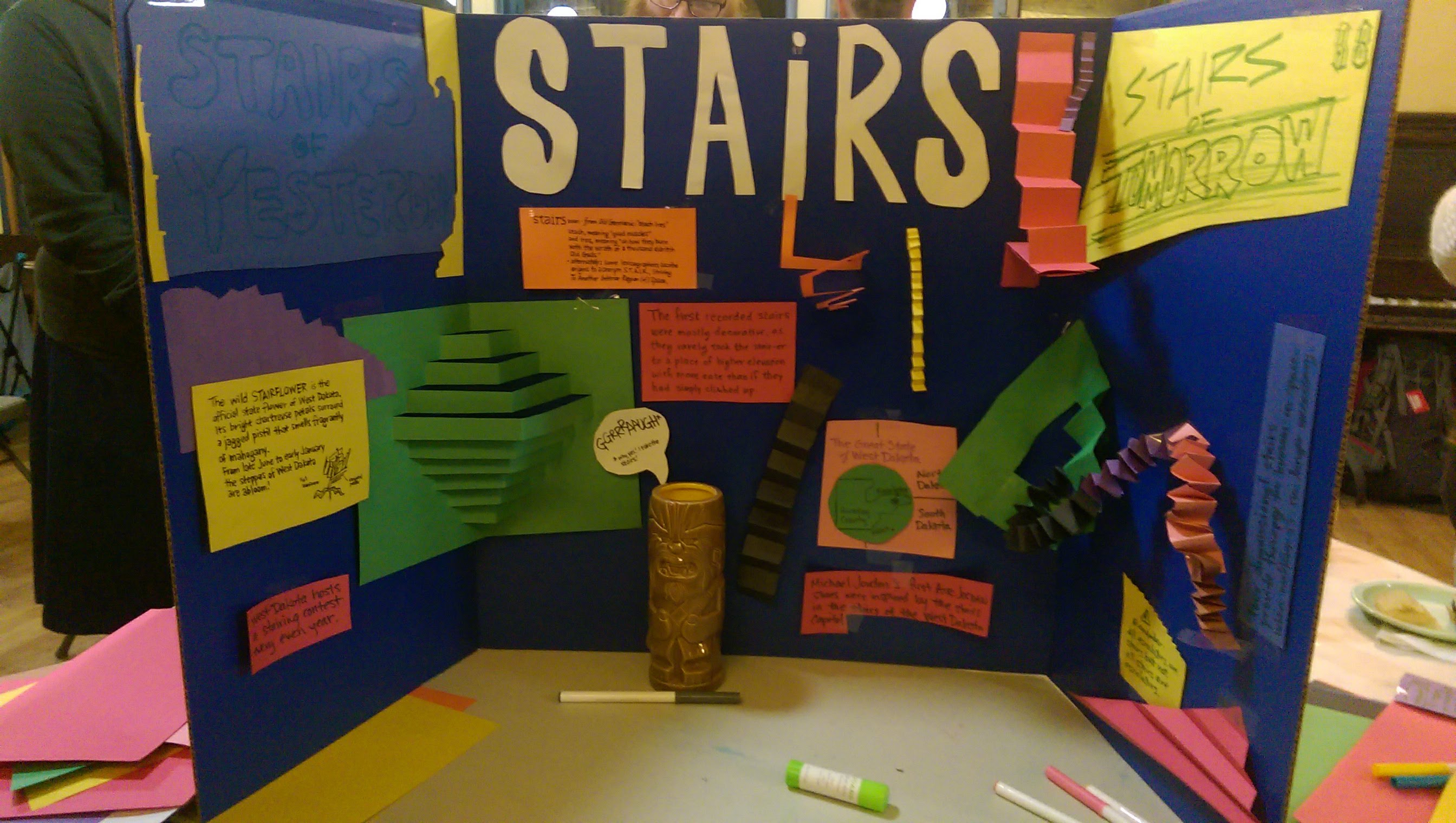
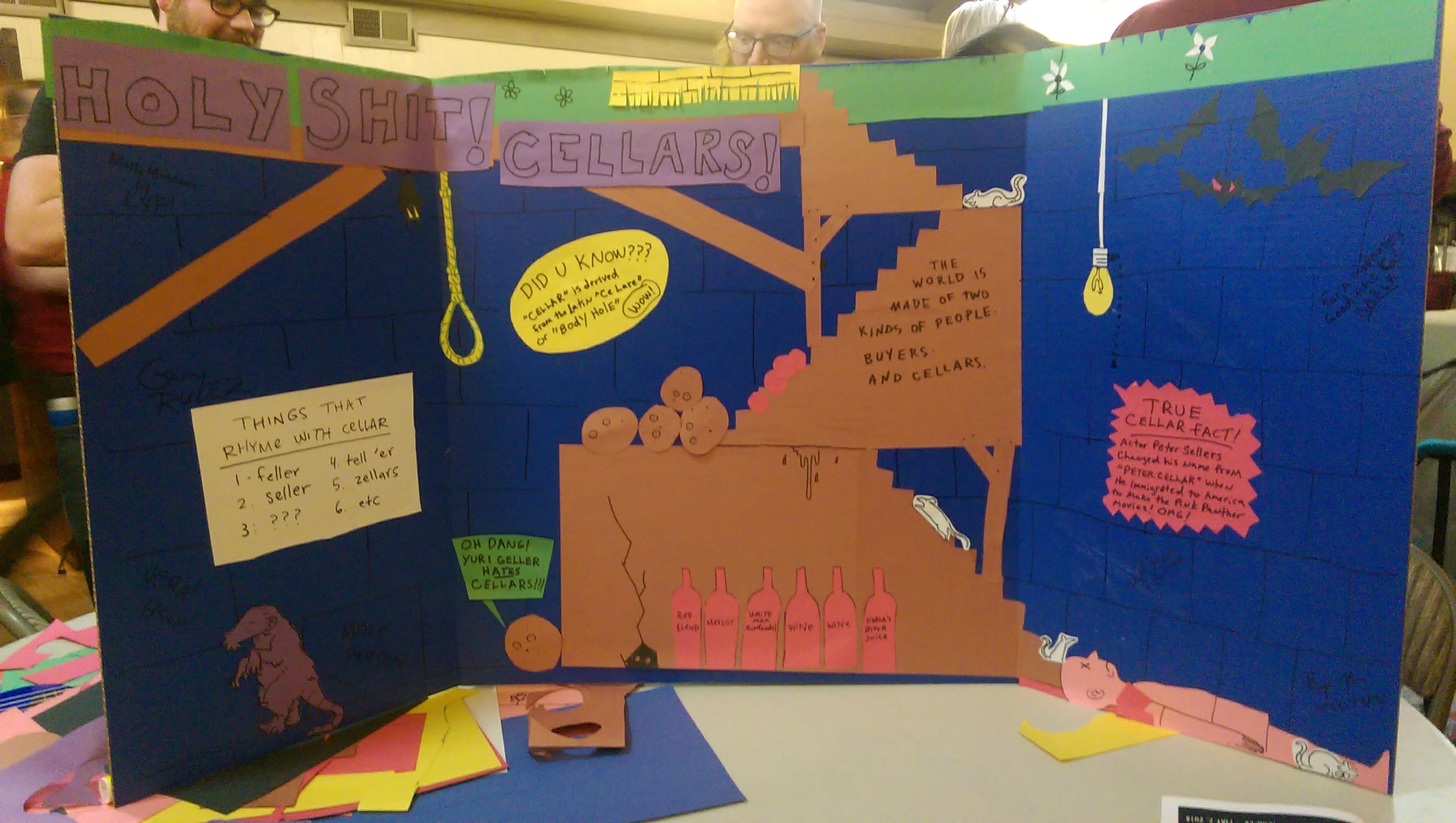
      And then it was time to break down, load up, and head out to the Camp; there were intros, and kids (both Ben & Anna Hatke and David and Nikki Rice Malki ! brought offspring, who were both remarkably even-tempered and delightful for being 3 and 1 years of age, respectively), and dogs (many skritches were had by Pippin and Brio and Nova). Gear was packed out to cabins, a light dinner was had, and Camp chef de cuisine Jeste Burton³ let us all know that she had a requirement — about which more later. The last bits of structure for the evening involved the Science Fair — people formed into impromptu groups, and then giving a topic on which to produce an informative poster. Don’t call it an icebreaker, don’t call it a teambuilding exercise, call it an excuse to get weird with new friends and very possibly the contents of the booze table.

      Come to think of it, the act of physically creating things outside the typical comics wheelhouse would become a theme for the weekend, with a heavy dive into the fabric arts to start. But we’ll talk about that tomorrow.

      _______________

      Pictures:

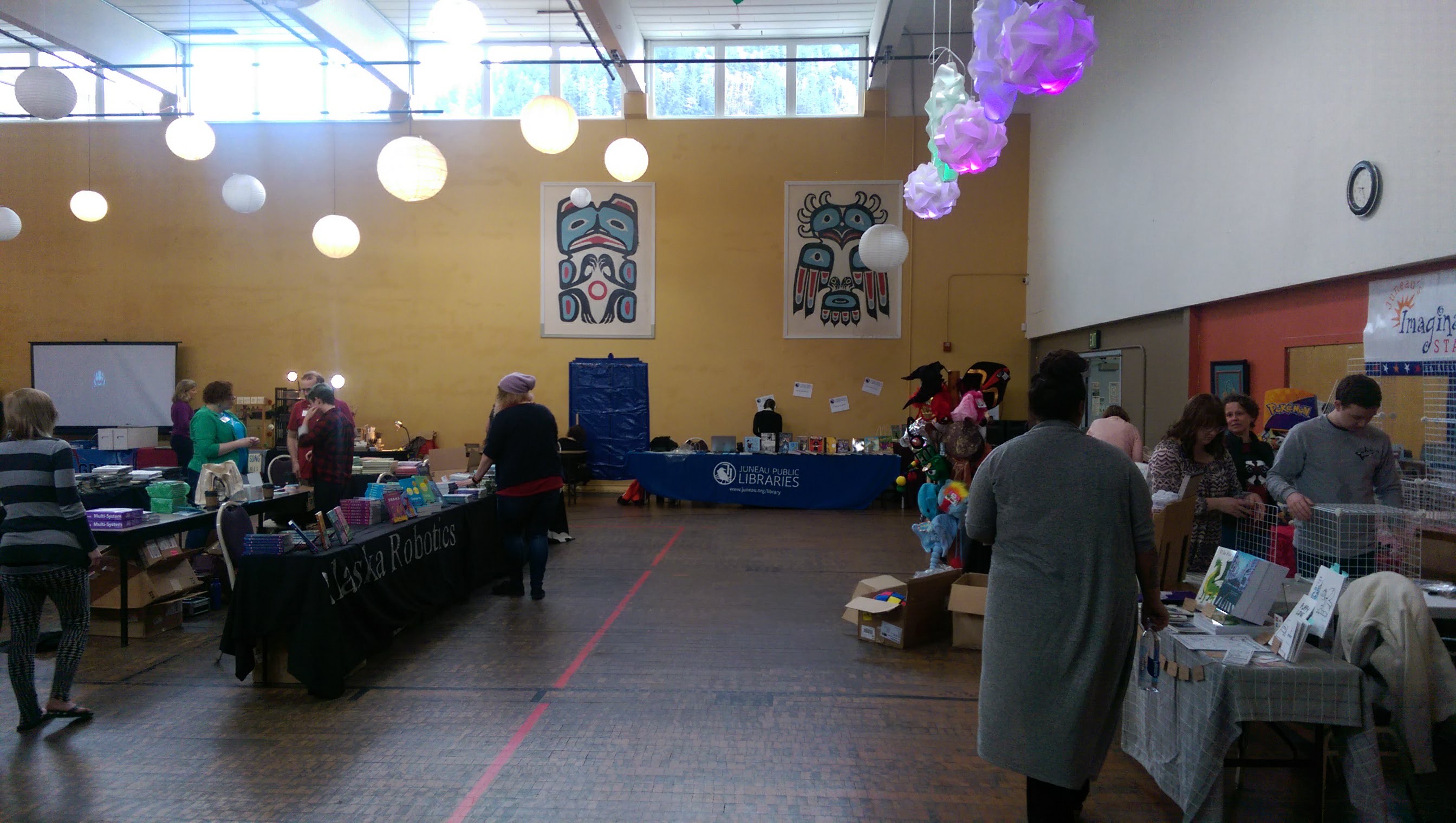
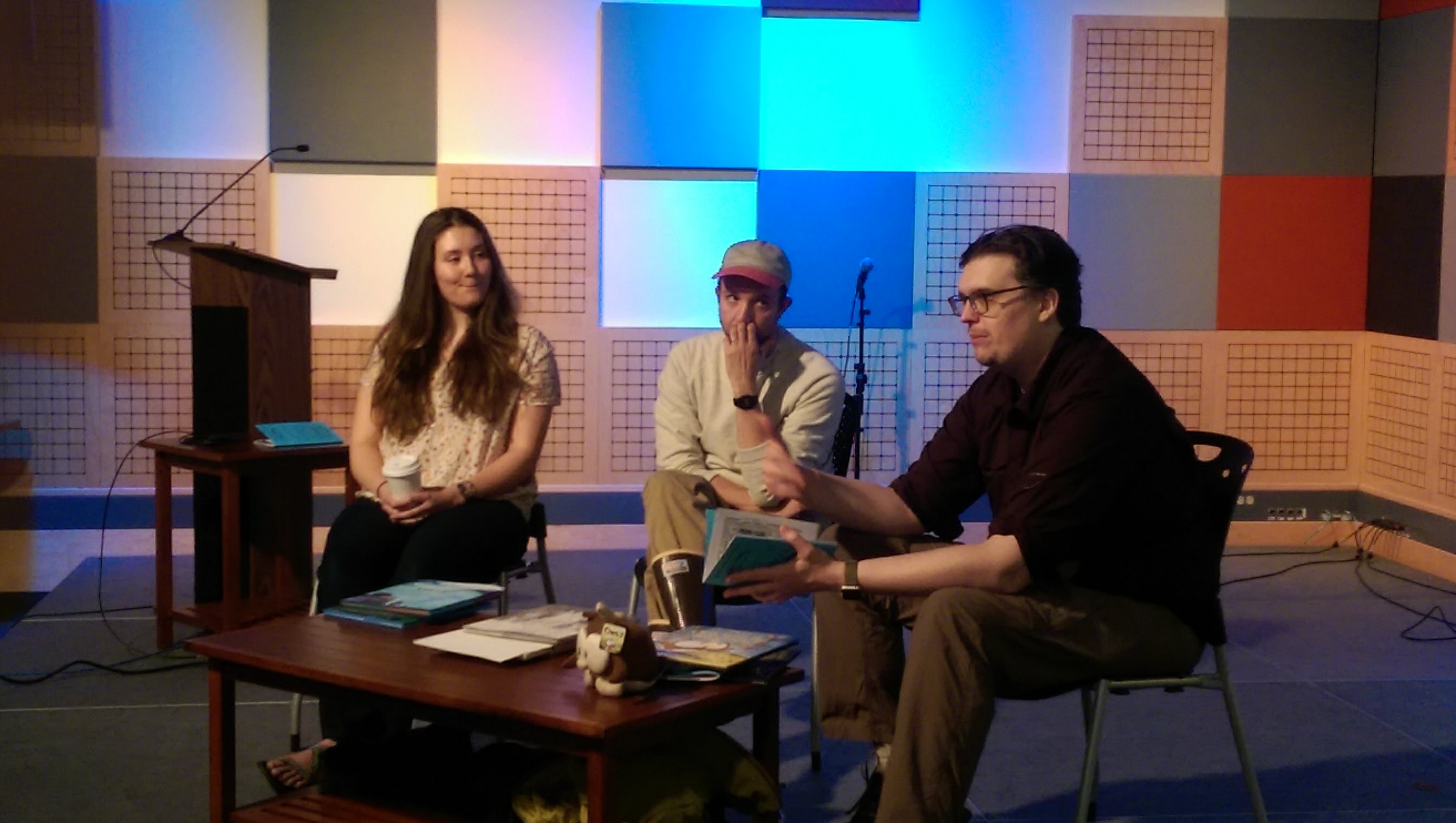
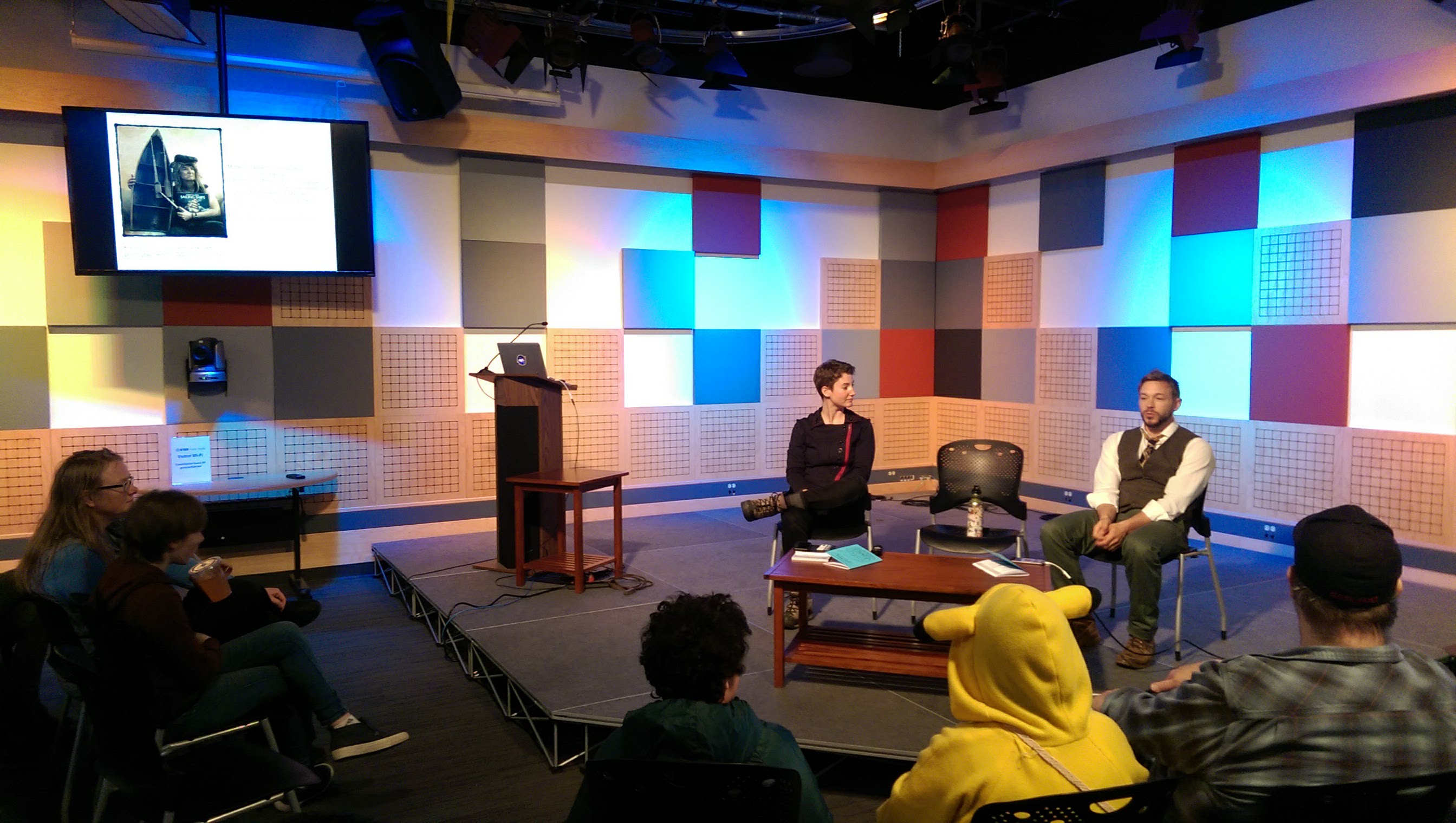
        The JACC main hall is not very large; think the combo auditorium/gym in a typical elementary school. The meeting rooms at KTOO for panel talks (Childrens Books with Goade, Klassen, Runton from left; Lucy “Boats” Bellwood and Ben “Bows” Hatke locked in intellectual combat) and hangouts (Malki ! and Spike on publishing) were very comfortable.

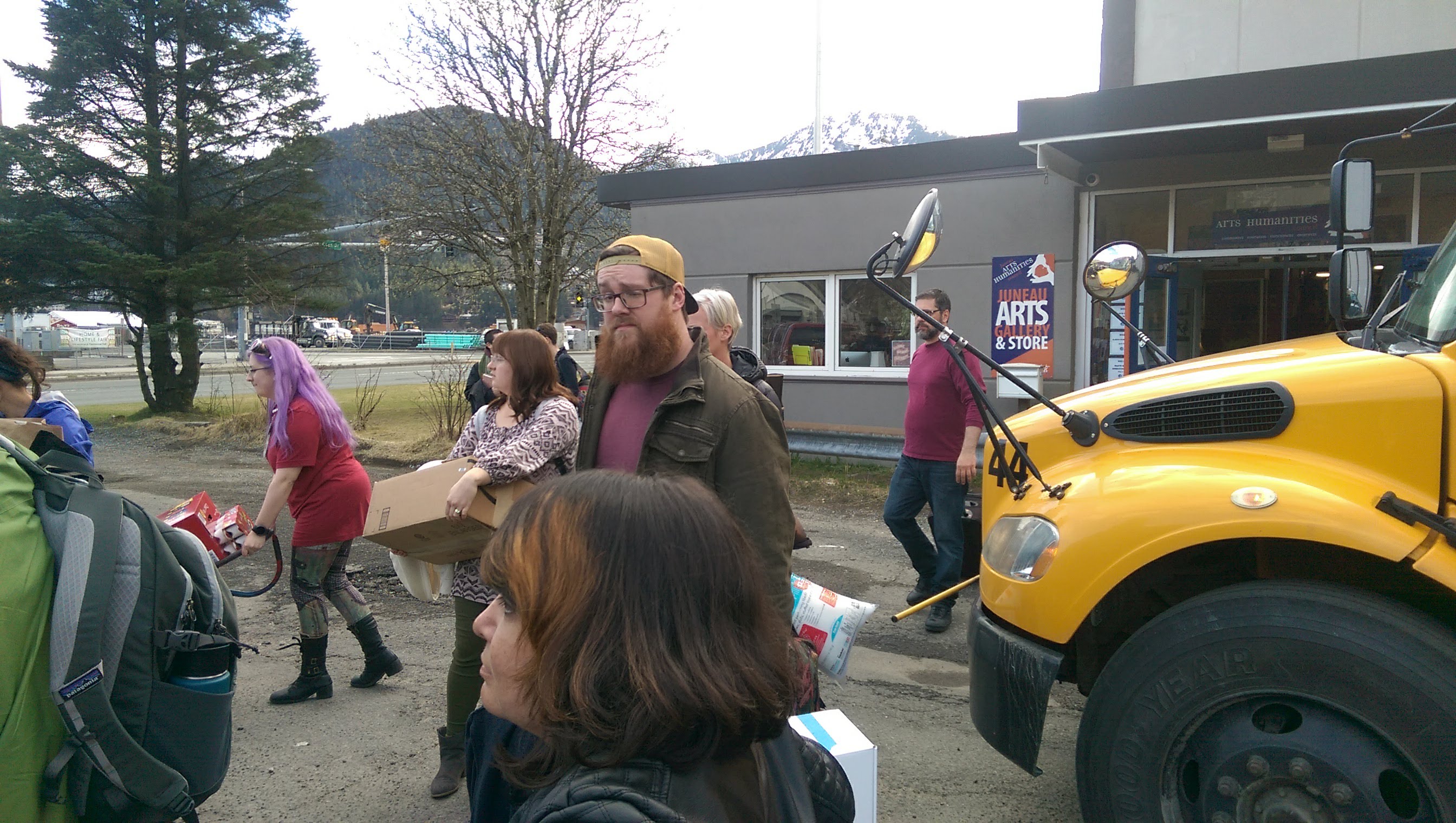
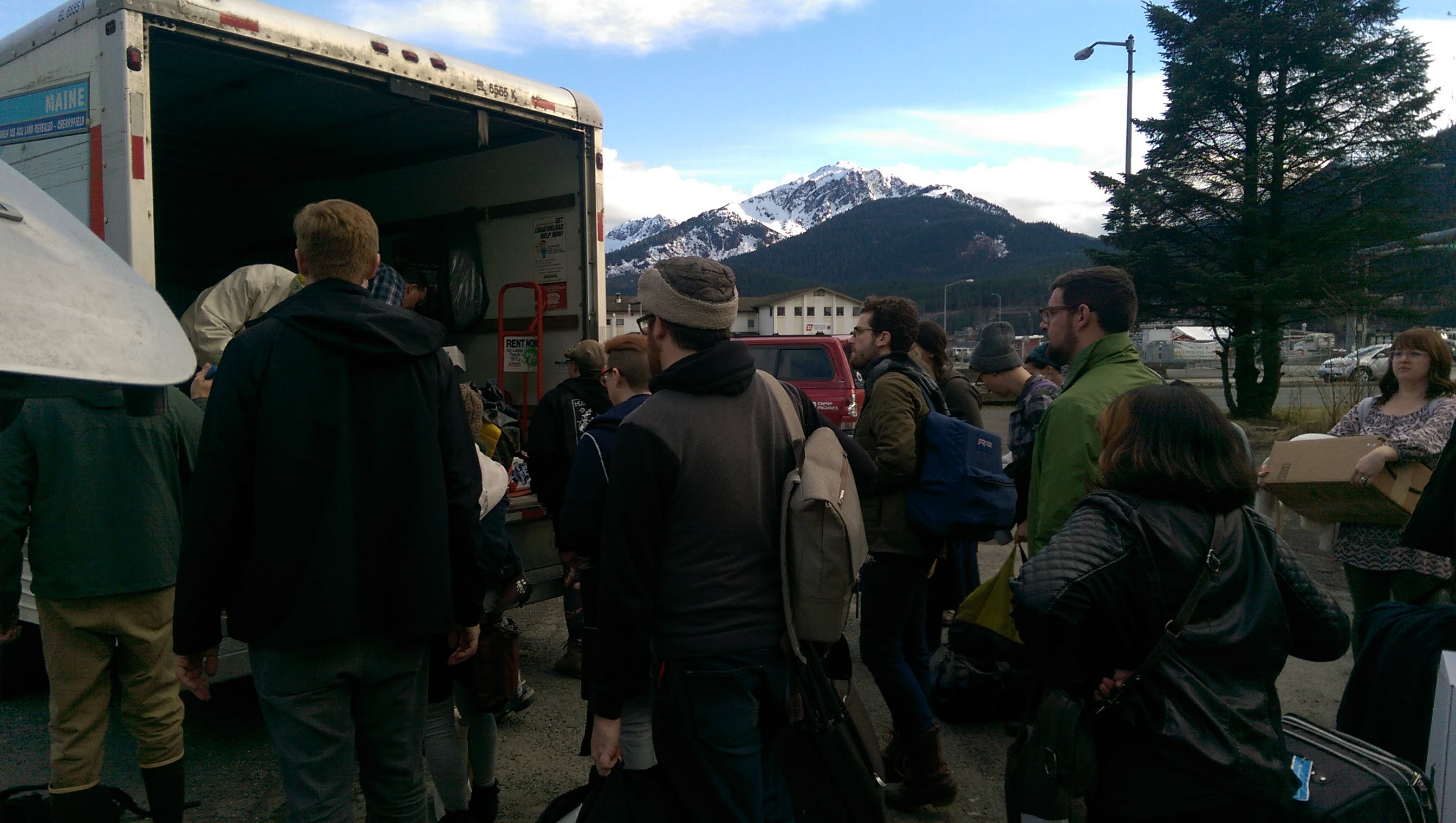
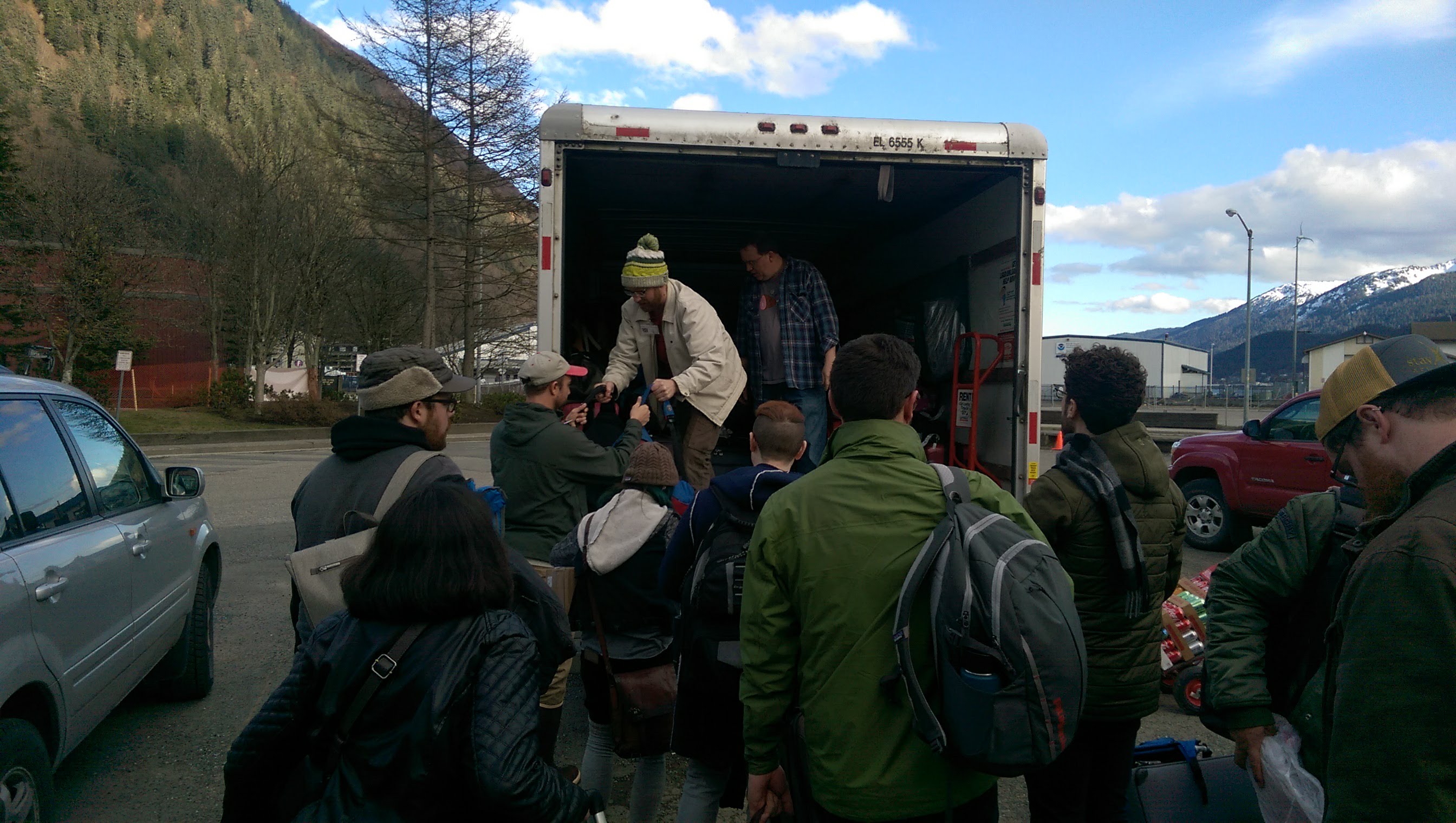
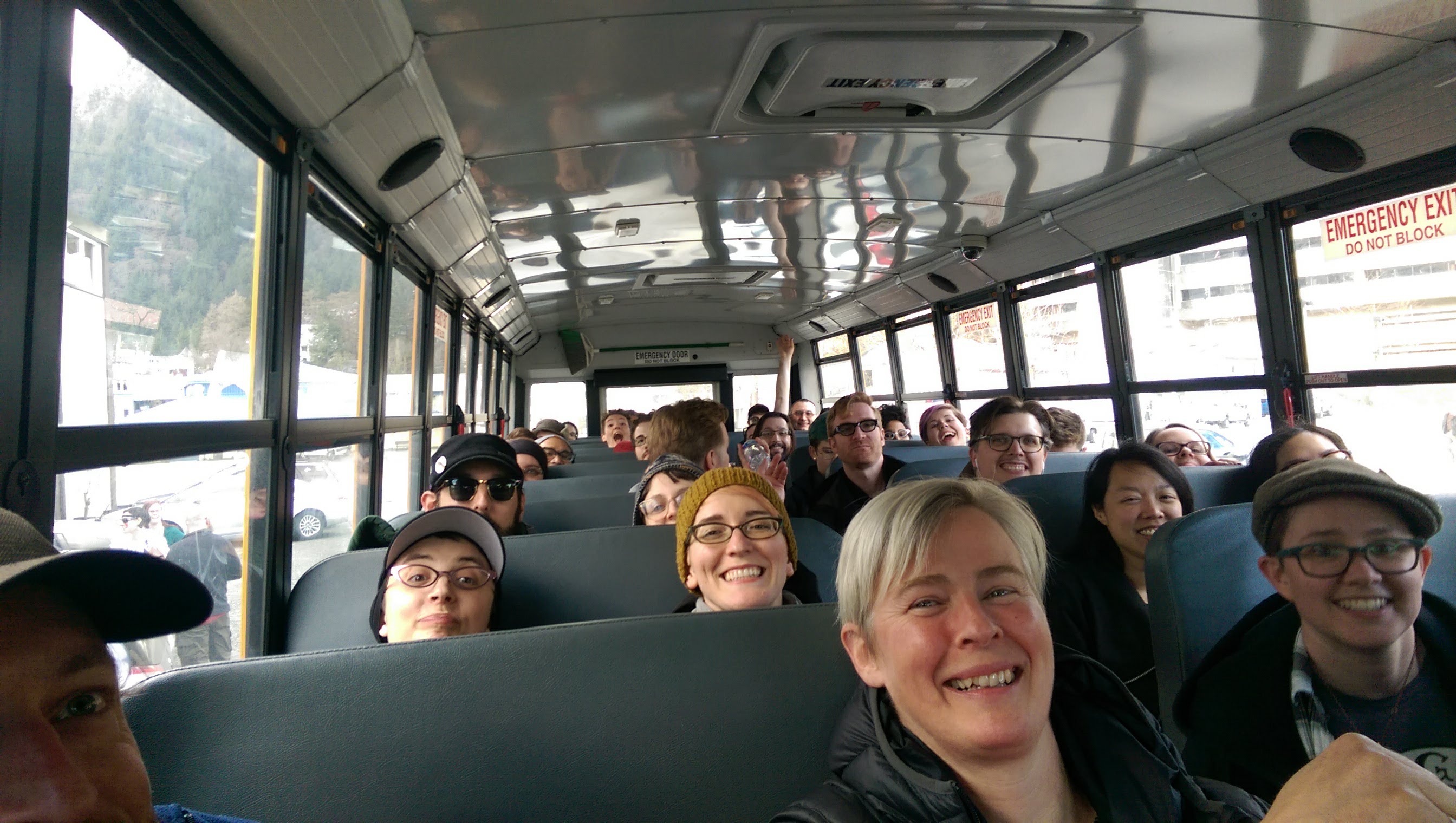
        The exodus of exhibitors made their way to the U-Haul to move stuff to Camp; this was a considerable improvement on last year’s transport, where the last 5-6 rows of the bus were taken up with luggage and people were crammed in. Look at the spacious luxury! A mere 45 minutes later these smiling folks would be taking stuff to their cabins and deciding what to do in the coming days.

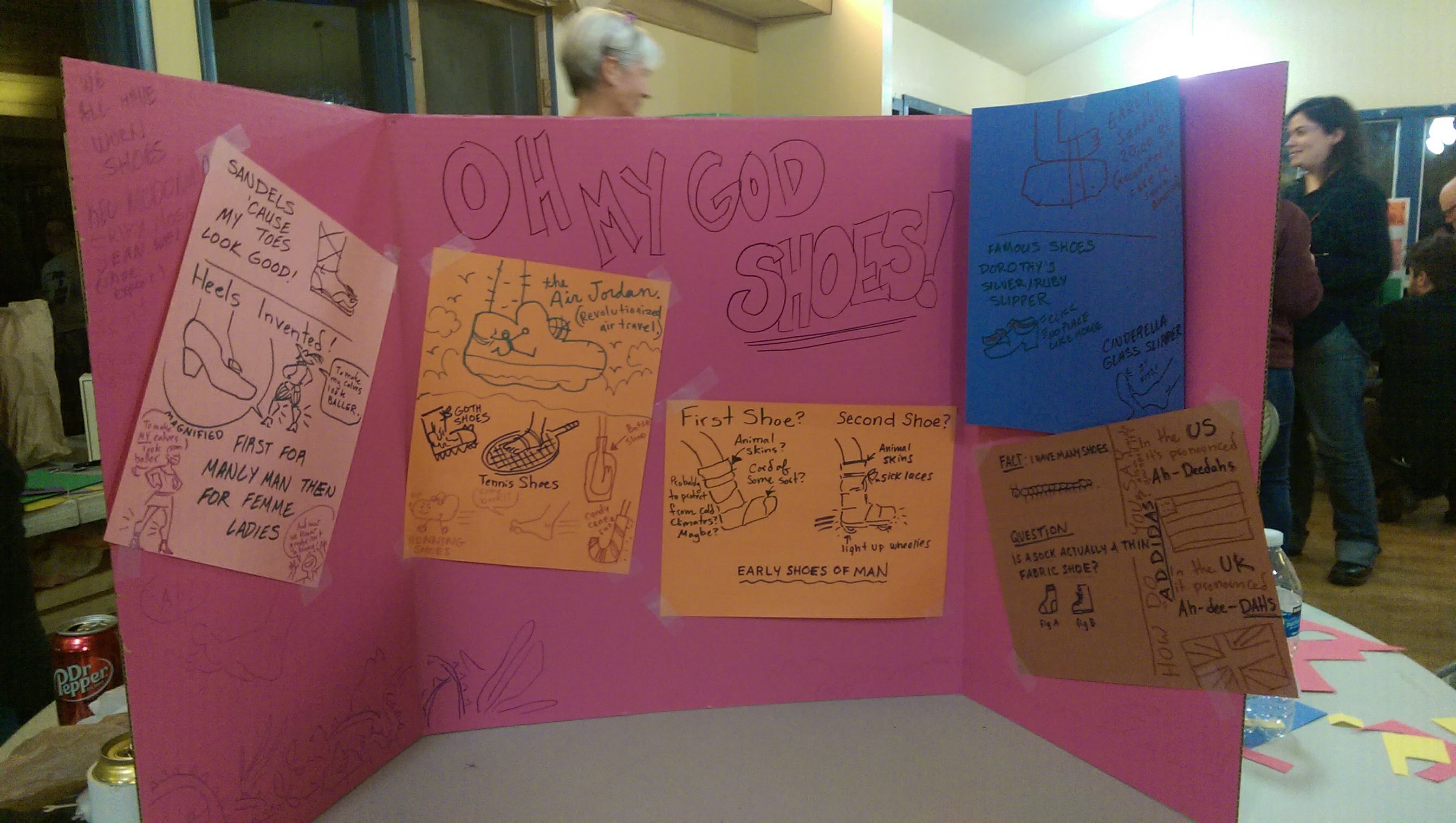
        Did you want to learn about shoes? Or perhaps the duct tape that might hold shoes together? How about berries, or the door that leads to the stairs that leads to underground. Sure some of those other projects might have had “better composition” or “prettier art” or “actual facts”, but did any of them have rats running around on a corpse in a murder hole that’s populated by godsdamned mole people? I think we all know which one was best.

        _______________
        ¹ Just a big ol’ pile of cardboard, with the actual for-sale snacks buried in a secret chamber far underneath; customers would be forced to plunder the sugary tomb.

        ² Hire these two to liven up any panel discussion. They play off each other beautifully.

        ³ Who managed approximately 1000 meals with a dozen different dietary restrictions and preferences, and the help of two or three civilians on any particular prep or cleanup; the woman is a marvel. And I would commit actual crimes to get pan full of the sticky buns she made for breakfast.

        Camp 2018, Part Two

        Friday is a busy day for comics types in Juneau; Pat Race, Aaron Suring, and the other Alaska Robotics folks have been in contact with schools across the region, and there will be fifty assemblies and class talks that take place today. Consensus best one: The Toronto Man-Mountain went to a junior high class that’s been intensively studying Shakespeare and his choose-your-own books are a hit. They got all the jokes and smutty bits Willy S hid in iambic pentameter!

        In the time before, after, and between their visits, a steady stream of creators passes between the lobby of the Juneau hotel where most are staying, and the aforementioned Rookery for coffee, tea, snacks, lunch, and good times. I was talking with Erika Moen¹ (force of nature and Beetmistress General) and Molly Ostertag (creator of my favorite book of 2017) in the lobby and we wandered into The Rookery for hot beverages.

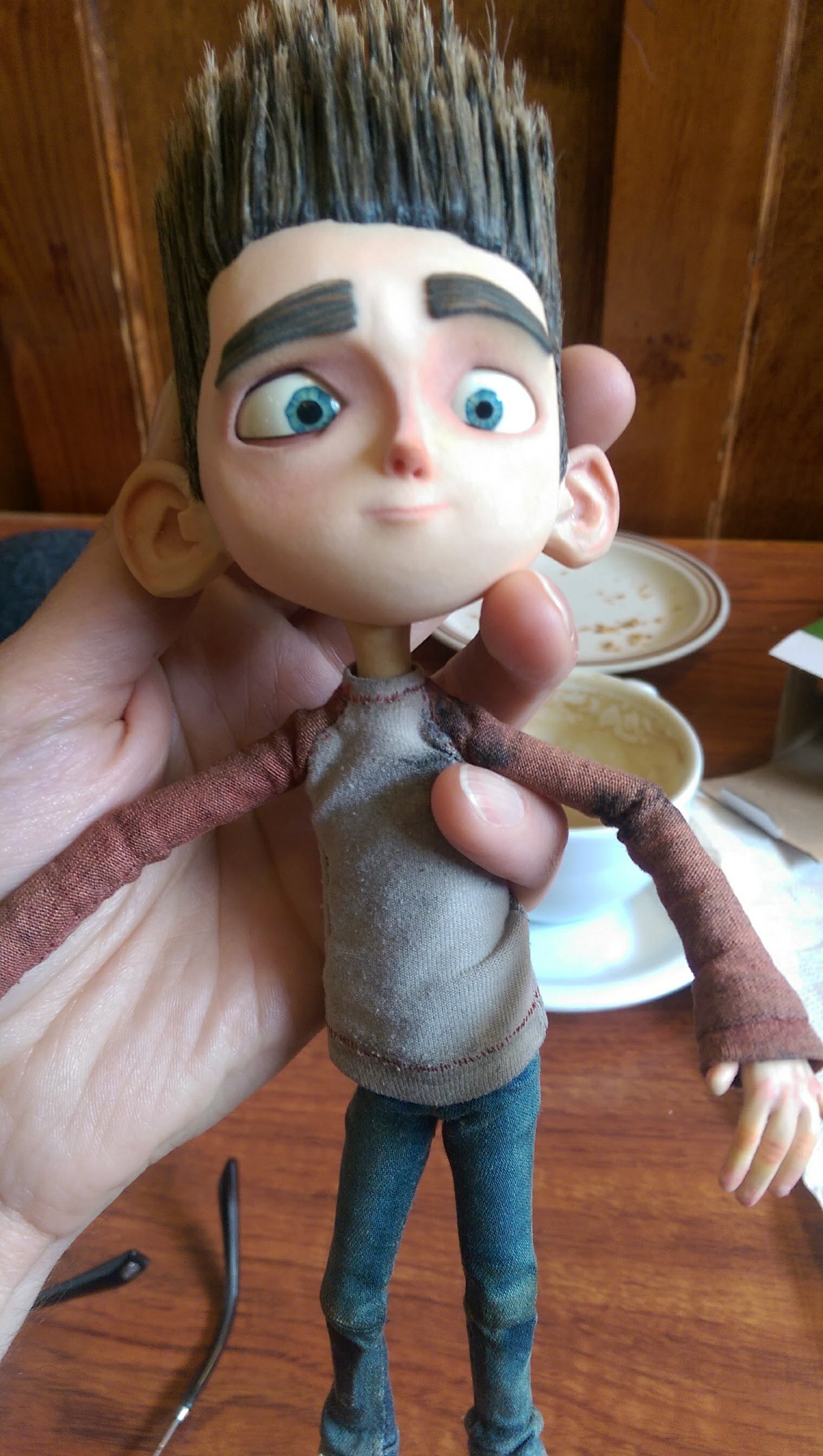
        This was where Georgina Hayns — late of Laika Studio, now taking time off before deciding on the next stage of her professional life — found us with a box that claimed to contain … I want to say a medium-sized florescent light fixture, but maybe it was a smallish set of blinds? Anyway, about the length of a box of aluminum foil, with a 50% larger cross section. Do you want to see ParaNorman? she asked, as if people say no.

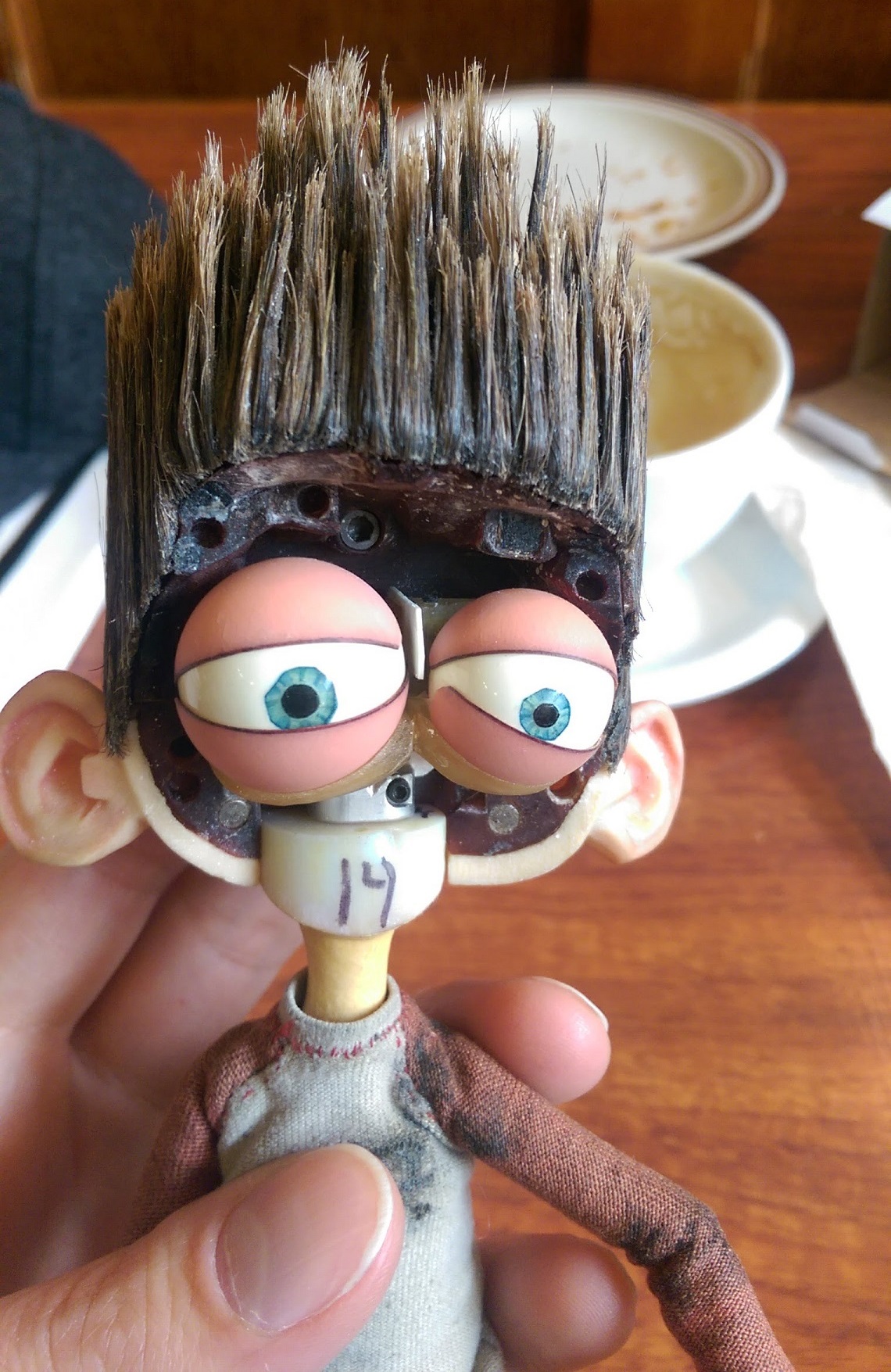
        This, she explained, was her own puppet (gifted to her by one of the animators), and she let us get our grubby hands all over it. Having had the opportunity to play with multiple puppets from Kubo And The Two Strings last year, I knew that Norman’s face would pop off and proceeded to do so immediately; it’s possible that Ostertag and Moen thought I’d just mutilated Hayns’s priceless possession, but any trepidation quickly gave way to fascination with the puppet.

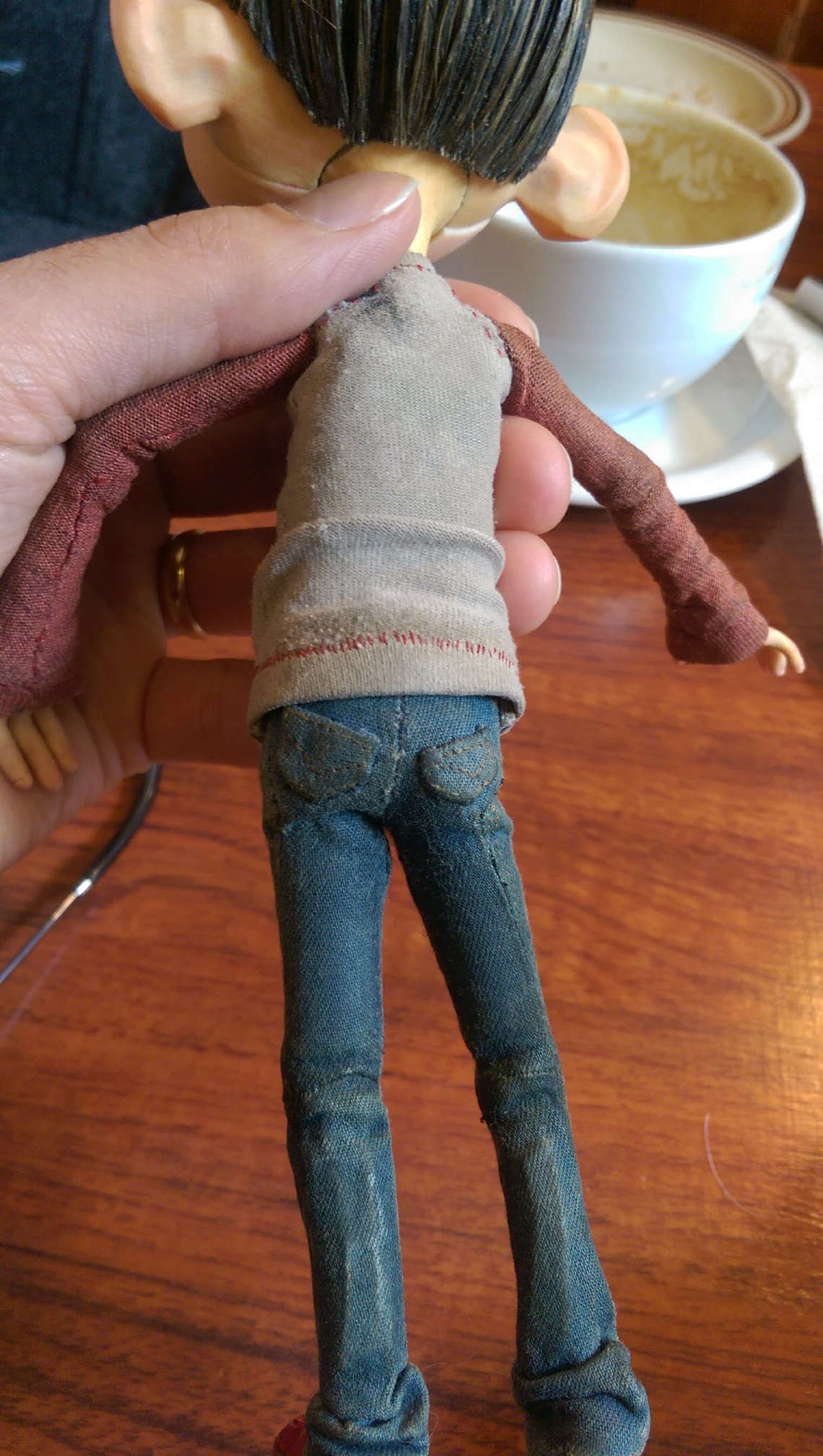
        Here’s the thing — the Laika animation puppets defy that simple word. They are perfectly designed objects that are both practical and aesthetic at the same time. There are few things that blend function and form so well, I told Hayns — the Zippo lighter, the Fender Strat, the Swiss Army Officer’s Knife — but ParaNorman (and Coraline, and Beetle, and Eggs, and all the other stars of Laika’s movies) falls squarely into the category. I appreciate the artistry, and the engineering in equal measure. Plus, check out the wardrobe. Somebody had to reproduce the scuffs and tears in Norman’s clothing across dozens of iterations of the puppet.

        Friday evening is given over to a public show at the Juneau Public Library; Seth Boyer, Marian Call, and Molly Lewis sing songs and play comics folks on with appropriate snippets (Raina Telgemeier enters to her name being sung to the tune of My Girl²; Molly Ostertag gets Concerning Hobbits from Howard Shore’s Lord Of The Rings soundtrack) as they each spend five minutes on something interesting. Raina does a reading from Smile, and Ryan North reads his recently-announced children’s book How To Be A T-Rex³.

        Ostertag talks about how to run a D&D game; Andy Runton shares an Owly short; Vera Brosgol shares the research that went into her stellar Be Prepared (a book she shared the beginning pages of here last year). Ben Hatke talked about why drawing Wolverine in nonstandard costumes (ex: Vampirella) and saying Bub is always funny; Jon Klassen did a reading accompanied by Boyer on guitar — Can you make it sound like Zorba The Greek? asked Klassen. As it turned out, Boyer could.

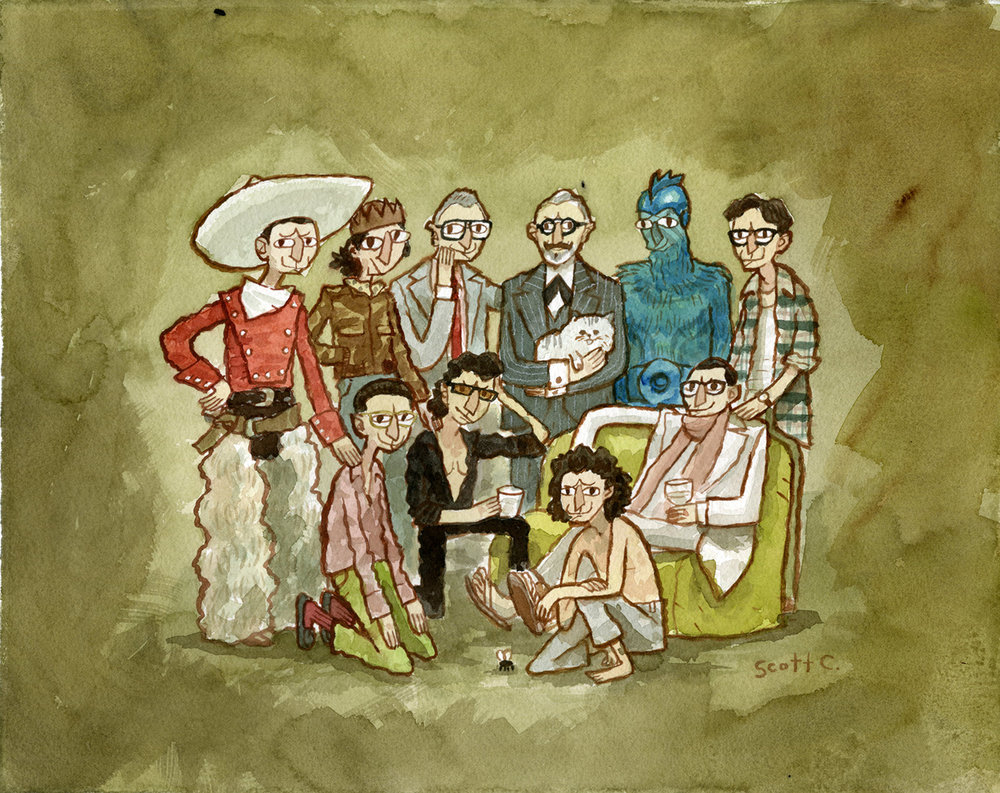
        Shing Yin Khor shared her love of roadside America’s greatest public art series, the giant fiberglass muffler man in all his infinite variations; Dylan Meconis shared a story-in-a-story from her forthcoming Queen Of The Sea, and C Spike Trotman talked about why everybody who thinks aliens built the pyramids of Egypt is an idiot who doesn’t know their history. Lucy Bellwood spoke about, oddly, not boats, but the process of creating 100 Demon Dialogues and the attendant little jerk; Scott C closed things out with a discussion of his past career and how one comes to do a painting of Jeff Goldblums or Carl Sagans or whatever strikes your fancy. How many Carl Sagans are there, you guys? Can science answer this for us? Maybe.

        There was an afterparty in a house designed for large groups of people to mix easily and comfortably; there was amazing ice cream (charred coconut and wild blueberry) and chili and cornbread and far too little sleep. The morning would require packing up, packing in, running a convention, packing out, and heading to Camp. Juneau was behind us, and a long road ahead.

        _______________

        Pictures:

          Not so many this time, since I was running A/V for the Library show. But you still get to see Norman, the incredible detail in his clothing, and what he looks like without a face.

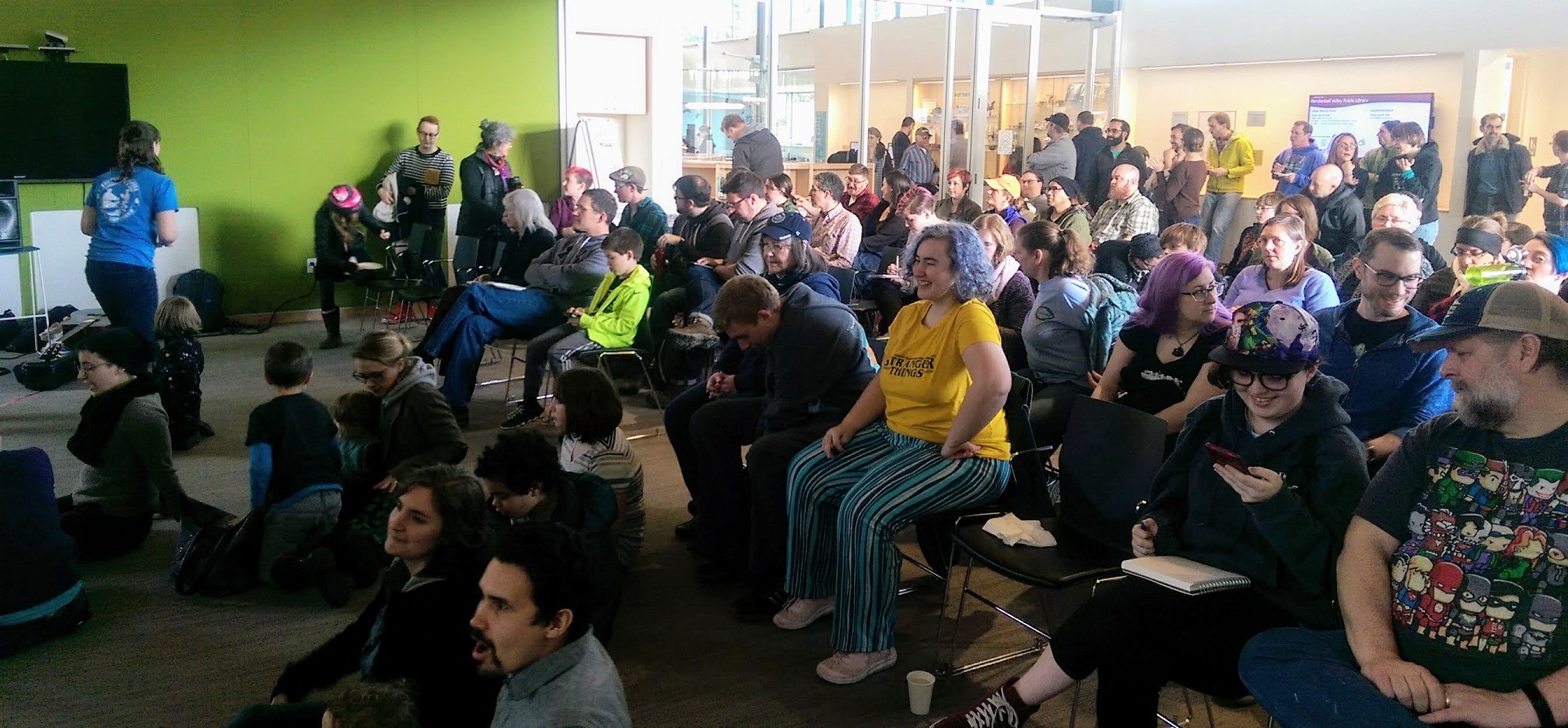
          Here’s a fun game: how many famous cartoonists can you find in this picture? For reference, that room at the Juneau Library was entirely set up, populated, entertained for two hours, and cleaned up again in about three and a half hours; much of that was down to the well-organized MCing of Pat Race, who kept things humming.

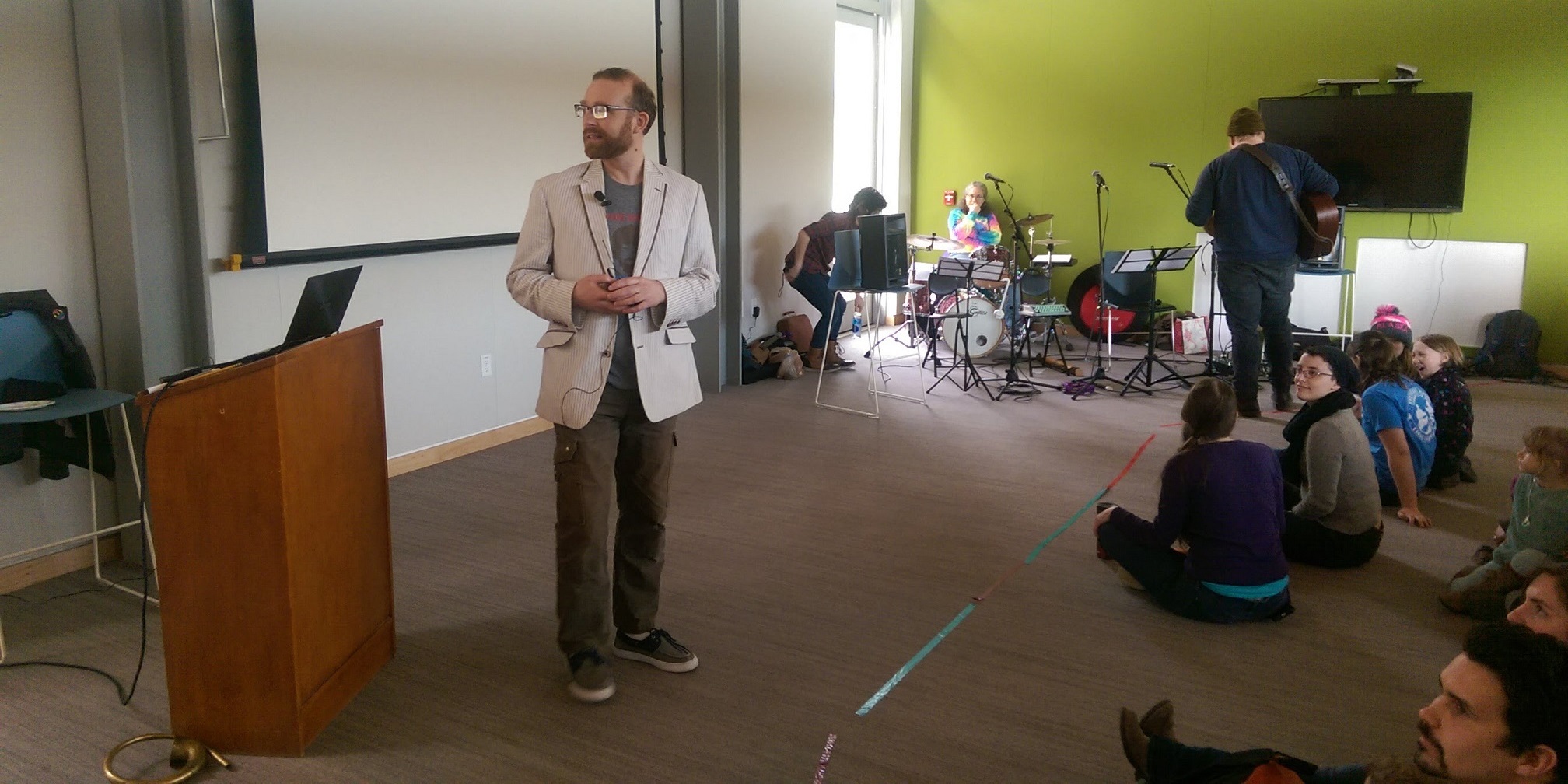
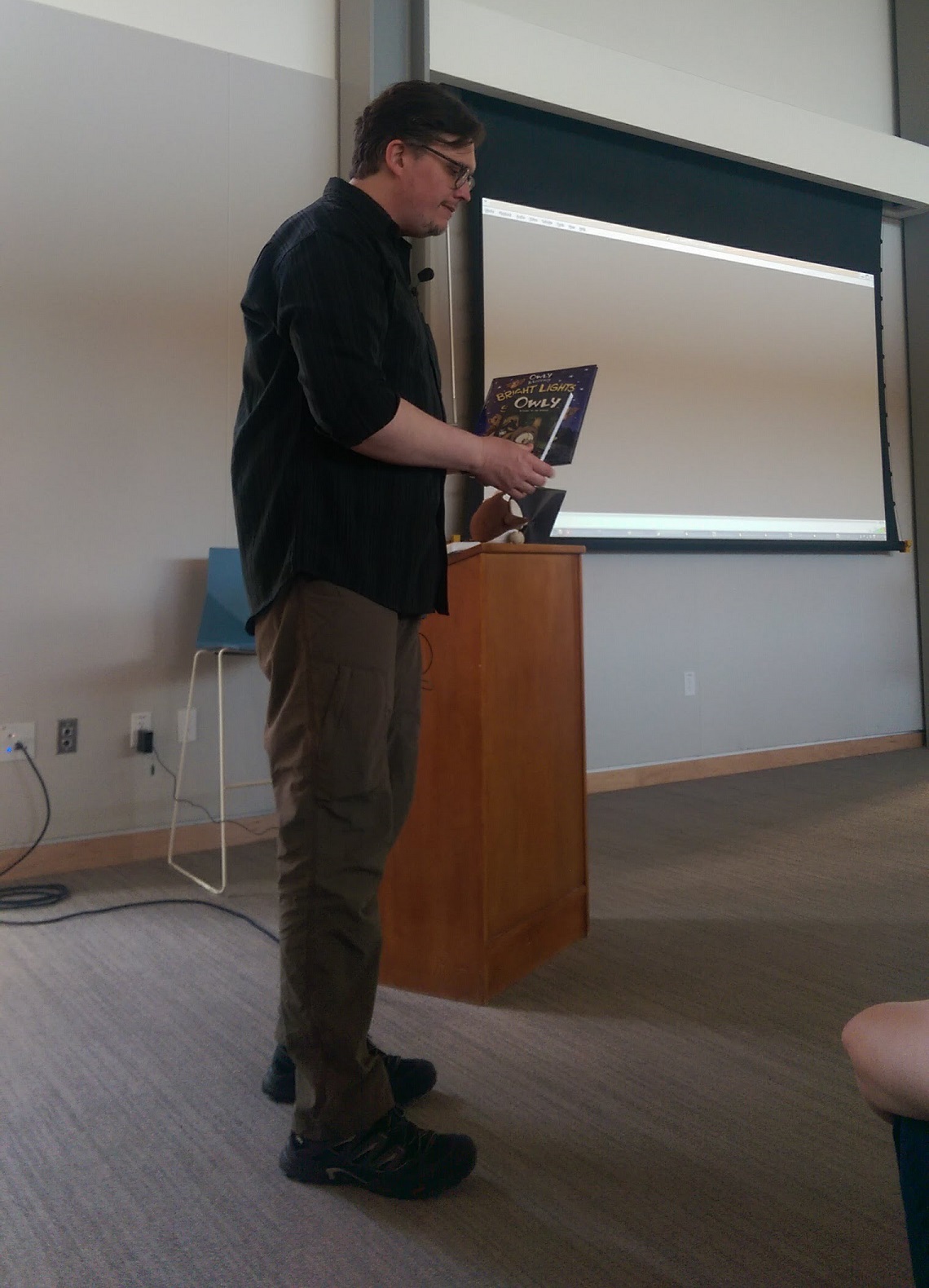
          Seth Boyer and Andy Runton were the only performer and presenter I managed to get pics of. Like I said, I was busy.

          _______________
          ¹ Who did not get murdered by a serial killer. It’s not my story to tell, but if you know her IRL, ask her.

          ² Taaalllkin’ ’bout Raaaainnnna, Raina!

          ³ Best part of this book? It’s got multiple places where whoever is reading (or reading along) gets to ROAR, which makes kids really happy.

          Camp 2018, Part One

          For anybody that’s read this page, you may recall that Comics Camp was a major formative experience for me in 2017; if you wish, you can read about 10,000 words on it here.

          The first I realized I was truly on the verge of Comics Camp this year was 26 April, early afternoon in Juneau; I was 13 hours and four time zones from when I started my day at Oh-Stupid-Thirty, and I stared out of my fourth floor hotel room and pretty much directly into what looks like the kitchen of a house not that far behind the hotel. Juneau is a very vertical city, populated at all times by ravens, at some times by wolves and/or bears, and pretty much nonstop by eagles if you’re near the dump. A raven alighted on the roof of the house whose kitchen I was staring into, nonplussed.

          _______________

          The thing about Alaska Robotics, the one-day con they put on, the myriad of school visits by creators they arrange¹, and the Camp associated with all of the previous, is that it’s run by the very best people, attended by even more of the very best people, in a location that is almost as far as it could be from my home. As I find myself past the half-century mark, the travel necessary to attend these marvels is taxing in ways it would not have been ten, or even five years ago. And as I find myself in an increasingly chaotic society, those rigors of travel become a price I am increasingly willing to pay.

          _______________

          Thursday is the travel day for most who are making their way to the Mini-Con/Camp², so the afternoon is largely open; I dropped by the Alaska Robotics Gallery (a comics/game store, with art supplies and magnificent works of local artists) to get my volunteer assignments for the Mini-Con, as well as my staff t-shirt. I also make arrangements for my assisting gig at the kick-off event of Comics Time in Juneau; the musical cohort of Camp — Marian Call, Seth Boyer, Molly Lewis — will be playing at local cafe The Rookery³ and there’s seating to arrange and a door to watch.

          The show is the latest iteration of Call’s Space Time series, which often involves writers, scientists, Flight Controllers and Directors … you get the idea. Tonight, it’s Three musicians and a series of comics artists that will be livedrawing along to the music. There’s a local poet, Catherine Hatch, talking about relationships and fighting and compromise If You Want Your Laundry Folded. There’s a reading from The Little Prince (the meeting with The Businessman); the tone slides from earnest to silly to contemplative and back.

          Lewis sang her ode to Juneau hirsuteness, The Year Of The Beard. Boyer brought the room to tears with the saddest, most melancholy song in English. Call shared the story of how her signature tune got turned upside down and backwards via a musicbox and a Moebius strip, and became a tribute to last year’s eclipse. Georgia Patton, Lee Post, Lucy Bellwood, Lucas Elliott, and Kerstin La Cross took inspiration from the songs and created Art.

          And through it all one thought resonated, but was finally brought to voice in the refrain of the second to last song of the show, which is also the last song of Call’s latest album:

          Beggar, Banker, King, and Pawn
          We’re only bones with stories on

          We are the sum of our stories, the ones we tell each other and the ones we tell ourselves. The storytellers were gathering, and Juneau was poised to listen.

          _______________

          Pictures:

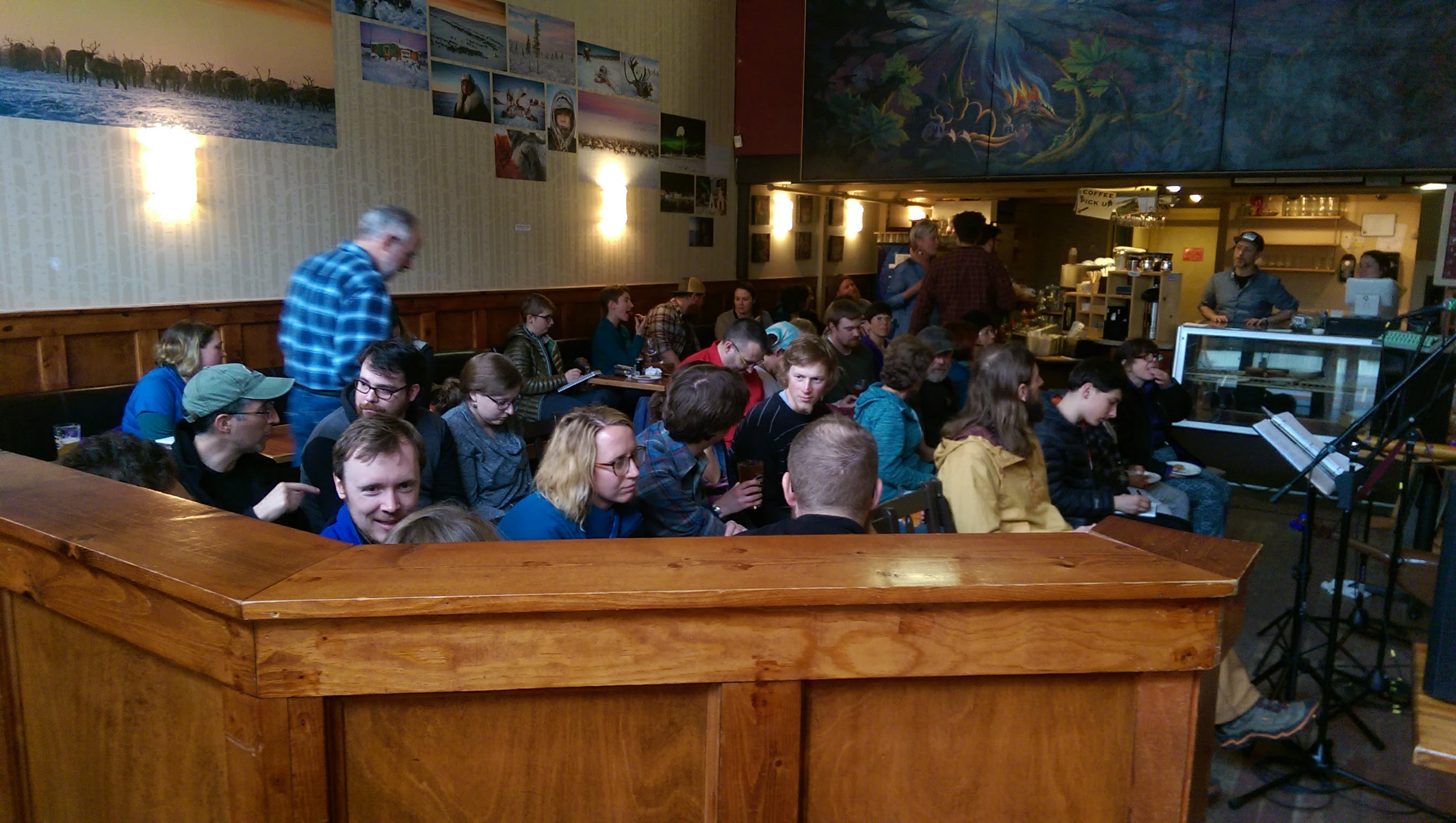
            The crowd gathers, and the performers perform. Pictures drawn to Good Morning, Moon, No Paper, The Year Of The Beard, Pantsuit Sasquatch, Frozen Man, the story of The Businessman, Good Night, Moon, I don’t recall which song, Mediocre Algorithmic First Date, The Avocado Song, don’t recall again but man, it’s pretty, All Star, Like This, Grandpa Had It Right, and Space Weird Thing.

            Music:


            Spam of the day:
            Sent away until Camp recaps are done.

            _______________
            ¹ More than 50 of them this year; last year, it was closer to 35.

            ² At least, those who are coming on the exhibitor side of things; attendees will be making their way to Juneau from across Alaska, but not until after work on Friday in many cases. Alaskans think nothing of hopping down to the local airport and flying for hours in this fashion; organizer Pat Race would recount stories of traveling a thousand miles or more in order for his high school soccer team to play in an away game. Things are just bigger up there.

            ³ Run by lovely people, and home to some of the most outrageous cookies known to humanity. Try the Chocolate Chip, Cornflake, and Marshmallow cookies.
            Busy Packing

            As I believe that I may have mentioned one or two times, tomorrow I awake Stupid-Thirty and make my way to Juneau for Alaska Robotics Mini Con and Comics Camp; as a result, I’ll be largely absent from The Interwebz for the best part of a week. So let this be your last bit of that Fleen-Flavored Goodness¹ for a while.

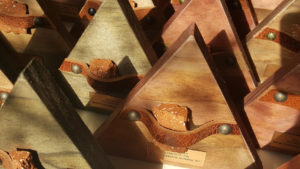
            • Speaking of Camp, I believe that Shing Yin Khor will be there, and I wanted to point you to something really cool she built recently. Some things, plural, to be accurate. See, when Taneka Stotts accepting the Ignatz Award for Outstanding Anthology for Elements (in her role as editor), she wanted a way to honor all of the contributors.

              Enter Khor, and a sledgehammer.

              She took the brick (the Ignatzen are actual bricks) and crunched it up into slivers, mounted them onto triangular wooden bases — the upright triangle is the alchemcial symbol for fire — and added little engraved nameplates. It’s as classy an acknowledgment of one’s collaborators as I can recall in comics, and I thought you should know about it.

            • Something else I think you should know: although large corporations stealing the art of independent artists persists at a shameless rate², there is an important new development. Susie Ghahremani called out a variety of related companies for stealing pin designs, and has scored an important precedent in what appears to be federal court:

              Basically, this says if you put your name and/or other identifying information on your work (as we did), and someone removes that (as they did), they broke the law. And if they put their own name or other branding on copies (they did), they broke the law AGAIN.

              The infringers were trying to argue that the art they stole was too simple and therefore not deserving of copyright. No, really. Of course, they don’t mind associating with simple designs as long as they get to make money from it, I guess? Anyway, the precedent is a powerful tool the next creator who wants to actually own what they created for themselves can use, and not a moment too soon.

              Because Old Navy has been caught stealing designs from Lili Chin and are actually having their lawyer try to get a judge to order Chin pay for the privilege of being sued because she called them out. But now there’s a precedent, and if Old Navy’s lawyers aren’t aware of it, they should read up quickly and re-evaluate their strategy.

              Now I don’t know which jurisdiction Old Navy is pulling their shenanigans in, but I’m guessing that since it’s a copyright matter, federal law pertains (but, obviously, I Am Not A Lawyer). Here’s hoping that since they’ve decided to be dicks about it, this precedent bites them in the ass and provides a significant deterrent for the next corporation that decides to be dicks. Hey corporations, want to get good designs from artists? Fucking well pay them.


            Spam of the day:

            Natalie wants to share her 21 private photos, Access NOW, nbwabi

            Huh, nbwabi appears to not be completely random, and previously appeared on page 4 of The Daily Times from New Brunswick, New Jersey, dated 13 May 1893. Weird.

            _______________
            ¹ I’d like to say that sounded better in my head, but it really didn’t. Let’s not do that again.

            ² And it seems to me, in a more aggressive form. Used to be a company caught art thieving would blame a junior designer or contractor and promise to never do it again, cross their heart. Now, they’re fighting in court to defend their right to violate copyright.

            The Weekend, And Hiatus Is In The Air

            This is the official notice that there will be only a few postings next week, and most likely none the week after; I’ll be going dark to accommodate my travel to beautiful Juneau, Alaska, for the Alaska Robotics Mini-Con (Saturday, 28 April) and the Comics Camp that follows immediately thereunto. A murdersworth of amazing creators will be there, and I’ll have all the news when I get back in early May; if you’re curious if you should attend Mini-Con and Camp some day, the answer is almost certainly yes; if you’re wondering what the experience is like, I happen to have 10,000 relevant words.

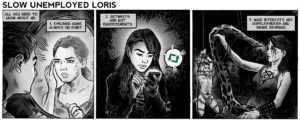
            • Update: John Keogh is providing us with new comics at a deliberate — some might say sensuous — pace. Enjoy numbers 34 and 35.
            • Magnolia Porter, as this page has noted more than once, tells good comic stories. Monster Pulse is the most visible, but she was responsible for a goodly chunk of some video games, which offers a very different set of story demands. And today comes word of another project that’s more different still.

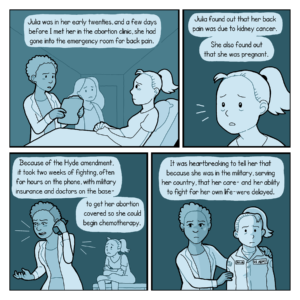
              Physicians for Reproductive Health have told the stories about people and their health care needs, and they’ve discovered that comics is an effective medium; they’ve partnered with Porter to produce a comics series titled This Is Life to accompany some of those stories. The first one concerns a young soldier who discovered her pregnancy the same time she was diagnosed with kidney cancer; the story is compelling enough, but distilling it down to four panels in Porter’s open, approachable style focuses the narrative even further.

              The compact nature of the story makes it easy to disperse via social media, and you can find this first installment on Twitter under the hashtag #ThisIsLife (which, quite frankly, is a bit crowded with messages; maybe search the hashtag specifically within the account?). These are going to be tough stories, and Porter is going to do them justice.


            Spam of the day:

            ALERT Bank Account Exceeded Login Attempts If This Was Not You Please Call Now, Your Information Maybe At Risk 1 855-261-6462

            Motherfucker, my bank account name bears no relation to anything that identifies me, the password is maximum length, it requires a physical 2FA token, and I’m posting your identity-thieving number here so that people can call you up and give you shit. Sod off.

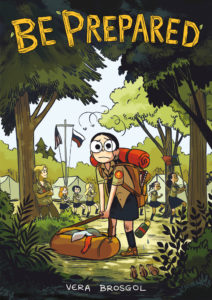
            Fleen Book Corner: Be Prepared

            The last time Vera Brosgol wrote a graphic novel, I had this to say:

            I could go on for another 1000 words and still not address these adequately, so let’s just finish up with the facts: Anya’s Ghost goes on sale on 7 June. It is 224 pages long, was written and drawn by Vera Brosgol, and is the best comics work of 2011.

            That was just about exactly seven years ago, and if there’s one thing you can say about Brosgol, she’s consistent. Her new autobio-graphic novel from :01 Books (who I thank for the review copy), Be Prepared, goes on sale 24 April. It is 256 pages long, and is the best comics work of 2018. I’ll qualify that with a so far this time, because quite frankly the graphic novel game has gotten so much stronger in the past seven years, and we’ve got books from top flight creators on the way. More about the book below, with spoilers aplenty.
            Vera just wants to fit in, like any other nine (almost ten!) year old girl, but she doesn’t. She’s too different, too poor, too Russian. The rules of fitting in are pretty clear (sleepover parties with Carvel ice cream cakes and stuffed-crust pizza), but the execution just isn’t quite there (cake from the Russian bakery, pizza with crusts tragically devoid of stuff) and so she sits on the periphery of grade school social circles, drawing and wondering where she’ll fit in. Most of all, all the other kids clear out for summer camp, leaving Vera and her brother Phil the only kids in town.

            Until she learned about a camp where she’d surely fit in — a camp for Russian expat kids and their kids, a camp that understands the mysteries of Slavic language (they keep chiding her to not use English), a camp that knows about the Orthodox ritual, a camp full of kids just like her.

            Except even when you’re with the kids you’re just like, snotty teenage girls are still snotty, open-air latrines full of spiders are still disgusting, and boys — from eight to eighteen — are still infuriatingly immature and gross. It’s going to be a long two weeks.

            Did I say two? On the day that she’s supposed to come home, Mom has news: she’s got an important job interview, and if Vera and Phil can hang in there another two weeks, it could mean a job that she’s been working towards ever since they came to America; the sort that could keep them from being too poor (but Vera knows she’ll still be too different and too Russian). It’s a huge sacrifice for a nine year old, staying where the other kids hate you and the counselors don’t understand and you have to poop in a hole.

            It’s even more painful when she realizes that in some ways, she’s been picking up the mean girl lessons too well; Vera catches herself in some incidences of casual cruelty, shocked at herself. It’s cringey and painful in exactly the right way, like all realizations that make us better people. It accompanies the occasion of making a friend, of rising above the disdain of snotty teen girls, and finding a way to get back at the boys¹. The remainder of camp gets lighter (even if you have to poop in a hole), and the prospect of returning the next year becomes less horrifying — but still not as appealing as the idea of a hike around the park at home, where they have toilets.

            I’m certain that when the book launches next week (and sees its premiere at the Alaska Robotics Mini-Con in Juneau, next Saturday), Brosgol will have plenty to talk to kids about. The experiences she writes about are so true, so universal (and so, so funny) that they’re going to declare her a kindred soul. Every kid that finds themselves on the outs, awkward, unsure, hiding behind their glasses, will find themselves in this book, and find a bit of hopefulness for the future.

            Because by the end of the book, she’s getting the hang of it just a bit. Maybe her first friend is at Russian camp and lives far away, but she’s a friend. And if she can figure out how to navigate mean girls at Russian camp, she can figure out how to do it back in Albany! She’s finally — finally — starting to feel at home in America, if not yet American.

            But to be Russian is to suffer, and there’s one more upheaval in store as the book winds down; Vera didn’t fit in in the upstate suburbs, she didn’t fit in at Russian camp, and now she’ll have the opportunity to reset and not fit in someplace completely new. There’s a natural hook for a sequel in the closing pages, and I just hope it doesn’t take seven years for it to come to fruition.

            But if it does? I’ll have a spot on the bookshelves waiting for it — like young Vera, I have learned to Be Prepared.

            Be Prepared goes on sale Tuesday, 24 April, at bookstores everywhere.


            Spam of the day:

            Some things are better left to the professionals

            I was afraid to see what kind of pornspam this was, and relieved to see it’s actually for Terminix pest control.

            _______________
            ¹ Which required the development of sweet ninja skills. Nine year old (almost ten!) Vera is so cool.

            In Your Copious Free Time

            John Keogh has been one of the most detailed (and simultaneously disturbing) webcomickers ever since the days of Lucid TV (which now exists only in the memories of those that followed the adventures in Jim Belushi Memorial Hospital). Every once in a while he pops up with an insanely detailed poster or album cover or tranche of comics. There is little warning when this happens; he just says Comics and there they are.


            Spam of the day:

            Factor clearly utilized..

            What kind of factor? What kind of utilization?
            Ohhhhh, boner pills. Gotcha.

            _______________
            ¹ With bonus points for the New Yorker universal caption.

            ² With callback to Orange Julius Secret Menu Password = “Fucked Up Julius” Orange Julius Double Secret Menu Password = “Dark Julius … Strange, Painful Julius”.

            ³ Heh, “bone”.

            Hey. You. You’re Doing Okay.
            Today’s post is brought to you by the idea that it’s gonna be okay. There is so much hate and stupidity in the world, but on Saturday I met a six week old kid that was absolutely adorable while I was riding in an elevator and he doesn’t know that there is all that hate and stupidity. With luck, we’ll make it a good deal less so by the time he can tell the difference.

            • On the list of difference makers: George Rohac, or as he is known in these parts, George. Not many people get to be mononymic — your Madonnas, your Barbras, your Beyoncés — and here at Fleen only two people have earned that status¹, and only one of them could post a tweet to a survey that asked for my real name, address, birthday, and a whole squatload more info, and I’d fill it out.

              It’s part brand research, part effort to understand people better, part feedback on how he (that would be George) can be a better person. It caused a lot of thinking on my part, and I don’t doubt it will do the same for you. Give George some info, you know he’ll do something amazing with it. It’s the least you can do — it’s his birthday².

            • One of the most important things that George ever did, bee-tee-dubs, was share a video about his challenges with mental illness; it’s not available any longer, but you can read what I wrote about it at the time. It was a hell of a lot less common, five-plus years ago, to make these kinds of public declarations. It let a lot of people know that they aren’t alone; this message is particularly important in the creative community, which seems to have more than its share of people shouting down the lies that their brains tell them.

              Every share of this nature — and here’s the latest I’ve seen — increases the chances that somebody else gets the help they need³. Help can mean a lot of things, and the webcomics community does an inordinate job of helping the creators they follow. Whether it’s sticking with creators during involuntary hiatuses, or readers coming together to increase support so that creators can take care of their families, I think there’s another benefit at play.

              For each person that we know (or “know”, in the sense that we know their work) and help, the thought pattern grows — why just these people? Why not everybody? It’s making the selfish and exploitative stand out as outliers as we do what we can. It’s a hopeful thing, to think we can turn that desire to help into permanent, structural mechanisms that will keep health crises from bankrupting entire families. I’m usually far more cynical than this, so enjoy it while it lasts.

            • And in case you’re worried about what your future brings, young people, Matt Boyd and Ian McConville have a thought for you today. And if it’s still a dread day for you, consider: after doing far better in his surgery last November than expected, Jon Rosenberg’s son Alec was told he didn’t need followup surgery the day before his birthday no less, and his dad is able to get comickin’ again. New SFAM, folks, with Jon at his Jonnest. If his curmudgeonly ways don’t make you smile today, wait until the next strip. He’ll definitely get you then.

            Spam of the day:

            My Name is Mr.Thomas Phaahla and I am writing to Introduce you and your Company to the Asia Pacific Investment Pte Ltd.(APIP) Debt/Loan Funding Platform.

            Dude, you managed to spell your purported name three different ways. Try harder.

            _______________
            ¹ After first reference so that any newbies have context. The other is Raina Telgemeier

            ² Just in case you were worried, George is the person least likely to demand a birthday present that turns him into a twisted shell of himself, warped by greed and evil, and tied up in the doom of the world. Second least likely would be, I dunno, Mr Rogers or Dolly Parton.

            ³ Not to mention the very key effect of normalizing treatment. As a tweet I saw over the weekend said, If you don’t have enough artisinal, handmade neurotransmitters, store-bought is fine.