The webcomics blog about webcomics

Now This Is Some Bullshit

This, in this particular circumstance, being a clearly full of crap website that’s selling simply dozens — dozens, I tell you! — of stolen TopatoCo t-shirts every day. A full of crap website that’s stolen not only the designs (which are sarcastic air quotes submitted to us by independent designers close sarcastic air quotes) but even the SKUs. They may or may not be associated with another full of crap website that appears to lay off the stolen webcomics designs but has lots of other stuff stolen too, like traditional Haida designs that non-Haida people don’t get to use or sell. And the most hilarious part? Their shitty knockoffs (if in fact they actually produce and send anything) are priced above the genuine articles.

Normally, I’d tell you to politely contact the full of crap website to very politely ask them what the fuck, but a) they’ve done their best to hide who they actually are (although it appears the possibly-associated second crappy website keeps an address in Delaware that coincidentally houses a consultancy that provides a incorporation services and possibly a mail drop), and b) Jeff Rowland is already on it, and c) they may have roused the wrath of R Stevens III, in which case I doubt you’ll even find DNA when he’s done with his vengeance.

So instead, how about we look at some shirts that are both official and original?


Spam of the day:

Big Ass-Photos – Free Huge Butt Porn, Big Booty Pics

Holy crap, this spam has adopted the [adjective] ass [noun] rule from xkcd #37.

_______________
¹ Unfortunately, the website doesn’t link the exhibitors to the floor map, and those that qualify as publishers (around the perimeter of the main floor) appear not to be listed on the site at present. But there will be several creators associated with George Rohac’s Creative Havoc, and given the likes of Iron Circus and Hiveworks are listed as Sponsors, I’d presume they have a presence as well.

Fortunately, the scale of the show is such that you probably won’t miss out on anybody, even if you didn’t specifically know they were going to be there. If the exhibitor info updates before the show, we’ll add to our listings here.

And On The Twelfth Day, They Rose From The Dead

I speak, naturally, of The Nib, which resumed updates today as an independent site wholly under Matt Bors’s control. On the one hand, hooray, complete editorial freedom and no wondering when a billionaire or startup or corporation is going to yank funding and all your work comes to an abrupt end. On the other hand, the need for subscriptions remains high so that Bors can continue to do what he’s always done and pay cartoonists; he’s doing all of that completely solo, too, having had to lay off his editorial staff¹.

But they’re back, with three cartoons, from Ward Sutton, Joey Alison Sayers, and Bors himself, about which a few things should be said.

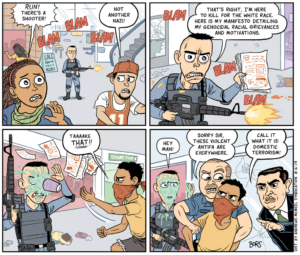
Firstly, in the twelve days of hiatus, there are have been multiple mass shootings and follow-on wannabes. White supremacy and deeply-ingrained misogyny are, unsurprisingly, at the core of the respective shooters (and wannabes) motivations. Thus, Sutton and Bors address that particular elephant² in the room.

Secondly, you may note that Bors’s contribution carries a date of 6 August. It was originally offered up via his syndication deal with Andrews McMeel, but something interesting happened along the way. Bors shared that cartoon (as is his wont) on Instagram, where it was taken down for promoting violence and dangerous organizations. Two days later (after a Rolling Stone story), Zuck came to his senses, but seriously: what the fuck?

It’s all of a piece with social media companies allowing themselves to be gamed by bad-faith complaints and being totally unwilling to fix their shit³. Just today, occasional Nib contributor Eli Valley has been through the Twitter wringer, as actual fucking Nazis mass-reported old tweets for being antisemtic and he was suspended as a result. Not to be outdone in the stupidity department, when Valley set up an alternate account to report on his suspension, it was suspended because he was impersonating himself. As of now, his original account seems to be restored, where you may discover that while the mass-reporting by Nazi CHUDs was going on? Valley was under arrest for participating in the Jewish protests against Amazon’s collaboration with ICE.

The ability to stay out from under the control of capricious money-suppliers (not to mention uncontrolled social media weaponization) is a powerful motivation for Bors to keep The Nib independent. If you came to him with a few million and said Here’s enough money to run all the cartoons you want in a week and hire back all the staff you want, I think he’d hesitate, or ask to see the money in an escrow account. The risk of being at the mercy of somebody else’s pursestrings and/or policies is just too great. It’s just much safer to have a few thousand (preferably, a few ten thousand) subscribers each contributing a small amount; it’s so much harder for thousands of people to fire you than one person (or one crap algorithm).

But all the same, welcome back, Nibsters. I’m thrilled to see the variety of takes and viewpoints, and hope we’ll be back to the full volume of cartoons we had until so very recently. And if you’ve ever browsed past there because of something I wrote, give ’em some love. Support starts at two lousy bucks a month, and only four bucks a month gets you the best quarterly magazine of comics in print. Do it to get the best comics, do it to support your favorite creators, do it to piss off a billionaire, just do it.


Spam of the day:

New York Comic Con Exclusives

I’m not going to shame the company that sent me this, because it’s not their fault that they’re sending this to what they believe is a potentially interested member of the press. See, it’s been years since NYCC let me in as a member of the press because I don’t cover the stuff they want covered, but they still send out my email on their press contact list. Dick move, NYCC.

_______________
¹ Running the entire shebang himself means that some things are a lower priority than others; as of this writing, the About page still list The Nib as part of First Look Media and the editors as employed.

² With, no doubt, an elephant-sized MAGA hat.

³ Stage one of the shit-fixing: ban the fucking Nazis.

Quick Note

Got some things that will likely keep me busy and away from internet tomorrow, so maybe no post? We’ll see. If not, enjoy the early start to the weekend, folks.

Evan¹ Better Than We’d Suspected

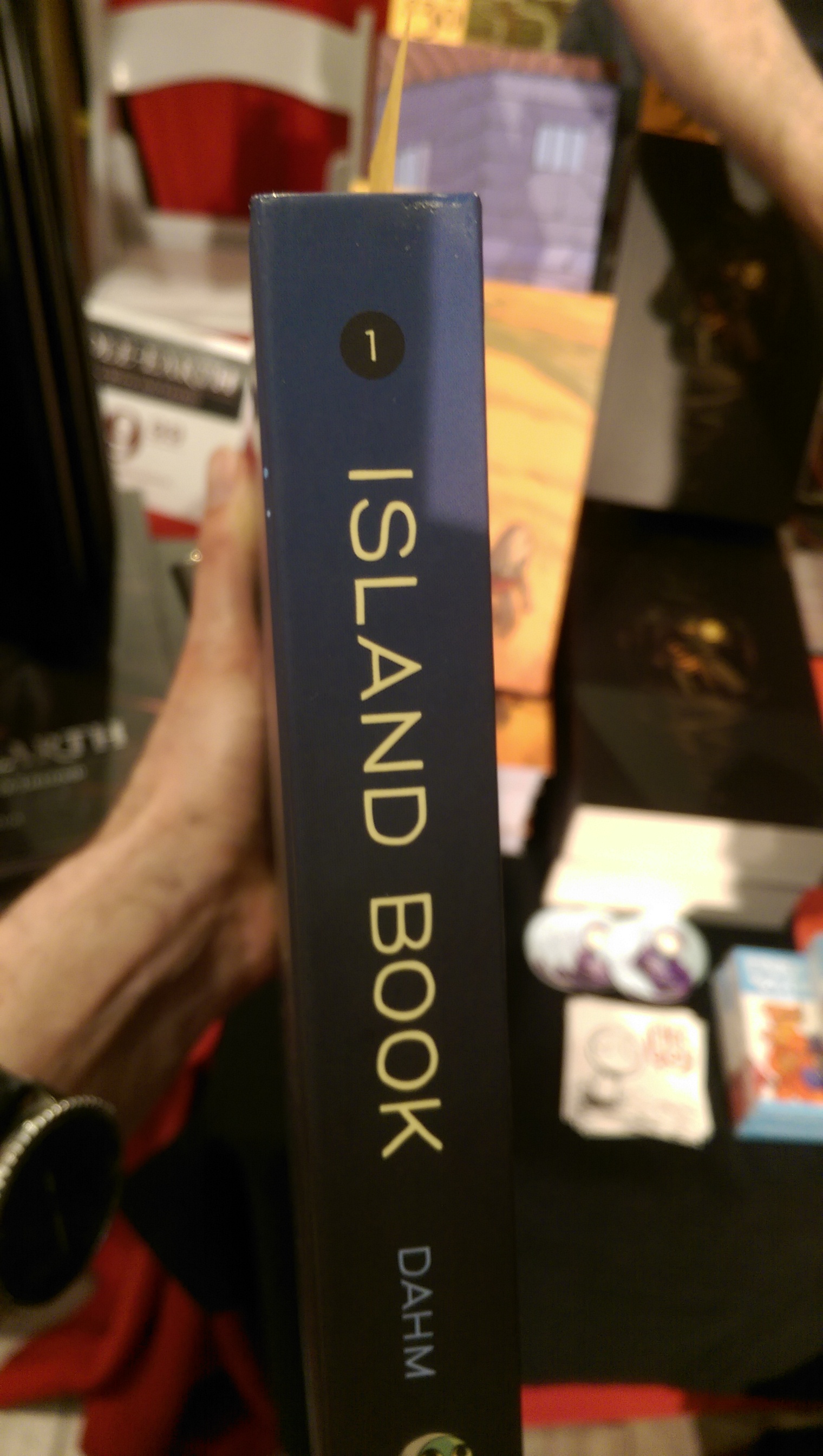
We at Fleen have more than once remarked that Island Book by Evan Dahm has a numeral 1 on the spine, tantalizing us with the prospects of further adventures with Sola. At MoCCA this year Dahm was careful with his choice of words, never confirming to me that there would be more to the story, but never outright denying it either. He may as well have adopted Beatrice’s protest: but believe me not; and yet I lie not; I confess nothing, nor I deny nothing.

But wonder no more, for Dahm has made it clear today: there will be a sequel to Island Book, and a third volume as well:

This interview is also maybe the first overt Announcement that there will be TWO SEQUELS TO ISLAND BOOK

The interview mentioned is at The Comics Journal, with the always-erudite Sloan Leong. There’s very few people that think about the act and meaning of creation, and the context of story within the entire artistic tradition as Dahm, and he’s given a lot of room to talk about his intentions in the interview. There’s a lot of creators that make deeply philosophical comics, and of course there’s a McCloudian philosophy of comics, but I think that Dahm is the the closest thing we have to an actual philosopher working out a system of the world via comics.

More about the Island Book sequels is at Dahm’s Tumblr:

Two sequels to Island Book are in production with First Second Books. These sequels build a cohesive trilogy out of Island Book, and expand the fable storytelling of the first book into an enormous, harrowing adventure story with a focus on authoritarianism, looming apocalypse, and queer identity.

Of all of those themes, I would have only said apocalypse was a likely story arc based on reading only the first volume; I would have described the cultures of the islands we’ve seen so far in terms of small-minded prejudice (in once case, something akin to toxic masculinity), but a critique of authoritarianism? Queer identity? I can’t wait to see how those fit into what we’ve seen so far, if only because the big-publisher process of editing² is going to make Dahm refine his message to the point where it’s super effective. The kids that read Island Book don’t know how many big ideas he’s going to hit them with in 2021 and 2022.

Me? I just want to know who that guy on the left is. We saw one of Sola’s fellow islanders was be-stached in passing, but didn’t get any of his deal in volume one. Is this the same character? He looks important, or maybe thinks the sword and epaulets make him important. I want to know his deal, just because he looks so different from what we’ve seen so far. But that’s kind of Dahm’s whole approach — That character right there, we’ve never seen their like, what’s their deal? — and it always pays off.


Spam of the day:

Our International company consists of about 65 Internet projects related to crypto currencies and ICO. Now we recruit staff from around the world. Best regards, Evan Ferguson, HR Dept.

The thought of a crypto farm having an HR department absolutely tickles me.

_______________
¹ I see what I did there.

² Longtime readers may recall that Mark Siegel at :01 Books (who I believe has been working with Dahm) has described his editing process before. It’s pretty much the opposite of how Dahm freeforms his self-published work. I’m not going to say it’s something he’s in need of, but I will say that it likely makes his work far more likely to succeed in a kids demographic than he could have accomplished on his own.

Kickstarters Come And Go

As Jon and Amy Rosenberg’s Kickstarter From A Multiverse successfully concludes at the high end of the expected range (the FFF mk2 had the midpoint of the range right about at the goal), and C Spike Trotman launches her … I want to say 22nd? … campaign for her latest anthology.

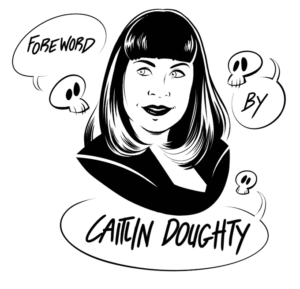
You Died is an anthology of what happens to us after death, and for my money the big news is not the participation of Raina Telegemeier (contributing to a story called A Funeral In Foam) or Caitlin Doughty (and could there be a better choice for the foreword than America’s favorite mortician and scholar of death?), but the price point.

In typical Spike fashion, it’s a simple campaign: the two tiers allow you to get a PDF only, or a PDF and print copy (an early bird tier offered free domestic shipping and cheap international shipping, but is otherwise just the print tier); the one stretch goal (a cover enhancement) kicks in at US$5K over goal (which is the same level that the Iron Circus creator page bonus starts at). Two weeks for the campaign and if I know Spike, the art’s in and the production’s ready to begin the day the payment clears. All of this is bog-standard operating procedure.

But that one tier (okay, and the early bird) that gets you a physical book? It’s ten bucks less than Spike’s ever done before:

A thing I’m compelled to point out: As YOU DIED ((link: https://www.kickstarter.com/projects/ironspike/you-died-an-anthology-of-the-afterlife?ref=djikjm) kickstarter.com/projects/irons…) demonstrates, black-&-white Iron Circus anthologies will now be $20 a pop. This is a 33% price reduction.

The reasons for this: Printing larger runs, distro sales on the back-end, and the Hesitation Point.

No, I don’t mean the vista in the Brown County State Park in Indiana (although it IS lovely). I mean the price point at which potential buyers unfamiliar with ICC’s output will no longer outright reject a book before consideration.

$30 was fine when we were a small press that primarily self-distributed, or sold online and at cons. But now, The books have EXTENSIVE lives after the Kickstarter and con season.

Like… I essentially sold 4 figures (unit count, not dollar amount) in one day, last week.

When you’re moving volume, you print in bigger runs. And when you print bigger runs, the per-unit cost craters. Which is why a mid-range publisher can print, say, 10k units and charge $10 each, but a boutique pub maybe puts out runs of 1500-2000, and the same book would be $20.

All the feedback I get from the distro I work with (and sometimes from the folks I have at the ICC booth at shows) is $30 was too much for a book someone was wishy-washy on getting. I wanna convert the wishy-washy folks into customers. That’s what price cuts do.

And goofy as it sounds, the psychological angle is advantageous, as well. Take the price down ten bucks, and suddenly it’s only one bill out of someone’s wallet instead of two.

Weird? Yeah. But Totally A Thing Regardless? Absolutely.

All those scales and side-effects from distribution will make one other thing noticeably different about You Died vs all previous Iron Circus anthologies: delivery isn’t scheduled until September 2020. When you work at distribution scale, you have to give plenty of notice about your offerings. If Spike turned this book around in six to nine months like previous offerings, a fair number of clients might not be able to take it because they’ve already planned their budgets and spending around books that were announced a year ago.

And if they could place an order that quickly but something (cough, cough, trade war, cough) were to delay the books a week or two past the promised date? Promotions budgets, space on bookshelves, even warehouse stock space would be disrupted. And those buyers that got burned would think twice about ever taking another Iron Circus title.

Spike’s in a whole different world now, and I’m pleasantly surprised to see how well she’s done so far. The number of people that can take a company from one-person garage startup to part of a global supply chain with dozens of inputs and thousands of outputs and not screw the pooch is vanishingly small. Those are completely different skillsets, and the managerial mindset necessary for the post-transition business (especially the importance of delegation) is about 173° out of phase with the fast hustle that’s needed pre-transition.

It’s part of why so many start-ups (not to mention mega-huge Kickstarts that keep growing in complexity) crash and burn — the kind of person that can run the one-person endeavour is usually not only really bad at management, they usually are even worse at recognizing the things that they can’t do (or at least, need to do differently). So sincere kudos to Spike for beating the odds in yet another way; it’ll give her detractors one more thing to cry into their Cheerios over.


Spam of the day:

GET YOUR DONALD J TRUMP COMMEMORATIVE COIN TODAY! Best wishes, Your patriotic friends at Ape Survival

So that’s an Australian prepper supply site getting badly misreading my interests in commemorating anything about Donald Trump other than the monumental crap I’m going to take on his grave someday.

Never Seen This Happen On Release Day Before

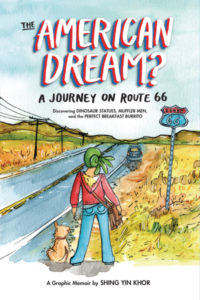
So the plan was to pick up a copy of Shing Yin Khor’s The American Dream? A Journey On Route 66 Discovering Dinosaur Statues, Muffler Men, And The Perfect Breakfast Burrito and read it. Khor’s work, as has been discussed on this page, is powerfully personal; their watercolors are capable of the most delicate filigree and the angriest rage, often simultaneously, and perfectly suit their stories. Plus, this one has at least four of their obsessions in it — dinosaur statues, muffler men, road trips, and a small adventure dog named Bug; it’s been my most-anticipated book of summer.

But it wasn’t in stock at the local bookstore. It wasn’t in stock at any store I could find in the state of New Jersey via Indiebound¹, not in stock at Powell’s, or The Strand, or even Barnes & Noble. At the time I checked, Amazon (who I will not buy anything from as long as an alternative exists) had eleven copies in stock. Eleven. As in, ten plus one, nationwide, on day of release. And none of those we-don’t-have-it-in-stock places would take an order because they couldn’t tell when the backorders would fill.

I mean, I suppose I could have gotten a copy of the e-book, but I believe I’ve made my feelings known on licensed media.

Somewhere between the publisher (Lerner) and the distributor (there’s basically one left, Ingram²), there’s just no copies that have made it to the retail end point — and based on a conversation I had with the publisher’s sales division, it’s probably the distribution end that is slow this time. See, I placed an order with Lerner’s online store (which is really skewed towards schools and libraries from the look of it³) and then called to find out what the ship time would be (answer: probably about ten days, arrgh) and the very pleasant gentleman I spoke to told me we’ve got about 4000 copies in the warehouse, and it’s not like they held onto every copy for themselves.

So as of this writing, if you want to get a copy of TAD?AJOR66DDSMMATPBB, your choice for copies-on-hand are Lerner, maybe Target (if you’re interested in the library binding), or people on Ebay and Amazon’s Marketplace that claim to have single copies (possibly advance review copies) at inflated prices. Oh, and if you’re not opposed to Amazon? Too late. In the time since I started typing, they’re down to nine (9) copies in stock, and by the time you read this they’ll be out. Okay, okay, they’ve probably got the library binding edition. It’s still Amazon.

On the one hand, this is great — people want to read Khor’s work, and when the backlog in the pipeline finally eases, that demand will hopefully be promptly met. On the other hand, my bookselling experience (high school, plus summer breaks through college and grad school) tells me that when a book isn’t available when people want it — and these days, especially for online order — they tend to forget about it. With any luck, readers who are just now learning about Khor’s work will have the patience to make it through this rather distressing hiccup and be amply rewarded when the book comes out.

In the meantime, here’s a couple of teaser pages, and here’s an interview with Khor at The Beat, and you can buy a bunch of Khor’s minicomics here. With any luck, when their next graphic novel releases next year (date TBD), it’ll fare better on the logistics end.

PS: Five copies at Amazon, which is now listing it as #1 New Release in Teen & Young Adult Cultural Heritage Biographies.


Spam of the day:

Make money with your woodworking skills!

There was really no choice which spam to feature today, when I was talking about the Sawdust Bear. My woodworking skills are, by comparison, somewhere between nonexistent and pathetic.

_______________
¹ Except — maybe — a Hudson’s newsstand in Newark International Airport, terminal C.

² The comic shop industry could probably have warned the book publishing industry about what having only one distributor means.

³ And which required I open an account to make a purchase which I hate, but not as much as I hate buying from Amazon.

Sorry For The Missed Update

Spent most of the day in the ED for a medical thing that is now hopefully resolved. Everybody’s good, but it took priority. I know you understand.

What You Need On A Friday

Recently, Rosemary Mosco — science communicator extraordinaire and all forms of nature but especially birds afficianado — ran a comic (seen above) about birds whose common names suffer from Tony Danza syndrome¹. The Mo[u]rning Dove has a mug expressing its opinion on the topic of mornings, and because Mosco is a professional, you should know immediately that cloacal kisses are totally a thing.

Meanwhile, the mad geniuses over at TopatoCo know a good thing when they see it. The world needs a Mornings Can Kiss My Cloaca mug (complete with handy arrow) and now there is one. There’s also some misprints that lack the arrow for five bucks less, but honestly? It’s the arrow that makes it. Well, that and the irritated eyebrow the bird sports. Get one for the morning-averse person in your life.

Yeah, we’re a bit short on words today, but you got nearly 15,000 of them in the past ten days and I need time to catch up on everything that happened since SDCC started. Enjoy the weekend, we’re out.


Spam of the day:

How did your recent visit to 7-11 go?

I haven’t been to 7-11 in more than five years when on weekend EMT duty on the hottest day of the summer, we stopped by 7-11 on the way back from the hospital for Slushies. I hadn’t had a Slushie for, I’ma say 35 years, and had a moment of panic the next day. Blue is never a color that should come out of you.

_______________
¹ As in, what’s the refrain to that one Elton John song? Hold me closer, Tony Danza, right?

Viva

There’s only one thing to say today: For the first time since they revived under the auspices of First Look Media, The Nib didn’t update on a weekday. This is twice now that a media company sponsor (the first time was Medium) decided to pivot to something that we all know won’t work, and took The Nib into a state of uncertainty.

Today, it’s a one-person shop, with Matt Bors doing everything himself. His editorial staff — Eleri Harris, Matt Lubchansky, Andy Warner, and Sarah Mirk — are laid off until he figures out what happens going forward. The stable of cartoonists that brought us politically-informed chuckles, nonfiction stories, and reports from countries that barely get mentioned in news channels, much less get to provide editorial cartoons from their own POV are on hold, until Bors figures out what happens going forward.

I said it before, I’ll say it again: subscribe. Subscribe because The Nib 2.0 published more than 4000 cartoons and paid cartoonists more than US$1.5 million. Subscribe because in just under two weeks, they will be publishing again. Subscribe because the fourth issue of the print edition of The Nib has made its way to the world, and it’s their best yet. Subscribe because people deserve to be paid for their work, and as of today, we’re it for funding. Subscribe, because if you follow cartoonists, you’ll find that they are overwhelmingly urging you to subscribe and doing so themselves.

And when you subscribe, consider this: the cover price for the print edition of The Nib is US$14.95; that comes to US$60/year, or five bucks a month. Bors is letting you subscribe to the print edition for four bucks a month; if you value the work being done, don’t take the discount. Go to US$8/month or more; even though it doesn’t get you any additional physical rewards, you’ll be giving Bors the financial resources to get his staff back to pay his contributors, to have those multiple cartoons each weekday continue.

Me? I’m hitting up the US$16/month level, because that’s just about what I pay to back up this site, and that benefits only me. I can support the best cartoonists in the world at least as much as I support this quasi-vanity project. And hey, if that means the site stays more afloat and some of you who aren’t in a position to subscribe today can pay it forward later? Bonus.

Updates (for now) can be found via The Nib Daily newsletter, or their twitterfeed. The twelfth will be here soon and we’ll all figure it out together going forward.


Spam of the day:

The miracle that scares Big Pharma

I told you to stop emailing me, Marianne Williamson.

The Best Panel I Saw During SDCC

I had a picture of the panel, but it was one of the ones that got eaten by my phone, dammit.

[Editor’s note: This will be the last of our SDCC 2019 panel recaps. Exact quotes, italics, etc, you know the drill, but since there were so many go back-and-forth elements to the answers, I’m going to do my best to identify who made each of the paraphrased points.]

I went to the panel on how magic and technology can coexist in fiction on a whim, and I’m glad I did. Moderator Lilah Sturges did the best panel-wrangling job I saw in San Diego, tossing questions, prompting useful digressions, keeping things moving, and avoiding the dreaded Now each of you answer the same question in depth, one after another at all costs. A’course, when the panel includes Ursula Vernon, Bree Paulsen, Gene Ha¹, Carey Pietsch, Maya Kern, and Katie O’Neill on the panel, there were plenty of opinions to go around.

The only Okay, everybody answer this question was the first which was Is Star Wars sci-fi? Clarke talked about sufficiently advanced technology being indistinguishable from magic, and if it is, what’s the difference? Nerd senses tingling, hands involuntarily clenching, takes heating to the searing point, the panel was on notice that they’d have to bring their A-game, and the audience was primed to be invested in the answers. While the panel pretty much all dodged the first part of the question, they dug into the second with their own thoughts on the differences.

Kern: We can at least pretend to understand technology.
O’Neill: Technology is created for a purpose and direction, magic isn’t.
Paulsen: It depends on how characters interact with it.
Vernon: Technology is replicable, magic is just Yer a wziard, Harry. Sometimes it’s democratic, sometimes it’s Luke, you’re a Jedi but nobody else is or can be.
Paulsen: It’s the difference between created (technology) and channeled (magic).
Pietsch: Are you reading Witch Hat Atelier? Spoiler warning: people in the story believe that magic is inherent to witches and nobody else can use it, but it turns out that it’s a skill set. I really enjoy stories that tread that line.
Paulsen: I like stories where technology is used to direct or harness magic.
Vernon: Spontaneity is key — magic can just exist out in the woods on its own, but an iPad doesn’t just happen.
Ha: Mary Shelley is regarded as the first science fiction writer, but you could say that she wrote a story of a wizard who engaged in forbidden rituals. Frankenstein is a fantasy story but it’s told in terms of technology, these new discoveries. She invented the mad scientist.
Kern: Bottom line: technology needs people to make it/use it, but magic can just exist on its own.

Notice that back and forth? It worked great. Sturges’s later questions didn’t request that everybody answer, they were just lobbed out there and people had a conversation until they’d all made the points they wanted to. Panels that turn into an open discussion by smart, engaged people rock, and I wish every session at SDCC ran like this one did. The next question asked the panel how they use technology and magic for different kinds of stories.

Paulsen: Okay, we all know vampire lore, you can’t take their picture, but I’ve decided that was because film cameras have a bunch of mirrors in them, and your phone doesn’t, so you can get a selfie with a vampire if you wanted to. I like to find workarounds to folklore.
O’Neill: I love the intersection of magic and domesticity, or magic tied to a skill like weaving or blacksmithing.
Pietsch: I like using magic as a craft but also as a way to put characters into situations we don’t have a framework for.
Vernon: I have a story set in the Old West where the trains became sentient, then became gods, so they obviously needed priests. It’s tech becoming suddenly huge and disruptive, it must have looked like magic to the people seeing it for the first time …
Sturges: I want to do any exorcism with a train priest.
Ha: I HAVE DISCOVERED MUZAK’S TRUE NAME, NOW I HAVE POWER OVER IT.
O’Neill: One thing I like to do is think of limitations on magic, like you’d get with technology. [Editor’s note: somebody please write a story where magic is limited by the equivalent of battery life, or no signal.]
Ha: Samuel Johnson, in the 18th century, said the job of Art is to make the everyday magic, and make the magic everyday. When creating these systems, like the train priests, those engineers were folk heroes, so your metaphor about life back then …
Vernon: Who among us has not seen Elon Musk treated as a prophet?²
Pietsch: The edge cases are the most interesting to me. Maybe you could never achieve this [gestures to indicate modern life] with magic, now how do you get round that?

The panel firing on all cylinders (technology reference!), Sturges lobbed the big one at them: What is the difference between fantasy and science fiction?

Pietsch: Gatekeeping? [applause break]
Sturges: Okay, next question! [laughter break]
Paulsen: I think science fiction is where people are starting to understand something and ask But what if it went this far? It can be anything, and the line gets blurry.
Vernon: I’d say sci fi has a could happen vibe, and fantasy more this could never happen.
Paulsen: But the line is still blurry, especially as we learn about space. Black holes, cool! That’s magic!
Ha: In an earlier panel, a woman said the difference is gendered. In Star Wars, Luke is a princess, Ben is a fairy godmother, Vader is the evil step-parent …
Vernon: And he has a Death Star instead of a dragon!
Sturges: So science fiction concentrates more on how, and fantasy more on why?
Vernon: Yeah, but you can think about a million counterexamples. Lots of sci fi doesn’t care about how; How does acid blood work? I dunno, but it looks cool.
Pietsch: I feel like it’s a matter of framework, not definition. What was the author interested in?
Vernon: The stories that Trek wanted to tell were Why were humans like this? Why were aliens like this? That one Next Generation with the ugly bags of mostly water? That was hard-SF. The rest, not so much.

With that settled, it was time for the key question: Can technology and magic coexist in the same story?

Paulsen: I want a story where a witch can send a message around the world for you, but a text arrives first.
Vernon: Modern technology mixed with magic stories rely on hidden worlds a lot. I think they can coexist, but adult muggles have to be really dense for those stories to work at all.
Ha: Almost every good story is a mystery story. Magic is all about mystery. We can look up the answers to anything, so a lot of the storytelling depends on trying to figure out new kinds of questions.
Kern: You could say that augmented reality could be a form of magic.
Pietsch: If you could get persistent, self-sustaining augmented reality, that would be magic.

Sturges threw open the session to audience questions, and made an observation that should be made at every panel: Questions end in a question mark, and should fit in a tweet. It worked, too! No grandstanding, no manifestos, no explanations to the panel about how they’re wrong and bad and wrong some more. Bliss!

Question: What are some examples of blended magic and tech in your own work?
Sturges: I have witches researching spell components, inspired by bioresearchers that use supercomputers and simulations to explore new drugs via algorithm.
Vernon: Train priests³.
Paulsen: Vampires and cameras.
Ha: Mae is portal fiction, with mad science, pre-human technology, and magic plus technology mixing.
Pietsch: I have elevators in a medieval fantasy setting. I like to draw technology and have the characters just run with it
Kern: Snapchat filters are magic in real life.
O’Neill: My Tea Dragons grow tea, but it’s about how technology can be quick, efficient, accessible, but also you end up overlooking the older (and still valuable) methods.

Question: In stories, the role of magic is often to empower, but technology serves to isolate and polarize. Can we get magic to solve these troubles for us?
Vernon: I suspect that if magic existed the same things would happen, but that doesn’t make good books.
Kern: Allow me to introduce you to every old, weird magic hermit in fiction.
Ha: In art history, there’s always the images of saints tormented by demons, which makes me think that Hieronymus Bosch4 was just foreseeing the internet.
Vernon: [with gravity] We are all Saint Anthony.

Question: How do you address the complexity in the systems of modernity, the Industrial Revolution, and such? Do we need a story that can serve as a cautionary about climate change?
Vernon: One point I wanted to make about the train priests was the trains were no longer under the control of the financiers and rail barons that paid to build the rails. When the decided on priests, they looked to the people they’d seen work and die to build, so 2/3 of the train priests are Chinese, black, Irish, a few Cornish. Troops got sent and the trains ate them.
Paulsen: Thomas, no! I remember a Discworld book that talked about the pollution of a river; magic mining was going on but the side effects were still there.
Pietsch: Was that Thud!?
Vernon: Could be The Fifth Elephant.
Paulsen: A real world example: companies are harvesting white sage unsustainably, which is needed for ecological balance, but we’re all witches now.
Sturges: Also there are eye of newt shortages, newts just bumping into each other.

Question: There are two discourses here; what about the stories we’re telling ourselves in a post-truth world. I don’t know if you saw the anti-vaxxers parading around, there’s magical thinking …
Pietsch: Oh, you mean lies. [applause break]
Vernon: I think we could use some hopeful stories about, say, climate change. Grief is paralyzing, and it’s hard. I’ve tried to write about dealing with this new world, how do we deal with it and what do we influence? If there were easy answers, we’d be doing it.
Paulsen: Tommorowland tried to address this, but it didn’t quite land.
Vernon: How we can write stories to make people not listen to Fox News? I got nuthin’.
Paulsen: I recommend NK Jemisen’s The Broken Earth books. They’re about facing a global catastrophe, but hopeful.

Question: Okay, so muggles are dumb. How do we write stories with non-dumb magical systems included?
Vernon: I just make all the shamans homeless, and everybody ignores them.
Ha: I’ve worked a lot with Alan Moore, and in his system, magic is language.

Whew! That’s a lot of transcribing, but it was worth it. Follow all of the folks that took part, and thanks again to Lilah Sturges for a magnificent job of keeping things rolling.


Spam of the day:

Is international dating more trouble than it on most DAYS during his commute from Green Lake to his Georgetown office, Alejandro Pea is observing his phone.

I can’t tell if international dating is meant to refer to dating across national borders, or just the run-of-the-mill mail-order bride deal. Clarity, please!

_______________
¹ Who spent time thinking about answers by sketching folks in the front row or so of the audience, then presenting them with the portraits.

² Me and Vernon’s husband Kevin who I was sitting next to: [stiffen and subvocalize growls, as if to express the thought Fuck that guy.]

³ Because the question came up, you can find the train priests in the novelette The Tomato Thief, which won a Hugo. The story features Grandma Harken, who also featured in the Nebula-winning short story Jackalope Wives. I love Vernon’s cantankerous, wise old women that smart folks know not to cross.

4 Weirdly, this was the second time Bosch came up at SDCC for me, and Carey Pietsch was present for both of them.