I Wish To Apologize In Advance
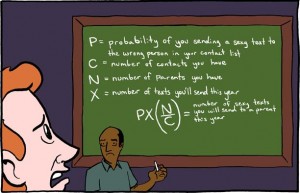
It started innocently enough, with Paul Southworth musing on Twitter about a movie trailer, like you do:
Why does the old man say “I can make you mortal” in the Wolverine trailer? Wolverine isn’t immortal. He can/will die eventually, right?
If you detonated a warhead in his colon or waited 5,000 years, I feel like Wolverine would probably be dead.
Wolverine healing himself together after being torn in half? Awesome. Reassembling himself from scattered atoms? We have crossed a line.
‘Nother day, ‘nother set of opinions on comics, but then somebody¹ had to go and blow it all straight to Hades. See, the only two things I really remember from high school biology class (which I never did very well with) are genetics (it’s got math! and something resembling certainty!) and the paramecium (the “white mice” of single-cell life). Certain species of paramecia would, if cut in two, completely regenerate into two whole little critters; the parallels were obvious:
If you tear him in half, do you end up with two Wolverines?
As was the cost of such speculation:
@fleenguy You, my friend, have just written the next 7 months of Wolverine. Congratulations!
So, yeah, sorry about that. Marvel’s gonna have to come up with some new adjective to pre-pend to the many, many Wolverine comics and it’s all my fault. On the bright side, maybe Jim Zub can borrow whatever that new adjective might be, seeing as how Zub loves him some adjectives.
Yeah, okay, you got me — while the above exchange did take place spontaneously, I’m really just bringing it up because it’s a good reason to talk about the enlightening Mr Zub again, especially as he’s recently written the first installment of a multi-part series on effective communication as part of his ongoing habit of sharing the hard-learned lessons in a decade of making indy comics. The paragraph I keep coming back to is:
This may seem like an odd topic for a tutorial but, believe me, it’s just as important as anything else I’ve covered so far. The quality of your communication and how you’re perceived as a communicator has a direct correlation to how you’re treated as a professional.
Boy-howdy, I’m glad that Zub said it², because there are people in the [web]comics world that desperately need this lesson.³ Guys, if you are your brand, how you communicate “you” is important; your personality, your POV, your humor can all help to build that brand. But if you’re building something with its own identity, something professional, you have to switch those parts of “you” off that don’t convey professional in your public pronouncements.
You may get great mileage out of lolspeak or edgy humor, but as soon as the conversation shifts from you-personally to you-the-person-that-is-negotiating-contracts-proposals-and-money, you need to be somebody else. Somebody entirely professional, probably a bit boring, and relentlessly correct in your spelling and syntax.
Even if you can pull off the trick of shifting voice, anybody that looks you up and finds the other voice on the same venue (Facebook, Twitter, Tumblr, whatever) is going to suffer from some degree of cognitive whiplash, with the likeliest outcome being that the people that want to see “regular you” don’t notice the difference but the people that need to see “professional you” don’t get the impression you’re trying to make. Consider it the work equivalent of accidentally sending naughty pics to your Mom.
If you’ve ever found it useful to have different email addresses for personal use versus business use, it’s probably time to make the same decision for your social media interactions. Just remember which account you’re logged into, okay? I know what a pain it is to find one social media client that you can be comfortable with, but if you need that division of message, you’d be better off finding different clients for different accounts to lessen the chances of spillover.
________________
¹ Hi.
² And said it better than I ever could have.
³ No names, so you can assume I’m talking about the person sitting next to you.