Smart People Saying Smart Things
After holding forth at some length for the past couple of days, I hope nobody finds it amiss that today I’m mostly letting others say things, especially because they’re very thoughtful things.
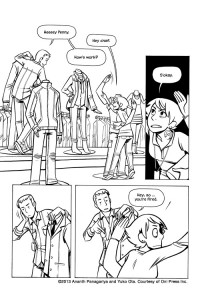
- First up, Colleen Doran, whose career in comics spans decades, and whose musings on Bad Publishers remains mandatory reading. She’s in a wide-ranging two-part interview at SciFiPulse, dealing with starting a career and issues of the creator/publisher dynamic in Part 1, and more recent works and her experiences in webcomics in Part 2. She really is frighteningly clever and bravely analytical about the ups and downs she’s experienced in her career; whatever modern creators might encounter, she’s probably already run into some form of the same situation and is willing to share what she’s learned.
- One of the topics that doesn’t get nearly enough consideration, is the question of site design, archive presentation, and users experience. In the webcomics arena, Lore Sjöberg has probably done more thinking along those lines than anybody else, going back to the many experiments of design and redesign at the original version of The Slumbering Lungfish [sadly dead due to evil scammers] and the original of the recently-remade Bad Gods.
Sjöberg’s lately been putting a lot of thought into Bad Gods, finding ways to separate the writerly bits from the funny bits (or unifying them if that’s what you want), making significant changes since the relaunch, trying to make things intuitive, and thinking about the needs of newbie readers as opposed to longtime invested fans. Those last two links are probably the most significant, as they represent an issue that is likely to only get more important as creators start to accumulate extensive archives¹.
While keeping everything in print is much easier online than on paper, making it easy for people to find everything has to date largely relied upon having different sites/domains/clearly delineated areas; Sjöberg’s more interested in having a brand built around the creator than any one project². However, as today’s blogging nicely identifies, any approach will inevitably favor some subset of the audience at the expense of another when trying to make things as transparent and intuitive as possible.
I’m not saying that Sjöberg has identified The One True Solution, just that he’s further along than anybody else in identifying the questions and the trade-offs in different approaches. Good stuff.
________________
¹ Especially those that have different “tracks” to their content; Sjöberg may be uniquely broad in this respect, but consider the cases of John Allison’s three entirely separate (but linked) webcomics, or Brad Guigar’s plethora of comics sites and entertainments.
² A particularly important advantage if the creator jumps from an established project to one that’s entirely unrelated. Keeping the brand focus on the creator rather than the project makes it easier to not lose audience in the shuffle; they might decide the new project isn’t to their liking, but at least you won’t get attrition from not being able to find you.