The webcomics blog about webcomics

Back To Normalcy, Or As Close As We Get Around Here

How’s about a roundup? I feel like a roundup today.

  • New comics, each with fewer than ten updates, which I feel confident in recommending to you: on the one hand, what looks to be a first foray into webcomickry by Priscilla Tramontano, whom I’ve not heard of before, with the whimsical and charming My Roomie, The Dark Lord. Theoretically a weekly (just RSS it and you’ll be fine), a nameless girl (unless her name really is “Vermin”) shares a flat with a standard (if nameless) evil fantasy-world Lord of Power and Doom and Badness. They seem to get on great, and it’s the little touches, like the Dark Lord’s jammies or the girl’s utter nonchalance at his malevolence that drive the humor. There’s a lesson in roomie relations to be found as well, as any two people, no matter how different, are sure to have aspects of their personality that the other can value. I’ll be watching this one.

    On the other hand, acknowledged master Doug TenNapel is worldbuilding with Nnewts. It’s about, well, newts, those little amphibian critters that undergo all kinds of metamorphoses on their way from egg to tadpolish swimmy deal to moist-skinned quadruped. Only these newts have magic, and society and adventures and it’s pretty. Readers may recall TenNapel’s previous webcomic, Ratfist, which ran for a year and got ever’body good and hooked before completing in print; no idea yet if Nnewts will do the same, but dang if there’s not something appealing in the idea of a creator running a story for a while, wrapping it up, and moving on to something completely different.

  • Speaking of “wrapping it up”, both John Allison and Kris Straub are killing it as they bring stories to a close. For Allison, The Case of the Fire Inside has delved ever deeper into the minefield that is the psyche of Tackleford Teens, what with hormones starting to bubble and opposite sexes getting noticed and wondering who you really are, oh, and seal girls also. The conclusion was stepping along smartly, with everybody possibly getting what they wanted, (if not necessarily what they needed) in a bittersweet fashion and then … wham. Punch in the gut.

    Meanwhile, all the pieces that Memnon Delphius Vanderbeam put into place were coalescing, as he died in his own arms his plans to save the now by canceling the future via the past came together with the promise of his heart’s fondest wish. I’ve been wondering how Straub would take an act of supreme optimism born of despair and make it pay off without cheating. Now we know.

  • Portland, ho, where one should note some books on the horizon. As previously noted, Bucko is getting a print treatment in September, and should you have an interest in purchasing it¹, the Diamond order codes are now available to take to your friendly local comic shop. And just across the aisle at Periscope Studio, Dylan Meconis is prepping up print versions of her three most prominent out of print/never been printed works: Bite Me!, Danse Macabre, and the Eisner-nominated (Best Digital Comic, to be determined in a month in San Diego) Outfoxed, which you may peruse via the requisite Kickstarter².

    My only dilemma — I already have a (signed, sketched) copy of Bite Me! and very little shelf space, so I don’t need another copy. Which level of support (it’s a given I’m going to support any project that gets Meconis’s work out in print) do I pledge at to get a copies of the other two, and not get a superfluous copy of Bite Me!? Modern problems, y’all; might just have to bite (so to speak) the bullet, get all three, and give the spare BM! away.

  • I don’t know why it’s not at their website, but at least some of this week’s books from The Big i feature a house ad of Jim Zubkavich, all around nice guy and walking creative explosion. Fortunately, Mr Zub has a copy of it at his site, and it’s damn good photo with some damn good words. Nice one, Jim.

_______________
¹ Which should be akin to remarking, “You like to breathe.”

² Which features the best video I’ve seen this week, and that includes Neal Stephenson’s video for Clang.

Just When I’m Out, Back In, Etc

I’ve been wondering why it is that I hadn’t met Matthew Inman before Memorial Day weekend at the NCS shindig, then I started wondering why I was wondering. We hadn’t crossed paths because I don’t do that many conventions these days, and he does even less; most of the people I’ve met in this deeply weird community have been via personal introductions. The Oatmeal is on my casual follow list rather than priority follow list¹. That being said, he’s exactly the guy that you want to be talking with when you’re in a room full of people you don’t know and have not so much in common with, and he’s somebody that I’m going to genuinely look forward to seeing when our paths have cause to cross.

All of which is to say, I am resolved that should I ever feel the need to be a tremendous douchebag towards Matthew Inman², I am going to remember a few things:

Not that I am likely to feel the need to treat Inman with extremely rude, explain-to-me-how-this-is-not-extortion-please behavior, as I have managed a run of 1882 consecutive days of governing myself accordingly³ and don’t see that streak ending anytime soon. Still, it looks likely that at this rate, the bears and the cancers are going to be splitting northwards of US$250,000 (US$152,000 with thirteen days to go as of this writing) so I guess we should all thank the FunnyJunk [no link because seriously, screw those guys] people for deciding that Matthew Inman gave them a sad and that escalating their hurt feelings into legal threats was a good idea.


Speaking of legal threats, The Great Todd Goldman Contretemps of Aught-Seven4 stirred up not just a lot of commentary at this page, but also a lot of communications direct to me; nothing has matched it since, but the amount of requests and enquiries I’ve gotten from the latest Kickstarter pieces are getting close. Since it looks like I’m not going to be allowed to let Kickstarter fade into the background just yet, let’s mention some of the more notable ones:

  • From commenter “Myth”, an argument that the US$10 and under tier represents “impulse buy” tendencies and attracts people who want to feel randomly good about backing things. In my experience, most people won’t kick a quarter into the tip jar of a talented busker on the street, so I’m not so sure about them donating ten bucks for random good feelings. I’ll concede the possibility, but there’s no way for either of us to assert definitively without a survey of users as to their motivations, and I have neither the data nor the time to manage that. As for the specific dollar figure cited, I’m going to fall back on a half-decade of working con booths and stand by US$20 being the quantum unit of money.
  • From commenter Mark V, a wondering as to whether low-tier backers drive participation at higher tiers by means of momentum. I was mentally thinking Hey that sounds interesting, go do that to Mr V’s suggestion to do a daily sampling of a bunch of projects and look at the cross-correlation of the time series for the different tiers (time, people, I am not made of it!), but before such a churlish suggestion could escape my lips, he produced a quick analysis of success vs backer count, incorporating my 39 projects and another 20 that failed.

    Two things to note here: I really wanted to find some “near miss” projects, ones that came just shy of succeeding, but couldn’t come up with a set that wasn’t all outliers the last time I went looking (similarity was a big part of why I set an arbitrary floor of US$10,000 for my analysis), so good work by Mark finding a set that he considered valid. Even more interesting was a datum that jumped out at him:

    Surprisingly (?), there is a clean break between the funded and unfunded projects at 100 backers. Does anyone know of any unsuccessful comics Kickstarters with more than 100 backers?

    Damn good question, Mark. Anybody know of any? And please, before somebody that’s looking at Kickstarter as a kind of magic ATM skims this bit and takes away the wrong lesson, 100 backers is not a magic guarantor of success. The dependency goes the other way — if you’ve got the kind of project that would be a success, you’ve already amassed a pool of supporters that would hit triple digits. As always, there are contrary cases.

    Thanks to Mark V for seeing an investigatory direction that I hadn’t considered, and to everybody else with specific questions — the data are there waiting for you same as for me. The more people that dig around and look for answers, the greater chance of something meaningful getting unearthed.

  • Alternately, you could wait a couple days and hear me and Richard Bliss compare notes; Howard “My Evil Twin” Tayler introduced me to Mr Bliss via email yesterday:

    Richard “The Game Whisperer” Bliss has been doing research on, and a podcast about Kickstarter since November of 2011, mostly focused on what it means in the board game space.

    So scheduling on that is getting worked out today, and I’ll let you know when you can listen. Honestly, when I stared my lines of enquiry, it was because I’m a numbers nerd and when I see patterns in them I have to dig around and see what I can find. I didn’t expect all of this interest from so many quarters. Oh, and as long as I’m on the topic of Howard Tayler, congrats on completing twelve years of updating Schlock Mercenary every damn day.


Hey, did you notice that Cameron Stewart brought back Sin Titulo? Because he did, and with no other projects competing for his time, it’s going up every day until it’s done. Read it again for the first time.

_______________
¹ Inman’s in good company there — there’s some incredibly popular and successful comics that serve their audiences well, but they aren’t for me.

² Say, bears are facing an extinction-level threat and need a few bucks.

³ Seriously, Charles Carreon, Attorney-at-Law, when somebody calls your bluff on legal threats that we all know you were never going to act on, you cut your losses and quit with making the noise.

4 If I may be indulged for a moment, it’s probably my greatest point of pride with respect to this blog that we at Fleen did not remove any of our Todd Goldman coverage when “invited” to do so. Major publishing houses did, we did not.

Outliers

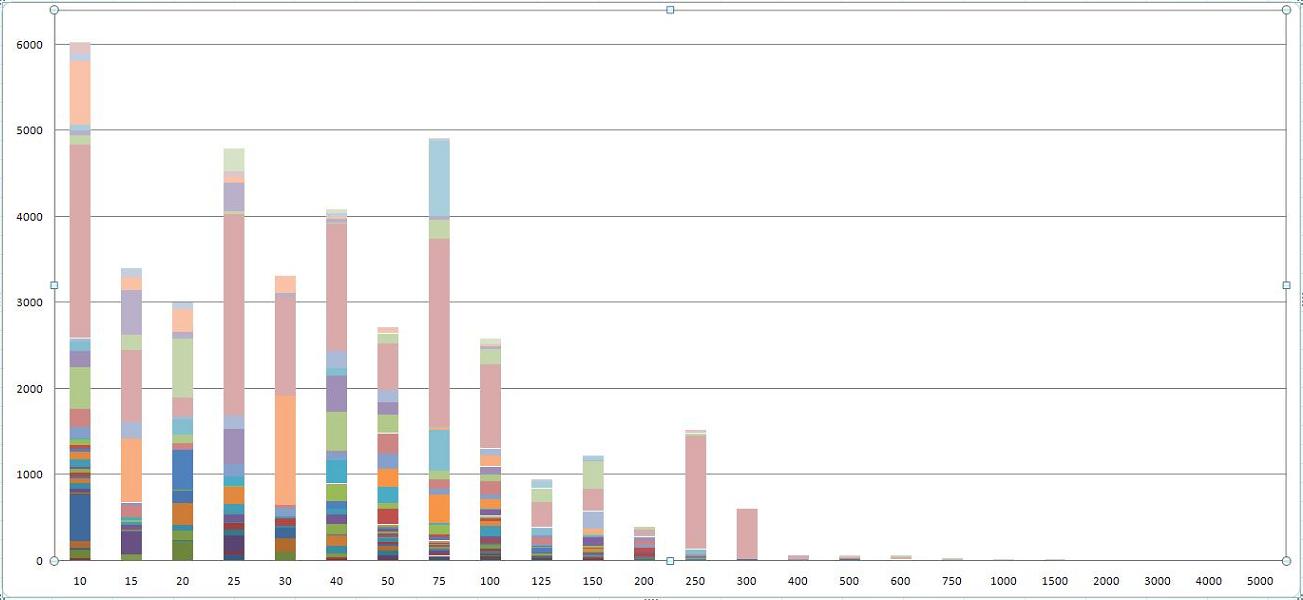
For those that joined us late, yesterday I looked at a bunch of Kickstarter projects related to webcomics and drew some conclusions that seemed to hold pretty true for a wide variety of cases. But I kept coming back to two sets of numbers. The first being the listing of all contributors in various tiers across all 39 projects:

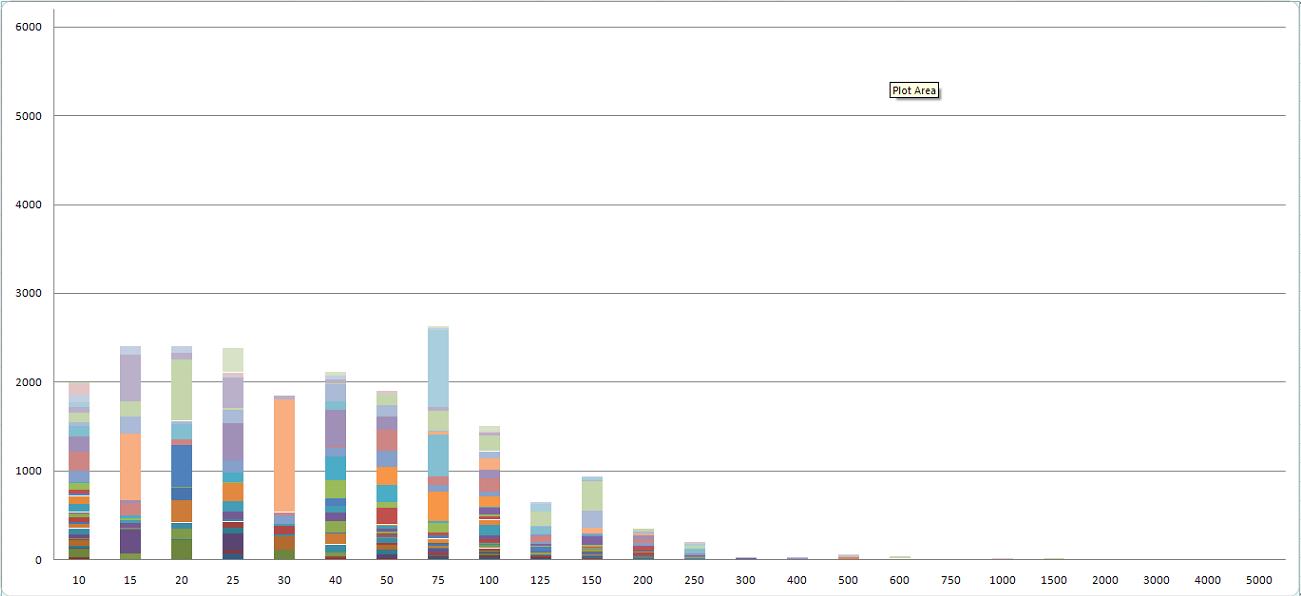
… and the second being that same graph, with the most obvious fringe cases removed:

Removed because the sheer number of contributors to just four projects (Order of the Stick, Poorcraft, Diesel Sweeties, and Borogove) really skewed the results. Without those four projects, the others produced a tolerably flat distribution up to the US$100 tier, then a second one up to US$250; past that, the counts were negligible.

But these projects weren’t necessarily unusual just for their supporter counts (the 14,952 OoTS supporters accounted for more than 37% of all backers in all projects; the other projects had support counts¹ that were matched or exceeded by other projects not called out), but for their lumpiness. In fact, there were other projects that were lumpy in interesting ways, but tended to balance each other out and disguise that fact. It’s the lumpies that we’re looking at today.

In addition to three of the four already cited (I’m omitting OoTS from call-out analysis because there’s just too much there — too many microtiers, too many limited rewards, too many add-ons … I suspect some B-school wannabe could write a thesis on just that one campaign), we’ll be examining how Girly, Narbonic, Kickstand Comics, Schlock Mercenary, Modest Medusa 1², and Smut Peddler are atypical, yet found niches to exploit. The usual warning that your mileage may vary applies double to these case studies.

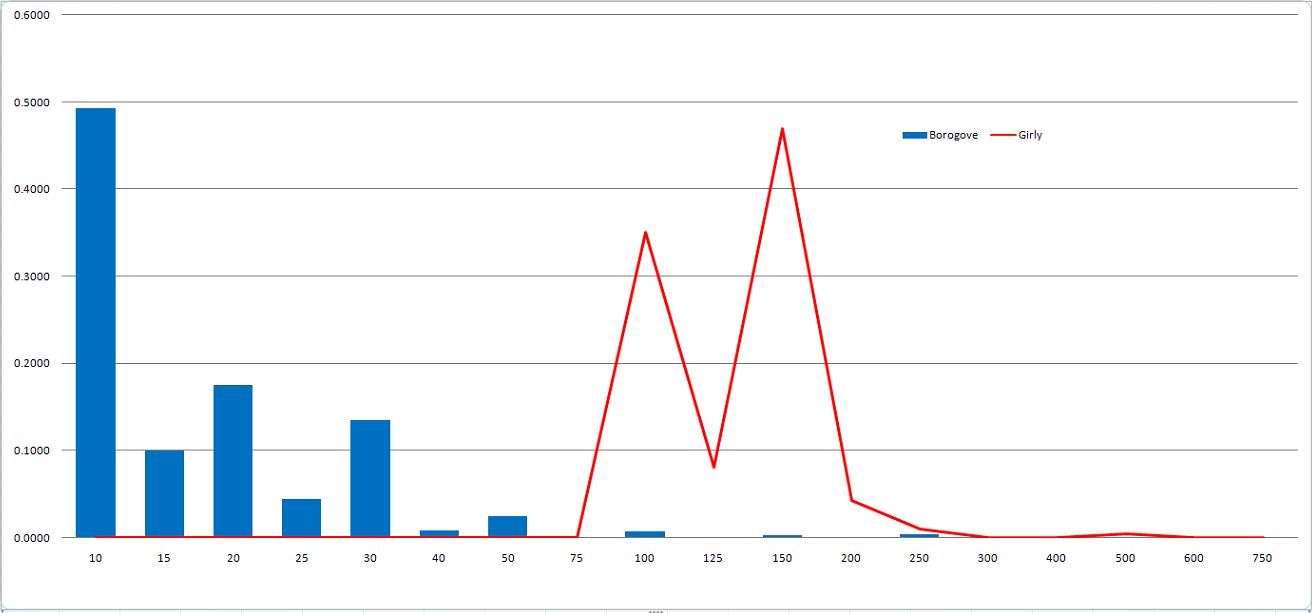
First up, a pair of projects that have opposite tendencies in dollar figures: Borogove had 1500+ backers, and operated predominantly at low dollar figures; Girly had about 200 backers, with the lowest reward tier at US$100:

Quick side note: because details would be lost comparing two projects where the backer counts differ by a factor of five, I’ve translated this and the remainder of charts into percentages; the 740+ backers at US$10 or less for Borogove equals just under 50% of all backers for that project. Likewise, the 74 and 99 backers at the US$100 and US$150 levels (respectively) equate to 35% and 47% (respectively) of all backers of Girly — we can see how the relative counts stack up without Girly being too small in the vertical dimension to appreciate.

How did Girly succeed with only high-dollar value donors? The base reward was a multi-volume, slipcased book set with a built-up demand. Low count, very high margins per item. Borogove, by contrast, was a card game (cheap to produce) that was tangentially referenced in Kory Bing’s Skin Deep. Essentially cheap enough to be an impulse buy, one has to hope that the few dollars to be made after cost of producing the decks didn’t get entirely consumed by shipping and the efforts of shipping. This was probably a break-even proposition at best.

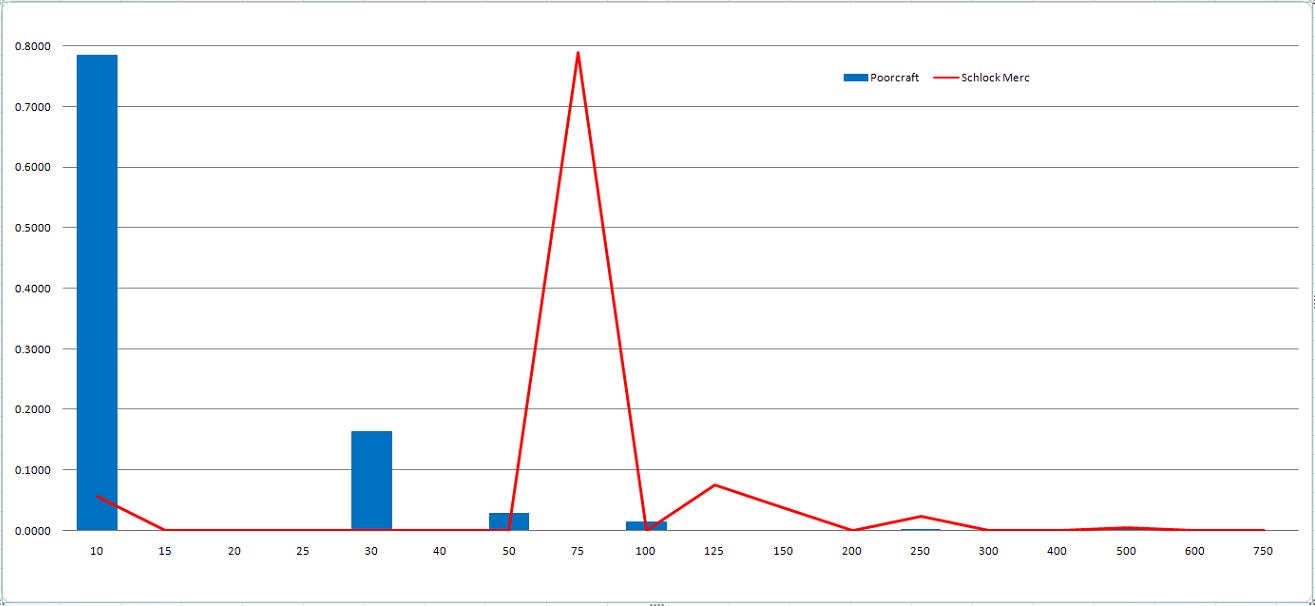
Next up: Poorcraft and Schlock Mercenary: The Board Game.

I chose these two not only for their obvious contrast in distribution, but because both managed to absolutely dominate in just one reward tier (nearly 80% penetration), at opposite ends of the spectrum. 877 out of 1111 people took the lowest pledge that would get them a copy of the boardgame, and 495 out of 793 people took the lowest pledge that would get them a copy of Poorcraft (plus another 51 in the same statistical grouping that would have gotten a PDF instead of a physical copy).

Ironically, the much higher-priced SM: The Board Game might not actually work as a high-margin item, as it’s a fairly complex production with lots of parts and fiddly bits³ requiring assembly and many bonus content doodads. Poorcraft, by contrast, had most of its rewards related to nothing more complex than the number of copies that went into the envelope, with higher value rewards attached to essentially free items — credits in the book, appearances in the book, original pages (already paid for). If the books could be gotten in quantity sufficiently cheaply (and finding good value for money is the theme of Poorcraft, after all), the ROI might actually be better than for SM:TBG.

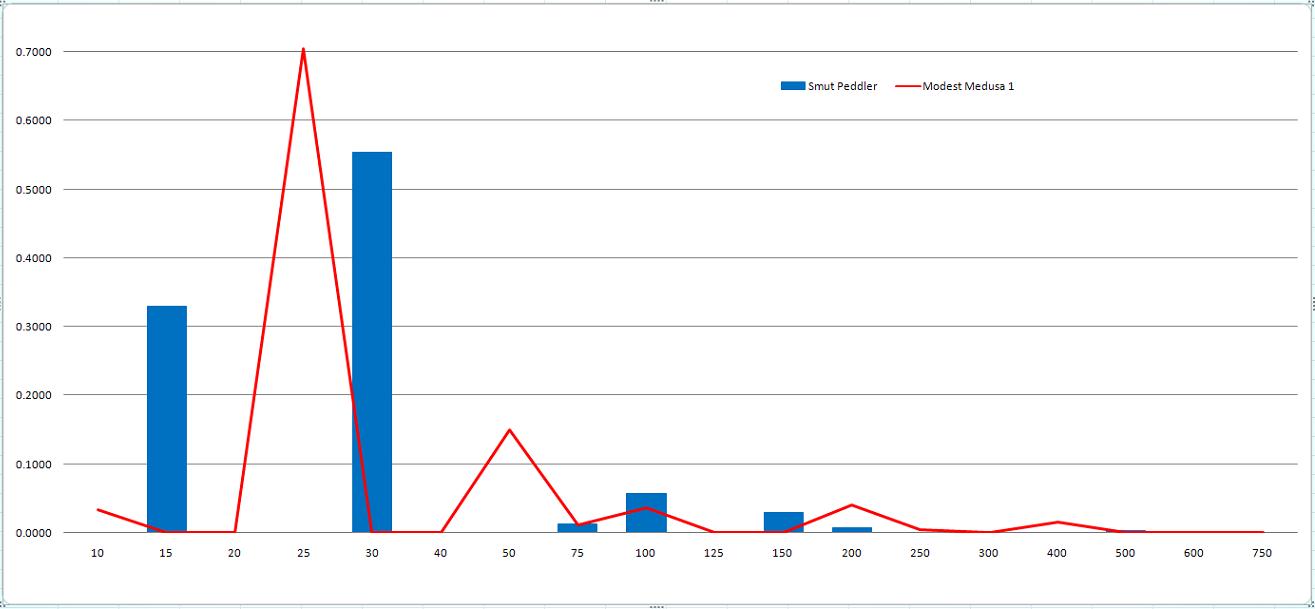
Similar breakdown with Modest Medusa 1 and Smut Peddler:

The US$15 tier at SP gets you a PDF of the book, and the US$30 tier gets you a paperback; the 2291 backers made those two reward tiers account for an unreal 88.3% of all pledges. The near-zero cost of distributing PDF (compared to mailing) and the higher income per copy of SP (by a factor of three vs. Poorcraft) means a whole lot more free cash rolling around in Spike’s pockets, which she famously paid out to her artists — US$700 per creator or creator team. As a spread-the-wealth project, this was a resounding success, one that couldn’t have worked at lower pricepoints.

Modest Medusa saw a pretty impressive spike at the base-get-a-book level (70%), which makes it a perfectly cromulent use of Kickstarter to accomplish a particular project. Given the relatively low backer count (274), the excess funds aren’t enough to be self-sustaining going forward to the next project (cf: footnotes, where we note that MM2 is currently raising funds).

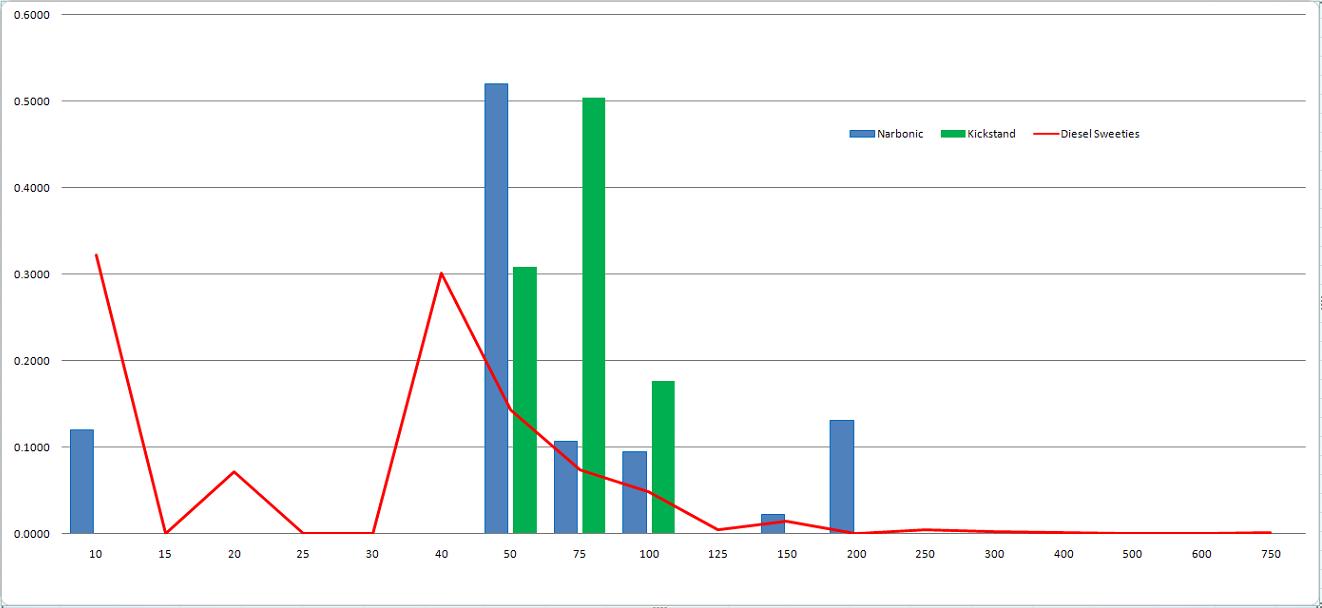
Last up, a contrast between relatively few reward tiers and a lot of reward tiers all over the damn place: Narbonic, Kickstand Comics, and Diesel Sweeties.

The first two have, respectively, 6 and 4 reward tiers (two of which were combined into one by the data grouping in the case of KC), each featuring a relatively high price point (US$50) to get something tangible (the US$10 tier for Narbonic gets you a PDF). They’re also both giving fairly large rewards — six years of comics in the case of Narbonic (with higher reward tiers giving tangible and desirable value-adds in the form of hardcovers and handtooled slipcases), and three books totaling more than 1000 strips in the case of Kickstand. The only differences between the Kickstand rewards were foreign (higher shipping costs) vs domestic, sketched vs unsketched; the relative paucity of bike-themed comics probably worked in Rick Smith’s favor, particularly given the prominence of cycling culture abroad (a full 29% of his 660 orders were international, which is probably a record).

Rich Stevens, by contrast, is able to treat the one third of backers in the cheap seats as free money — he had to put in the effort of making an e-book out of 3000 comics to satisfy the higher-tier rewards, and they get to download work he did anyway; that’s 490 people times 10 bucks (actually 8, since he did almost all his pricing in 8-bit multiples) times no fulfillment costs. As noted in earlier analyses, that’s the only way to not go broke with so many backers getting something for so little money.

The spike at the US$40 range (actually 32) represents the minimum to get a tangible reward (a USB drive with the e-book on it). The real costs to Stevens are the time/effort to produce the book; the drives themselves can probably be had very cheaply in the quantities Stevens is looking at (458 in this tier, plus everybody at higher tiers, for most of 1000 people — and you can find USB drives of similar case complexity for 8 bucks retail), and the damn things are made of rubber so they don’t need protective shipping. One caveat: Rich Stevens is a mad genius who regards sleep as the enemy; unless you emulate that, you will go crazy trying to work things like he does.

Tomorrow: Nothing about Kickstarter or I may kill myself.
_______________
¹ Poorcraft: 703; Sweeties: 1520; Borogove: 1507.

² I probably should have noted yesterday that Modest Medusa volume 2 is likely to outstrip volume 1, but still has two and a half weeks to go.

³ Not that my evil twin would have it any other way — fiddly bits are a way of life for him.

My Last Word On Kickstarter Until The Next One

No kidding, you guys, I have been crunching numbers on successful Kickstarter campaigns since last week, and everything I look at reveals as many questions as answers. Time to share what I’ve come up with, and what I think it means.

To start with, a few definitions:

  • I wanted data sets with large numbers of contributors, so I set a floor of US$10,000.
  • Projects are being added all the time, so I picked an arbitrary time of June 8, early afternoon EDT as the time to collect numbers; TwoKinds was still collecting funds for another 26 hours at that point, but I don’t think that will cause a major shift.
  • There will be roundoff errors — there are projects where backers pledged at a level below the first reward tier, and they don’t show up.
  • I’ve reduced the backers into dollar ranges that don’t necessarily match one-to-one with each project; when I say 100 people backed this project at the US$100 level, it means They gave more than the next lowest category (US$75), up to and including US$100, despite the fact that the actual pledge amount may have been US$80, or US$93, or some other increment in between those endpoints. Again, probably won’t have a big effect on the final conclusions.
  • I’m looking at webcomics, for which there is not a clear category; most of the projects listed in this analysis came from the Comics category, but I allowed others in, provided that they were from prominent webcomickers, and driven primarily by that creator’s identity/property.

    This means that some tough choices got made — I included some anthologies like Smut Peddler, Cautionary Fables, but excluded Daisy Kutter. The Schlock Mercenary game and SFAM bunnies are in, but Scurvy Dogs isn’t. If you think I should or should not have included a particular project, I invite you to gather your own numbers.¹

For reference, the projects included Dreamland Chronicles volumes 4 and 5, Athena Voltaire, Cautionary Fables, Modest Medusa volume 1, nemu*nemu 2011, Multiplex volumes 1 and 2, Poorcraft, Regalia, TJ & Amal volume 1, Spacetrawler volume 2, Sfeer Theory issue 1, Skin Horse volume 3, Rice Boy one-volume, Order of Tales one-volume, Boxer Hockey/Diesel, Wormworld Saga app, Double K volume 1, Narbonic perfect collection, Tiny Kitten Teeth hardcover, Girly complete collection, Dumbing of Age volume 1, Kickstand Comics 2, 3, and 4, Goats volume 4, Benign Kingdom, Cucumber Quest, Extra Ordinary Comics volume 1, Smut Peddler, Erfworld motion comic, Order of the Stick reprint drive, TwoKinds, Monster Alphabet board book, Schlock Mercenary boardgame, Borogove card game, Dr McNinja video game, Glorkian Warrior video game, SFAM bunnies, and Uncle Rich’s crazypants largest e-book in history.

Some basic stats:

  • Thirty nine projects
  • 39,727 rewards-level backers
  • A total normalized value of US$2,424,955

That word is important — normalized. Given that individual reward tiers were grouped together for convenience (Rich Burlew had more than 60 by himself), the normalized value was derived by multiplying the total number of backers in a dollar range by the assigned value of that range. This is likely overestimating the value somewhat, but a surprisingly large number of the reward tiers fell at or near the chosen range values².

Here’s what the total number of backers at each level look like; there’s no legend because there’s too many projects, just get a look at the overall shape:
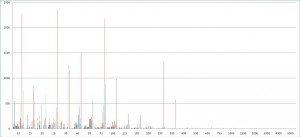
Big vertical spikes for OoTS, but notice how you can’t really see which levels dominate until you get to the higher levels and there’s almost nobody. Now we’re going to show something different — same data, but stacking the totals in each dollar range on top, adding the OoTS numbers to the Poorcraft numbers to the SFAM numbers, plus another 36 projects:
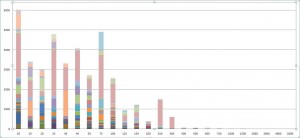
From this we can see that the low-value tier (up to and including ten bucks) is the most popular, with more than 15% of pledgers there; not all projects offer any kind of reward at that level. Now here’s what surprised me — I’ve been saying that the sweet spot in Kickstarter rewards is between about US$30 and US$75 for a while now, and there are peaks at 25 and 75, and pretty healthy stacks in between those two points. After 75, the numbers have a pretty clear down trend except at 250, which is almost entirely an outlier.

That’s because a few high-count projects (OoTS, Poorcraft, Borogove, and Diesel Sweeties) are dominating some of these levels. Just to play “what if”, I’m going to take those four projects away, since nearly everybody that starts a Kickstarter will not have responses like those four; don’t worry, I’ll put it back in, but I was curious to see what happens when the outliers went away:
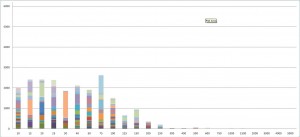
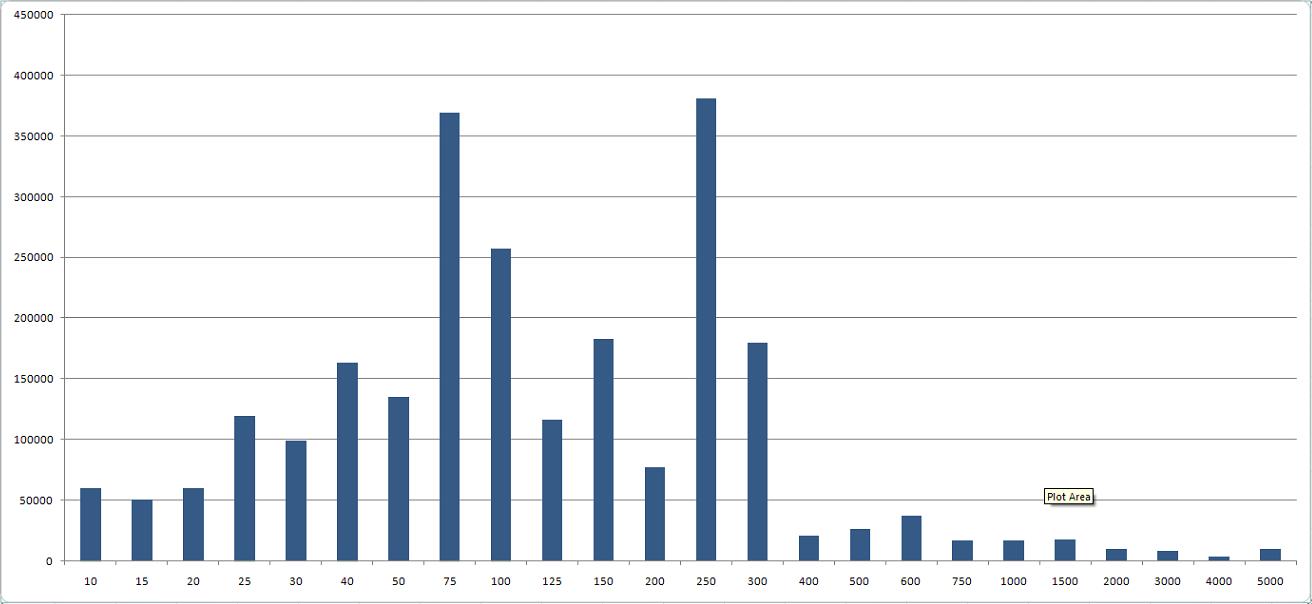
I left the vertical scale the same so you can see the impact — 75 now dominates, and the highest dollar value with a significant count occurs at 150. Interesting. Also, I just noticed that when I screen-shotted that chart, there was a pop-up label but screw it, I’m not going back and doing it over. Y’all can just deal.

Back to the issue at hand, maximizing those supporters by any means isn’t the key thing, unless you don’t mind going broke fulfilling a Kickstarter campaign’s low-value rewards — each of those low-dollar supporters might incur a couple of bucks of postage, effort, or bandwidth if they get a reward. The question is, do you want to work on volume or on margin? Which is why the next picture is the important one:
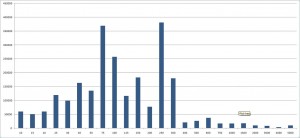
What you are looking at is the total dollar value for each of those tiers — as noted above, this is going to be approximate, since anybody that pledged between 1 and 10 bucks gets counted as a 10 dollar donor, but that effect of overvaluing is most pronounced at the lower tiers. And look at those tiers — the 10 dollar tier accounted for 15% of donors, but only supplied 2.5% of total dollar value, and that’s with an overvaluation. The peak value points are at 75 and 250, and you can ignore 250 because that’s literally about 90% due to Burlew alone (likewise the spike at 300, which is about 97% Burlew).

In fact, when looking at value, we have to ignore pretty much everything above US$200 — the only tiers above that point with enough backers to be statistically significant are 250 and 300, and since they’re almost entirely down to the stick figures, they don’t apply to ordinary projects by you. So if Rich Burlew’s project was an anomaly that shouldn’t be relied on for predictive power where it’s radically out of sync with other projects, what should we be looking at? I’d like to introduce you to something I’m calling the Value to Count Ratio.

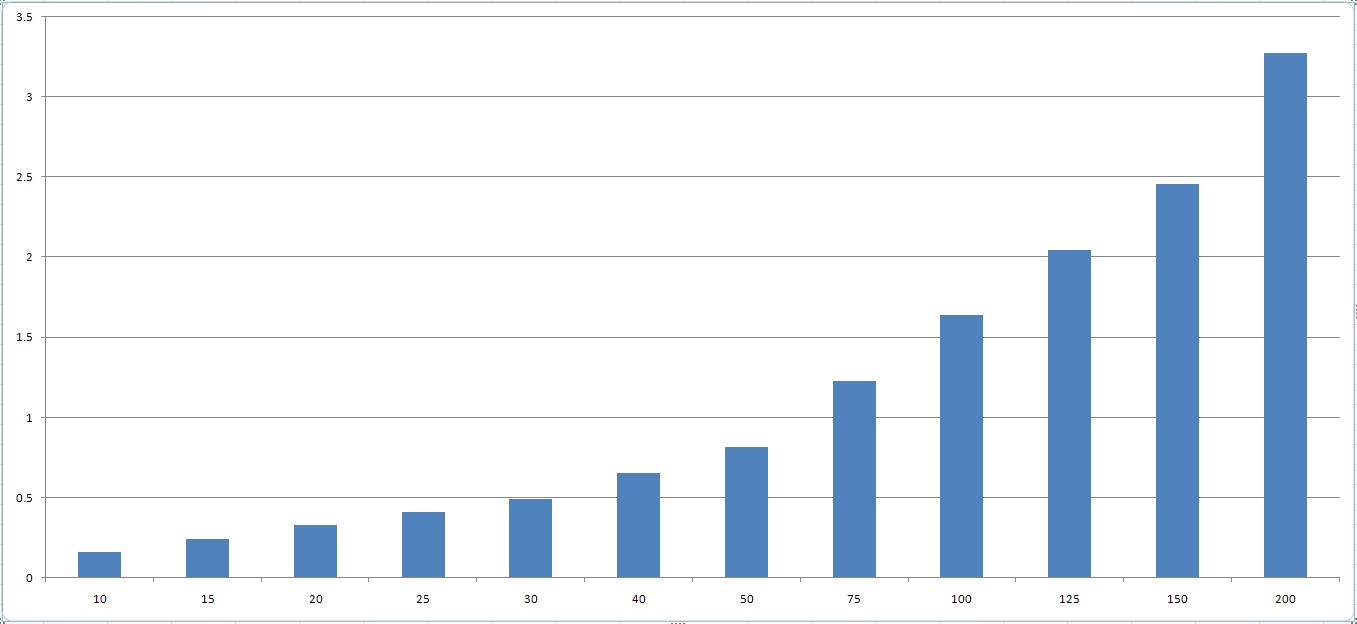
Put simply, if 5% of your backers produced 5% of your value, that’s expected. If 5% of your backers produced 20% of your value, those are people and habits that you want to identify and seek out. 5% of your backers producing 1% of your value are under-providing slackers that are worth less of your time. Divide the value of a tier into the total value of the data to get a percentage; likewise, divide the backer count for a tier into the total number of backers for a second percentage. As stated above, the 15% of backers at the 10 dollar tier only produced 2.5% of value — meaning slackers. How much? Value% divided by Count% gives a ratio of 0.16383, well below the 1.0 level that indicates expected performance. Here’s what the ratios look like:
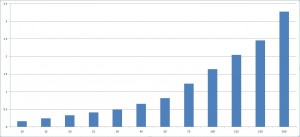
Remember, value ratios under 1.0 are underperforming, and above 1.0 they’re overperforming. Don’t worry about numbers past 200 — I’ll concede that the ratios get explosively large, but you aren’t going to get enough pledges in that range to make the effort in tailoring your campaign to those high-value donors worthwhile (not that you should entirely ignore them — see below); for our purposes, they’re an attractive nuisance. Instead, we’ll note that 75 is once again a significant value, where the ratio gets into overperforming territory. But remember — 75 is also the peak-value point. This is leading me to somewhat revise my earlier conclusion that the US$25 to US$75 range was the sweet spot.

True, that’s going to be where you get nearly half of your backers (49.91%, to be precise), but it underperforms by a decent interval on value (36.60%; ratio of 0.7333). It’s still where you want to pitch the majority of your rewards, though you should set up some high-value rewards in the US$100 to US$200 range³ to sweep up the generous donors. Note that limited rewards in this range seem to almost always max out their selection when 20 or fewer are offered; it may be the scarcity drives a few on-the-fence types to adjust their purchase upwards. This is probably also where you want to introduce the greatest number of additional goodies unlocked by stretch goals.

So taking my earlier advice of US$25 to US$75 as the prime range, and adding in my new appreciation for rewards up to US$200, we find this wider range accounts for 62.786% of backers and 62.785% of value captured — a ratio of 0.9998, which is as close to balanced performance as you can get. Bringing in the low-value tiers (US$20 and under) only adds another 7% or so to value, but accounts for a whopping 94% of all backers.

Conclusions: You want to put the bulk of your rewards in the US$25 to US$75 range, with some nicer onces (maybe limited availability) up to the US$200 point. Anything in the lower tiers should be minimal cost to you to produce and distribute, since you’ll be producing/distributing a lot of them for not very much income. Go ahead and have some pie-in-the-sky rewards at US$250 and up, but realize it will be rare occurrence that somebody actually takes the bait.

Tomorrow — how some projects are rude and don’t follow the patterns. We’ll see if there’s anything about these outliers that can be made to make sense for the typical project.

_______________
¹ Seriously, please do. My decisions were consistent, but could be considered arbitrary, and the number of projects is at the low end of anything I’d ascribe statistical significance to. Then again, large number of backers. Then again-again, fan behavior is not easily modeled.

²Those chosen values were (all in US dollars) 10, 15, 20, 15, 30, 40, 50, 75, 100, 125, 150, 200, 250, 300, 400, 500, 60, 750, 1000, 1500, 2000, 3000, 4000, 5000. Several projects had listed reward tiers up to 10,000, but no pledges were found above 5000, so that’s where I stopped. Each of these ranges, by the bye, has at least one backer.

³ Many of the campaigns had a fair number of limited rewards, which can throw off these analyses something fierce — but for the most part, they didn’t occur until the US$100+ tiers, which minimizes their impact.

Can’t Talk … Working

Guys, I may have cracked the Kickstarter code. Gotta crunch some more numbers.

Still Crunching Numbers

Yeah, still working on my latest Kickstarter thing; there’s 38 separate projects I’m including in this one, so it’s taking a while. So let me point you at some brief items of interest.

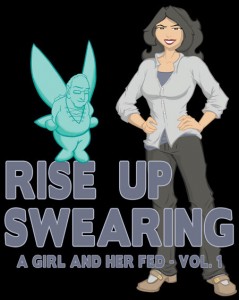
  • Firstly, I want to show two ways you can purchase the first collection¹ of A Girl And Her Fed (by K. Brooke “Otter” Spangler) in PDF form: 1, 2. One may note that both copies of Rise Up Swearing contain the full content of the print book, minus the bonus art on the get-Otter-to-sketch-this-page page, because hey, no pages. They are in all ways identical, except for the price.

    One of these versions is identified as To Own (for US$5.00), and one as To Give To A Friend (for US$2.50). Naturally, there’s no way for Otter to tell whether the copy is for you or for somebody else, you’re on the honor system here. I actually think this is a great way to get an established member of your audience to help spread the world-of-mouth to people that may like a comic, by making it easier for them to do so. It’s a PDF, so the production costs are already sunk from the print version; getting half the usual price is better than none, when pretty much by definition it’s going to somebody that never would have bought it in first place due to not knowing about it; in the case that new somebody likes it, they may well become a paying customer in the future. I’d be surprised if I didn’t see this model adopted by other creators.

  • Attention, residents of Pittsburgh, Pennsylvania and surrounding areas: Andy Runton² is coming to see you next week. On Saturday, 16 June, Runton will be at the ToonSeum³ at 1:00pm for a demonstration and signing. No special charge for the event, but there is the regular admission fee to the ToonSeum which is only five bucks if you’re 13 or older and one single dollar for children 6 and over. That’s as good as free, and Andy captivates kids as well as anybody this side of Patrick McDonnell. Grab yer kid, grab yer Owly books, and go meet a humble, talented guy who will most definitely put a smile on your face.
  • Attention, residents of Boulder, Colorado and surrounding areas: Chris Yates isn’t coming to see you, on account of he lives there. But he will be dropping by FACTORY|Made creative lab/design incubator to teach a workshop of wooden puzzle making. The fun starts on Sunday, 17 June from 12:00 noon to 6:00pm; tools and materials provided, just bring your imagination and a willingness to get all swoopy and curvy with a scroll-saw. I imagine room will be limited so that participants aren’t sitting around all afternoon waiting for their turn, so advanced registration is recommended; call FACTORY|Made at 303 927 0802 and please note the US$60 registration fee. If you’re uncertain as to whether or not Yates makes stuff that’s up your alley, check out his work here (where, I hear through the grapevine, he’s having a sale).

_______________
¹ Disclaimer: I wrote the foreword for this book, but I don’t get anything out of pimping it here, other than a sense of satisfaction that a work I really like might find another reader or two.

² Who, yeah, technically doesn’t do a webcomic but Owly is great and it’s in the spirit of independent owners and it’s my blog so shut up.

³ Who, yeah, aren’t devoted to webcomics either, but they do a lot of good exhibits and events and they got the funk.

Aw Man, Ray Bradbury

I imagine that many of you are taking the news that Ray Bradbury died about the same that I am — sad that we’ve lost such a creative voice, tinged with satisfaction that he lived long enough to see how beloved he was [AV, and probably NSFW]. Looking around the webs, lots of creators that were influenced by Bradbury are remembering him and their interactions with him. Thanks for everything, Ray.

  • In less depressing news, you learn something new every day; cross reference here, then tell me that Kris Straub hasn’t been planning this for, oh, seven years. I love it when the pieces of a long game come together.
  • Speaking of the seven-eight years ago time frame, these sketches from David Hellman’s sketchbook are gorgeous, and reminiscent of that time he started working on A Lesson Is Learned But The Damage Is Irreversible, which just happens to be coming back. All in favor of taking up a collection to send Hellman to Italy every couple years, raise your hands. Thank you.
  • Working on that new Kickstarter rewards analysis that I mentioned yesterday — a major player in the form of TwoKinds (currently tracking to be the #2 best-funded comics project of all time) isn’t quite complete yet (it has another three days to go), but I think those last few days won’t significantly affect its contribution to the way I’m looking at things. Maybe I’ll just type in their numbers last.

What The Heck — Anniversaries

For those of you that weren’t up around 3:00am EDT (GMT-4), it appears that webcomics has a couple of anniversaries to mention today. Let’s give some props for longevity, shall we?

  • First up, the only man that my moustache fears, Darren J “Dern” Gendron:

    Huh. Today is my sixth anniversary of making webcomics.

    To be slightly more specific, this is Gendron’s anniversary, not the anniversary of any single particular webcomic:

    My first comic was Dear Pirate, which was like Dear Abby, but instead people got advice from a pirate.

    Current Dernprojects may be found at the Dernwerks, plus the Monster Alphabet project (previously noted here for the achievement of hitting 5000% of goal on Kickstarter). Dear Pirate appears to exist solely in one plasticine-rich update and nowhere else.

  • And a bit more approximately on the anniversary date, Aaron Diaz¹:

    I started Dresden Codak 7 years ago and all I got was this t-shirt (and a career and prestige and personal fufillment).

    Although, technically, we’re a few months overdue on the congratulations:

    I actually technically started in March, but my first comic in the current Archives is June.

    Even if the date is somewhat approximate, Diaz still gets included purely for the joy and optimism by which he regards his webcomickry, even when in the depths of Sleep-Deprivation Work Madness, which I believe he refers to as “The Gauntlet”.

  • As long as we’re handing out the congrats, we ought to note that David “Damn You,” Willis concluded his latest Kickstarter (for the first Dumbing of Age reprint) last night at just shy of 300% of goal, or some US$30,000 (just under US$45/backer on average, exploiting the previously-identified sweet spot). It’s become routine for creators with established audiences to routinely pick up tens of thousands of dollars and hundreds of supporters. I think it’s time to go back and run those numbers again, see what the normalized distributions look like.

_______________
¹ The Latin Art-Throb.

When In Doubt, Pizza

Man, not much going on these days — lull between conventions, SDCC doesn’t have programming info up yet¹, couple of things I can’t talk about yet, and a pervasive sense that everybody else is in a holding pattern. So let’s go with the no-fail way to find something cool on a Monday², and set the WAYBAC machine³ for PIZZA ISLAND.

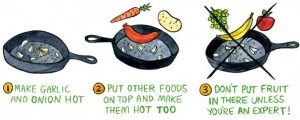
  • Over at Saveur Magazine, the latest Recipe Comix contribution comes from onetime Pizza Islandian Lisa Hanawalt, as she takes us through not just a Hearty Sausage & Sweet Potato Soup, but through the basis of all cooking itself:
    1. Make garlic and onion hot.
    2. Put other foods on top and make them hot too.
    3. Don’t put fruit in there unless you’re an expert!

    Honestly, it’s not too far off something Saint Alton would say, and I’m sure he’d approve of the prominence in Hanawalt’s artwork of the single most useful cooking implement ever invented: the cast-iron skillet. It lasts forever, makes food taste good, can block bullets, and is easy to draw. Everybody feel good for an implement from antiquity!

  • As long as we’ve taken a trip to Pizza Island, let’s drop in on Julia Wertz, who’s put together one of her best comics ever today. I’m not sure she saw this one as being particularly significant, or thought that people being clueless/dicks/clueless dicks towards her at conventions would resonate as it has today. Really, it’s mostly people not taking three seconds to ask, Is my behavior even remotely appropriate rather than actual malice. And while most of us don’t sit on the other side of the convention table and have to put up with this kind of nonsense, I like to think that most of us can shake our heads in wonder and have a bit of empathy for those creators that end up on the receiving end. Tl;dr: awkward interactions — compelling in a cringey way.
  • New format for the next while over at Octopus Pie: tall stories, told three or so pages at a time. Nobody does uncomfortable dreams like Meredith Gran (cf: here), so here’s hoping that fictional Brooklyn keeps up the heatwave that makes for fitful sleep for a while. For those of you that dislike scrolling, the individual pages are also available.
  • No pizza here, but Dave Kellett dropped some interesting hints via Twitter all weekend as his docufilm recorded a musical number with his buddy KateOatesMicucci. Photo to whet your appetite from the artiste herself. Innnnteresting. Can’t wait to see what this looks like when the film releases.

_______________
¹ We’re less than 40 days out from Preview Night — has the programming always been released this close to the con? I could be wrong here, but it seems like we’re cutting it close this year.

² I mean, apart from all of the webcomics that are utterly free and entertaining, but that’s not news.

³ If you don’t remember Mister Peabody and Sherman, I suggest you go back in time and convince your ancestors to get you born sooner so you can watch Rocky & Bullwinkle. You can thank me later.

By Now, You’ve Probably Missed It

Paragon of agility Rich Stevens is going to be a business school teaching case someday, what with his ability to turn on a dime¹ and execute his mad plans quickly; Small, fast, ruthless … all Edge as Mr Gibson put it. Yesterday, about this time, he put up a microsale [link probably dead by the time you read this] in honor of his tenth anniversary of Quitting The Day Job:

The one thing I don’t know about Diesel Sweeties is the day I posted the first comic. It was some time in early 2000, twelve years ago.

The one thing I’ll never forget about Diesel Sweeties is the first week it was my full-time job. That was ten years ago this week.

This is the longest, most stable-yet-rollercoastery job I’ve ever had in my life. I’ve screwed up plenty, but never enough to have to give it up. It’s all thanks to you folks out there reading and buying stuff. I’ve been sorting comics by year for my 3,000+ strip ebook project and it made me wonder … do I have a shirt in the store from every year this had been my job? Actually, kind of yes.

******

Because this is how my brain processes things, I’m doing a DecaSale. Ten shirts are on sale for $12.10 each for 24 hours. They represent a little tangible reminder of every year from 2002-2011. A few will be weeded out during this sale to make room for 2012.

This sale starts NOW, 3pm Eastern AKA Easthampton, MA time and runs for 24 hours. [emphasis original]

I think if you were to do a comprehensive trawl of my archives (and I would never recommend that to anybody), you’d find certain names cropping up with regularity: Gran, Kellett, Khoo, Vernon, Beaton, because they’re consistently out there doing new stuff, consistently interesting to me. But probably the person that gets the most mention would be Rich², because nobody in webcomics is out there trying as many things, experimenting, pushing himself, looking for The Next Way Of Doing Things, and The Way After That, and The Way After The Way After That. He is in constant, almost Brownian motion, trying, succeeding, failing, learning, and having the goddamn time of his life as he does so. He just might be who I want to be when I don’t grow up.

So good on yer, Richard Stevens the Third — it’s been a great decade for you, and I can’t imagine the next ten years will be less {fun | frustrating | exciting | meaningful | other value-laden words here} [choose all that apply]. As for everybody that missed the DecaSale, there won’t be another of those for ten years, or until Stevens has some other excuse to do something similar that pops into his head like unto a bolt from the blue. Week from Tuesday, I’m guessing.

_______________
¹ Before any of you make with the sexual innuendo, just … don’t.

² Actually, it’s probably Scott Kurtz³, now that I think of it, and for mostly the same reasons as Rich.

³ And Guigar.