The webcomics blog about webcomics

Gonna Be The Future Soon

Know something? You’ve gotten like 3500 words out of me since Sunday and I’m tired. Let’s keep this one brief for all of our sakes.

  • Seen online:

    last starslip drawn on may 30, 2012, 5:53pm, at abbot’s habit, venice, ca

    We won’t see if for some weeks, of course, but I can’t help feeling both a little happy and sad for Kris Straub. It’s been seven years, three titles (if memory serves) and one big ol’ reboot since Starslip (as she is now) started; saying goodbye to your creation can’t be easy, but wrapping up the story on your terms, tying up all the loose ends … that’s got to feel great. Thanks very much to Mr Straub for letting us take the ride along with him.

  • Seen in person: the Square reader has been a badge of office for people that are making your purchase options broader and easier at conventions. Waiting to get approved and receive that dongle in the mail has been a ritual for more than one webcomicker. So what does it say about ubiquity that I saw one hanging on the pegs at Staples for ten bucks yesterday?

And The Way After That

The things is, working on The Next Way Of Doing Things isn’t enough. As Dave Kellett clearly stated as the final thought of his talk, his analysis and recommendations are only good for 12 – 18 months tops; after that point, the complexities become too pronounced, the future path too hard to predict from here and now. In a lot of ways, for a lot of people, The Next Way Of Doing Things is arriving just in time to become irrelevant, since everybody already engaged in The Next Way is currently developing The Way After That.

This situation leads to Rashomonesque situations for observers, and where participants who just now are coming to realize that they’re a generation behind on business practice are unable to even perceive that they’re actually on the verge of being two generations behind¹. I have to imagine that such a realization would lead to — at the least — disorientation, and likely anger.

Before Jim Davis’s talk, word was already making the rounds about something that happened at the closed-door NCS member’s meeting that morning. Jon Rosenberg was busy being taught the secret handshake as a new member, business items were taken care of, and the floor opened to anybody that wanted to make comments.

Cue the ominous music.

The NCS has a hefty contingent of members that are extremely elderly²; some of these guys remember what it was like 50, 60 years ago, when there weren’t no dames, everybody looked alike, and the engineers that would someday invent the tools these digital whippersnappers would eventually use were still in diapers. Change is the last thing you want at that stage in your life, but most people are too polite to shit over somebody in public. One guy, though….

Okay, I want to go out of my way to be fair, here. I don’t know the gentleman in question, haven’t ever met him, and for all I know he loves his dog and his great-grandchildren and is motivated more by fear than by malice. In my head (for I was not there), I imagine that one slightly crazy great-uncle that every family seems to dread inviting to Thanksgiving, because while he might profess to be joking when he complains about all of the <insert minority here> you can’t shake the feeling that he’s “kidding on the square”. Good ol’ crazy Great-Uncle Slappy. Yeah. Pass the yams.

So Great-Uncle Slappy engaged in what others have described (accurately, I believe) as a “screed” against them young’uns, and how there need to be different tiers of membership because real cartoonists use paper, and anybody using digital means should have to pay more to belong³. Welcome to the NCS, Jon.

I might not have brought Great-Uncle Slappy up, except that for the rest of the weekend, I heard one thought repeatedly expressed: people were angry about the rant. Maybe he was kidding, maybe he wasn’t, but to act in such a manner towards fellow members was not acceptable. I heard people that wished they could have told G-US to sit down and shut up, but felt constrained by politeness and the fact that he apparently always gets the last speaking slot to complain. I heard one board member apologize to Jon personally, saying that he’d wished he’d been able to cut the mic. I wonder if Cathy Guisewite, Lynn Johnston, Hillary Price were wondering if the bile would turn in their direction.

So there’s the crux of the problem — a generation that remembers How Things Used To Be, a generation that sees How Things Must Change (which, to be clear, seems to incorporate the entire leadership of the NCS), and a teeny-tiny generation that have been working on their own and decided to find out what the NCS might have to offer. For actuarial reasons, it is imperative that the second generation increase the numbers of the third generation and rapidly, because without new blood, the organization will age itself out of existence. While we’re at it, the NCS probably needs to be a whole lot less male, a whole lot less white, or what appeal will it have to the extraordinary talents that surely have better things to do than be berated — he’s kidding! really! — by Great-Uncle Slappy?

And there’s the rub. To a person, every member I met and spoke with (especially the board members) recognizes this reality and the importance of making changes. I think that the new division award for On-Line Comic Strips (one last time, imperfect; one last time, potential to be what people want and need it to be) is just the first step. Making the organization institutionally friendly to younger creators isn’t just a good idea — it’s a survival strategy.

People like Mike Krahulik and Dave Kellett may have first picked up a pen because of Garfield or Bloom County or Calvin and Hobbes, but what of the half-generation that came behind them and may not have had the habit of reading newspapers? Is being in the room with history — but not personal inspirations — enough to entice them 10 or 20 years from now?

But what if the current generation of creators4 were there to greet them? Do they have an incentive to join for the sheer love of the medium and wait out the generational shift? Heck, will they see value in going to another city for the weekend and not sell stuff?

If I seem to be more identifying questions than proposing answers, it’s because I don’t really have a say in the matter. I’m not eligible for membership, I don’t draw, I am very much the consumer instead of the creator. To the extent that I’m able to work a small part of the transformation5, I am happy to do so. But right now, the future of the organization depends on how much potential members value being part of a continuity to the history of comics. There’s a big dialogue to be had among the interested parties and I think it’s going to be fascinating.

_______________
¹ Or perhaps merely haven’t processed it into higher realms of acceptance yet.

² I heard the number 91, being the count of members over the age of 80.

³ I imagine that Gregg Evans, who has produced Luann on a Cintiq for years, was thrilled at this notion.

4 Off the top of my head: Gran, Beaton, Brosgol, Telgemeier, Larson, Vernon, Moen, Meconis, Corsetto, Allegri, Sugar, Ward, Jones-Quartey, Dreistadt, Ota, Carroll, Miller and Mercer (yes, I’m still on about them, they’re terrific), and shall I go on?

The careful reader may notice something most of these creators have in common.

5 I’m actually torn about this — I have great affection for webcomics and some people think the depth and breadth of my knowledge are enough to make me useful in the ongoing process of coming up with an award everybody can be proud of. On the other hand, from a philosophical standpoint, I feel it would be better for the NCS if it had a wide enough swath of members with enough exposure to webcomics that my services weren’t needed. That’s probably pretty synonymous with “there’s a lot of younger members what joined up”.

The Next Way Of Doing Things

The title of the session was Making A Living As A Cartoonist In The 21st Century, presented by Michael Jantze, Dave Kellett, and John Lotshaw. Although I met Jantze for the first time over the weekend, we had served together on the nominating committee for the NCS’s first division award for webcomickry; Kellett has been mentioned many times on this page and (disclaimer!) is a personal friend; Lotshaw I didn’t know or meet until after the talk was done. As I had some idea where the session was going thematically, I spent a lot of time watching the audience rather than the podium.

Jantze was up first, with a detailed, fairly lengthy presentation on the history of cartooning, which initially struck me as incongruous for a session detailing current and future business models. However, watching the audience (largely creators in long-term relationships with syndicates or publishers), it began to make more sense — by tying the current state of cartooning with the changes it has gone through¹, Jantze primed the audience to accept a need for change.

Kellett talked about the value of disintermediation, of maintaining a direct connection to the audience, of the 1000 True Fans premise. Heads nodded sporadically, but the real turn-around moment was when Kellett effectively demonstrated that every syndicated cartoonist is already in the Give It Away For Free game. Citing numbers from Jeff Zugale regarding the total size of one day’s edition of Los Angeles Times in square inches vs cost (US$0.75), the amount paid by a reader for an average comic strip is literally measured in hundredths of a cent. Assuming that the ultimate customer of a comic strip is the reader², that’s about as close to the “Webcomics Model” as you can get.

The audience was still adjusting to that fact when Kellett hit them with some numbers: Here’s how I make my money, in percentages and broke it down by books, merch, advertising, and such. To demonstrate his point that there isn’t A Way To Do Things, he contrasted the very percentages supplied by Jeph Jacques, Danielle Corsetto, Howard Tayler, and other prominent webcomickers. This was when the flurry of note-taking began in earnest, with numbers and names being scribbled on any available blank surface³.

Having been primed to recognize Where They Are and How Things Can Work, Lotshaw hit the audience with Things You Can Do: differences between sites and apps; how to obtain ISBNs of your own; differences between Print on Demand, local print shops, and offset; how many copies of a book makes for economy of scale with each of those sources; good ways and crappy ways to produce PDFs for print; the fact that no middlemen taking a cut4 means you have to do all the things they would do. Scribble, scribble, scribble, Qs followed by As5, very enthusiastic applause.

More importantly, for the remainder of the weekend I watched Kellett get cornered by creators (fairly reconizable names, too), following up with more enquiries. How can I put things online? My archives are locked at [syndicate site]. Would I have to start over with a new project that I own? I don’t really see traffic at my website, much less sales. How long to build up that audience rapport?

I’ll acknowledge some confusion about the reluctance to start new comics that I heard expressed more than once — I’m in daily communication with creators that have two, three, or more things going on all the time. Then I realized that there’s a crucial time-sink in working for somebody other than yourself, one that takes up time that webcomickers don’t have to spend time on: webcomickers only have to put up work they’re happy with. Working for somebody else means lead times, approvals, rewrites, rewrites, rewrites. I wouldn’t be surprised if for many syndicated creators, those efforts take up time equivalent to developing merch, doing shipping, or traveling the con circuit.

I also suspect that a lot of minds shifted from the position of That Webcomics Model is stupid and can’t possibly work and over to Jeeze, I wonder if I have the time to shift to that Webcomics Model before I get to the point I want to retire. Will I bleed newspapers to the point of non-viability before I can make a shift? Can I ride it out? I’ll stress that nobody expressed words to that effect to me … but as far as gut feelings go, it’s a fairly strong one.

If there were stragglers still resistant to the notion of the need for change, they were pretty much obliterated when Jim Davis endorsed everything from the Jantze/Kellett/Lotshaw presentation towards the tail end of his own talk the next day. Garfield gets delivered to 5 000 000 Facebook accounts; small apps and comics are distributed with the hope that they’ll be passed around; he wished he’d known the things that J/K/L talked about three years earlier, as it would have saved him a lot of mistakes; giving away the comic for free and getting rid of the middlemen is the way to go. I get the feeling that if tomorrow, every newspaper on the planet ceased to carry comics6, Jim Davis wouldn’t see a measurable dip in income, and none of the five dozen people that work directly for him would lose their jobs. Again … gut.

So where to next?

_______________
¹ And particularly to the fact that the current day has a lot of similarities with the 1890s.

² It’s actually the editor of the newspaper, for whom the cost of a strip is measurable by whole coins or bills.

³ In a number of cases it was the session handouts from Infomercial Guy, who had supplied note-taking space thereon. Each page in that handout was branded with his name and web address so I guess that counts as free publicity. Well played, Infomercial Guy.

4 Or, as Kellett put it, living on large margins instead of large volumes.

5 Big response of the Q&A: when the datum that when Bill Amend released his recent Fox Trot app for iOS devices, he made 25% of his usual two-year book sales in two weeks. Cue audible gasps and Ooooohs. The only ones in the audience that didn’t seem to be surprised at that point were the duo of Mercer & Miller, who were sitting directly in front of me.

6 Fun fact: 60% of Garfield’s audience is international, and a lot of dialogue/situations are designed to make the effort of translation simpler.

To Be Posted When I Reach Ground

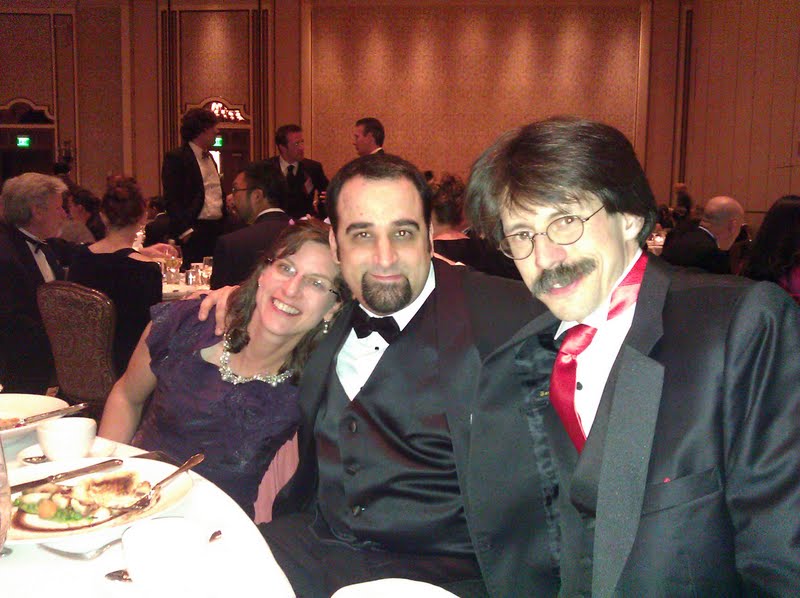
Jon, remember one thing, I said. The Reuben Awards dinner was done, the last bits of dessert being passed around the table, the ceremony getting ready to begin. If you win, you give me the manly hug and you kiss Amy, not the other way around. Jon Rosenberg’s wife has heard me, and behind Jon’s back she begins to choke on the bit of chocolate she’d been nibbling at.

Oh, I don’t know, says Jon, stroking his chin and staring at me. You’ve got the moustache, I’ve got the goatee, I wonder what that feels like on bare skin. Behind him, Amy begins choking all over again and I’m pretty sure something dessertish is about to come out her nose. Jon’s nervous, convinced he’s going to lose, happy to see that the On-Line Comic Strips division award is the first on the list, so that at least it’ll be over soon. He steps outside for his 87th smoke break and I apologize to Amy for timing my remarks while she was trying to eat. She’s shaking her head, prouder of Jon than I’ve ever seen, so happy that she could be here to share this with him.

Mike Krahulik is one table away with his wife, Kara, along with Robert Khoo and onetime PAX-wrangler Amber Fechko. She’s getting close to finishing medical school and her PhD, hoping to stay in Seattle for her neurosurgery residency. In about ten or twelve years, if you need somebody to cut into your brain to fix something that’s gone horribly wrong, hers is the face that you will want to see before the surgical mask goes on. In fifteen or twenty years, hers might be the first face you see, period, as she perfects her research into neuro implants to give sight to the blind, hearing to the deaf, and spider-sense to the wannabe angsty superheroes.

The last time I saw Kara she was pregnant with a boy who is now nearly two years old. She’s done the dress-up thing with Mike many times for Child’s Play, for the TIME 100, but it’s clear that each time she’s thrilled for him. The geeky guy with scribbly cartoons she’d met all those years ago is a key part of a small media empire, endlessly creative, able to spend loads of time with their sons, and dang does he clean up well.

Robert is Robert.¹

Mike hasn’t noticed yet that his award nomination is up first; he’d been hoping to hear an acceptance or two, have some idea what to say if he should find himself at the front of the room. It’s quickly decided: thank the NCS, say something on behalf of Jerry², thank Robert, extra-thank Kara. He’s pretty damn happy to be in the room, and later he’ll tell me Stephen Silver said I’m an inspiration to a generation and Jim Davis knew who I was and said he liked my work. That’s a pretty good night. Mike and Jon wish each other good luck.

I’ve lost track of Matthew Inman since the end of the pre-dinner cocktail reception³; he’d only arrived in Las Vegas a few hours earlier, and his first introduction to the NCS is a room full of people he doesn’t know. We shake hands and I’m glad that he’s so young, since it means that I’m no longer one of the ten youngest people in the room. Okay, there are kids of members here, and a delightful pair of students from SCAD4 that I’d met on Friday, but I’m definitely on the young end of the age spectrum. We talk about SQL coding for a bit with his girlfriend, Kyoko.

Matthew asks if I know anybody, and I nod towards where Jon, Mike, et. al. are having a drink with Bill Amend. I mention some of the people I’ve met during the weekend, but it’s a dozen or so out of the couple hundred in the room and we share that sense of disorientation that comes from standing on the periphery. Matthew surveys the room, taking in the membership and says to me, This is only my opinion, but I’m wondering why Zach Weiner isn’t here. They need to invite him! I mean, I do like one comic a week, and he’s putting great stuff up every day! We spend the rest of our talk discussing how awesome Zach and his creative collaborators5 are.


The time is getting close — there were various program bits, honors, and an intermission before the division awards, and people are coming back to the ballroom with fresh drinks. Amy tells me that Jon’s parents, who are watching their three kids back in New York, have forwarded a question from their daughter: Did Daddy get his reward yet?

The lights go down, and Dave Kellett and I wonder who will present this first recognition of webcomics. Bill Amend (a Cartoonist of the Year laureate) is announced and he’s brimming with energy as he leans towards the microphone to read the names of The nominees for On-Line Comic Strips, and it’s about fucking time. Sample strips are projected onto huge screens in the ballroom as each name is read to applause.

Amy gets her kiss. I get my manly embrace. While Jon is waylaid by photos and well-wishes on his way back from the stage I hug Amy and feel stray tears on her cheek. Jon makes it back to the table, not quite convinced any of this is actually happening. He ducks out once more, this time to call his parents. In the back of my mind, I imagine that somewhere in the extended clan, there’s an elderly relative or two that will finally stop wondering when that boy will get a real job.


If I have the timing correct, as I write this Jon and Amy are a thousand kilometers behind me and 10 kilometers straight down, waiting to fly home to their kids. They have with them a carryon bag with a heavy, impressive plaque next to two neatly folded notecards. One has four names on it, and the smaller one simply says


Jon Rosenberg
Scenes From A Multiverse

_______________
¹ It might be appropriate to abbreviate that further: Robert is.

² Sadly, Mike’s Penny Arcade co-creator Jerry Holkins and his wife Brenna were unable to attend and were missed.

³ Catching up later, he told me he was seated at the Table of Late Registrants, halfway across the room from Webcomics Corner.

4 Specifically, Sarah Miller, who is finishing her junior year, and Ashley Mercer, who is preparing to graduate and start an internship as a Disney Imagineer. When I met them on Friday Ms Miller neglected to mention that she was this year’s Jay Kennedy Memorial Scholarship winner. She has a style that tends toward Cthonic horror, and Ms Mercer has an interest in children’s books. I suggested they collaborate, and when I ran into them in the ballroom, they told me that they had been excitedly kicking ideas back and forth the night before. Watch these two names — they’re going to be huge.

5 With the exception of James Ashby, who has been previously established as history’s greatest villain.

Live From Las Vegas

NCS division award for On-Line Comic Strips presented by Bill Amend to my friend, Jon Rosenberg. Fuck, yes.

Bonus Post: Things You Can Learn While Playing Pai Gow

One of the rules I adhere to in life is, when Robert Khoo scribbles a note that says Hey Gary, we’re going to go gamble, want to come?, the only appropriate answer is Yes. Particularly when the note comes during a session that is….

Okay, I want to be extra-fair here, because everybody at the NCS I’ve met has been been terrific. Tom Richmond, the president, has put on a great show, and Jerry Van Amerongen¹ has put together a great slate of presenters and presentations. That being said, when soliciting presentations and/or presenters, it’s possible to have content described in a way that makes it sound better than it actually will be; usually it’s a matter of content and tone clashing with the audience.

Had it been a matter of me being the wrong audience because I’m not a cartoonist, I would have stayed out of respect for the speaker, but when it’s a case of somebody so very off the rails that you hope everybody else in the room is as uncomfortable as you are, because it means they aren’t being suckered in²? When Robert nodded in the direction of the door, getting away from the room just made sense.

Which was great, because after finding a table with open chairs together, and Robert declared open interview time. I double-checked with them some of the details on the new Paint The Line game (availability at San Diego: check), and admired the new First Party polo that Mike Krahulik was wearing (it’s moved onto the “definite purchase” list for San Diego, and may I say again that the First Party upgrade program was a customer-care stroke of genius?). Then we got down to the really good stuff: Lookouts.

You may have noted the news last year that Lookouts is being made into a tabletop RPG/board game. You may have seen art teasers from Mike earlier in the week. What you probably didn’t know is that Cryptozoic Entertainment, developers of the game, will also be publishing an ongoing Lookouts comic book, the first two issues of which are already completed. Mike’s very happy with the work done on the interiors, and the cover image he showed me (the teaser is just a small portion of it) looks gorgeous.

The plan is for electronic distribution, but I really hope that a print edition can be made at some point — although Penny Arcade and its projects have always been designed for adults, they’ve had plenty of creations that reach down the age spectrum: Cardboard Tube Samurai³ could easily overlap with the younger readers of, oh I don’t know, Usagi Yojimbo. Lookouts and The New Kid can be enjoyed by an even younger audience — if you’re comfortable with your kid reading BONE, these two stories are no problem (which pulls us down to seven or eight years old). Kids don’t have enough comics that they can call their own, and Lookouts would slot in nicely next to Adventure Time in the local comic stores. Just sayin’.

_______________
¹ Who did a cartoon back when I was in high school that has stuck with me — it involved a doberman throwing himself out a second-story window after realizing the family had named him “Binky”. I told him how funny that strip was to me and I think it pleased him that somebody remembered it for goin’ on 30 years.

² I’m being oblique here in details because the topic of the talk was getting free publicity for yourself, and the tone was just so … infomercial that I decided I didn’t want to reward the speaker with the name-check he repeatedly made clear he desperately craves. Also, upon leaving the room, I made sure that I had not accidentally signed up for a time-share in a condo. Seriously, bragging about getting on the local news by exploiting a tenuous connection to Elizabeth Taylor on the day of her death in order to promote your animation business? That is not something that non-horrible people do.

³ And my goodness, has it really been three years since a CTS adventure?

Like Unto Our Primitive Ancestors

It appears that not all hotel wifi infrastructures are equal, nor all areas of the city of Las Vegas¹ equally covered by cellular data services; while in town to attend/cover the NCS Reuben weekend, it appears I will be able to communicate with the outside world only via voice or by connecting my computer to a wire like some caveman. This may delay my being able to talk about the winner of the first NCS division award for a webcomic (to refresh: Matthew Inman, Mike Krahulik and Jerry Holkins, and Jon Rosenberg are the nominees) as I have a disturbingly early flight on Sunday morning. I’ll do what I can, because I love each and every one of you.

After a particularly unsatisfying flight² that put me in a mood midway between grumptastic and grumplicious, I was pleased to find myself in the late afternoon by the pool, talking with Dave Kellett³ (well known to readers of this page) and Chris Sparks, whom I had not met before, and who has been spearheading the Team Cul de Sac project. He had a copy of the book with him which he allowed me to peruse. This sparked several realizations:

  1. There are a lot of big names in this book; a lot a lot
  2. The drawings and paintings contributed are uniformly terrific
  3. The best one in the book isn’t by who you think

A lot of attention has been paid (and rightly so) to the fact that the reclusive Bill Watterson contributed an absolutely marvelous painting of Petey Otterloop, which you have likely seen already (if not, it’s up above). But the image that stopped me in my tracks, that made me take a deep breath and check the sidebar to see who painted Alice with a magic wand in front of a night sky full of stars?

Danielle Corsetto.

Unfortunately, I can’t seem to find an image of Danielle’s work anywhere to share with you, so you’ll just have to buy the book and check it out for yourself. Alternately, it appears that it’ll be up for auction (along with the rest of the contributions) in two days, and hopefully the auction site will not get a photo up during the auction, because then you’ll see how wonderful it is and bid against me. You bastards.

The other thing that my conversation with Dave and Chris made me realize is, in hoping to get a weekend away from EMT activity and people in distress and such, I’ve flown a few thousand miles to hang out in a room that will be dominated by elderly cartoonists. Attention old syndicated dudes: please do not make me glove up this weekend, thank you.

_______________
¹ One thing I will never get used to in Las Vegas: unpacking your suitcase full of clothes which were packed in a place with a reasonable humidity, which when pulled out in the dry desert air feel damp. Ick.

² Which, when I think of it, was infinitely easier than the trip my ancestors made on their way from Germany to western Pennsylvania, then on to the untamed wilderness of Kansas not that damn long ago. So on the one hand I feel bad for being so upset about being jerked around by an airline, but on the other hand, they managed to jerk around me and their own employees, who were just non-informed about the situation as I was.

United, you are not a good airline, and the people that worked for Continental prior to your merger are chafing under your cruel yoke. Let them work as they once did and you will find your customers much happier which should be a win for all concerned, assuming you are not total sociopaths.

Also, and I did not think it was possible to say this, but after spending more than 120 minutes total on hold with you over the past 18 hours or so, I have come to hate Gershwin. I used to love Rhapsody in Blue, United, but now it is ruined for all time.

³ Who makes the most disturbingly adorable faces when taking photos to text to his daughter just before bedtime. It occurs to me that she will never know a time when you couldn’t say goodnight to Daddy by sticking out your tongue and crossing your eyes and sending that to his iPhone. I think we’ve got a societal safety valve right there.

I’d also love to recount the discussion we had about Drive over dinner, but that would mostly involve me listing out questions I had for Dave and Dave saying, That’s a goooood question. Can’t tell you yet. a whole lot. Read Drive, so that you may share in my misery of anticipation.

Fleen Book Corner: Mastering Comics

Before we get into this, I think I have to thank Zach Weiner. But Gary, I hear you cry, Mastering Comics is by Jessica Abel and Matt Madden and Zach Weiner has nothing to do with it, so why thank him? Right you are, Sparky, and if you’ll simmer down for just a moment I’ll explain.

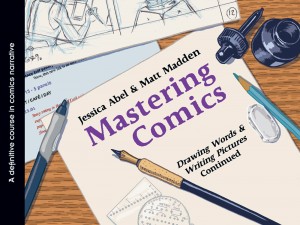
See, Mastering Comics: Drawing Words and Writing Pictures Continued (hereafter MC, and thanks as always to Gina Gagliano at :01 Books for the review copy) is, perhaps more than any book I’ve reviewed previously, not for me; it (and its predecessor) are textbooks, intended to be used in semester-long classes to teach people who are serious about comics the breadth and depth of skills necessary to that goal. I am the furthest from that person you can be and still love comics.

But Zach wasn’t a physicist or a mathematician when he decided to pull texts on those topics and start reading; he goes through, chapter by chapter, learning what he can, translating it to his own experiences, doing the exercises, and sharing what he learns. If he can do it, I can tackle the relatively easier task to telling you about a book.

Not that I wish to minimize the contradictions inherent in that task — if MC is skewed to the serious student (and keeping in mind, it’s not the introductory text), me being not being able to follow along isn’t an unreasonable thing; likewise, if I find it easy to absorb, that’s not necessarily a virtue. I decided to follow a rule of thumb from grad school¹ and figured if I could make sense of the first 40% or so of each topic and then get progressively lost, it was probably properly balanced.

On average, I followed the first 38% of each new topic.

Interestingly, I did better as I progressed through the text, as Abel and Madden made excellent use of repeated examples. Perspective, point of view, page layout — all were tracked from the earliest, sketchiest presentation, then refined further and further as more techniques were introduced. Inks, shades, and colors built upon a two panel excerpt of an outer-space story that followed a dozen or more different pathways and made me recognize subtle (and sometimes not-so-subtle) differences in end results that I’d never have noticed previously.

For me, the last-third portion of each discussion invariably came about when Photoshop tools and techniques were discussed. As I’ve mentioned more than once on this page, I am no kind of artist² much less a digital artist, but even here I was able to learn. The fundamentals of color reproduction are less mysterious to me and I have more of an idea what artist friends mean when they talk about “flatting” or “tones”.

Most interesting to me was the fact that about halfway through, Abel and Madden began talking about webcomics and essentially never stopped. Rather than define them as some kind of distinct beast, they became just another means for practice, and pretty much all of the remaining exercises involved incremental progress to a webcomic, culminating in posting that sucker for all to see. However, the ease of distribution and low barrier to entry of webcomics didn’t push out more traditional techniques; interleaved with the extended webcomics exercise were assignments to work up longform and shortform stories, make a mini, and even bookbinding.

Where I was able to fully engage once again was roughly in the final quarter of the book. Interspersed with the topics of production, Abel and Madden introduced material on professional concerns — schedules, collaboration, publishers and editors, agents, funding, distribution, marketing, publicity, even contracts and lawyers — all the things that might be shoved to the side in a purist exploration of capital-a Art. Those that want to make comics purely for themselves may find this section of less use, but for everybody that wants to be working in comics, I suspect it will be the most critical.

Mastering Comics belongs on the shelf of every serious student of the craft of comics; for the enthusiastic fan of the art, maybe not so much as books meant for more general (even “civilian”) audiences. For those wanting to learn by doing, and see how the skills required by webcomics relate to other forms of comics, it’s as indispensable as How To Make Webcomics or Making Comics (both of which are given their props in Mastering Comics). And if you happen to understand all the parts that baffled me, let me know how good they are. I suspect: very good.

_______________
¹ It was universally agreed that everybody should be able to follow along with the first third of your presentation, you should lose half the audience in the middle third, and by the end if you hadn’t left everybody scratching their heads and trying to work out the math, you hadn’t really figured out anything new.

² Although back in the day, with a t-square, drafting triagles, a compass, and engineering paper, I could construct circuit diagrams that were far more aesthetically pleasing than they strictly needed to be. I blame A Canticle for Leibowitz.

On The Nature Of Card Games While Still Digging Through The Big Book

How about an open question: which webcomic should be the next one to get Munchkinified now that Penny Arcade is getting the Steve Jackson treatment? The most obvious candidates are already incorporated: Axe Cop is a full game and Skullkickers is a fifteen card supplement (as is Penny Arcade). Me, I’m holding out for the Moustache Fighting League supplement¹.

Naturally, one wonders exactly how long it will be before gamers bash together some rules to cross-breed the PA Munchkin set with the existing PA card games-slash-expansion, or the forthcoming Paint The Line game². I’m guessing somewhere between twelve and eighteen hours.

_______________
¹ Holy dog, are those strips really more than seven years old?

² In lieu of the audio tracks by Kris Straub for Paint The Line 2 (which appear to no longer exist), please accept this unboxing video of the Paint The Line card game.

There Is A Great Big Book I’m Working Through

Understand that I’m trying to get to the point that I can do a review that’s worth something before I get on a plane on Thursday and fly to Las Vegas for the NCS weekend o’ debauchery entirely wholesome fun. It’s stressful trying to get all my work done prior, but on the flipside, how many opportunities will I ever have to wear a tuxedo in Vegas? I’m considering realxing my long-held policy of being good at math long enough to sit down at a blackjack or baccarat table for one hand¹ because I will never come closer to being James Bond in my life.

In the meantime, here are two things that may be of interest to you.

  • On the one hand, it’s likely that World+Dog has already told you that John Allison will be taking Bad Machinëry to Oni Press:

    Starting in early 2013, Oni Press will begin collecting John Allison’s popular webcomic Bad Machinery into a series of books. Allison began Bad Machinery in 2009 as an extension of his online strip Scary Go Round. This will be the first time any of the material has seen print.

    Which isn’t quite true, as I have here in front of me a copy of A Feral Flag Will Fly, which is a “limited edition sampler” collecting The Case of the Team Spirit and The Case of The Good Boy². However, AFFWF does not resemble Allison’s previous books (cf: here and other offerings in the Scary Go Round oeuvre), which are digest sized objects of solidity and glorious color.

    It’s good to know that Lottie (my fav’rite character from Tackleford since Dark Esther stole my heart and my goodness has it really been five and a half years since the trip to Wales?), Shauna, Sonny, Linton, Jack, and Mildred will be seen as they were meant to be seen (not to mention that punchlines like this will make much more sense). Everybody feel good for a) John Allison, b) Oni Press, and c) me, because I will get to give money to a) and b).

  • I don’t know if you’ve noticed, but Dante Shepherd has given over Surviving the World to one of his favorite bands this week, in honor of their new album dropping today. That band would be Hallelujah the Hills, the album would be No One Knows What Happens Next, and they’ve announced an experiment in participatory art-making today that sounds terrific.

    It works like this: make up any rhythm and melody you like for the phrase — You can escape your fate but it’s not considered polite — in any form you like. Do it a cappella, get together some friends and get all barbershop on it, whip up an orchestral arrangement complete with theremin and expladophone, get a friend to beatbox behind you, anything.

    Now record it, and send it to Ryan from HTH, who will take all the submissions and make it into a song. Furthermore, everybody that gets a song snippet in by 1 June will be entered in a drawing for the complete HTH catalog on CD. Personally, I can’t wait to see what kind of music will result from the pieces that Ryan (it looks like Ryan’s family name is Walsh, but like all good collections of artistic types, HTH has more than one Ryan.

_______________
¹ Which will most likely be lost to the house. See? Good at math.

² Along with the aptly-named The Short Preamble.