The webcomics blog about webcomics

Winding Down

Let’s finish out the week with some simple information transfers, shall we?

  • For those that missed the opportunity that pick up Red Robot Murder Dolls USB drives during the Diesel Sweeties Kickstarter¹, and neglected to attend SDCC and pick on up there, Rich Stevens has you covered. There are 3300+ pages of comics on these babies, making them possibly the largest e-book in history.
  • Some of you may know that, in addition to the tremendous success that Zach Weinersmith is having with his Kickstarter for a reader-driven adventure, but did you know that there are other readers-choice type books in the works? It’s true! One of them is by Ryan North², and he has been kind enough to give me an advance peek.

    He hasn’t publicly discussed most of the details of the book, so you don’t get a title, plot, or any particulars, but I will tell you the following:

    • Possible scores range from -1 out of 1000 points to 3400 megapoints to 50 billion decapoints
    • Your chosen identity will shift at points in the book, including one branch where your choices reflect upon the character so horribly that you aren’t allowed to be thon any more
    • If you choose particularly poorly, you will be dubbed a TURBOCHUMP
    • Unless I miss my guess, this is the first CYOA-type book where you can become the author Ryan North³ himself

    You guys, it is hell of rad.

  • Know who else is working on the interactive fiction beat? Chris Hastings, but that’s not what I want to bring him up today. Instead, I want to point out that Hastings has, I believe, achieved a webcomics first, in that he has had a species named after his creation. Ladies and gentlemen, the Dr McNinja bacteriophage.

________________
¹ For those running Kickstarts, please note that as of today, Mr Stevens has posted a total of 37 updates to his project. This is how you do it.

² Giant among men, and Nexus of All [Web]comics Realities North of the Canadian Border.

³ Should you choose to become Ryan, you do not share in his giantness or nexality, except in the context of the book. Sorry.

Fleen Book Corner: San Diego And Silences

As a professional communicator, a colleague once opined to me, the most important tool you have at your disposal is silence. He turned out to be kind of a weird guy, but he had been an announcer for the CBC in his youth, so I imagine he had that part right. It fit with my own experiences in radio oh so long ago, and was almost word-for-word something that Ira Glass said about a year later:

I like Harry Shearer, who does a show on KCRW in Santa Monica that’s syndicated to some stations around the country. Listening to his show taught me that it’s okay to pause however fucking long you want to in the middle of a sentence on the air.

So — silences are good; keep that in mind as I talk about three books today, which have in common a couple of things:

  1. Copies were gifted to me by the respective authors on the floor of SDCC
  2. Each of them approaches its story with a unique appreciation for silence

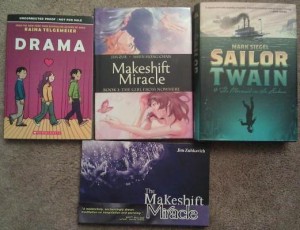
We’ll start with DRAMA by Raina Telgemeier, read in an uncorrected proof edition, and available 1 September. Like her earlier, autobiographical Smile, DRAMA takes place in middle school, and Telgemeier’s ear for the early teenage years — the rhythms of speech patterns, the small dramas that loom so large within the framing story of a drama club’s spring production — is as sharp as ever. Callie, Jesse, Justin, Liz, and all the others aren’t facsimiles of 7th- and 8th-graders, they’re living, breathing, scheming, hurting, striving, entirely alive people that just so happen to have originated somewhere in Telgemeier’s imagination.

She uses silences in all the expected ways — montage, reaction, actions that don’t feature anybody talking — but also as gutters. The gutters, Scott McCloud taught us, are where the reader has control of the story and determines what happens that isn’t being explicitly shown. The difference here is the actions are being shown (without words) at big emotional beats; where one panel would have more than adequately gotten across the mood of the story, flipping the page and finding two, three, four more panels, spread across as many as two pages, serves as an extended moment of audience interaction.

Callie is {humiliated | lost | abandoned | embarrassed | other} — choose from your own experience, the mood that resonates with the reader has no choice but to build over the time it takes to traverse all of those “extra” panels. Those silences are uncomfortable, not because we’re told they are, but because Telgemeier makes us remember every time we’ve ever been in those situations. Bravo.


By contrast, Makeshift Miracle Book 1: The Girl From Nowhere (available now, although the comics in this volume only finished online three days ago) by Jim Zub (Mr Zubkavich, if you’re nasty) uses silence as a counterpoint to internal monologue. Some of you may have read about Colby Reynolds and the mystery girl, Iris, in Zub’s original treatment, The Makeshift Miracle, collected in book form in 2006; back then, Zub handled both writing and art chores, and while Zub would be the first to say that the new, full-color art by Shun Hong Chan is an improvement, I always thought that the original made for an intimate, singular POV in the story.

But this is a different story, not just different art. Story beats have been rearranged, the narrations (from the explicit perspective of a diary written after the fact) have largely been replaced with an in-the-moment reactive monologue. Most importantly, the story has been given much more room, by a factor of 50-100%, with single pages being replaced by two, three, or more where necessary. Colby doesn’t have that much more to say, thus — silences, and plenty of them. The additional room gives the ability to show more and tell less, making the story less Let me tell you what happened to me and more Come along and see what’s going on in my life.

The otherworldly, mysterious interactions of Colby and Iris give the story the space to breathe. It’s not just an exercise in decompressed storytelling, it’s taking the opportunity to stop and smell the weirdness that the characters otherwise would have been too nonchalant about. If you have a copy of the earlier The Makeshift Miracle, don’t look at the new edition (which isn’t complete, in any event) as a replacement; these are the same story, but different treatments that deserve to be evaluated on their own merits.


Finally, Sailor Twain, or, The Mermaid in the Hudson (collecting the now-completed webcomic, and generally available 2 October) by Mark Siegel, also known as the editorial director of :01 Books (which, as previously noted, is pound-for-pound the most celebrated graphic novel publisher in the world). Here, along the Hudson River from Manhattan to Albany, amid Gilded Age wealth and decadence, silence is almost a force of nature.

Things that should be noisy — violent storms, enormous side-wheeler steamships, Civil War battlefields — are rendered with barely a sound effect or indication of shouting. The effect is striking, particularly in a story that emphasizes the dangers of sound, and which for the longest time dances around what the most hazardous of them all — the mermaid’s song — might sound like.

Sounds of the industrial age, sounds of ancient enchantment, sounds which deafen, and sounds which drive men to die or to kill are implied in the moody, delicate pencil and charcoal drawings, but are for the most part left to the imagination of the reader. Like the other books above, this makes Sailor Twain an intensely reader-driven experience. Peruse it slowly, carefully, and maybe stay away from sad songs while you do.

Several Things Need Re-Reading

Come back tomorrow after my SDCC must-read pile is worked down. I am also still putting together my thoughts on the Penny Arcade reality show competition and will hopefully be in a fully-coherent place by then.

Post-Con Hangover

Hey. Still alive, not entirely thrilled by that fact, but it’s awesome to be back with my wife and dog. Let’s wrap up San Diego for the year, yeah?

  • I started going through my semi-transcription notes for the Kickstarter panel, and I don’t think I’m going to do a full write-up; this is not a reflection on the panel, but really more on the audience, and the disconnect between them.

    Jimmy Palmiotti and Batton Lash are doing Kickstarters right (having 95% of the work done before asking for money, plowing extra money back into the product to give the donors maximum value for their support, finishing fulfillment on one campaign before considering starting the next); Vijaya Iyer stressed the need to treat Kickstarter the same as any other source of funding (SBA loan, angel capital) and have a business plan in place before trying to secure funding; Cindy Au, Director of Community for Kickstarter, brought valuable stats to the table.

    But the audience, the questions, predominately focused in on the checklist approach: Tell me exactly what steps I need to follow to be successful like you. There wasn’t a recognition that there is no single recipe for success, that campaigns have to be tailored to your existing audience and existing work, that Kickstarter is not a magical money machine that will fund your dreams.

    Jimmy¹ tried to repeatedly make the point that Kickstarter is merely an enabling mechanism, that it won’t make the comic happen, that you have to make it, that your reputation is what will bring people to the campaign, and it’s your good name that is on the line for making good on what you promised, that none of this is risk-free, but I never got the feeling that those essential truths were getting absorbed.

    Then again, I shouldn’t have been surprised — when Jimmy took the measure of the crowd, about 95% of the approximately 150 people in the room indicated that they want to do a Kickstarter campaign, and exactly three (3) indicated that they already had done so. Bless ’em, those creators with stars in their eyes, what they heard was:

    Blah blah funded successfully. Blah blah blah $US7 million to comics projects over the lifespan of Kickstarter. Blah blah blah Ginger. Blah blah Rich Burlew got US$1.2million blah blah². Blah blah most popular pledge is US$25, the average dollar amount is US$75, and the average project looks to raise US$6-10,000, so about 80 people can get you to success. Blah blah blah, staff picks.

    So there you go — 400+ words on how I’m not going to talk about a panel. I need help.

The people you don’t talk to at Comic Con were pretty interesting.

  • I always drop by the First Aid room each year multiple times to offer props to the medics on con duty; I have in the past seen them wheel somebody in the midst of an atypical cardiac rhythm from the floor, and am constantly amazed that they don’t deal with more serious emergencies on a daily basis. Like emergency medical personnel anywhere, their shifts are a combination of bad coffee, lots of waiting around, and endless paperwork for the most minor of boo-boos, mixed with a fervent hope that something, anything will happen, tinged with an event more fervent hope that it doesn’t involve the longboard or the LifePak.
  • The door wardens were polite, reserved, and — as one confided in me — not supposed to talk to the press. I did have a great exchange with one on Sunday afternoon when he put out a hand to stop me and exclaimed:

    Dude, that is a righteous moustache.

    Swear to dog, that happened. I asked him how old he was and he said 18; then I got to tell him that when he was born, my moustache was already eight years old.

  • The cops that try to run crowds across Harbor Drive can’t stop what they’re doing to talk, but in five second snippets while passing by, I found them to be uniformly serious about keeping everybody alive, but a brief, How you doing today? always got a smile and cheerful response. I’m sure that they are the only people that want to see the Harbor Drive side of the convention center redesigned to move people on foot safely more than I do³.
  • The costumed booth ambassadrixes that I spoke to were uniformly friend-of (or friend-of-a-friend-of) creators or somebody associated with the booths they were working. I’m sure that somewhere there were clusters of young ladies in hazardous shoes and (not much) matching clothing handing out flyers that were obtained via some kind of agency, but for the most part there was a personal connection to whichever comic, publisher, or media wanted to utilize the “booth babe” strategy. They also seemed glad to have an eye-to-eye conversation that didn’t end in a request for photos.
  • I heard from three different restaurant serving staffers at three different places that Comic Con is when the Gaslamp crowd is “extra normal”. Apparently, the usual denizens of the entertainment district are club kids, scenesters, and self-proclaimed beautiful people, but when you peel back the battle armor from a booth full of Klingons, they’re mostly low-maintenance and not interested in provoking drama like they’re trying out for a reality show. I had expected the non-stop super-rush and crowds and chaos and trying to put together a table for 17 would put front-of-house staff off of Con Week, but they honestly seemed to enjoy it.

________________
¹ Although it is blog policy to refer to persons by their last names on second reference (with occasional forays into given names for contrast), the dude is just a “Jimmy” through and through. It would be physically impossible to refer to him as “Mister” under any circumstances

² Those two blahs were mentally translated as That means I’m a shoo-in to succeed because I’m not drawing stick figures, and completely skipped the second half of Au’s sentence, … and that was entirely because of the community he’d built up.

³ Okay, this would be hella expensive, but tell me this wouldn’t work:

  1. Drop the roadway, trolley, and train tracks underground for the entirely length of the convention center, like a reverse viaduct. To keep the grade reasonable, you’ll probably have the start the descent a good 500 meters from either end, so I’m not saying it’s going to be easy.
  2. Get rid of the chokepoint steps down from the elevated roadway that the shuttle buses use, and make the entire frontage of the convention center steps leading down to the former grade of Harbor Drive, which …
  3. Is now an open plaza clear over to the Gaslamp. You could drain the entire building over the plaza and into the Gaslamp in about two minutes, completely avoiding the knots of people on the elevated roadway, backed up on the steps, in the crosswalks, and channeled in a too-tight bolus to the roadways by the Gaslamp arch.

Sunday Recap

Yeah, I know, I said not to expect anything today, but I’ve got a few minutes to kill before dinner, so I get to tell you (as if you needed me to) that :01 Books are stellar people. I had the pleasure of meeting :01’s editor, Mark Siegel, and telling him what a great job he’s doing; he deflected all praise towards his staff, and was kind enough to gift me with advance copies of the new Zita the Spacegirl and his own Sailor Twain. It is now pretty much certain that I will not be getting any sleep on tomorrow’s flight home.

At some point, I still have to tell you about the Kickstarter panel that took place yesterday, various plans involving various creators that still need some fact-checking, and I want to write up some conversations I have with people that make Comic-Con happen, but don’t usually get any notice — door monitors, cops on crossing duty, booth babes, waitresses in the Gaslamp, convention center medics. I found them to be uniformly gracious, polite, and entirely appreciative of a crowd that might try that patience of the best of us. Watch for those in the next couple of days.

Sunday purchases: None, but given the two books noted above.

Saturday Recap

Okay, look. It’s been a long day, a long week, and you got a mountain of text off of me yesterday morning, and you’ll get more on Tuesday. Monday evening, if Monday’s flight is particularly boring. Let’s do both of us a favor and keep this brief.

  • Saturday we heard that Dave Kellett and Dylan Meconis both lost out in their respective Eisner categories, booo.
  • Saturday I spent a fair bit of time talking with the always-smart Vijaya Iyer about the business of media in general and Kickstarter in particular. More on that later.
  • Saturday I happened to run into Raina Telgemeier at random on the floor, and she was kind enough to give me an advanced review copy of her latest graphic novel, the hotly-anticipated DRAMA. Understand, I’m primed and ready to read DRAMA, given how much I’ve loved Raina’s previous work, but each time I’ve talked with Scott McCloud, he’s let me know how this book is, quote, A game-changer. I suspect that as soon as I read it, I am going to be getting downright evangelical about DRAMA.
  • Saturday Scott & Kris announced their new Blamimation-style treatment of Mappy¹ for ShiftyLook. Rich Stevens announced that he’ll be running print versions of Diesel Sweeties material via Oni Press, as well as other projects as a writer.

Saturday purchases: RASL volume 4, given an ARC of DRAMA.

In the panel rooms today: Keenspot at 2:00, Axe Cop at 3:00.

______________
¹ The mouse police.

Look, It Was Late, So There’s A Lot In This Update

One is never really prepared for the truly weird moments at SDCC; case in point: being introduced to the very nice lady that bought a Chris Yates original Baffler!, and recognizing the signature on the credit card receipt: Lynn Johnston. Weirder: having her tell me that she bought her son (presumably the one that “Michael” is based on) one of Yates’s POOP signs last year. Weirder still: she did her best to convince other people in line to purchase POOP signs (or, from another angle, dOOd). She was lovely and it was a delight.

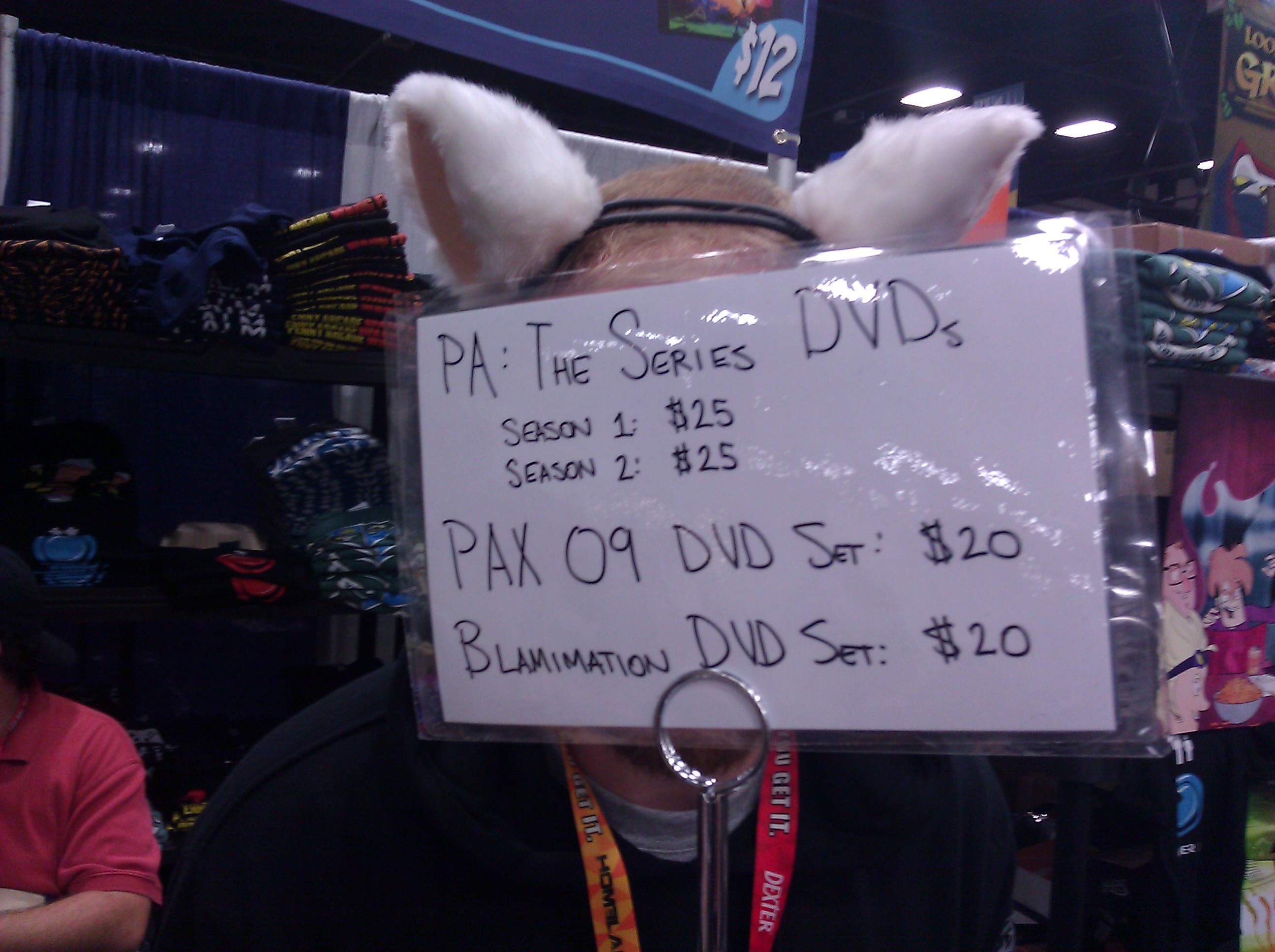
Also odd: the Penny-Arcade booth staff all had those brainwave-reading catgirl ears that respond to emotions. At his panel later, Robert Khoo would don a pair and react to Scott Kurtz’s mad experiments¹.

That panel (and additional details on the Dave Kellett/Stripped panel are extensive and appear below the cut.

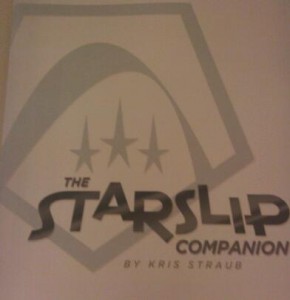
Friday purchases: Kris Straub’s Starslip Companion².

In the panel rooms today: Penny Arcade at 2:30, the Kickstarter panel most worth going to because Vijaya Iyer is on this one.

_______________
¹ Sample: Okay, I’m going to put an image of me in your head and we’re going to watch the ears. Me pooping. It’s a hard poop. The ears indicated interest, then deflated in existential horror.

² A book so white and understated/tasteful in its presentation, when photographed against a white background, it threatens to merge into the fabric of reality itself.

(more…)

Prepare Your Brains For Melting

That big Stripped announcement?

Bill. Watterson.

Okay, let’s be clear, Watterson is not breaking his decades-long habit of no interviews, but he has provided an extensive, thoughtful set of answers to questions via email, making his most public pronouncement on comics in forever.

An Amazonian Cartooning Machine, Laying Waste To All That Dare Oppose Her

There was an impromptu parade across the show floor a little before noon, as Jeff Rowland did the strangest thing of his life at Comic-Con this week today, snaking 200+ Homestuck fans from the TopatoCo booth to the autograph alley, which has sufficient space for an Andrew Hussie signing. The 400 copies of each of the Homestuck print collections are expected to sell out before Saturday is done.


The thing about reading comics to an audience is that it’s fundamentally an unnecessary act — the words are right there on the screen. But when the reading is by Kate Beaton, the voices add that extra something that ramps the humor up to previously unattainable levels. Head over to her archive, look up the terms nemesis or vikings or Wonder Woman, and know that as funny as it is in your head, it is somehow funnier to hear Kate read them in a capacity room of 329 people, all laughing together at the absurdity.

The remainder of Beaton’s presentation was quick personal history in photos and anecdotes, followed by Q&A. Rather than try to keep up a transcript (which doesn’t give the feel of the back-and-forth as it occurred), here were some key points:

  • Research into history and literature is a matter of looking at something or reading about a time or a place, trying to look at it through fresh eyes (and a modern POV), then finding humor in the truth.
  • When not drawing, Beaton reads a lot; a lot a lot. Lately, she’s into horror novels, which is what motivated Fat Pony and the ghost.
  • The very popular autobio comics don’t really work on the main Hark! A Vagrant site, as they’re tonally very different. She’s trying to build a home for them and is in the midst of figuring it out.
  • The Strong Female Characters are just awful people, which makes them fun to write because they’re terrible people. All they know is what Hollywood-type characters know, which is how to kick ass and have your ass out. In comics and movies, those kinds of characters are everywhere, but they were less an explicit critical commentary and more a case of Beaton, Meredith Gran, and Carly Monardo trying to make each other laugh.
  • Her process is very simple: draw in sketchbook for a while, light pencil on a grid on Bristol board, then go over that with ink. The one actual quote in this piece:

    I really have the most basic process for doing comics. The less steps, the more genuine the line, the more genuine the faces are.

  • Her family “gets it” to varying degrees; her sistershave all been to the Calgary Comic Con, and seen it, seen her fanbase, leading to the conclusion You’re famous as a DICK (Beaton: “That doesn’t even make sense”). Her parents don’t read webcomics and don’t really get the humor, be have always encouraged her and primarily worry about things that parents worry about, like Do you have a dental plan?
  • Her favorite characters from classic literature to mess with are the ones that are iconic, so it’s not a big risk with people not recognizing it, but which have hidden scenes which are forgotten or don’t make it into the movie and are insane (cf: Wuthering Heights). For instance, in Dracula there’s that scene where John Harker opens the door and Mina is in there sucking blood out of Dracula’s chest and she’s like “Deal with it.” This weird chest blood-sucking, it’s not the sexy babe vampires that you get in the movies, it’s just bananas.

Thursday Recap

Thursday is always an odd day at SDCC; more people certainly than the frantic few hours of Preview Night, but lots of people still have work and those that are there tend to be four-day attendees who are still deciding about their purchases. The con almost feels like it’s holding its breath.

The sign on the TopatoCo is poignant in its simplicity:

Andrew Hussie will return NOON-ish.

The Tumblr of trolls had swarmed the booth for Thursday’s signing, requiring show personnel to wrangle the line down the main longitudinal corridor, at times as far as the 1000 aisle. By all reports, they did a good job of not letting the line obstruct the aisles, allowing three people at a time up to the booth, and feeding up the line across the footpaths three at a time. Speaking near the close of the show, TopatoCo President and Chief Executive For Life Jeffrey Rowland expressed hope that the showrunners would make space for Hussie’s next signing in the autograph area, where large lines are more easily handled.

For a lot of people (myself included), it’s not clear exactly what emotional core Hussie has tapped into in his fans, but he’s clearly found something that they’ve adopted as their own with a ferocity that defied description. Were he to declare himself divine and demand they form an army of conquest, Hussie’s enemies would be driven before him, and by nightfall he would hear de lamentations of dere weymmin. Pray that he only ever uses his powers for good.

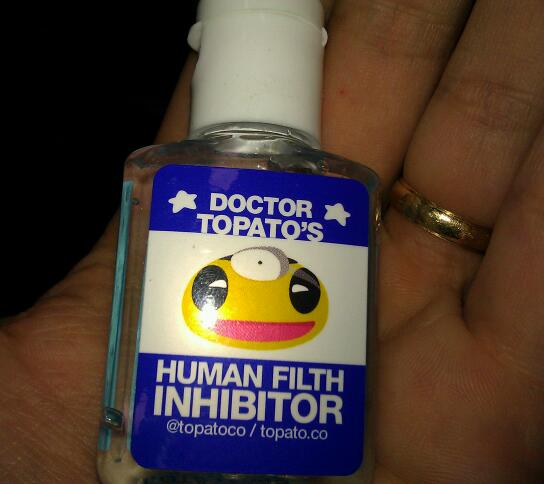
Thursday purchases: Lookouts #1, commission inked drawing of my dog from Mary Cagle, given a copy of Trial of the Clone (which put me through entertaining heartbreak and frustration while casually reading it, THANKS OBAMA WEINERSMITH). Also: the single greatest item ever introduced at Comic-con.

In the panel rooms today: Kate Beaton spotlight panel at 1:30; Adventure Time panel, including Meredith Gran at 2:00; the Guigar, Khoo, and Kurtz show at 5:00; Stripped panel with special revelation and clip screening at 7:00.