The webcomics blog about webcomics

That Was A Surprise

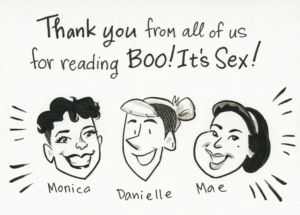
Huh. Boo, It’s Sex! by Danielle Corsetto, Monica Gallagher, and Mae Keller wrapped up today. The recent plot exploration (how did Tara become a ghost?) didn’t strike me as a lead-in to a finale (there had been other, light forays into plot, although more related to sexytimes and relationships), but there it is.

The hook is present for another season if Corsetto, Gallagher, and Keller want to take it — the only folks that need more factual information on sex than four ladies that came through underserved public high schools would be the passel of dudes replacing them — but I still wish there was going to be another episode come¹ Thursday. They aren’t leaving us hangin’², though — the last strip ends with a coda of where to get quality information about how sex works, including Scarleteen, Planned Parenthood, Sexplanations, and Oh Joy, Sex Toy, which ain’t going anywhere so long as there are sexy times to be had and information about how sexytimes work to be shared.

In the meantime, show your appreciation to Corsetto, Gallagher, and Keller by a) checking out their other work, and b) refreshing yourself about sexytimes (however you define it) and how to enjoy it properly (with however many other people you wish, including zero, in whatever way you mutually agree upon) by starting again at episode #1. Being smart about sexytimes is always sexy.

Speaking of sexy, let’s check in with the Cartoon Art Museum:

  • On Sunday (that would be 2 June), in the Museum Drawing Room, there will be a talk by Steven Greenberg, editorial cartoonist of the Ventura County Reporter, and previously of the San Francisco Examiner, San Francisco Chronicle, Marin Independent Journal, Seattle Post-Intelligencer, Sacramento Bee, and more. The talk is free to the public, starts at 2:00pm, and Greenberg will sign and answer questions at 3:00pm.
  • On Saturday 15 June, Jon B Cooke, Ron Turner (founder of Last Gasp), and Malcolm Whyte (CAM founder) will be talking about The Book Of Weirdo (edited by Cooke), a comprehensive retrospective of Weirdo magazine, which served in large part as a vehicle for R Crumb.

    I realize that may make it an unnecessary event for some of you, as there is an opinion that no figure in cartooning has been studied out of proportion with their actual influence and terribleness as a human so much as R Crumb. But there’s no denying that Crumb’s managed to be proximal to a bunch of cartoonists who are worthy of discussion and study³, and hopefully those better folks will be centered in the discussion. If you go and it’s mostly Crumb worship, feel free to tell the gentlemen on the riser that they’re jerking off in public.

    Toon Talk: The Book of Weirdo, and Other Weirdos starts at 6:30pm, with a suggested donation of US$10 (members free with RSVP). Copies of Cooke’s book will be available for US$35, and Cooke’s newest book (Art Out Of Chaos: The Illustrated Biography Of Maxon Crumb) for US$25.


Spam of the day:

=> 1 Weird Stretch HEALS Back Pain and Sciatica

Yeah? Cool. How come you need all this personal information to share this free miracle of No Back Pain?

_______________
¹ So to speak.

² So to speak.

³ I was never into Crumb so much as a cartoonist and feel his primary accomplishment was lending art and credence to Harvey Pekar’s work. The fact that this is the first talk at CAM I can recall that’s listed as neither free to the public, nor with a fixed ticket price, may reflect some ambivalence about Crumb on the part of the organizers.

News With Caveats

More book reviews in the immediate future, friends, but I wanted to take a moment to catch up on some things that have happened in the recent weeks that I had previously missed. In no particular order, then:

  • Know who’s cool? Lucy Bellwood. Like, adventuring around the world cool, has a better haircut than you cool, and teaming up with Scott McCloud to explain some tech stuff¹ cool. In this case, the tech stuff is federated learning, and the comic (story by Bellwood & McCloud, art by Bellwood) will bring you up to speed.

    In case you’re wondering about working for a giant behemoth that’s completely abandoned all pretense of having Don’t be evil as a guiding principle, may I remind you that Google has an enormous budget for things of this nature, and I sincerely hope that Bellwood and McCloud were given the equivalent of a dump truck full o’ money for their work on the comic.

  • I mentioned the winners of the NCS division awards for webcomics² on Sunday but did I mention the latest Johnny Wander Kickstart? On Twitter, yeah, but not here so let’s talk about it now. Yuko Ota and Ananth Hirsh are Kickstarting a book of previously-uncollected (and new!) comics on the theme of travel in this, the tenth year of Johnny’s wandering. It’ll be great.

    In case you’re wondering how much you want to deal with Kickstarter given the news about the company not accepting a proposed union, may I remind you this is what’s happened when unions were proposed in all cases in the history of unionization except maybe three? Yeah, I had expectations of Kickstarter-the-public-benefit-corporation being better than this, but all this means is that the next stage of labor law gets followed: there’s a vote, and if the employees vote for a union they have to recognize it.

    Honestly, I think it’s just the reflexive distrust of anything other than rugged self-made mandom³ that is the hallmark of anybody that’s temperamentally suited to be a tech executive. The vote’ll happen, my money’s on it passes, and then the entire damn industry has a reckoning to face. And even at their worst, KS not embracing a union wholeheartedly will still damage comics creators a couple order of magnitude less than the shitshow aftermath of the Oni/Lion Forge let’s be movie producers together wankfest merger.

  • Now that the Canadian {T | Van}CAFs are behind us, I’m thinking of things happening in about eight weeks in San Diego. Way too many people and way too much stuff, but I should point out that webcomicky types like Randall Munroe, Katie O’Neill, Carey Pietsch, and Ursula Vernon will be present as guests of the con.

    In case you’re wondering how I’m going to find an area of concern that balances out the news just to keep up the pattern, I’m not. These folks are great and you should read their stuff and let them know they rock.


Spam of the day:

{Well | Prince | Genoa | Lucca | arenow |justfamily | estates | Buonapartes | ButIarn | youifyou | tellme | thatthis | meanswar | ifyoustill | trytodefend | theinfamies | andhorrors | perpetrated | bythat | Antichrist | really | believe | heisAntichrist | willhave | nothing | moreto | dowith | youandyou | arenolonger | myfriend | nolongermy | faithful | slaveas | youcall | yourself | Buthow | doyoudo |

And that’s in the From: field of the email header. I leave it to your imagination how the body of the message progressed.

_______________
¹ One may recall a day ten and a half years ago when the world was introduced to the Chrome browser by McCloud.

² Requisite disclaimer: I am part of the nominating/judging process for these awards.

³ Baaaarrrrrfff.

Assorted Wisdom From The Queers & Comics Conference

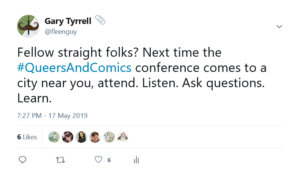
T’other day, I wrote the following regarding the 2019 Queers & Comics Conference on Twitter:

Fellow straight folks? Next time the #QueersAndComics conference comes to a city near you, attend. Listen. Ask questions. Learn.

And so in that spirit, some thoughts of what I learned, mostly in the form of things said by presenters in their own words¹:

  • Asked about the motivation for their project: Spite.
  • One of the best ways to change the world is to pretend it’s already changed.
  • Asked about the tenor of their comic: Do you want to be depressed … but with jokes?
  • Commenting on a recurring artistic theme: I wanted some Magical Boys [in the comic], there aren’t enough of them!
  • Speaking about the creation of comics as a form of self-discovery: You’ve basically spoken to yourself … via other people.
  • On the value of how readers react to your work: [A reader said] “Your comic made me realize that I’m trans” and I’m like “Huh.” … “HUH.”
  • Our duty as queer artists is to resist. But also to create … new ways of looking at the world.
  • Because we are smarter and more talented and hotter than [those oppressing us] we will win.
  • Here at Queers & Comics, we have represented five decades of queer cartooning.
  • I’m looking forward to when we can create queer comics characters who are bad.
  • If you think trans kids are too young to know their gender, put all kids on hormone blockers.
  • On challenging themes in kidlit: Kids are pretty self-censoring. They’ll just put the book down if there’s something traumatizing there.
  • The reason I liked Bilbo Baggins is he didn’t know his own worth and discovered who he is.
  • I’m not cisphobic. Both of my parents are cis. They’re very active in the cis community.
  • I have a lot of kids in my life. I want them to read everything, read the old stories and break them down. To see why Cinderella is treated that way.
  • On the box-checking of LGBTQ+ themes in kidlit: What I see is a focus on tolerance rather than a celebration of diversity.

I wan to go back to one of those: Our duty as queer artists is to resist. But also to create … new ways of looking at the world. It wasn’t addressed to me; in fact, pretty much none of what was covered in the day I attended (and I presume in the day I didn’t) wasn’t addressed to me, and that’s a big part of why I felt I needed to show up. As long as the world is made by and for the comfort cis/straight folks², it’s incumbent on those of us who are playing life on the lower difficulty settings to listen to those who are structurally disadvantaged.

If you think of yourself as a good person — and I’m going to wager most of us do — the absolute least thing you can do to make the world fairer and more equitable is to show up and listen when people say We’re being hurt. We’re being ignored. To take just a couple of hours and immerse yourself in a space where everything isn’t about you. To ensure that those who are trying to figure out their place in the world aren’t just speaking among themselves³.

And because this page is about webcomics, a note from the discussion on libraries.

Karen Green is a superstar in the comics/libraries world, having established the collection at Columbia University. I will listen to her talk on any panel, anywhere. And because she noted the unique challenges in properly archiving some of the more ephemeral forms of comics (‘zines, webcomics), she decided to do something about it. In conjunction with colleagues at the University of Chicago, and using technology from the Internet Archive, Green helped to establish the Global Webcomics Web Archive.

Got a webcomic that would otherwise be lost? Contact Green, and they can crawl it/preserve it. Not saying that maybe every webcomic that is ultimately dependent on Tumblr for its presence should do this but maybe I am. Also at risk for loss: e-file rewards. That PDF that’s unique to your Patreon or Kickstarter? Some day it won’t exist anymore. Green doesn’t have a good solution — if you wanted to send it to her, she’s got no place to keep it, and no right to circulate it. You could give her permission for circulation — say, after a certain date — but she’s still got no place to store it. Your physical copies, though, she’s happy to accept. Maybe you could print off and do a simple binding on a copy of that e-reward and let Green know you’d like to donate it?

Finally, because Green is one of the best people, she has a budget for acquisitions. I’d say make donations if you can (grab out a copy from a print run and send her an email to ask where to mail it), but point her at your store if that’s not possible for you. She also now has a line item in her budget for acquiring original comics art from the New York City community, so if you’re making stuff and you have an original that especially significant that you’d prefer to see preserved for the future? Contact her.

Karen Green’s email is klg19, which may be directed at Columbia, an educational institution of high repute. She’d love to hear from you.


Spam of the day:

You were recently chosen as a potential candidate to represent your professional community in the The 2019 Worldwide Association of Female Professionals We are please to inform you that your candidacy was formally approved Congratulations!

You have fundamentally misunderstood something about me, would-be identity thieves, but it’s an interesting coincidence that you came up today.

_______________
¹ Or as near as I could capture in the moment. All quotes are believed to be accurate.

² And let’s not fail to extend that to include white, male, wealthy.

³ The introductory/welcome session on day 1 was held in an auditorium with a posted capacity of 180, and I’d say it was about 70% full. The program for the conference listed 144 presenters. Granted, not everybody that was going to be at the conference was in the room for that session, but I’d say that not only do more straight folk need to show up to listen, more people who aren’t on the presenter list need to.

It’s still early days for the Q&CC (this was the third iteration), but you need to have a lot more people in the audience cohort than the presenter cohort to get the ideas really into circulation so the one community (queer) can effectively disperse ideas to the other (comics). Which again: straight people, but also all comics people regardless of orientation need to show up. It’s twenty bucks and some time.

They’ve Been Making Comics Since Small Times

Word is getting around on Twitter that at the Reuben Awards last night, the prizes for Online Comics — Short Form and Online Comics — Long Form were given to Cat And Girl by Dorothy Gambrell and Barbarous by Yuko Ota and Ananth Hirsh, respectively.

All three have been making comics on the web about forever, all three are at the top of their games, and all three are well deserved. Everybody feel good for Hirsh, Ota, and Gambrell!

While We Were Busy

A number of things happened while we’ve been going through the 2019 #ComicsCamp recap; for example, TCAF and a book that I loved, loved, loved released (review coming). A catch-up, then, for you.

There’s not one, not two, but three comics events take place in different corners of the continent starting tomorrow.

Speaking of pointing to people’s work, there were creators I met at Camp¹ whose work is new to me, and you should check it out. In no particular order, then: Anastasia Longoria, AnneMarie Rogers, Michael DiPetrillo, Leila del Duca, Jessi Jordan, Colin Andersen, Beth Barnett, Megan Baehr, Ally Colthoff, Tori Rielly, Bekka Lyn, Payton F, The Giant Rat, and Lily Williams.

And if you read this page you damn well better know who Tillie Walden is, but her UK publisher has put together a starter kit of her tricky-to-find first three books (she was only able to sell me two of them in Alaska). Okay, might not want to spring for the shipping if you’re not already in the UK/Europe (on this side of the pond, there’s a limited supply at Retrofit), but I thought I should point out that she had books before Spinning and that you should get them.

That should do for now. I’ll try to get something together for tomorrow, but the Q&C Conference is going to take up pretty much the whole day.


Spam of the day:

Introducing the brand new Ho’oponopono Certification…Secrets that bring you to “zero.”

Oh yes, pair of white guys, please tell me more about how you have decided that you are the official deciders of how to properly enact a traditional Hawai’ian practice. That’s totally cool of you.

_______________
¹ You didn’t think I was really done just because I’d talked about everything that happened, did you?

Camp 2019, Until Next Year

And then #ComicsCamp was all done until next year; breakfast on Tuesday followed by an all-hands closeout session, followed by packing up and clearing out. Most everybody that attends is on a midday flight from Juneau to Seattle, and then onwards. Some few people will be on flights around 6:30 or 8:00pm, and a handfull of unfortunates¹ won’t fly out until 5:40am on Wednesday, generally because we’re making our way east across three or four time zones.

Those that need to be on the bus get their stuff together and say goodbye and help clean and pack up common resources until they have to leave. The dozen or so leftovers and locals stay until noon or so, sweeping and cleaning the main lodge and bathrooms, mopping the kitchen and packing out leftover food. By 1:00pm we’re checking into our hotel for the last night, and making plans for lunch and hang-outs in town.

The thing about 78 awesome people in close proximity is it can sometimes be hard to interact without a constantly-shifting population of participants, and a desire to pull ever more people in — it’s the usual convention Who’s going to dinner? problem writ somewhat smaller. But with a half-dozen people at The Rookery for lunch, or maybe ten at In Bocca Al Lupo for dinner (divided into tables of four), it’s easier to have a small conversation².

Thus, questions that have nothing to do with comics or creative careers come to the fore: If you won the fuck-off huge Powerball jackpot, where are you going first? If you were stuck on a desert island, what three books would you take? What one movie prop would you like more than any other?³.

Also, beers, and an invitation back to Rob & Pagan’s place to catch that week’s Game Of Thrones — the battle at Winterfell, y’all — with a big screen and an Aperol Spritz close to hand. If you ever have the opportunity to watch like your fifth GOT episode ever in a room full of enthusiasts and then have to go back to your hotel and immediately pack up your stuff to squeeze in 4.5 hours of sleep for a 4:00am taxi, I encourage it.

Multimedia:
Coincidentally, as I was wrapping up this year’s Camp recap, Los Angeles resident Dave Kellett shared his recollections of Camp, in the form of the latest Comic Lab podcast. I think that the infectious joy in his voice (which is hard to convey with words on the screen) is matched only by the infectious nature of his Ursaphobic Stan Lee impression (ditto). If I have to hear it in my brain until I die, so do you.

_______________
¹ Hi, how ya doin’?

² Or to share tater tots with those whose lunch order tragically does not include them.

³ My answers:

  • Portland, to make legal arrangements with Katie Lane so I don’t fuck up my life.
  • The Great Outdoor Fight, the collected Digger, and the Seamus Heaney translation of Beowulf.
  • The dress jacket worn by Kenneth Branagh in his version of Much Ado About Nothing, which set off a lengthy discussion of the various versions of that play between me and Molly Muldoon, leaving Tillie Walden thoroughly bemused that we each knew so much of the text by heart.

    That Molly, though — she’s got opinions on Claudio (which I thoroughly agree with).

Camp 2019, Every Creator Needs That Reassurance

So there’s still some of #ComicsCamp Monday to discuss, and it all fits a theme, even if it didn’t all happen at the same time.

Kazu Kibuishi spoke about making a living at comics, and while he spoke about work process in terms similar to his public session on Saturday, it was more a conversation about finding what works for you. Remember the contrast between Kibuishi and Tillie Walden’s work styles? Let’s add a contradiction — in all that formal process, Kibuishi finds it helpful to draw at the speed that somebody would read the page.

Pages that are meant to make you linger and consider carefully? More time on that puppy. Middle of a fast action scene, flipping breathlessly? Speed it up. I’m tempted to call this a variation of Scott McCloud’s observation that manga panels have varying levels of detail to draw your eye to what’s important now (Understanding Comics, page 44 in my 25 year old copy).

Apart from that, Kibuishi shared that he’s putting more thought into character designs for future series, with an eye to make cosplay cooler and easier to build¹. Oh, and there was a great digression about the benefits of drawing to Dick Dale instrumentals, both because they’re super awesome, but also because of the wealth and breadth of inspirations behind them — Dale made surf guitar standards out of the Lebanese folksongs that his family taught him.

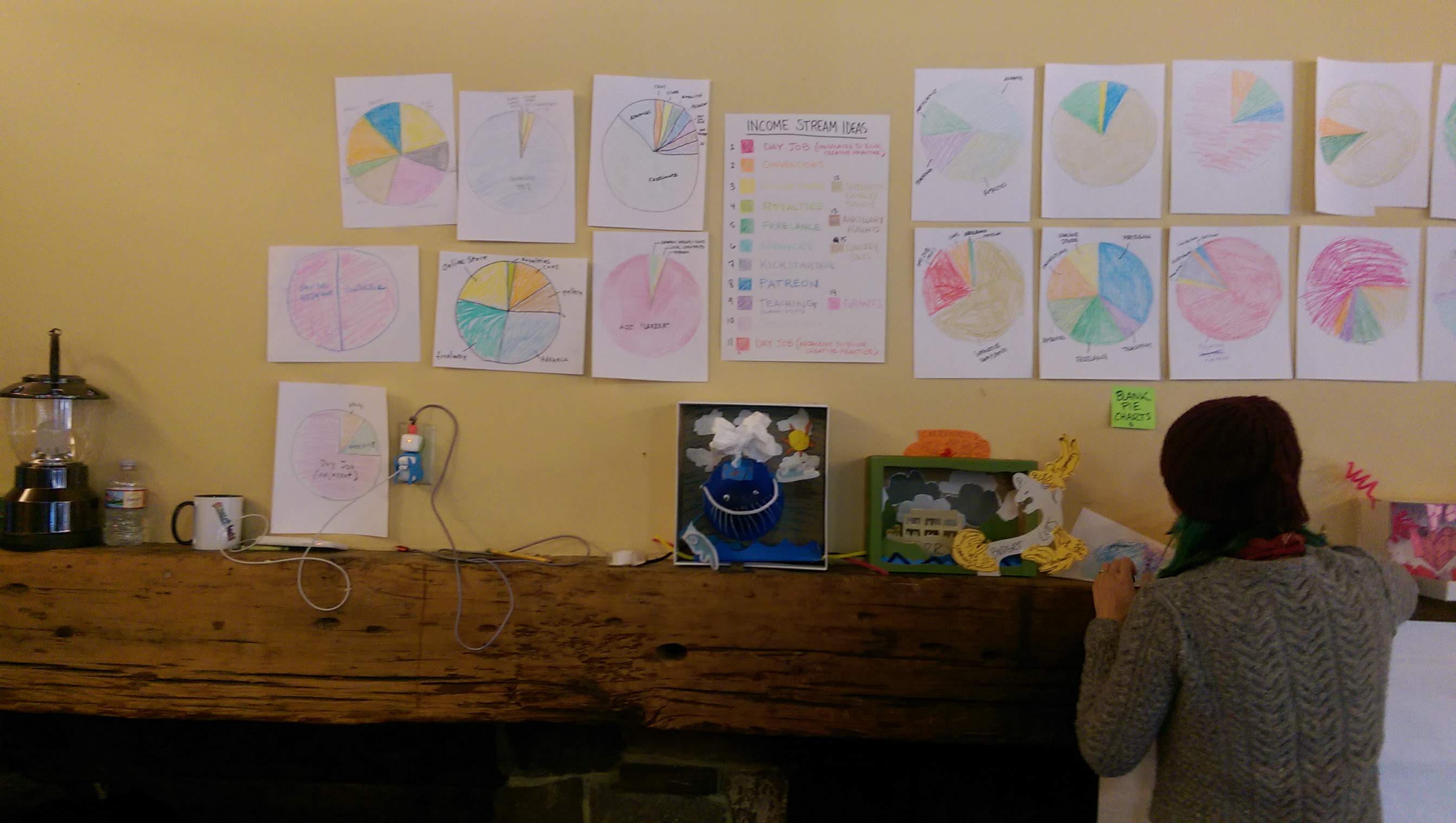
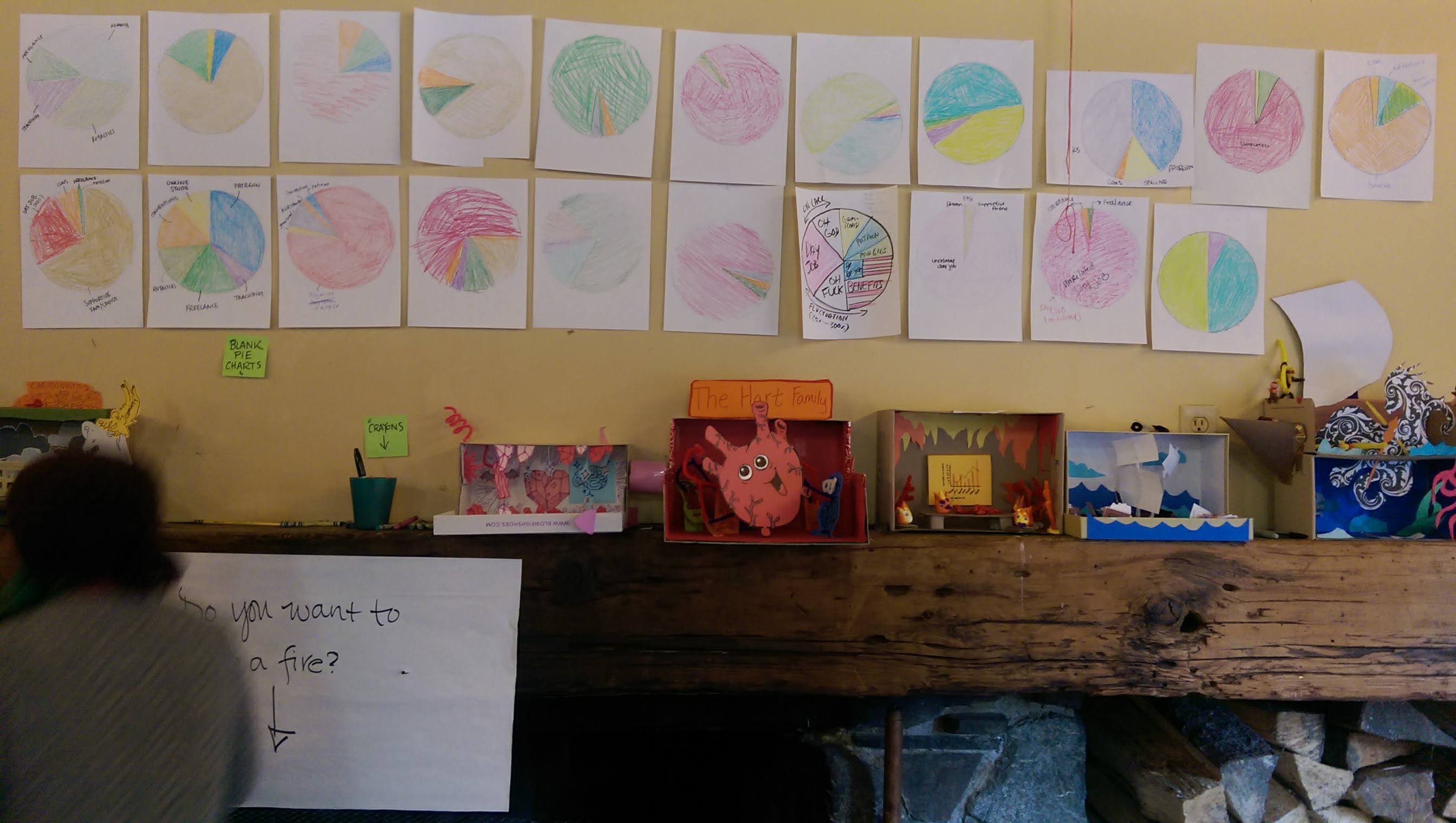
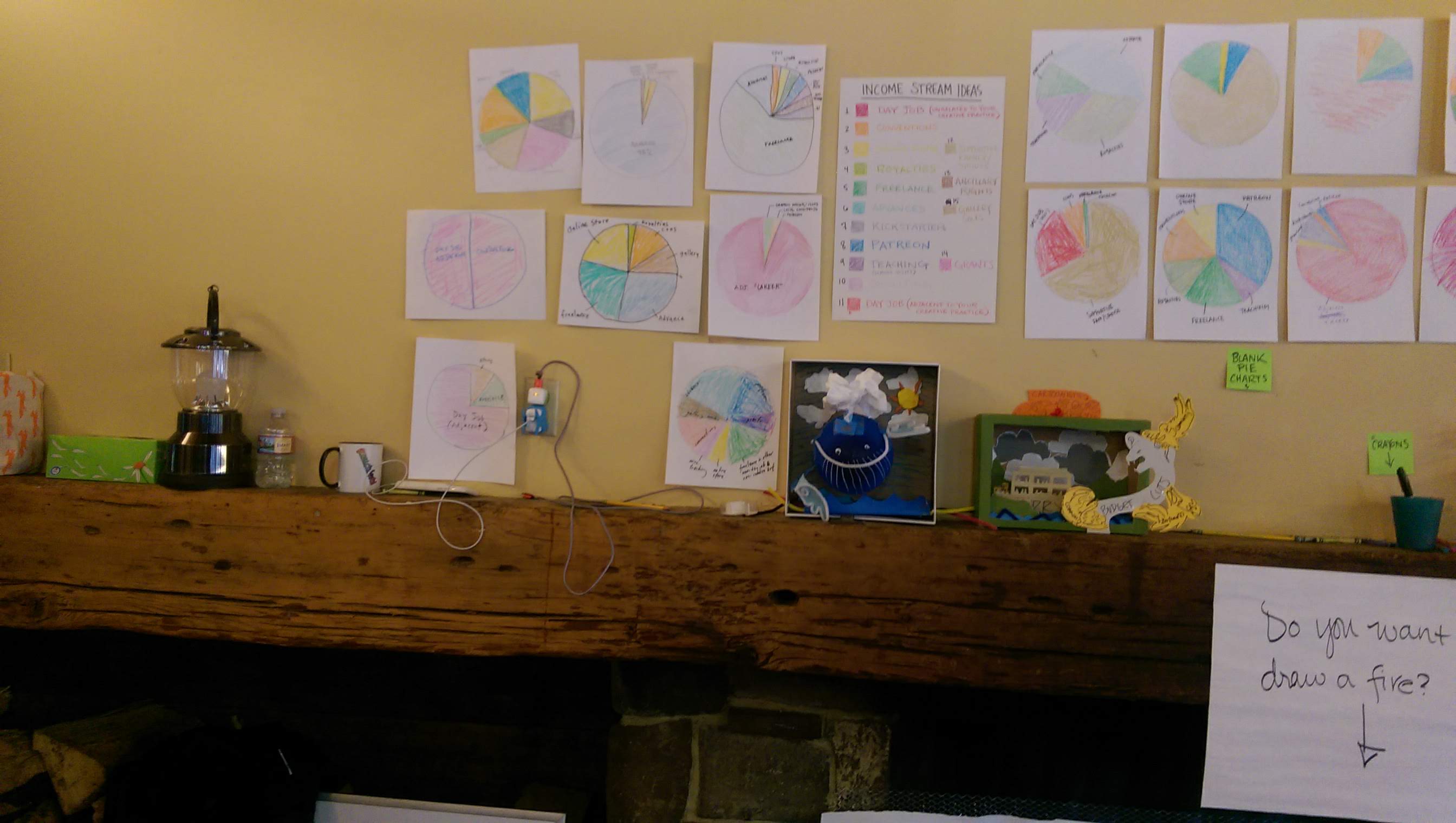
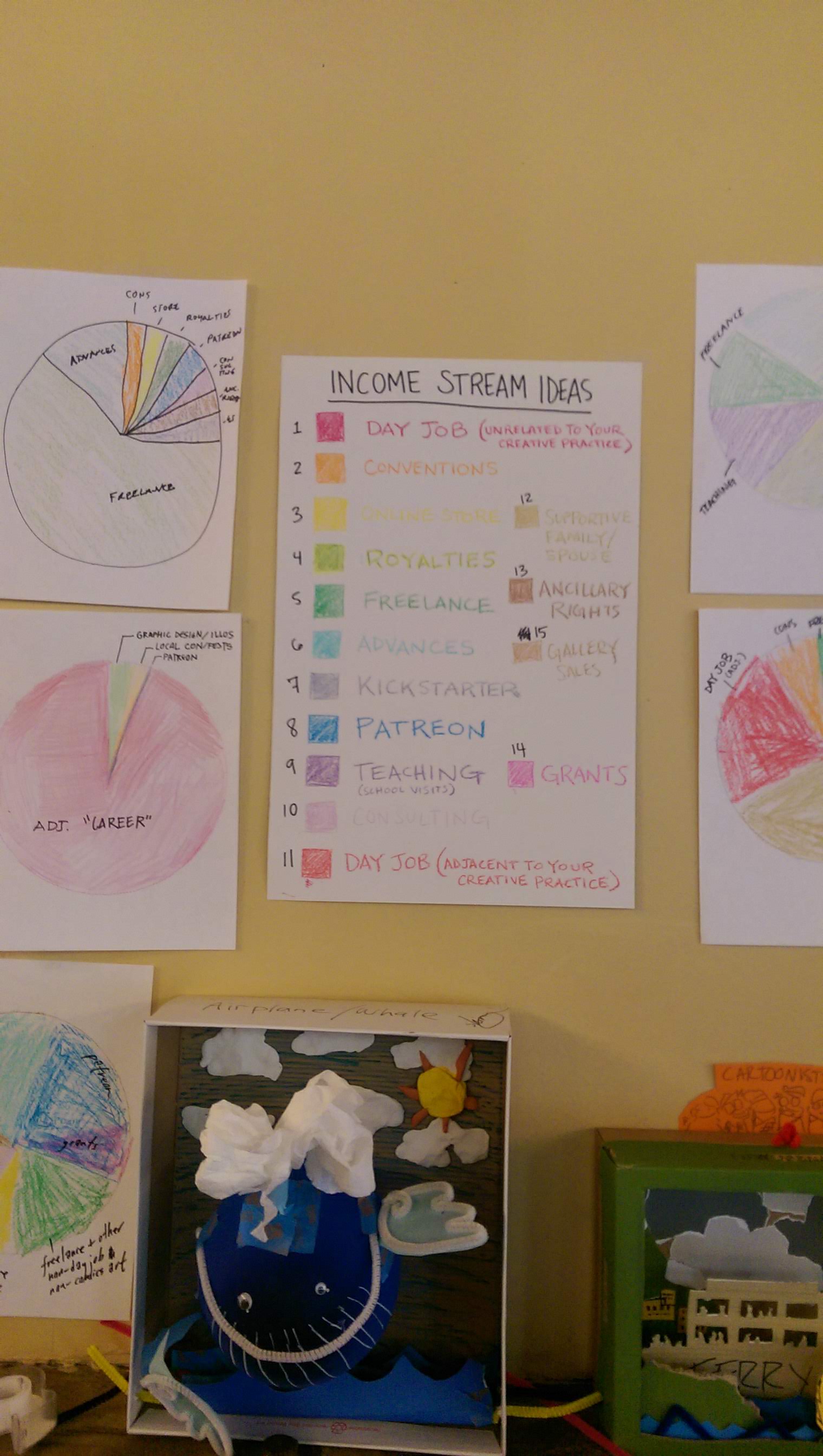
But if there was one thing that lay under Kibuishi’s talk (and multiple others) it’s that while he can discuss what works for him (process, satisfaction, definition of success), it’s different for everybody. Remember the session back on Sunday about financial stability? After that one, posterboard-sized sheets started appearing in the main lodge, each bearing an anonymous pie chart indicating sources of income. Some of them look vaguely similar, some have scant resemblance to most others, a few are gonzo-unique outliers. But no two are the same, and arguably no one is better than any other, even if each creator who shared their experience probably wants to change some things about their balance.

Let’s get back to that commonality thought for a moment — everybody’s experience is in some ways similar, and in other ways utterly unique. The act of working, for most cartoonists, in isolation can make it seem even more unique, especially when the doubts kick in. But when you look at the experiences of peers, and near-peers, and will-be-peers, the journeys to finding that unique set of success conditions start to look familiar. And during the secret session, that point was made again.

I’m being coy, so forgive me. You may recall that Los Angeles resident Dave Kellett made a film about comic strips, and the transition from the newspaper page to webcomics. It’s pretty neat. That movie is about 90 minutes long, and it’s built from about 300 hours of interviews, including with some of the biggest names of comic strips that you love with all your heart. There’s exabytes of stuff that didn’t make it into the film, and LArDK shared some of it. I’m not mentioning names because while it was judged that this likely wouldn’t cause the creator in question any distress, it’s also not meant for mass consumption. But I will share this:

Every creator, no matter how famous, also needs to hear from time to time that their work had an impact on readers. Every creator, no matter how successful, needs that reassurance that they’re doing good work.

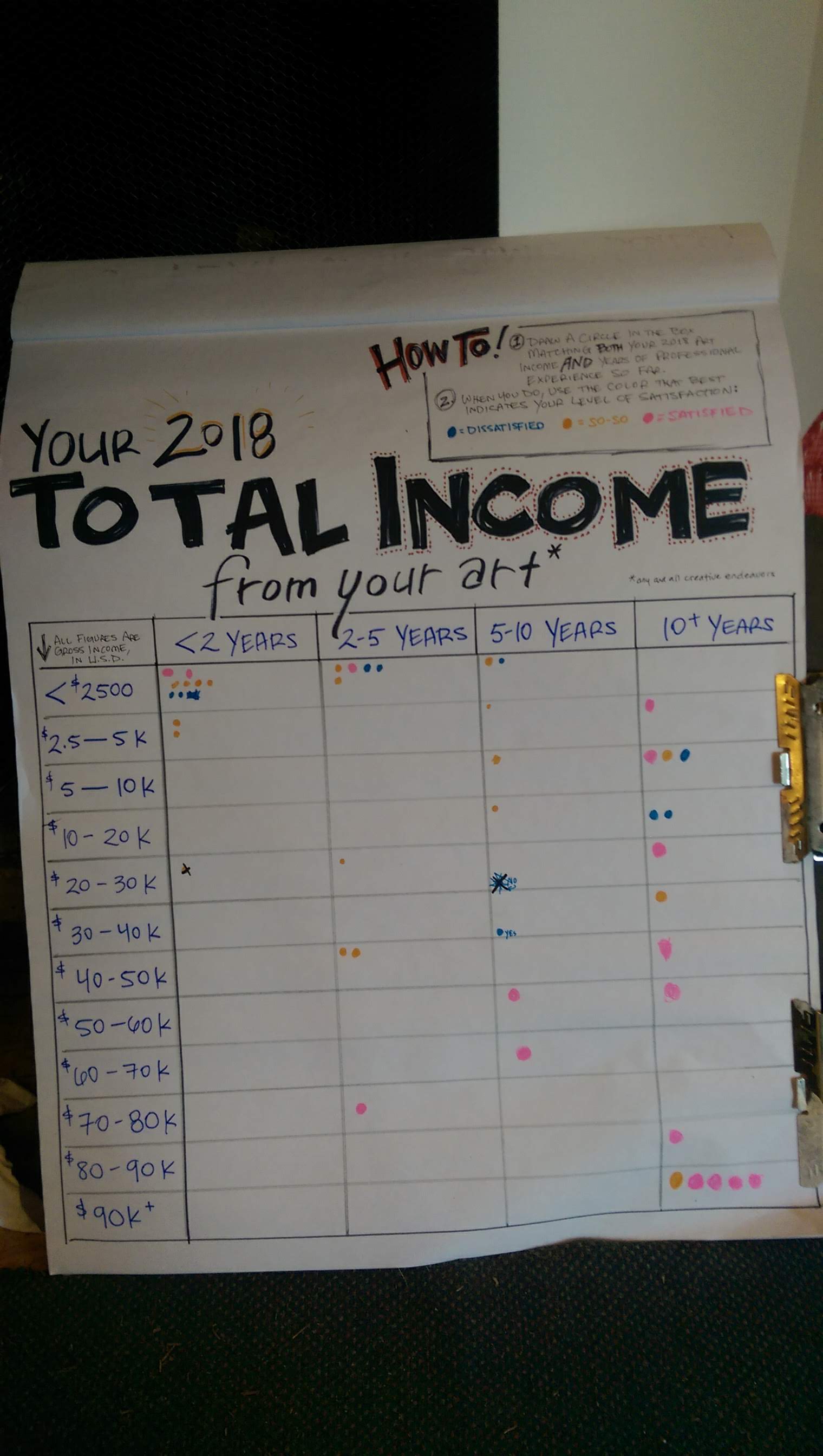
Speaking of universality, after dinner on Monday night the question came up — in the same vein as the pie charts indicating proportions of income sources, could there be a report on the ranges of income? A bit of brainstorming among LArDK, David Malki !, and Ryan North determined there could be an income band axis, a years as a cartoonist axis, and some color coding to determine satisfaction². Brio supervised from the couch.

The survey sheet remained up until after breakfast on Tuesday morning, and people added their input. In some respects, no surprises — people at comics as career for a short period of time reported income clustered at the bottom of the range, and the top end was reserved for long-time vets. After about five years, the entire range of income was represented, and after ten years the satisfaction score was mostly positive — either because regardless of income, people found ways of working they enjoyed³, or those who weren’t satisfied with comics as a career mostly self-selected out before spending a decade of their life at it.

I suspect that if you put the easel up with the same income survey today and magically gathered all the same Campers to add their responses, there would be differences up and down the sheet, of only because much of the response came as the booze table was being steadily worked down so there would be less to pack up on the morrow. For my part, I did my traditional Create A Camp-Commemorating Cocktail duty, and came up with a tasty concoction that was eventually named for Brio:

2 oz Laird’s applejack
0.5 oz Aperol
0.25 oz simple syrup
0.25 oz St Germaine
dash aromatic bitters
dash citrus bitters
dash ginger bitters

Muddle one wedge of lemon and one wedge of lime to liquid ingredients. Shake over ice, strain, and drink carefully, musing on how we’re all figuring out our way in the world.

Pictures:
Even if you can’t see all the writing, you can probably see no two pie charts are quite like each other. Bonus views of the dioramas from Saturday night.

Income vs time vs satisfaction, with about 55% of Campers responding. Still not enough for real statistical significance, but enough to get the idea — you’re not the only one trying to figure this shit out.

_______________
¹ The result, he said, of seeing an Amulet cosplayer with an intricate, complicated, difficult build of a costume and realizing that if he’d made the character a bit more work on his end, it would have made things much easier for the fan.

² I helped with the layout a little, and because I’m a stickler for such things, I asked if the income numbers were constant dollars and if they should account for US/Canadian exchange rates. However, I did not contribute data to either the income survey or the pie chart collection. For starters, my pie chart would look like a circle with one color for DAY JOB.

³ Plus, not everybody is trying to make comics their sole gig.

We Interrupt This Series On Camp For The Only Important News Today

Details soon enough, I'm sure. Let's just let them rest for now.

Congratulations, Kate and Morgan. We love you.

Camp 2019, Safe And Whole

One of the things that I find most valuable about #ComicsCamp is that there’s a degree of honesty, of willing vulnerability that quickly becomes a cultural norm; you start out meeting strangers¹ and a couple of days later you’re sitting on a couch sharing your deepest insecurities about your career, artistic evolution, and/or life. In a couple of instances, you talk about them in a room of a couple dozen of your new best friends, simultaneously looking for and providing reassurance that it’s gonna be okay.

There’s a lot of raw edges at times, trying to find walking the line between feeling exposed for becoming totally emotional, and feeling comforted that everybody there has your back. And because of that, there’s an agreement in the culture of Camp, that we may talk about what was said, but not who said it or under what circumstances², I am in a couple of cases not even going to mention who was taking the lead in sessions. Here, then, is how Monday shook out:

10:00 am Hey Let’s Draw Each Other w/ Scott C Procreate & Clip Studio w/ Lucas Elliott & Gale Galligan Comics Collaboration w/ Alison Wilgus
11:30 am Board Game Jam w/ David Malki ! Mid-Career Burnout Comics & Community Event Planning w/ Jen Wang, Pat Race, and Aaron Suring
2:00 pm Making A Living Drawing Comics w/ Kazu Kibuishi Z-Brush & Stop Motion Animation w/ Nikki Rice
3:30 pm Games, Books, Hangs Let’s Talk About The Hard Stuff
5:00 pm Games, Books, Hangs SECRET PANEL w/ Los Angeles resident Dave Kellett

Lot of open space during this day, time to mess around in impromptu groups and make it up as you go along.

  • Scott C provided loose direction to three round tables of artists, each getting five minutes to draw another person before rotating to the next person at the table; after a while the tables were shuffled, and in the end you got a bunch of new portraits of yourself. I can’t draw for crap³ but I love watching it happen. Elsewhere, the mysteries of Clip Studio were deciphered by Gale Galligan and Lucas Elliott, and Alison Wilgus talked about creative collaboration, something she has a bit of experience with.
  • David Malki ! is known for a bunch of things, but at Camp he’s known primarily for Always Doing A Bit With [Los Angeles resident Dave] Kellett. Are Dave and Dave being serious right now? was asked with increasing frequency as the weekend progressed. Nah, it’s a bit was the invariable response. It was a relentless iteration of voices and premises, polishing the humor ever finer until it shone like a laugh-chuckle diamond4.

    But he was also known for boardgaming, playing everything with cheerful ruthlessness (or possibly ruthless cheerfulness), and designing new games throughout the weekend and at the Jam. If you see him, ask him how to play Mine, which features tension and splodey things.

  • Jen Wang knows a thing or two about organizing comics events, what with being one of the founders of Comic Arts LA. Pat and Aaron put one this one-day con and camping event that you may have heard of. Between the three of them, there’s a mountain of event planning experience, and if you get the chance to hear any of them opine on the topic, I urge you to take advantage.

The first of the big raw emotion sessions dealt with the serious condition of career burnout — there’s some data I’ll share later on about how folks in the various stages of their comics careers view success — and the feelings that Nothing Is Working Like It Should and This Sucks and the very real possibility of those mutating into I Suck. Folks from all ends and durations of comics careers contributed to how they experienced and dealt with feelings of burnout, and let me assure you — everybody feels those creative doubts, everybody is subject to imposter syndrome. Some thoughts, without names:

Because I put myself on the page, I have to figure out how to stay safe inside.

Best advice I ever received: Don’t let being an author take over from being a writer.

When caught up in [the work] I felt like I gave my life and soul and there was no way to stop.

I’ve had a self-made career, in the self-published, self-promoted space. But there’s not a [contract] that obligates me to that.

Everything I was asked to do, I said yes.

To do this, you have to ask others — family — to sacrifice.

I want to be able to maintain a relationship with my work that’s healthy.

There’s more (and plenty of crossover with the other big raw emotion session that afternoon, which was focused on self care in all aspects of life): family and friends that don’t understand the sheer amount of work that’s involved, even if you can do it on the sofa; money and how to keep it from interfering in personal relationships5; how to keep the career dream from colliding with the family/friends/relationship dreams.

My contribution to these discussions is pretty constant, and it comes from a place about as far as you can get from creating comics, and it’s something I want to repeat for everybody. As you probably know from reading this page, I’m an Emergency Medical Technician, and in my spare time I’m Deputy Chief of Operations for my town’s EMS agency. I also teach lil’ baby EMTs how not to kill their patients. The first thing — literally, the very first thing — that we teach lil’ baby EMTs is a simple three-word mantra:

I’m Number One.

When I roll up onto the scene of a horrific accident, patient(s) on the verge of death, onlookers everywhere, emergency apparatus hopefully screening me from the highway traffic whizzing by with too little attention paid? The most important person on that scene is me. In all circumstances, no matter what, I go home safe and whole6.

Second most important person? My partner. I will pull her back out of the way of a speeding car; I will not throw myself into her, knocking her free of the speeding death vehicle and take the impact myself7. Next? Everybody on that scene that is not already sick or injured. Don’t make more patients.

The actual person we’re called to help? They come last.

The goal is that the entire population of people in and around my response scene is no worse off than if I’d never showed up. I can only make things better for the initial patient if I (and my partner) can work, and nobody else gets added to the list of patients. If keeping everybody safe means that we can’t get to that patient and they die on scene? That’s too bad, and simultaneously the best possible outcome8.

There’s a reason why that emergency information card in the plane’s seat pocket tells you to secure your own mask before attempting to help others. If you aren’t able to protect yourself, you won’t be in a position to help anybody else, and now you’ve got more people damaged or dead. People will tell you you’re being selfish, but it is absolutely true — you must take care of yourself first.

Anyway. There was an uncertain laugh when I shared my screw everybody else, I’m going home alive rule, but I think the context — not a creator, but a representative of your audience — as giving permission for everybody to take a step back and take care of yourself first. We’ll be here when you’ve got something ready for us at your pace. You have to set boundaries, you have to be able to say no, you have to adopt a pace of work that will not injure you, physically or emotionally. Success can’t require sacrificing your life and soul.

More on how to reach that success, and what it looks like, tomorrow.

Pictures:
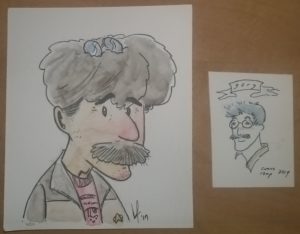
Up top, two portraits of the blogger with moustache. Lucas Elliott wasn’t at the Draw Each Other session, as he was presenting elsewhere at the same time; it didn’t stop him from doing a bunch of quick portraits during the remainder of Camp, including one of me. Shing Yin Khor did the other, small enough to fit in the palm of your hand, delicate and perfect. Coincidentally, they are two of the finest cabinmates you could ever ask for.

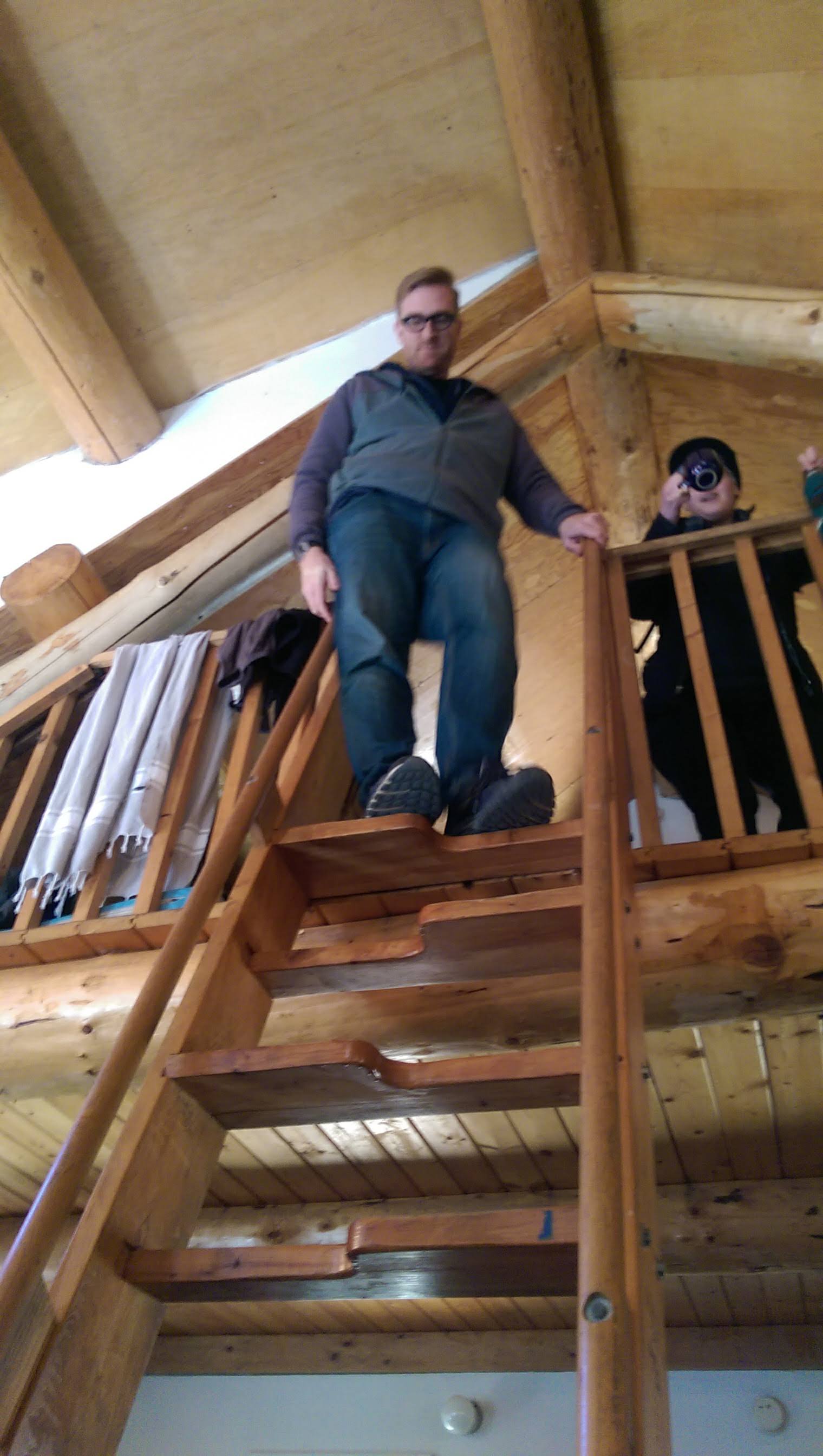
The cabin where the the Burnout and Hard Stuff sessions were being held featured a loft. Not content merely being a giant among men Ryan North climbed the ladder and loomed even larger over we tiny creatures below. He’s so tall, it’s impossible to get all of him in focus at once.

_______________
¹ Sometimes very strange.

² Barring explicit permission, which I have chosen not to ask for.

³ Give me a pair of drafting triangles and a circle template, and I’ll make circuit diagrams so beautifully symmetric it’ll make your eyes water, but that’s not what we’re talking about here, is it?

4 Either that, or by the 57th iteration, anything (no matter how stupid) is hilarious.

5 Especially in two-creative-career relationships. If you’ve never heard LArDK talk about the balance he and his wife struck to develop both of their careers without risking financial ruin, dig through the recent archives of Comic Lab.

6 I will admit for myself one exception to this rule: if there is a cadet on my crew, I have promised their parents that I will bring them home safe and whole. They’re number one-half.

7 There is a terrible sort of calculus in this logic. If my ambulance is hit by an idiot turning left through a red light, injuring me and my partner? It takes four additional crews to deal with that situation: one to help me and my partner, one to help the idiot that hit us, one to help the patient we were originally dispatched to, and one to replace us until we’re able to ride again. This self-protection is doctrine because my presence is a force multiplier for the general health level of my service territory.

8 Remember the tiger that got out at the San Francisco zoo a dozen years back and killed/injured multiple people? At one point on the security cameras, an ambulance can be seen coming up to where a person — maybe still alive — is laying in the road, and the crew doesn’t get out to render aid. They were excoriated as cowards for not rushing out into the open, not knowing where the tiger was, with nothing to defend themselves but a stethoscope and a blood pressure cuff.

They did the right thing. EMS personnel are more poorly paid than you realize, not that any salary is sufficient to require tiger suicide as a job function. I’m a volunteer, and I sure as fuck am not getting killed to satisfy anybody with an opinion about my bravery for free.

Camp 2019, One In 87.5 Million

I was writing very quickly.

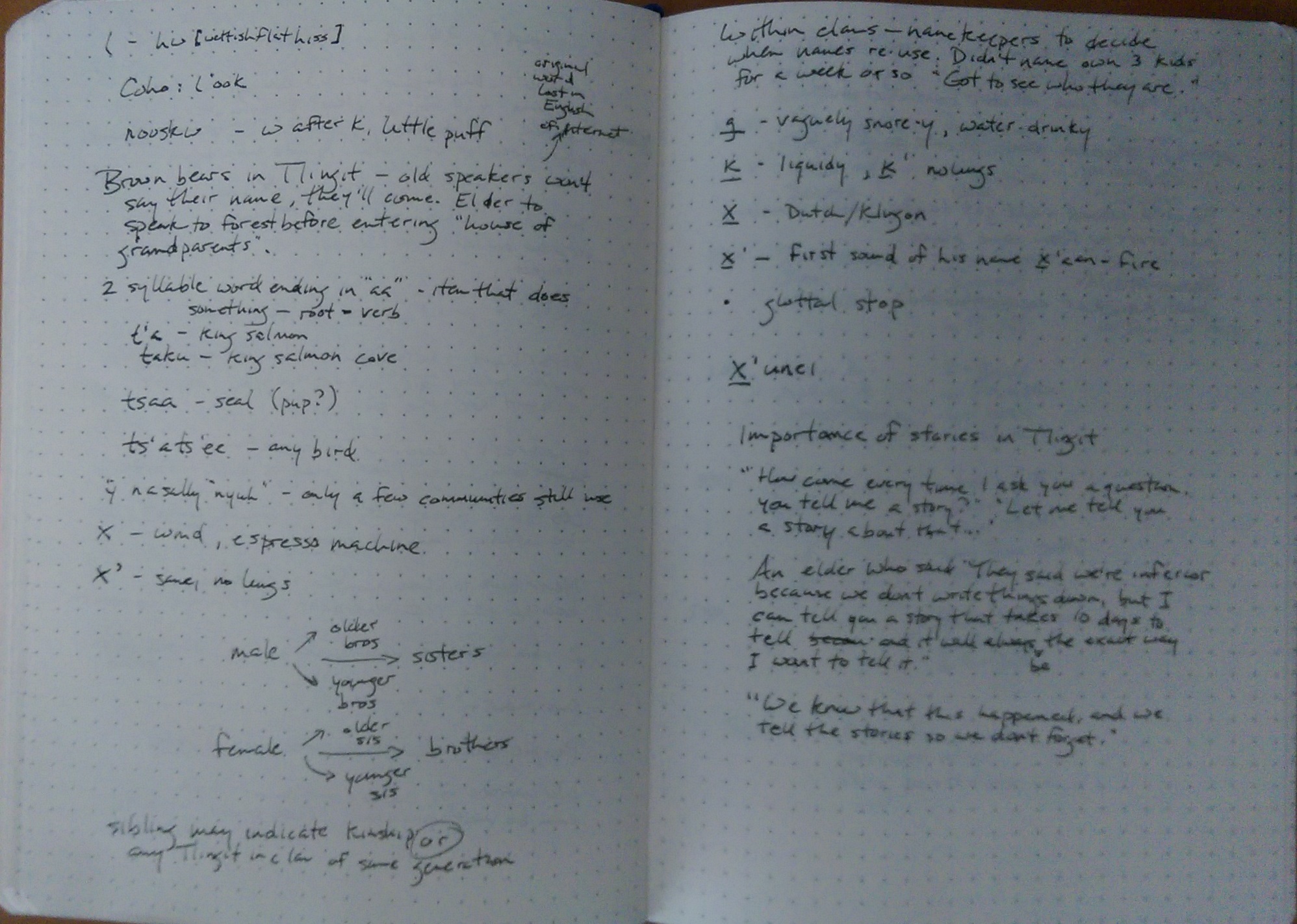
It’s time I introduced you to someone; his name is X’unei and he introduced himself on Saturday night to the assembled #ComicsCamp cohort in Tlingit.

He told us about himself, at some length, before generously repeating himself in English. He is a university professor, and has his hands in novels, poems, screenplays, filmmaking, music, visual arts, and oh yes — he is one of perhaps 80 people in the world that can speak Lingít Yoo X’Atángi. I am fond of quoting a cartoon cat that describes his expertise as being held by one dude or even none in a million, but in a world with 7 billion humans, X’unei is literally one in 87.5 million.

He has an English name, but he prefers X’unei, a name which is rooted in this language, this people, this place. Because of how time works in Tlingit (both language and worldview), he is not only X’unei, but he is every X’unei that has lived before and every X’unei that will live in the future¹.

So X’unei has seen 400 or so indigenous languages at the time of European contact dwindle to maybe 300, and will see perhaps another 100 lost in the next 50 years. There’s two dozen languages native to Alaska, and most of them are dying; he’s looking to the speakers that remain — many of whom are in their 80s — and wondering if the 130 or so people who are studying this one language — which may be 15,000 years old, born in the southwest near the Navajo, spread north into Canada, and then along the rivers and glaciers until it made its way back to the coast — can keep it alive.

He has so much to tell us about this place that we’ve found ourselves, about those who came to claim the land and called the Tlingit inferior because they don’t write things down; about the elder who countered that she can tell a story that takes ten days and it will always be the exact way that she wants to tell it.

So as not to make a terrible botch of things — I took a lot of notes, but I’m certain I missed more than I caught and I may very well have gotten details wrong here — I am going to spare you a lot of what X’unei taught us, and point you to Lingít Yoo X’Atángi, his online language resource.

You can hear the sounds of the language, there and on his YouTube channel, and you can learn about the 61 sounds you need to make in order to speak (26 of which are not in English), and the four vowels that each come with four variations (long vs short, high vs low). You can try to break yourself of the habit of up-talking to indicate uncertainty or a question, and try to get used to the fact that virtually all of the sounds are made behind the teeth² and a bunch of them require you to take your lungs out of the equation.

All of that? That’s the easy bit. Thinking in Tlingit is very different from thinking in English.

There’s a lot of metaphor³, and verbs classify based around whether or not they have happened yet. There’s a suffix that indicates a thing that performs an action (a ladder, a saw), a way to turn a verb into a noun. There are siblings that may be your kin, or any Tlingit of the same generation. The metaphors are more than a linguistic construct, they’re a way of thinking of the world, a way of looking at how things are and then describing your place within it4.

And the stories, always the stories. The story of how the Tlingit people came to their lands by passing under a glacier, about not speaking the word for the brown bear because they’ll come, about announcing your intentions at the edge of the forest before you enter to hunt or forage in the house of your grandparents. About the place names that are lost, about the true owners of this land who will take you away if you whistle at night unless you carry tobacco and copper with you, about the Salmon People who will teach you the value of the food you might disrespect. About how they know all these things happened, really happened. About how they tell the stories so they don’t forget.

And if you start to wonder if maybe there’s a few too many stories, then X’unei will tell you about the time he saw a youngster ask an elder How come every time I ask you a question you tell me a story? and was answered with Let me tell you a story about that….

We dipped out toes into a vast ocean, one that serves as a means to connect a people across past and future (and if X’unei is every X’unei ever or to be, then we who come to Tlingit lands are the same people who stole them, and hopefully the same people who will act to decolonize them). It was a gift freely given, and one that I will do my best to treat with the respect it deserves.

Pictures:
No other pictures today; if you can make out my scribbles in the photo up top, good on you.

_______________
¹ He told of meeting an elder who expressed that his own uncle had been named X’unei; afterwards, the elder referred to him as Uncle.

² What’s the hardest job in the world? Tlingit lip reader.

³ For example, there aren’t colors, per se, but there are comparisons to common things. One particular blue is the blue of a Stellar’s jay.

4 I think this relates to how X’unei said you might not name your kids for a week or so, because you have to see who they are. I’m guessing the ubiquitous Have you decided on names yet? ritual that parents-to-be go through around the seventh month are utterly alien to the Tlingit mindset.