The webcomics blog about webcomics

I Thought Don Johnson Was Dead

Today’s Theatre Hopper examines the point of the Miami Vice movie. I think Tom is onto something when he asks why the movie was even made. I mean, who gives two shits about pastel suits, rolled sport-coat sleeves, and cheesy eighties techno? The show was never good to begin with.

How do I know this?

Because my father loved the damn show, so as a child Miami Vice was crammed into my unsuspecting brain. Images of Don Johnson cavorting around in sock-less loafers and spouting cliches still play back in my mind as horrible night terrors.

SDCC Recap: Webcomics 103 Class Notes (Part Two)

Continuing from yesterday; if you’re interested in some of pictures of these sessions, Gilead Pellaeon has ’em, along with his writeups of these sessions.

Webcomics 103: Making Money
At the podium, Bill Barnes (Unshelved)
On the panel, Robert Khoo (Penny Arcade), Howard Tayler (Schlock Mercenary), Jennie Breeden (The Devil’s Panties), Phillip Karlsson (Dumbrella Hosting), and Scott Kurtz (PvP).

The Sign Said, “I’ll Just Blow It On Bandwidth”
Barnes opened up the floor to questions, and the first one dealt with making money when starting out — and how can comic books be a part of that? Khoo leapt to the fore with a strong answer that we’ll quote here: “I don’t know why everybody has a fuckin’ hard-on for the book deal. This is webcomics. The goal is not to make comic books when you can do so much more. You can create lots of kinds of content, you can monetize lots of different things.”
(more…)

Working On Getting The Graphics To Display, Please Bear With Us A Bit Of Fun News

Dave Kellett mentioned something to me over the weekend in San Diego, something potentially cool. Well, it’s up at Blank Label now, so I guess it’s gone from “potentially” to “thoroughly” cool.

Seems our Dave will be doing a stint as Cartoonist-in-Residence at the Charles M. Schulz Museum in Santa Rosa, California. Past C-i-Rs include Mike Jantze, Dan Piraro, and Pixar animator Don Crum. Look for Kellett at the Sparky shrine on December 9th, and then again on the 10th at the Cartoon Art Museum in San Francisco.

Drinkin’ Fun and Games

As pointed out by Jeff Rowland, (And now Allison)there is a wiki with drinks and drinking games related to webcomics. The drinks are themed for a selection of possibly more well known webcomics, and may or may not actually be for human consumption.

I think there would be hours of amusement browsing a wiki such as this. But, alas, there is more to this wiki than mere amusement:

This website is intended as a tool for the gathering and organization of information related to the publishing of a book or books for commercial purposes.

All information entered by users, whether registered or anonymous, is considered to be an uncompensated contribution to the project.

Owners of copyrighted or other content submitted through this website grant to Phillip Kahn the unconditional and unlimited use of that material for all manner of publication.

It’s a derivative work, a spinoff, a tribute. Phillip Kahn seems to be a webcomic podcaster, involved in the policy of the WCCAs, and it seems he’s trying to make a book to capitalize on webcomic success. The idea that contributions are uncompensated says that he’s trying to be compensated.

Interesting. Very Interesting.

Edit: An earlier version of this post had content that was based on mistaken assumptions; Phil Kahn was kind enough to provide further information, and Fleen regrets the error.

I Can Finally Get Drunk And Call It Research

Over at Overcompensating Jeff is giving back to his audience by linking to the “I’m Just Drinking: Web Comics edition” page. This page holds a rather extensive list of popular and not-so-popular web comics and drink recipes based off the comic itself. I thought to myself “Is it possible that such a list even exists?”

Oh, it is. And it does.

Here are a few of my favorite recipes so far, but I’m sure you will have your own personal favorites.

This list will get you started on the hazy, blissful road to alcoholism.  Have fun friends and remember, if you hook a car battery to your testicles, it is going to smart.

SDCC Recap: Webcomics 103 Class Notes (Part One)

This is the report of the third “Webcomics School” panel session at SDCC. After everything is vaguely back to normal around here, we’ll consult with the session moderator and panelists, expand these recaps, and keep ’em conspicuously posted as a resource for webcomics creators. Please note that these writeups are lengthy, and continue behind the cut for a good long ways.

As an aid to readability, these recaps are presented not as a transcript of a Q&A (although certain sections will quote participants at length, due to extremely critical information that doesn’t deserve truncation), but as a heavily edited narrative, with “takeaway” lessons that summarize the mood of the panel in response to each topic of discussion. Fleen welcomes corrections or clarifications from the participants.

Webcomics 103: Making Money
At the podium, Bill Barnes (Unshelved)
On the panel, Robert Khoo (Penny Arcade), Howard Tayler (Schlock Mercenary), Jennie Breeden (The Devil’s Panties), Phillip Karlsson (Dumbrella Hosting), and special surprise guest Scott Kurtz (PvP) fresh off his Eisner win. Back to room 3, seating 150, with every seat filled. Fan:want to make webcomics ratio of about 20:130.

Who We Are, How We Got Here
Barnes opened the session with a general question to the panel, asking each, “How did you get here, and how do you make your money?” Given the wealth of experience and wisdom at the head table, the answers took nearly a third of the allotted time; pay attention to their answers, as there will be a test later.
(more…)

This Is Worth Checking Out Today

Adis! once again has captured a raw yearning for things to be a little bit more simple, more finite and easy to solve. Ever since Hezbollah captured an Israeli soldier, and Israel put its policy into practice, scenes like this have come to life, escaping from their 132 bit video game screens.

Our newspapers need hugging, considering the headlines and the images of death, despair, and the inexorable march of nations which few in their paths can stop.

SDCC Recap: Webcomics 102 Class Notes

This is the report of the second “Webcomics School” panel session at SDCC; look for the third tomorrow-ish. After everything is vaguely back to normal around here, we’ll consult with the session moderator and panelists, expand these recaps, and keep ’em conspicuously posted as a resource for webcomics creators. Please note that these writeups are lengthy, and continue behind the cut for a good long ways.

As an aid to readability, these recaps are presented not as a transcript of a Q&A (a shame, really, as a transcript of what quickly became The Scott & R Show would be really, really funny), but as a heavily edited narrative, with “takeaway” lessons that summarize the mood of the panel in response to each topic of discussion. Fleen welcomes corrections or clarifications from the participants.

Webcomics 102: Finding Your Audience
At the podium, Bill Barnes (Unshelved)
On the panel, R Stevens (Diesel Sweeties), Kristofer Straub (Starslip Crisis), Scott Kurtz (PvP), and Jerry “Tycho” Holkins & Mike “Gabe” Krahulik (Penny Arcade). More than 200 people can fit in the room, if 50 of them stand around the perimeter; Krahulik suggested the audience ask for a larger room next year, and to let the con organizers know that “webcomics are kind of a big deal now.” Moderator Bill Barnes started by asking the audience how many of them were there specifically to hear a creator speak, and how many to learn how to make webcomics; it comes down about 200 to 30, in favor of learning webcomics. Given the sheer number in the audience, Barnes opted to immediately open the session to questions from the floor.

Giving The People What They Want
Asked how often they pander to the audience in an attempt to boost readership, Holkins and Krahulik commented that Penny Arcade has a history of being “self-indulgent” (Holkins) and sometimes irritating people who just want a videogame gag. Put another way, “I got a lot of angry mail after Kenny Rogers saved Gabe from hobos” (Krahulik). But, Kurtz said, while you don’t want to pander, you do want to keep the audience engaged by providing something accessible.
Takeaway — If you want to do hobos, do hobos — but your audience needs to be hooked if hobos aren’t their thing.
(more…)

Weak Hu-mans With Their Flesh And Feelings

I thought QC was the only strip doing a guest week, but it looks like R.Stevens is taking a much needed rest and has called on the friendly assistance of his web comic pals.

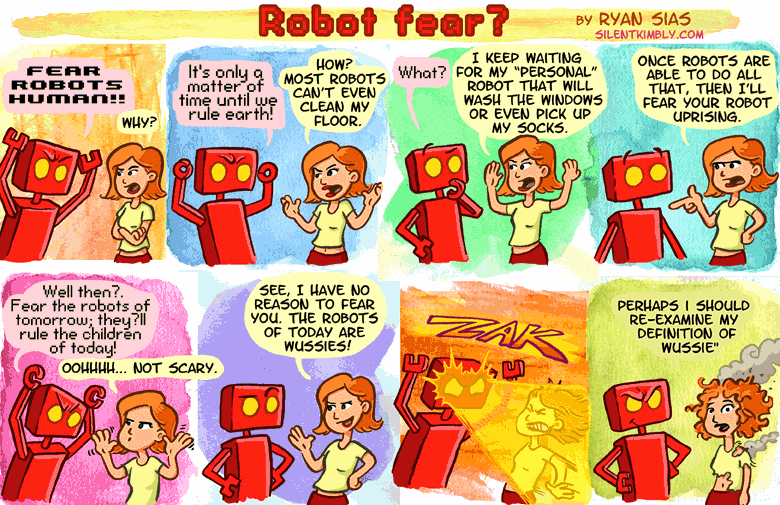
Today’s guest strip over at Diesel Sweeties features everyone’s favorite easily-angered character, Red Robot. This strip has him demolishing the human lifeform, which is his favorite pastime. Now what I’m really looking forward to is getting to order my very own Red Robot toy and having him guard my computer from pathetic hu-mans.

Wildcard? Or Permanent Fixture?

Scott McCloud did an interview with Wired.com in which he asserted that webcomics are the great wild card in the art form today. Seeing as he’s written books, and is seen as a “leading scholar,” you might trust what he has to say at face value. My understanding from the interview is this: Because there are no editorial limits, and with themes and genres multiplying to fit every niche audiance, as well as the techniques that can manipulate space, there are “mutations” which are changing the art form in new and exciting ways.

Colin Reed Moon wrote a piece in opposition to the assertion that webcomics were a wildcard. His argument, to the best of my analytic reading abilities, is that webcomics are often no different than their print counterparts, that they regularly crossover into the traditional print medium, and their influence is felt in the popular culture, as with the making (his verb, not mine) of Snakes on a Plane. Thus, webcomics are not a wildcard, they are an artform and they are influential.

Both identify the trend of webcomics becoming print comics in anthologies and such. However, McCloud mentions it in terms of how webcomics are like their print counterparts, whereas Colin sees it as a sign of success. How should we take this trend of anthologies? Does it limit the freeform and free-for-all nature of the webcomic? And is the influence that Colin identifies evidence that webcomics have arrived? Or is it more evidence of the wildcard nature of the medium — that anything can and will happen?