The webcomics blog about webcomics

Speaking Of Niche Strips

So “school” is a pretty popular location for entertainments of various types. It lets you attract kids (and their hefty allowances) as a primary audience, because it relates to their everyday experience. If you set said entertainment into the “high school” setting, it lets you attract creepy borderline pedophiles (an undertapped economic cohort) as a secondary audience, because it lets you put (possibly underage, or meant to be) oversexualized fantasy objects into key roles. It even lets you recontextualize traditional adult entertainments making them “fresh” and “hip”, leading to mystery, melodrama, horror, soap opera and the rest. And they’re almost always from the perspective of the kids. ‘Cause teachers are boring, man.

Or, at least just like the rest of us. Work is absurd sometimes. Lessons come from unlikely places. And sometimes, there’s little triumphs to be found in the misfortune of others. Thus, actual teacher Robert Anke’s new webcomic, Running In The Halls. It’s a bit awkward to navigate (being based in WordPress), but the archive is small so it’s not too bad for now. The art is a bit primitive, but already showing more detail in later strips than earlier ones; give it a year, and it’ll probably look as good as Unshelved. The humor follows the classic setup-setup-pause-punchline of the newspaper comic strip, but still manages to keep an absurdist edge. 

Presumably drawing from classroom experience, Anke is sharing with us a taste of being a teacher; one gets the feeling that much of what we’re seeing is taken from the best you won’t believe what happened to me at work stories that we all share with our friends over sophisticated adult beverages. And that right there is the universal message of Running In The Halls: teaching’s a job (just like yours), kids are kids (no matter how many antennae), and the right words can put you in a good mood all day long. Keep an eye on this one; it’s clearly just finding its legs, but in a year, it could really be something.

Upcoming Books

We’re a bit behind on some of this, so thanks for your kind indulgence, etc. Couple of books to mention today, in case you hadn’t heard of them.

Up first, Dorothy Gambrell, of the delightfully J. Ottoesque New Adventures of Death (Modern Tales subscription required, at least for now) and the weirdly twisted Cat and Girl (really, shout-outs to both the Goatse guy [get your own damn link] and the coolest of irrational numbers in one strip? Genius!) has a new book out. Entitled Cat and Girl (The Book), you may obtain a copy right here.

Meanwhile, Tom Brazelton over at Theater Hopper informs us of pre-sales on his first book, Theater Hopper: Year One. Brazelton, emulating the efforts of boutique clothiers, enormous corporations, and professional weirdos (and I mean that in the most complimentary way possible) alike, has started a Street Team. The relevant part:

I’m trying to get creative marketing the pre-sale and generate as much interest as possible, so I’ve also founded a street team.

The concept is simple. You pre-order a copy of the book for yourself. If you can get 5 of your friends to do the same thing, I send you a $20 gift certificate to Fandango.com! It’s like getting your copy of the book for free!

In addition to his bold experiment in fan-driven marketing (have other webcomics tried this? I can’t recall any), Brazelton has heeded our cry to include guest strips in his book. A case of two people coincidentally coming up with the same good idea, or a shameless attempt to suck up to us for free press? Either way, it worked.

In The Final Analysis

So now we’ve heard from IndieKarma how they’re intending to do things. With a couple of days time to reflect, some things stand out as significant achievement, and some things will need to be addressed. On the positive side:

  • They aren’t locking off content or specifying a delivery model.
  • They’re targetting the right demographic: webcomics readers are loyal to their favorites and, to quote Tycho’s manifesto, “will take care of you”.
  • They’re making the “tip jar” approach painless; the user doesn’t have to set out with philantropy on their mind more than once (the act of signing up).
  • They aren’t providing anything other than a funds-transfer mechanism. IndieKarma are not promising to deliver an audience or specific level of funding to the creator, so they aren’t overpromising.
  • They’re serious about this and are putting money into it: the budget may be undisclosed, but the first 5000 people that sign up will get a free dollar credited to their account.

Challenges to be addressed include:

  • Giving is assumed to be the default action. Let’s take Patterson at his word that which sites get your penny will be configurable in the coming weeks. Let’s further posit that IndieKarma takes off and year from now, there are thousands of sites using IndieKarma (and more signing up every week).

    That’s going to require a lot of attention from the user to separate out who gets money from who doesn’t. Since the service is supposed to be about ease of use, this is a problem.

  • Scale-up may provide significant challenges; if a rush of hits from the Kottke link caught IndieKarma unawares, they should pray that Penny Arcade never mentions them.
  • The chicken/egg situation must still be overcome; as of this writing, there are 227 sites and 540 users signed up. A medium-sized webcomic (one with a large enough loyal audience to drive sign-ups, but small enough not to swamp the service) or two is going to have to champion this system.

    But given the audience size needed to reach critical mass, this will (ironically enough) likely not be one of the traditional proponents of micropayments.

  • The dock: does it hit the fine line between obvious enough to drive awareness vs. obtrusive enough that it annoys readers? Given the customizability that IndieKarma are giving creators, it’s largely out of their hands, but it will have an impact on driving signups vs. driving them away.
  • Another one that isn’t on IndieKarma, but it’s still a challenge: it remains to be seen if the amounts given make it worthwhile for the creators. Will the people who already buy t-shirts continue to do so, and those who don’t choose to kick in a coin or two? That’s a net gain for the creator. Will the t-shirt buyers figure that pocket change is an equally-valid way to support their favorite strip? That could be a crippling loss for a creator.

From my perspective, here’s what IndieKarma will absolutely have to address before they see any significant take-up on the part of users (websites will come once users do):

  1. Get the user-customization tools in play, and these will have to be widely publicized. I suspect that much of the reluctance to use this model of giving (as was noted in several forms in our comment threads) will go away if users understand that they can control who gets money, who doesn’t, how much they get, and how often.
  2. Patterson doesn’t think that users will worry about a stray penny accidentally given here or there, and maybe that’s so. But users don’t want to feel that they’re getting “churned” (remember, IndieKarma makes its money when you give your pennies away).

    Rather than making the user stay on top of things, the giving model may need to default to disabled (you must specifically choose which sites to support), or IndieKarma may need to send email to users to inform them, You just visited these sites for the first time since they signed up with IndieKarma; confirm that you do in fact want to give them money.

  3. IndieKarma, despite their name, should not rely on the good intentions of users to keep giving once the intial interest (and first funding rush) dies off. To support sustainability, there will have to be some form of active communications from IndieKarma to users telling them, Your balances are getting low, and you need to refill if you want to keep giving.
  4. As one commenter pointed out, there will have to be a thorough security test performed; there may only be five bucks in my account, but it’s my five bucks, and I want to know that an unscrupulous website isn’t going to drain me all in one go.
  5. Many of the most loyal readers of webcomics do not have easy access to PayPal or credit cards, since they are underage and/or students. Unfortunately, there aren’t really other financial mechanisms for easy funding, but it’s something that may have to be addressed someday.

Only time will tell if IndieKarma are able to go the distance and fulfill the long-awaited promise of easy micropayments. Certainly, they have some advantages over previous attempts at mass-audience micropayments; most notably, IndieKarma can be a lightweight application. It doesn’t have to have complex tracking systems to verify that user X can read Y number of pages over Z days for a particular price. You show up at a site you like they get a very small amount of money without having to do anything except match up account numbers and time since last donation.

Assuming IndieKarma are successful, they are most likely to provide a measurable source of income to sites with sizeable traffic now. Curiously, this may lead sites that have conspicuously against micropayments (which are the high-audience sites) to be in a position to best benefit from IndieKarma, where sites that have traditionally championed micropayments (critically-acclaimed, but usually with small audiences) may not benefit measurably at all. There is every possibility that Cat Garza makes enough off IndieKarma to buy a pizza in the same time that Pete Abrams gets enough to lease a Lexus; the irony of this situation is left as an exercise for the reader. It’s precisely for situations like this that words like crisitunity were coined.

I don’t know the answers to these questions, and neither do Patterson and his team. They’ll have to be figured out with input from the users and the participating sites, and maybe it all works and maybe it doesn’t. More than the ease of use argument, the possibility of painlessly helping creators with whom they feel a connection is what’s going to drive users to the service … maybe. It’s going to be an interesting experiment, and we at Fleen will be keeping an eye on it.

Interview With The Micropayer

Here’s the interview that we promised yesterday regarding IndieKarma, the new kid on the micropayments block. With any luck, some of the concerns in yesterday’s comments section may be addressed here by IndieKarma honcho Brad Patterson, and we’ll have analysis on IndieKarma’s service tomorrow. Play nice, kids!

Fleen: Thanks for taking the time to talk to us, Brad. For starters, what’s your title at IndieKarma?
Patterson: I’m the founder, and I run the show on day-to-day basis.

Fleen: What are the plans for IndieKarma?
Patterson: We launched a week ago, and right now we have no idea what to expect in terms of growth, or the behavior of that growth. We intended to initially go site-to-site, looking to sign up groups of sites that are related and have common traffic — like webcomics collectives. Since Jason Kottke linked us last Friday, signups have actually been quicker than would have liked; right now we’re going try to continue to focus, digest the traffic spikes, and continue an active development cycle. Expect IndieKarma 2.0 in two to four weeks.

As a result of the unexpected rush, I don’t know if we’re in a position to actively solicit people to sign up with us yet, but we will get there. Originally we were aiming for blog market, but the more we looked at it, the more it seems we’re better suited to the comics/independent creator area. That is, sites with a strong connection between reader and content provider, where the reader comes back repeatedly for that content because they enjoy it. Right now, we’re excited to get our first handful of customers in webcomics.

Fleen: Okay, what blogs and comics have signed up? [Note: At the time of the interview, the IndieKarma website recorded about 130 websites and 340 users; as of this writing, the numbers stand at 199 websites and 443 users]

(more…)

You Have No Idea How Hesitant I Am To Bring This Up

In the context of not trying to stir up a shitstorm, I wrote the following about micropayments:

If you think that they’re crap, please acknowledge that they may eventually come about, but only by piggybacking on other protocols that will establish identity in a manner much stronger than is available today. If you’re in favor of them, please acknowledge that a viable one-click micropayment system won’t be developed until a viable one-click macropayment system is developed (because with the costs of building the damn thing, any developer is going to need to see a return on investment before scaling down).

So, one-click micropayments of the McCloudian model may or may not ever exist. How about no-click micropayments? I had a chat with a gentleman by the name of Brad Patterson yesterday, telling me about his new venture, IndieKarma. It may or may not be what we’ve been waiting to see micropayments develop into; Patterson is cheefully honest that he’s not sure what IndieKarma will develop into. But there’s some interesting ideas at play, and since he’s identified webcomics as the ideal sphere for his model, we really ought to discuss it.

Now, as we all know, micropayments are one of those topics pretty much guaranteed to cause a lot of hotly-contested opinions in this community, so I’m going to ask a favor of all here, namely: wait until we’ve presented the entire case before you start declaring it’s either the Second Coming or the Tool Of The Devil, ‘kay? ‘Kay.

A little background first: Patterson’s previous venture, PixelPass, was a more traditional micropayment-type scheme; it obscured content, and revealed it upon payment authorization, with pricepoints in the US$1.00 range. IndieKarma (originally conceived of with blogs as a target market, now looking more at webcomics and other forms of independent content creators) works off of a “fill a purse/drain it slowly” model: you put at least US$1.00 into an account, and it gets doled out automatically to participating sites US$0.01 at a time. Not quite what got envisioned in Reinventing Comics, but possibly pretty close. So how does it work?

There are two types of account with IndieKarma: individual user and content provider (for the purposes of this discussion, a webcomic or blog). The user places money into an IndieKarma account, and every time they visit an IndieKarma-enabled site (identified — hopefully — by a banner across the bottom of the page), a penny gets deducted from the user’s account and credited to the webcomic.

Development continues (the service only launched last week, and Patterson acknowledges that much feature development is underway at the moment), but the plan is that the user can set up a profile to control giving. Patterson seems to have started the service out of a sense of idealism (i.e.: wanting to have a mechanism to reward creators who might not be getting very much remuneration for their considerable efforts), but IndieKarma is definitely a business. The primary account top-up mechanism is PayPal, which takes a cut, and IndieKarma will take what it thinks is a fair amount for arranging the donation. If you’re a creator, of every penny that a reader gives to you, you’ll see 75%.

To prevent this from being an overwhelming discussion of the service, we’ll hold up here. Come back tomorrow and we’ll run the proper interview with Patterson and listen to his pitch. Depending on space, our analysis will run tomorrow or Thursday, and as always, we invite your comments.

Way Back, A Long Time Ago …

Once upon a time, Blondie was a loose woman. Really! She was a flapper, and accused of being a gold-digger! And though she was long since changed by her creator (the late Chic Young), and though she’s been basically doing the same things ever since Cookie was born (okay, fine, she’s a caterer now), in your heart you knew she was a seductress.

Given that we at Fleen are concerned with the unnatural, zombie-like nature of syndicated comics, today’s Overcompensating appears to give hope to those who would wish to clear out some dead wood on the comics page. Now, what would be so upsetting to, say, Beetle Bailey that he’d pull a Private Pyle on Sarge‘s ass in the middle of the night? What could convince Thel and Lois to emulate Thelma & Louise in a ragtop into a convenient canyon? Come on people, get creative!

Speaking of creative, congratulations to Ursula Vernon for the 300th installment of Digger (which, as the omnipresent Mr T noted, is free for the time being thanks to her Eisner nomination).

Remember When Letterman Was Told He Couldn’t Say ‘Bite Me’ Anymore? Man, I’m Old

Once upon a time, there was a young girl named Dylan Meconis who was much loved by all, for she could draw pictures and tell stories that made people forget their cares. She spun a story called Bite Me as a dwarf spins gold from wool, and all who read this story were enchanted. But one day, the story ended and the people were sore disheartened. But goodly-hearted Dylan heard their cries, and began a new story called Family Man. All who read the story were glad once again, and waited eagerly for midweek to come so that Dylan might tell them more. And they lived happily ever after.

Ah, fairy tales; you may not realize what those words actually mean. It’s been a couple of centuries since we really had fairy tales, you see; Jacob and Wilhelm were documenting language and culture when they compiled their famous collection of folk-tales, and they cleaned them up considerably to make them worthy of the right sort of people. More than 40 tales were omitted from their compilations for being unsuitable for respectable society. By the time Hans Christian Andersen came along, the Victorians had thoroughly sanitized the very idea of the fairy tale (Andersen’s originals are only now starting to be restored to their original grandeur). Then came Disney, and fairy tales became more than harmless — they became cute.

So here we are in a new century, with a thoroughly safe set of stories for children where the good guys always win and the bad guys always get punished safely off-screen, and some brave storytellers are writing fairy tales as they used to be. That’s what Meconis has crafted here: a story full of mood, from a time when the dark outside the house contained who knows what, and there are worse things in the woods than a wolf that needs to be put down on a frosty night.

Take a look at that page again — it’s the first one of Family Man, and it sets a high bar of expectation. Everything about the landscape screams “deep of winter”, in a time before climate control, insulation, or performance fleece, when the short days of the year didn’t mean winter wonderland, they meant maybe we won’t die of starvation and cold before spring comes. Look at the wolf’s face, with the narrow, malevolent eyes and a cruel sneer over vicious teeth; it was an undeserved reputation, but for millenia this was the most feared and loathed of the forest’s creatures, surely the very spawn of the Devil. That is how you start a fairy tale, with an attention to detail and mood that drags you along, will-you or no.

Very slowly, Meconis is doling out bits of the story. We have met Luther Levy, ink-stained scholar in the Saxon lands near Göttingen, and his merchant brother Johann, home for a visit. Their younger sister Liesl (sniffed out by Johann with his “Levy nose” … hmmm), their stern, religious mother, and their clockmaker father have been given to us in the smallest of doses, forcing us to learn about them in an organic, deliberate fashion. Right now, all is well and ordinary, but we know how fairy tales start — it’s just matter of time before the menace that lurks outside the hearth decides to step from the shadows.

From a starting point of modernity (for what could be more modern than the clock, bending the natural rhythms of time to the mechanical rule of man?), we’re about to fall back into a sense of magic and wonder. And when the ancient and modern bump up against each other, can danger and divine punishment be far behind? This story is to Cinderella as an angel (a real angel, a messenger of fearsome visage and great import) is to those treacly little cupids running around the greeting-card store at the mall. It’s worth your time; you deserve a little bit of real fairy tale in your life.

And since I’m thinking of it: I want a cherub to top my Christmas tree this year. A real cherub, straight from the King James Version or the Book of Ratings; there’s creative people that read this, so if any of you are good at soft sculpture or dollmaking, drop me a line. In a world where I can buy a plush Shoggoth or Summer Fun Chtulhu, there must be somebody willing to make me a four-faced, four-winged tree topper.

Y’know, Sometimes Stuff Does Suck, But Not Here

So there was beer at the Peculier last night with the usual crowd, plus Chris Hastings (newly of DFP) and by one of those odd coincidences that proves just how incestuous webcomics really are, the best friend of Liz Greenfield (also newly of DFP). “Oh,” she said, “you’re the Fleen guy.” That makes her at least the fourth person that’s referred to me that way … I’m thinking I need some business cards printed up. Anyway, Norna (sorry for not catching your last name) wanted to know why we haven’t written up Stuff Sucks yet; I told her I had intended to hold off a bit yet, wait for the story to hit a break point, but screw that. It’s damn good work and it’s time we acknowledged it. So here’s everything you need to know about Stuff Sucks:

Liz Greenfield is actually John Cusack.

Stay with me here. Check out the parallels in the cast: Daniel is a man-child, not always successful in being what his girlfriend wants him to be. Tony has a record store just to have a place to keep his collection. Aaron & Mike have the same conversation/argument over and over and over again; oh, sure, it’s different words, but it’s really the same conversation. Nicole is (was?) Daniel’s wealthy girlfriend who’s never been satisfied with the way he is. And there’s schemers in the form of Leo and Zemi, with grand plans (some of which target Daniel directly for special mind-games and life-ruining). I’m still trying to figure out where the fish fits in this model, but he does. Oh yes, he does.

And how do explain this? Faced with Nicole dumping Daniel (side effect of a cruel prank by Zemi), Tony heads to Nicole’s house for a little musical warfare á la Lloyd Dobler to try to get her to take Daniel back. But Greenfield knows that in the real world, there’s no boombox-induced awww, that’s sooooo romantic reaction. In the real world after a stunt like this there’s retaliation, escalation, and incarceration.

The loopy and appealling characters are wrapped in an open, clean-line art style that puts me in mind of a combination of Vera Brosgol, Raina Telgemeier, and Tyler Page. The writing is a prime example of show, don’t tell; even with first two dozen strips being reworked and currently unavailable, the reader has no problems dropping into the story at strip #25. Like walking into a well-written movie after the first reel, it only takes a moment to get the gist of the story because the characters are so well-developed. We might chafe at being forced to wait a week to see what happens next, but for the characters it’s all happening too fast as they try to adjust to this sometimes-sucky thing called life.

On Webcomics Creators as Animation Directors: Jon Rosenberg

Editor’s note: Been waiting a while to write this one and no, not all webcomics creators are analogous to Warner’s animators. I got a guy in mind that reminds me of Lasseter, but that’s for another day.

There’s a fundamental rule to comedy, Chuck Jones told us: funny comes from restrictions, having a concrete set of rules and forcing characters to act logically within them. This leads to the fundamental difference between a Jones short and, say, a Disney short: the Disney gang goes off and does something wacky because it’s in the script. Chuck’s characters find themselves in a situation, and who they are dictates how they react (the clever student can also pick out these two approaches in individual episodes of Seinfeld).

Thus, nobody makes an unnamed bull knock Bugs Bunny out of a bullring — they just both happen to be there, and it leads to an escalation of conflict up to the greatest sight gag of all time (involving wooden ramps, grease, glue, sandpaper, matches, a fuse, and many, many explosives — you know the one). Thus, nothing will make that son-of-a-bitch frog sing if there are witnesses. Thus, it’s perfectly clear that the Coyote will stop getting injured if only he’d stop trying to eat the Roadrunner … but he can’t (if my memory serves me well, that’s rule #4; the other rules include the ideal number of gags in a Roadrunner cartoon is 11; the Coyote’s greatest enemy is gravity; and all materiel must come from the Acme corporation). Thus, in the ultimate expression of rule-based comedy, Sam Sheepdog and Ralph Wolf are at each other’s throats merely because it’s their job. When the whistle blows, they stop trying to defeat each other, dust off, clock out, and the night shift picks up where they left off.

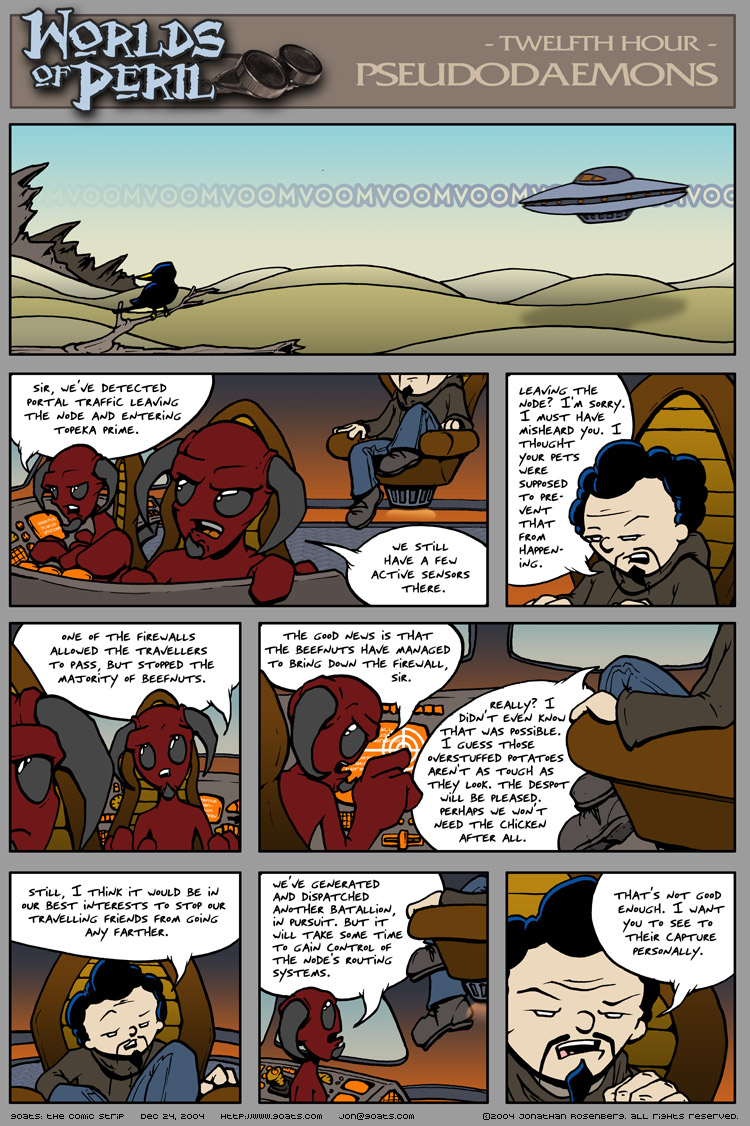
The reason that rule-based comedy is so brilliant is that it forces the creator to think through characters and motivations. You can’t just throw in a bundle of wacky for random use … it’s got to be logical. It makes you a sharper writer; it forces you not to create Funny, but to find it within your creation. Jon Rosenberg not only gets it, he’s even trying to subject a journal comic to a rules-based approach. But to really see an appreciation of rules, check out the recent years of Goats (say, since the earth was destroyed). Characters fill specific roles (chaos-initiator, hapless bystander, methodical planner, disinterested observer, henchman) according to who they are on the inside. Want to make characters truly hilarious? Force them to act outside their comfort zone.

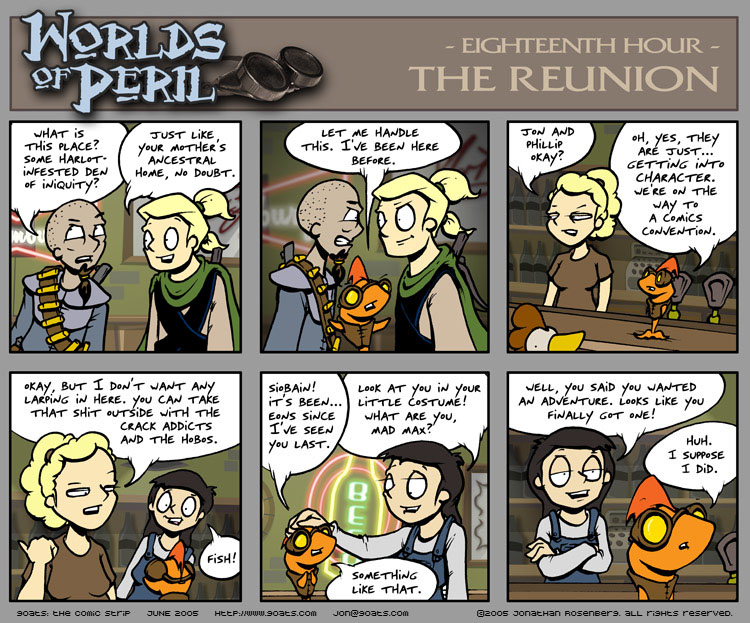
Just as importantly as the character rules are the world rules that Rosenberg has implemented; the rules were always there but they weren’t always obvious. Now we know why they’re there — Goats exists in a deterministic universe running off of a laptop. Its behavior is predictable: reality-crafting monkeys can’t create anything larger than a potato (which Oliver isn’t); Phillip will die from choking on trail mix at some time in the future (and I have to believe that Rosenberg will approach that day’s strip with particularly sadistic glee); people (human, animal, and other) in Goats bear a distinct resemblance to those in various far-flung futures … which at least seems to give us some hope that the universe won’t be ending in seven years after all. In every way, it’s far funnier and more intriguing to see what Rosenberg comes up with when he’s bound by the rules of his creation than in the anything goes days.

The flip side of this, naturally, is that it’s hard; you have to invest a lot in your characters and your world so that the readers know where the boundaries are. Your readers have to be patient, since the buildup is likely to take some time. But the payoff? Totally sweet.

Note: This post was edited to add the promised images pertaining to “various far-flung futures”

This Is A Fleen News Flash!

Myspace has updated its Terms of Service to no longer assert ownership or license over contents in backups. Implication: delete your account, they can’t use your stuff. Is it too early to declare that Jeff Rowland has brought Rupert Murdoch low?