The webcomics blog about webcomics

But Is She Really Raphael In Her Nature?

News, news, news. Getcher news here.

Joe Chiappetta, who is a father and somewhat less than serious, announces:

The first ever Silly Daddy animated cartoon short is complete and viewable here. This entire short movie was done in the Chiappetta studio by Silly Daddy and his built-in team of child laborers working for under minimum wage.

After 16 years total as a print comic and ongoing webcomic, now you can also spend a whopping 26 seconds watching the animated version.

All daddies, silly and otherwise, are directed towards this short.

From Michael Rouse-Deane, a followup to a previous story:

The Kid’s Book Project is nearing its climaxic finalé with only 10 artists left to don their pages. The cover, just released today, is created by the talented Liz Greenfield who had the hardest challenge of creating a cover without even seeing the inside of it. Each book costs £6 and all profits go directly towards the Make-A-Wish Foundation. There will only be 500 printed, so if you don’t get one you probably never will.

The first 100 pre-orders will get a signed printed “thank you” letter from all the artists ranging from Frank Page, Ryan North, Mitch Clem, Brandon J Carr and many many extremely talented people. So if you haven’t already, pre-order your copy today because as soon as they’ve gone, you’ll never find out the answer – “can webcomic artists create a good enough story?”

It is a scientific fact that there can be nothing more adorable than a Teenage Mutant Ninja Liz. Nothing!

Flirting With Notability

The Daily Telegraph talked a great deal about webcomics in their Digital Life section over the weekend; extensive quotes from Chris Onstad and some hack quasi-journalist. Best part — I got to point the reporter at some of my favorite webcomics, and I hope they all get big bounces out of it.

Least favorite part — another dozen webcomics that I adore didn’t make it to final copy. I would have thought that Britain’s only remaining broadsheet might have shown some love for Britain’s most famous webcomicker, but no. But at least Wonderella is there, derr hey? If anybody has a print copy of the Telegraph with the story, we at Fleen would love to obtain it.

In other news:

Zuda Thoughts: Final

Okay, so we’ve picked apart the contracts, and we’ve all had plenty of time to think about things. Let’s put this to bed, shall we?

The Zudadeal is both very, very good and very, very bad.

On the good side, it’s out in the open, completely above-board, fully-disclosed, and they even encourage you to take legal advice from an actual lawyer (that would not be me) prior to entering, because just entering requires you to sign the Submission Agreement.

There are even some bits in the contract that can only be seen as progress from what comics contracts used to look like:

  • retaining copyright
  • having the theoretical ability to recover other rights
  • defined payment schedule
  • audit rights
  • return of originals

These were all unheard of in years gone by.

But while the contracts may be better than what has historically passed for a comics contract, it remains explicitly work-for-hire and falls far short of what were identified as fundamental rights for comics creators nearly twenty years ago.

And that’s where all the bad comes in. If the Zudainitiative were all about finding “traditional” comics concepts, artists, and writers for the future, and it were positioned as, “Show us a good enough idea, and maybe you can come work for us”, I think I would honestly have no problem with it.

But it’s positioned in two very different ways:

  • Show us a good enough idea and you WIN!
  • Yay, webomics!

The first of these is less worrying — if you’re reading the contracts like they tell you to, and you’re getting legal advice like they tell you to, you should understand that this isn’t a case of “you’ve got the best stuff, we’re going to make all your dreams come true”. It clearly is a case of “you’ve got the best stuff, we’re going to buy it from you for what sounds like a decent chunk of money, and maybe you’ll make it big, but we will absolutely make more money off it than you will.”

This is not a knock on Zuda — it’s a fact. Royalty rates top out at 40%, and what strikes me as the most likely royalties to be paid (for print editions) are 1%. That’s what publishers do, and you’ve contracted to work for a publisher. You have not contracted to be partners and grow rich together; see the Rights Agreement, paragraph 24, and Services Agreement, paragraph 25:

INDEPENDENT CONTRACTOR. Nothing herein contained shall constitute a partnership or joint venture by and between the parties hereto or constitute either party the agent of the other. (emphasis original)

The second item concerns me more. The prolific Mr T is of the opinion that the contract is pretty good, and it may be as far as the comics industry goes.

But Zuda has been specifically pitched as webcomics, and that’s a place with a decade-long history of not doing work-for-hire. Those making their livings from webcomics do it on their own, not by partnering with a corporation and giving away the rights to their creation (exception: Penny Arcade, who managed to do exactly that twice, and bought themselves a five-year legal struggle; you won’t be that lucky).

How much does the Zudamodel stand in contrast with the Webcomics So Far model? Let’s just take one thing that Zuda will do for you: print your webcomic. If you work with them:

  • they bear the costs of printing, publication, and promotion, but are under no obligation to do so (cf: Rights Agreement, paragraph 21 and Services Agreement, paragraph 22)
  • they could get your book into the Diamond catalog or regular bookstores, but probably the bulk of purchasers will come from Zuda readers on the web
  • they keep 99% of cover price for the book, you get 1%
  • they own trademark on your webcomic for as long as they want

If you do things on your own:

  • you have to produce the book, sinking money up front into printing books you hope you can sell
  • you have to handle orders and fulfillment
  • you probably won’t get into the Diamond catalog or regular bookstores, but the bulk of purchases would have come from your readers online anyway
  • you’ll keep about 90% of cover price, but must assume the risk of unsold inventory
  • alternately, you could use a print-on-demand service, which drops the risk and fulfillment from the equation, but you’ll only keep on the order of 40% of cover price
  • even 40% >> 1%, and it’s still your property

Put these two points together, and Zuda is equating You Win! with We Own Your Stuff. Yes, they’re a publisher and that’s what publishers do. Yes, they do all the things that you don’t want to do because you’re a creator and dealing with the business aspects gives you a migraine. But the cost/benefit ratio is all out balance here — this is not 1942, when the only way for a kid with a head full of dreams to tell that comics story was to partner with a corporation that had figured out the very expensive disciplines of printing, distribution, promotion, and sales.

We’re talking about webcomics here; the barriers to entry are as low as human ingenuity can make them, and the only bar to success is the quality of your work. If you truly have a meltdown when considering all those business-related aspects, or if you’re honest and decide that you have no talent for them, and if you do them on your own you’ll only screw things up, then the Zudadeal is still not what you need. You need to hire somebody to handle the business instead of a business hiring you to handle the creative.

Let’s play What If for a moment.

What If a company (let’s call ’em Aduz) launched a contest to highlight webcomics in a contest, with a promise of A Deal for the winner.
What If the winner was given the opportunity to have Aduz represent them and handle the business aspects of promoting and exploiting the webcomic.
What If the winner kept all rights and Aduz instead got a 50-50 split because it assumed the risk, and it’s going to have to balance the duds off against the winners.
What If this deal was entirely governed by the Comics Creator’s Bill of Rights (big thanks to Scott Kurtz for pointing out to me that the CCBOR as written applies beautifully to webcomics).

Is it not possible for a company to make money off that deal? Of course it is. Aduz just won’t make as much as Zuda, and Zuda is interested in maximizing its return while paying out as little as possible while still attracting talent.

All that business stuff that gives you a headache? Zuda’s got people that eat it up, and they’ve precisely calculated the point that maximizes their return and minimizes their payout, and enshrined it in these contracts. If it’s your dream to work in comics and this looks like your best way in, if you can honestly look at everything described here and say you’d be happy to exist under these terms, then enter the contest and I hope you win and prove me wrong in every possible way.

But as written, the Zudadeal stands in opposition to the creator ownership that has been one of the core strengths of webcomics since Day One. Webcomics can do better, and so can you.

Reminder For All In The Pacific Northwest

Stumptown is this weekend, and it features a metric squatload of all your very favorite webcomics people, plus Dreamcrusher Prime. Go see!

Also, consider this conundrum:

But combining those three things on a t-shirt? Not “cool”.

CRACK-TACULAR is the word you’re loooking for. This one’s going to escape “webcomics” and cross over into the general population. I hope the postal workers in Easthampton, MA are ready for the rush.

Breaking Pattern

I know it’s been Zuda, not-Zuda for the past couple of days, but I had to get this out there on its own. How to reconcile the following two things?

  1. This message from Paul Southworth:

    My wife is scheduled for a c-section Wednesday, September 26 at 9am EST. Expect guest comics to start running soon after. I’ll post pictures here as soon as I can.

    Wish us luck!

    OH GOD
    (de-emphasis original)

  2. The Ugly Hill strip from Wednesday, September 26?

You have just witnessed a cartoonist’s youth get snatched away and be replaced with crushing, adult responsibility. Bravo, Paul Southworth! I thought only Randy Milholland could write Schadenfreude this well. Speaking of which, I’ve got half a mind to buy that strip just so I can threaten to give it to the newest Southworth in the throes of the mid-teen I HATE YOU DAD angst stage. Good times.

Oh, and young William Joseph Southworth? Something coming for you in the mail. Be sure to share with Mom & Dad.

Still Not Zuda

Sorry about the generally late posting; I’m home from work, sick with some kind of bug that’s taken up residence in my throat and generally reduced my day to napping and light web-browsing. Here’s the news.

  • Tim Demeter reports the All New Clickwheel is up and running. Some interesting exclusives over there, so if reading comics on an iPod is your thing (my second generation Nano is pretty unsuitable), give ’em a look. Oh, wait! There’s now a built-in viewer, so also check it out if reading comics on an iPod is not your thing.
  • From Pat Race, a link to photos of last weekend’s XKCD meetup. Looks like a lot of creative temporary vandalism at the park, with protections against raptors, red spiders, and fun for all in ample supply.
  • Bomb Shelter Comics announces that the latest iteration of Webcomics Idol is now open:

    Each week, a panel of judges comprised of BSC members and guest judges give feedback on each comic and their work for that week, and then open it to the public to vote.

    The winner gets automatic membership into the collective, and all the promotion we can provide. In addition, we’ll host the winner’s comic on Bomb Shelter for free (if they want it) and even design a new site for the comic (once again, if they want it). That was the prize last year, and since Digital Strips is going to be a co-sponsor this time around, (more details on that as it progresses) there might be more for the winner.

    You don’t actually have to have a site for your comic. DeviantArt and Comicspace hosting is fine and will be given as much consideration as a comic with a site. Last year this got a lot of attention, and one competitor, who until then had gone unnoticed for a long time, was nominated for a WCCA that year. Even those who get eliminated are invited to a weekly BSC podcast promoting their comic.

    Judges this year include DJ Coffman, Xaviar Xerexes, pro colorist & webcomicker Wilson Ramos, and some hack semi-journalist.

Raw Zudanotes III: Services Agreement

Editor’s note: we continue our skim of the Zudacontracts, with Big Ideas to be developed later. Today: the terms under which you supply ongoing contributions.

First impression: the Services Agreement is between the Submission (short) and Rights (long) Agreements in length. As before, numbers are taken from the various paragraphs in the contract, and it starts with standard boilerplate about who you are and why you’re signing.

1. You are being hired (“engaged”, in the text of the contract) to produce 52 pieces of work (“Screens”) based on your winning entry. Unless you and Zuda agree otherwise, it’s weekly, at $250 each. That’s $13,000 you’ll be paid under this contract, plus the $1000 from the Rights Agreement, plus whatever royalties may apply.

2. By mutual consent, at the end of 52 weeks, Zuda may hire you at the same rate to keep producing stuff. Said stuff can be immediately after the 52 week run, or delayed until schedules work out. If you opt not to, Zuda can hire somebody else to do your webcomic. I’ve said it before in these write-ups: if your webcomic is your baby and you don’t want to wonder who it’s running around with after curfew, then Zuda (indeed, any work-for-hire arrangement) is not for you.

3. You have a schedule for delivering your work, Zuda has one for publishing.

4. In addition to what you get in the Rights Agreement, you receive your per-screen payment of $250 within two weeks of delivery, plus 4% of cover price of print works. Merch is 6.4% of SRP or 12.5 of gross receipts, reprints are 30% of net, and both foreign-language reprints and English reprints outside the US/Canada are 15% of net. The implication I’m getting here is that the royalties under the rights agreement are what Zuda pays you for their long-term ownership of the material, and this paragraph covers your payment to make it.

5. But there are reductions to the amounts in paragraph 4. If you’re part of a team, those that produce the work split the money; if you’re part of a collection or anthology with other creators, you get pro-rated; combination with other properties is likewise pro-rated (so if your ICSWAFP gets paired up with — I dunno, Batman — and they become partners, you get half I guess). And here’s the interesting bit:

If Zuda exploits any Print Work, Retail Product or Licensed Reprint Edition that includes Material for which You rendered Services in a way or on a media platform not contemplated by this Services Agreement, whether now known or hereafter devised, Zuda shall pay You in accordance with the consideration structure created by Zuda, in good faith, for such exploitation.

Which I’m reading as, “We’ll come up with a rate for that brain-beaming. Trust us.” Once again, it’s these ambiguous cases that I hate, because it lets whichever party has the advantage in a contract (one guess as to who that is) leverage things further to their advantage.

6 and 7. Except for the biweekly $250 installments, payments and accounting are as in the Right Agreement: every six months and only if you’re owed at least $200, and you’re allowed to audit the books at your own expense.

8. What you create under this contract is subject to the same rights transfer as the Rights Agreement.

9. You may be assigned an Editor, and you will do what (s)he says.

10 — 13. Boilerplate matching the rights agreement: you created this stuff, it’s yours to assign, nobody else has a claim on it; if either you or Zuda screw up somehow, the other is not to blame; you’ll get credited on things that Zuda produces/prints; you get free stuff.

14. Layin’ down the law — if you fail in certain ways, you’re in default of the contract:

  • not meeting deadlines
  • not providing satisfactory work
  • not doing anything else in this contract for any reason (including being incapable)
  • not being straight about who you are and being legally able to enter into this contract with respect to this work

Given that I’m not any kind of lawyer (much less entertainment/IP), I’m guessing that this paragraph is entirely boilerplate; it’s reasonable enough to have things like deadlines, and if Zuda were to become arbitrary about what’s “satisfactory” or make a habit of coming up with unworkable deadlines with the sole purpose of screwing you, word would get around pretty fast. Hell, just putting these contracts out there in advance of accepting any submissions tells me that they aren’t interested in screwing you in an arbitrary fashion.

Zuda are apparently going to be avoiding the all-too-common situation in comics where a “monthly” book slips to “bi-monthly”, then “quarterly”, then “we’ll let you know when we can re-solicit”. As a reader, I applaud them for this; when asked for advice about how to build a webcomic audience, pick a schedule and stick to it is always at the top of my list.

BUT if you have circumstances in your life where, at random times for unpredictable durations, you’re unable to work (health or family issues, crippling creator’s block, whatever), best to disclose that at the beginning and find out if Zuda are willing to amend the contract or not; being in breach (no matter how unpredictable the reason) is not somewhere you want to be. How much do you not want to be there?

15. You got 10 days to fix the situation after you’re in default, then you’re subject to termination. You’ll get nothing more (except for what you’d be entitled to from the re-presentation of your work in other forms). Let’s call paragraphs 14 and 15 the Howard Tayler sez, “Keep a damn buffer!” section of the contract. You don’t get to run guest weeks at Zuda.

16 — 27. Repeats from the Rights Agreement: you or Zuda can transfer your interests to another (but you can’t up and say, “Pay Bob over there for the strip ’cause he’ll be drawing it from now on”); Zuda can do business with other Time Warner companies; register all issues in writing; law of New York state prevails; in the event of dispute, your only recourse is a suit; waivers are specific to individual items; Zuda isn’t obligated to actually publish you; if it’s not attached to this contract it doesn’t exist; you can’t be compelled to do something illegal; you and Zuda are not partners; paragraph headings are descriptive and have no legal meaning; and there are no third parties.

Non Zuda

Hey Kids! Comic Books! In this case, Starslip Crisis books being used as a traditional Chinese aphrodisiac. To battle the underground trade in, um, Starslip trades, creator Kris Straub is offering free upgrades to the Artist Edition (i.e.: you get a sketch) until Saturday, and passing the savings (i.e.: ten smackers) on to you!

So, for that matter, is Straub’s hetero life partner Scott Kurtz; given the recent discussion had at Webcomics Weekly (episode 4) about the raw economic necessity of charging for sketches that amount to more than fast pencil jobs, I was suprised to see this.

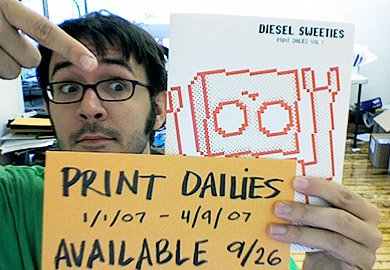
Also new on the book front: a Diesel Sweeties mini drops tomorrow, and Jeff Rowland has finished the latest Wigu collection, The Case of Mars. Because he loves you so very much, Rowland is allowing all & sundry to read TCoM for free online, but you may have to squint a little.

In other news of awesome things, you’ve got a Penny Arcade cameo in today’s Little Dee, a report on free Achewood tattoos in Portland, and a new Southworth ready for imminent debut. If you do nothing else today, give Paul’s wife your sympathy for having to carry his gargantuan hellspawn in her body for nigh on a year.

Raw Zudanotes II: Rights Agreement

Editor’s note: we continue our skim of the Zudacontracts, with Big Ideas to be developed later. Today: the rights and reversions under which you operate.

First impression: the Rights Agreement is about twice as long as the Submission Agreement. This could take a while. It starts with boilerplate — who you are, who they are, you won, yay. Numbered paragraphs ahoy.

1. Everybody on a creative team has to agree to sign the contract. Question (and this isn’t a knock against Zuda) — what if one contributor doesn’t? Presumably the team loses the opportunity to sign and then we have the question from yesterday — what rights from the Submission do you get back?

2. Okay, it’s boilerplate, but it’s still creepy:

You grant and assign to Zuda, its successors, licensees and assigns, solely and exclusively, in any and all languages and media, whether now known or hereafter devised, throughout the universe, for the term of copyright, all rights in and to the Material (emphasis mine)

So when somebody invents direct brain-beaming of comics on Omicron Persei VIII, this contract already covers how Lrrr can read it. Creepy. Specifically, rights include:

a. print and electronic publication, including A/V of all sorts, merchandising, software, multi-media, Internet and mobile, live stage and commercial tie-ins
b. use and/or licensing; I’m guessing this means that if your ice cream scooper with amazing freeze powers becomes a hot property, DC can pass the movie rights to Warners
c. advertising & promo, including you & your image/bio; if you become famous for other non-Zuda work (in comics or out), expect coattail-riding
d. Verbatim:

The right to edit, alter, revise and make any and all changes to any Versions of the Material, including making necessary additions thereto and deletions therefrom.

Hmmm. VERY hmmm. If you’re absolutely emotionally tied to your idea, this could be a dealbreaker for you.

You can sell your originals, as long as they’re labelled with copyright & trademark (more below), and 100 repros/year. Ownership of your originals is one of the elements of the Creator’s Bill of Rights from 1988 (see Reinventing Comics, pp 60 — 62 and here), so I’m very pleased to see this here.

3. Zuda wants you to sign the Services Agreement and create more work for them; presumably that contract has the details.

4. You get royalties, plus whatever payments the Services Agreement spells out. This is going to be fairly important, so details are:

a. You get $1000 “non-recoupable” up front for what gets posted on the Zudasite. I think “non-recoupable” means that Zuda can’t reduce that amount to reflect expense and effort to promote you (c.f.: the entire history of recording contracts ever)

b through f. various royalty rates are:

  • print — 1% of cover price
  • merch — 1.6% of SRP or 5% of gross receipts if no SRP
  • reprints — 20% of net
  • non-reprint publications (novelizations, books on tape, etc) — also 20% of net
  • other productions (including movies, TV, and stage) — 40% of net

Royalties will be reduced for things like unsold, returned, damaged, freebie, and deep-discounted (70% +) items. “Reprints” apparently covers print not done by Zuda, so the Bulgarian edition of ICSWAFP will get you a paycheck minus

any unrecouped foreign taxes, import duties and/or currency exchange losses, and less all direct costs incurred by Zuda.

I suspect that this is entirely standard boilerplate in any IP-based industy; lotta room there for creative accounting.

Interestingly, the merch royalties don’t apply to licensees. So if Zuda makes an action figure of your ice cream scooper with amazing freeze powers (gotta come up with a shorter name for that character), you get a royalty. But if Warner’s makes a movie out of ICSWAFP and there are action figures that look like, I dunno, the Tobey Maguire of the future as ICSWAFP, you get zip.

The 40% on scripted productions sounds good, but I’m not sure if the “net” in this case means “net on what Zuda made from the licensing”, or “net profits after ICSWAFP turns out to be a $300 million blockbuster”. Even if it is the latter, keep in mind that Frank Zappa once described entertainment-industry accounting as existing somewhere between “usury” and “science fiction”.

5. Teams split money paid out evenly, unless all team members agree to a different split. If your work is commingled with others (say, in a Best of Zuda ’08 anthology), you get pro-rated based on amount of content in the total package. If you don’t complete on deadline and Zuda has to pay somebody to finish for you, they get paid out of your royalties (up to a 50% reduction in payout to you). These all seem pretty reasonable.

6. Royalties are biannual, but you don’t get anything unless it amounts to at least $200. Fair enough.

7. The proverbial big one. This is going to be a vicious reduction to first principles:

  • You keep copyright. That’s good.
  • Zuda gets trademark. That’s less good.

Going back to the popular Siegel & Schuster example, if they’d kept copyright on Superman from Action Comics #38 and DC’s forerunner kept only the trademark, they would have wound up in about the same place as they did by having neither. S&S could have determined how and under what conditions the specific content of the Superman story would be printed and distributed. But the idea of Superman, and the ability of DC’s various historical identities to use Superman however they saw fit would stay with DC.

Which of those two is more valuable in the long term?

8. But you might get your rights back. After four years of your last hand-in of material under the Services Agreement, if Zuda hasn’t paid you at least $2000 over the prior two years, you can request in writing that all rights return to you.

It seems from a cursory reading that if your property if worth enough, but the royalties (or the terms of the Services Agreement) are slight enough, Zuda could just issue a new edition, cut a check, and keep the rights in play. This reminds me of the famed “Alan Moore gets the rights to Watchmen back as soon as it goes out of print” paradox.

And there’s my answer in sub-paragraph b: within six months of your request, Zuda either (choose one):

  • returns the rights
  • pays you for more services on mutally-agreed terms
  • finds a way to pay you at least $2000
  • brings material back into distribution

There’s the out — as long as Zuda are willing to cut you a check of at least $2000 every other year, you will never get the rights back. The cynic in me notes that what with pre-press, promotion, legal & other sundry costs, $2000 is probably a lot less than it would take to a) prepare a new release; or b) negotiate new work with you. So pretty much it’s either give you back the rights or cut a check.

The next sub-paragraphs indicate that if Zuda doesn’t give you your rights back, the 2 year clock starts again, and if they do, you get everything back. Given the long history of comics publishing treating all creator effort as work-for-hire, I suppose that even the theoretical return of rights is a step forward. But given that Zuda is meant to be working in the space of webcomics, which has a history of creator ownership, this model is about 180 degrees from the way that virtually every webcomicker works. They may be able to attract people who are not presently known and pro-grade webcomics creators, but I think this is a dealkiller for any existing webcomics creator.

The rest of paragraph 8 is technical details: you can publish whatever you like after reversion, but you have to leave Zuda’s name off it; anything they created in conjunction with you work they keep; any licenses or options (say, for ICSWAFP: The Movie!) in effect at the time of reversion stays in effect (but reverts to you on expiry), and nothing strikes me here as unreasonable.

9. Zuda has power of attorney to make deals on behalf of your material. Makes sense.

10. You can audit the books at your expense; bring your own forensic accountant.

11. You have the legal authority to assign rights to Zuda because this really is your work and nobody else has a claim on it. Boilerplate.

12. If you screw up, Zuda is not to blame and you can’t sue them, and vice-versa.

13. You get credited as creator of the work “in a size and manner consistent with Zuda’s standard practices at the time of publication”, which could include the fabled Teeny-Weeny Eyestrain-o-Vision. But if anybody fails to credit you as creator, inform Zuda and they’ll try to fix it.

14. You get free copies of various stuff. I like free stuff.

15. Zuda can sell their rights to the work, and you can direct them to pay your share to somebody else.

16. Zuda does business with Time Warner companies, and you agree not to challenge dealings solely on the basis of their having a common corporate parent. Still and all, expect Warner TV or movie productions to have a leg up on the option for ICSWAFP.

17. All notices in writing, make sure you get a receipt, and don’t send it postage-due (’cause honestly, you’d be a jerk if you did).

18. Again, all of this is governed by the law of New York.

19. Except as laid out above, none of Zuda’s interests will ever be given to you unless you sue and win.

20. Severability again: If any part of the agreement gets waived, it’s specific to a given item and not applicable to the rest, or to future agreements.

21. Zuda doesn’t have to publish your work at all. If that’s the case, look for a reversion after four years if they decide they don’t like your idea, or $2000 checks every other year if they do.

22 — 26. There are no side agreements, neither party is compelled to do anything illegal, you and Zuda are not partners, paragraph headings are labels only and have no legal meaning, and there are no third parties to the agreement. All boilerplate.

Four elements of the Creator’s Bill of Rights — right to accounting, legal counsel, prompt payment, and original artwork — are addressed in this contract. In fact, as others have pointed out, Zuda is recommending that you get a lawyer to advise you on the contracts before you decide to submit, so that’s actually progress. Unfortunately, the other eight — especially the first, The right to full ownership of what we fully create — are wavied under this contract.

Not Zuda

Little Dee volume 2 is now up for orders. Yay! And shall we talk “bargain of they year”? It’s only $12 including domestic shipping.

Randy Milholland has set up his Something*Positive 1937 strips on their own site — and redone them in a horizontal arrangement. This has removed the only possible problem anybody could ever have with them (namely, that they couldn’t be easily included at the top of a blog post), so you should go check out Classically Positive now and groove on the awesome Art Deco style that Milholland’s using for decorative flavor.

Hey! Do you do minicomics? Will you be going to SPX? Who do you like best — Dave Kellet, Kris Straub, Scott Kurtz or Brad Wigwam? They’ve got a bet about how many minicomics Brad and Dave will get at SPX, and you could help your favorite guy win some cash. Details (along with a lengthy digression about The Price Is Right math) in episode 7 of Webcomics Weekly.

Liz Greenfield returns to the e-posting fold with her first (of hopefully many) little slice-of-life sketch; it rocks.