The webcomics blog about webcomics

Nostalgia, Transformation, Finding Yourself
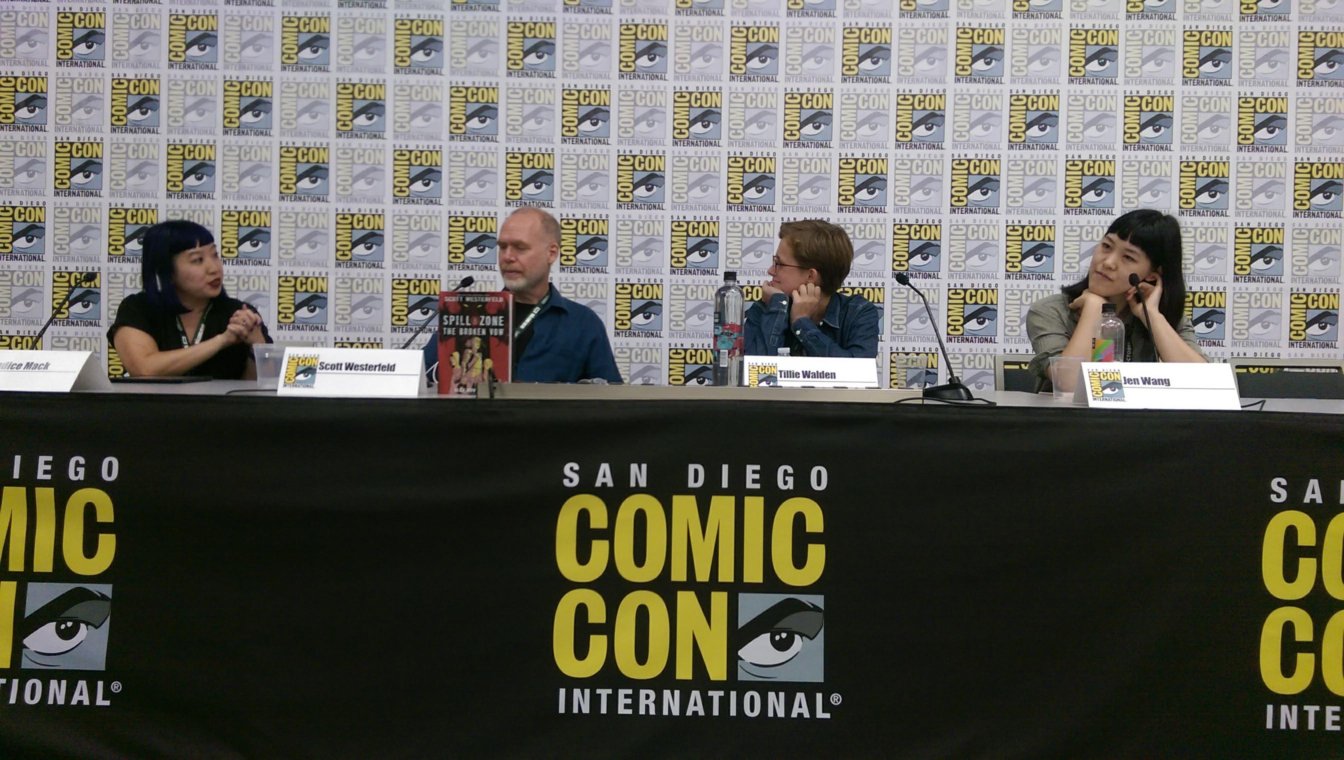
[Editor’s note: As in the past, these panel recaps are based on notes typed during the session; all discussion is the nearest possible paraphrase, except for direct quotes which will be italicized.]

What do you get when you combine a comics festival co-founder, a former competitive figure skater, a composer/computer scientist, and a manager of teen library services? A wide-ranging discussion on the nature of YA books, on account of those four people are, respectively, Jen Wang, Tillie Walden, Scott Westerfeld, and moderator Candice Mack.

With a small panel, Mack was able to address most questions to each of the panelists, and had them start out with a quick description of their latest or next graphic novels; Walden and Wang spoke of Spinning and The Prince And The Dressmaker, while Westerfeld mentioned his upcoming sequel to last year’s The Spill Zone, titled The Broken Vow (both illustrated by Alex Puvilland). For three such different books, certain common themes were described by the creators. We’ll come back to that idea in a bit.

Given the very different stories, Mack asked about the focus that each chose for their stories, and the process of coming to that series of decisions. Walden very nearly denied that such a process exists, indicating that for her the important thing is an intuition about the story she wants to tell; specifically, the sustained effort of making a graphic novel is such that she needs to find something to hold her interest for the whole time it will take me to make the goddamn book.

With reference to the critically and popularly acclaimed Spinning, Walden declared that one day she woke up and thought Shit I need to make a comic for class. I was an ice skater, I can make a comic about that! The story she could tell fit that particular need rather than being one she was burning to tell, despite the topic being that which had dominated her life more than anything else for a dozen years.

Westerfeld found his inspiration in place: the Spill Zone books take place in a post-low grade apocalyptic Poughkeepsie, and he’d learned about the history of the town while attending Vassar. Despite being very wealthy for a period of town and not falling into the traditional Rust Belt, Poughkeepsie is a post-industrial town that’s fallen from its glories. In this case, it was the center of the very lucrative trade in ice for New York City, until the invention of refrigeration dealt a blow in the early 20th century, from which the city has not yet recovered. The nostalgia that’s bred into the city and its residents appealed to him, as did his stint as an urban explorer, making his way through once grand/now abandoned buildings, filled with mysterious traces of the people that lived there. It’s basically the plot of The Spill Zone, minus the otherworldly horrors that killed everybody.

Wang said she had a couple of different ideas floating, specifically an idea for a story about sewing, or possibly someone whose superpower was sewing. The transformation quality to making clothes captured her imagination (despite claiming to have no skills in the arts), which provided a handy metaphor for the transformation that her main characters go through.

We’ll continue with Wang’s answer in a moment, but remember that bit about all three stories having common themes? Transformation was a key one, whether it’s the transformation of gender, the transformation of self via single-minded dedication (coupled with the transformation to somebody who doesn’t do that anymore¹), or the sudden transformation of a city and its unlucky inhabitants. I’d remark later that I couldn’t think of three more different books that I’d read in the past year, but they all had that piece in common, along with nostalgia and finding identity. At the very least, Westerfeld would later argue, the finding identity part is the ur-theme of YA.

Back to Wang’s answer, she also cited a desire to do something in the Disney mold, meaning the transformation would be more personal than superheroic, and provide the basis for (hopefully) a fun, light story. The Disney angle led to the setting (post Industrial Revolution, pre-modern), a time of change (horse carriages and department stores, mass produced sewing machines, and as Westerfeld observed, an aristocracy that’s moving from old fashioned to irrelevant).

That led to a discussion on their main characters, and the degree to which they were designed to be directly familiar to YA readers. Westerfeld had a story with a protagonist that could have been any age, but bringing her down to late teens/early 20s and making her suddenly responsible for a younger sibling let him explore another dimension of leaving youth. As he noted, adulthood gets thrust on younger people depending on economics and place; Poughkeepsie’s already a place of melancholy/nostalgia thrust on residents at a young age, and the disaster added another layer of nostalgia not for the rich past, but for the time just a bit ago before the city was swallowed by monsters and extradimensional horrors.

Walden, by contrast, never set out to do YA, but wound up there by virtue of her experience. When I was 17, my characters were 17 year old girls; publishers, however, do care about who stories are pitched to, and she realized how much she enjoyed working in the category of teens and children, coming of age, but ending up there was accidental. Wang also fell into YA by accident, where TPATD‘s characters were initially adults. Aging them down to teens allowed a story of big feelings, discovering things for the first time. Her only concern was Is it weird that the prince is expected to get married really young?” and the others agreed that it served to show how quickly life changes at that age.

Westerfeld pointed out that’s one of the key aspects of teendom is everything is SO BIG: a bad day when you’re a teenager is the end of the world, a good day is the best thing ever. Walden emphasized the speed, a time of life when big things happen one right after another; Westerfeld added some historical context to point out that you used to co from childhood straight to adulthood, heading into the factory or mines at 10, 12, maybe 15. The transitional stage between childhood and adulthood is a recent invention: The word teenager is only from 1948. We’re still working it out as a culture.

Less philosophical concerns rounded out the session. Mack wondered about work habits, and all three discussed the importance of routine. Westerfeld has the act of writing down to muscle memory, in that he writes every morning in the same space, in the same chair, at the same time, after the same breakfast. Walden’s had a lot of airport lounges and hotel desks in her writing experience over the past year, but at home in LA she’s found a co-working space to be a help: it’s got A/C in a warm climate, and you can leave your stuff when you go to lunch, as opposed to working in the local coffee shop.

Wang offered the routine was more present in her drawing time than her writing time, which prompted Westerfeld (who doesn’t draw) to ask if the drawing imposes consistency on their work — a predictable amount of output (Wang: by the time I draw, I know where the story is supposed to go and can steer it), the opportunity to fix writing in the drawing (Wang and Walden: Oh, yeah). Walden described drawing as the reward — she says she can’t write dialogue, but drawing speech bubbles makes her hear the words that characters will use. Westerfeld found all of this to be NUTS, but described a somewhat similar back-and-forth with Puvilland (a non-native English speaker, he approaches the story with different timing or beats that Westerfeld scripts, leading to new ways of looking at the story and what it needs to accomplish).

Mack asked each what the strangest thing they’d ever done for research was; Wang learned to play World Of Warcraft when adapting Cory Doctorow’s In Real Life to a graphic novel. Walden learned to drive stick because she had a character that did and had no idea how to draw their hands. Westerfeld didn’t have an answer himself, but mentioned that Holly Black once had herself thrown in a car trunk and driven around to determine what it was like; I’ve never done anything like that, so I guess I’m not that into research, he concluded.

A brief Q&A asked about desire to get into animation (all three: not really), and if there was a particular YA work that had an impact on their work. Westerfeld said that YA category didn’t really exist when he was grown up, but he gravitated to the sci-fi section; his most influential books were Dune and Charlotte’s Web. Walden loved Roald Dahl until he became problematic: My mom was “Tillie, he’s anti-semitic and we’re Jewish” and I’m WHAT. And Wang found her prime YA years more occupied with manga and anime, but at and earlier stage devoured Brian Jacques’s Redwall series.

None of them could say that YA had an influence on their work, but meaning the ur-themes of transformation and finding yourself were less inculcated in them, and more self-developed alongside the YA tradition. I’m going to bet in another 20 years, some future YA authors will have answers to the same question that much directly credit Wang, Walden, and Westerfeld.

_______________
¹ Which led to a hilarious exchange between Westerfeld and Walden:

SW: What makes Spinning really sad is walking away from something you committed so much to.
TW: I KNOW.
SW: You can see it from the beginning, and it makes everything that’s brutal about getting up at 4:00am not worth it. I, Tonya has a happier ending!

Ramping Up

If Thursday had one thing that everybody seemed to agree on, it was that the day was pretty steady. No huge swells, no long dead periods, nothing crazy. Pretty calm so far, hope it stays like this a security guy in the vicinity of Hall H told me. Nice and easy today a facilities worker by the food trucks said. The view from the booth even had the omnipresent line for Snoopy exclusives in a reasonbly-wrangled state¹ (as opposed to Preview Night, when multiple attendees tried to scam an alternate line when the real one got capped, and security came as close to yanking badges as I’ve ever seen).

I mean, that’s weird, right? I’ve never heard of such a thing; the closest equivalent I can think of was the fire marshals stopping people from entering the first New York Comic Con due to overcrowding. But it wasn’t the weirdest thing of the day.

The weirdest thing of the day was a guy in a head-to-toe Spider-Man suit with a single zipper that ran up the back and ended between his shoulder blades. I watched him walk into the men’s room, approach a urinal, and then just stop, trying to figure out his next move. I hope every superhero — especially the ones with armor and pouches and everything — has thought ahead to what happens when they need to take a leak when they designed their costume. As I left Spidey wondering how he was going to take care of bidness, I passed a guy who appeared to be changing into costume, pulling stuff out of a large shopping bag. He appeared to be going to He-Man, as he already had a furry, diaperesque pair of underpants on. You don’t get photos of those dudes because come on, it was the bathroom.

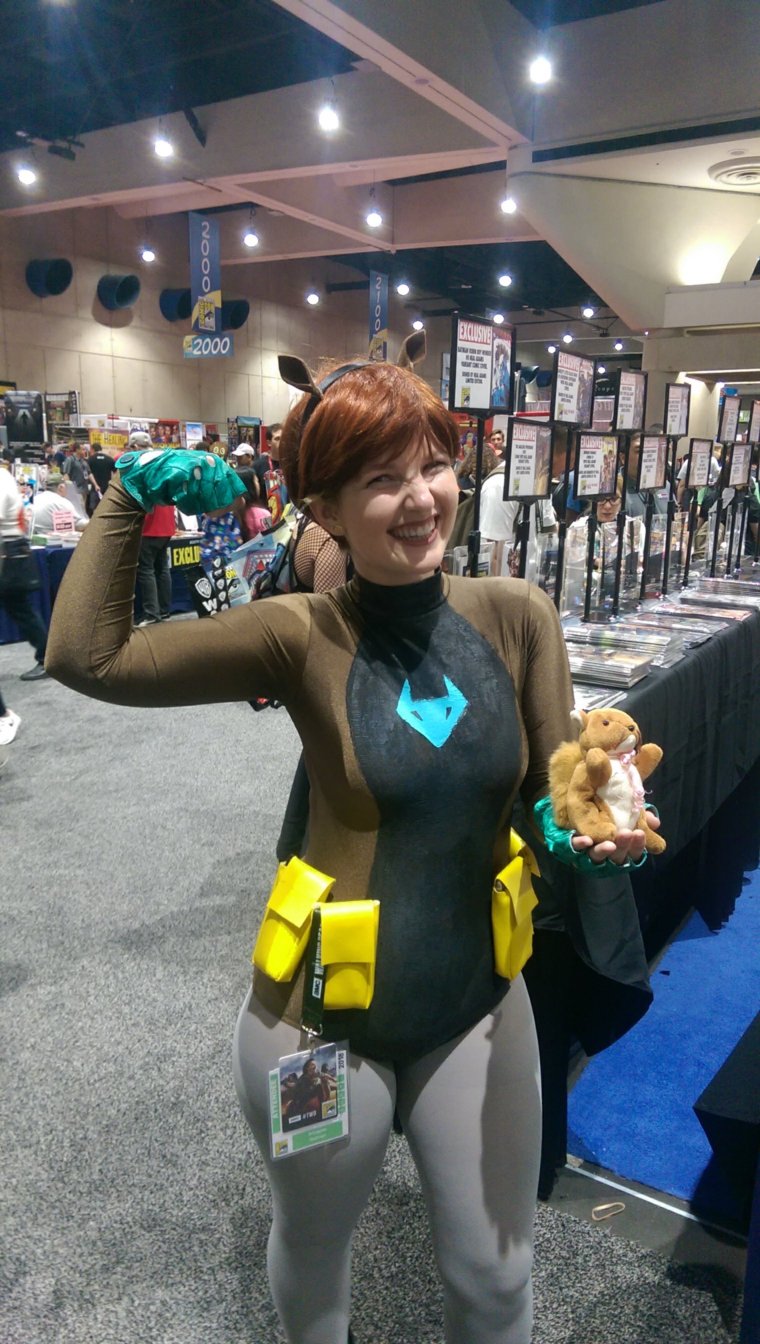
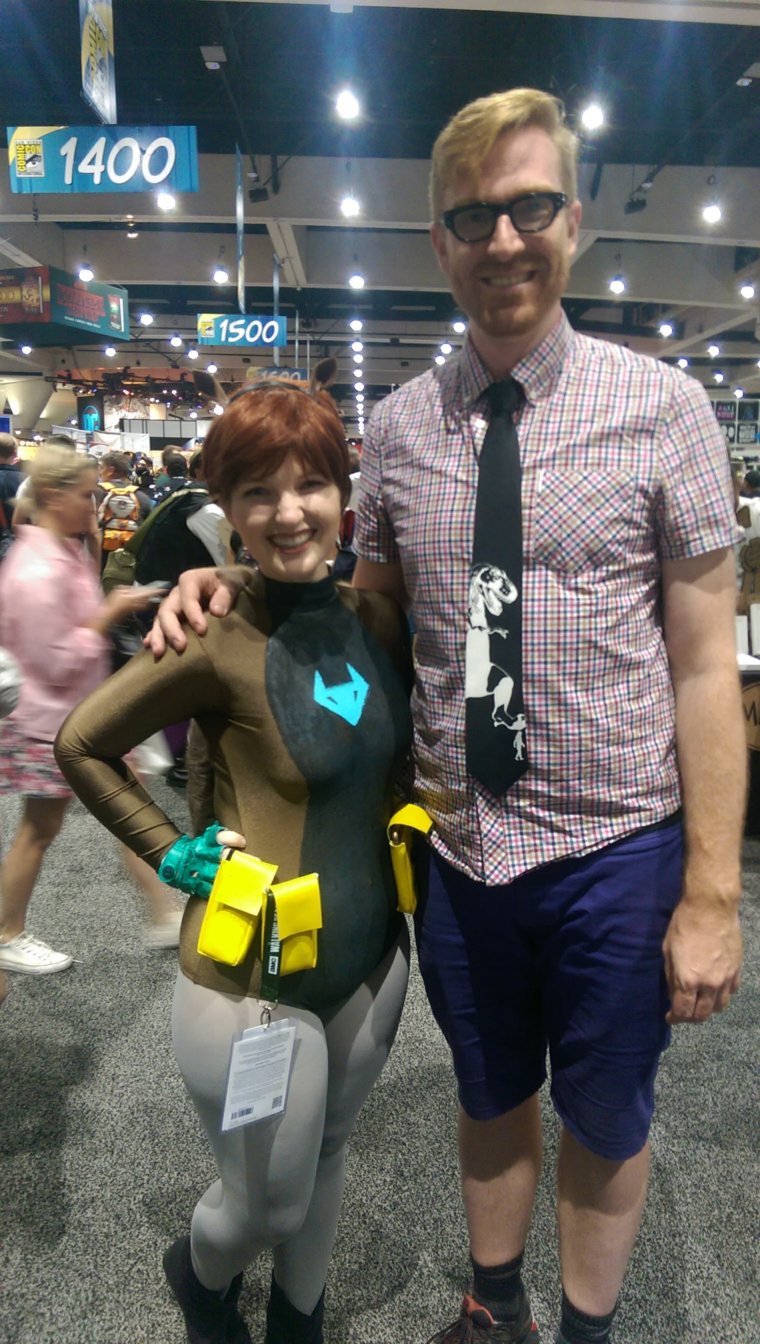
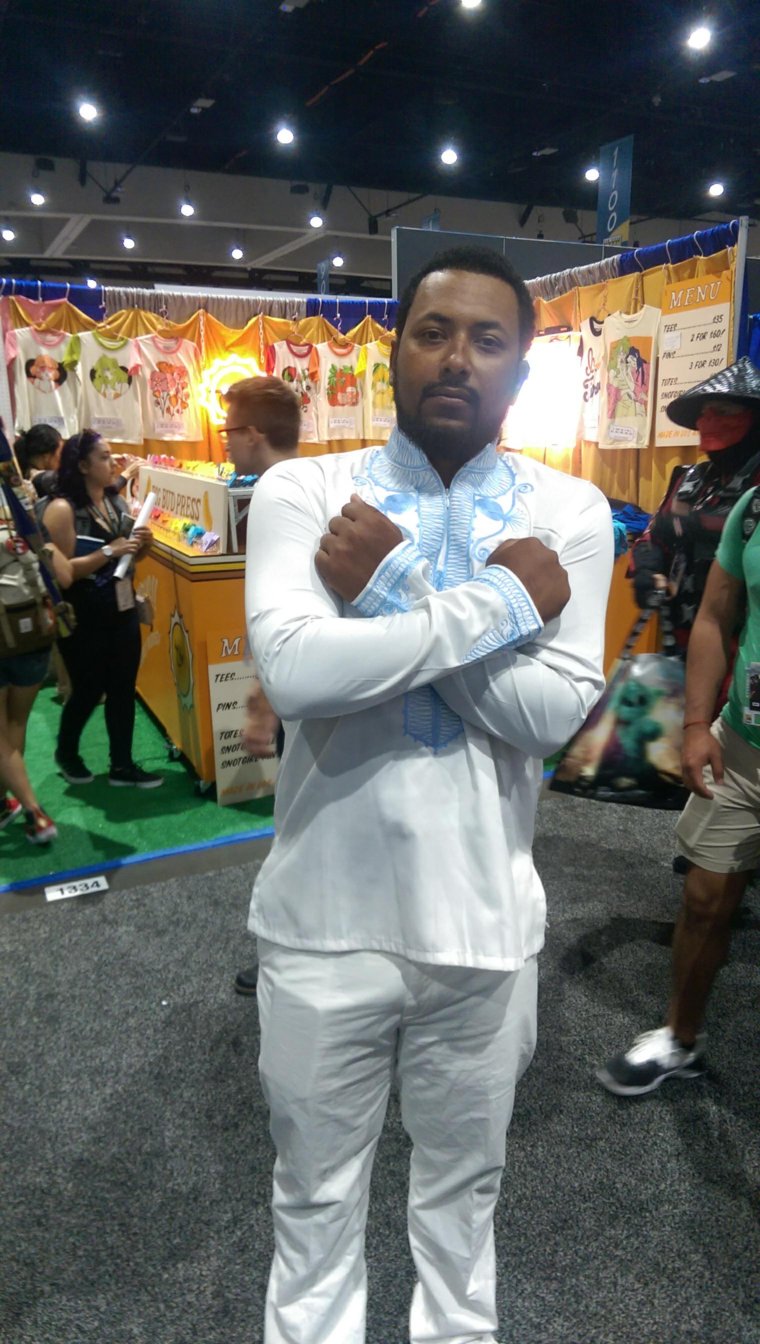
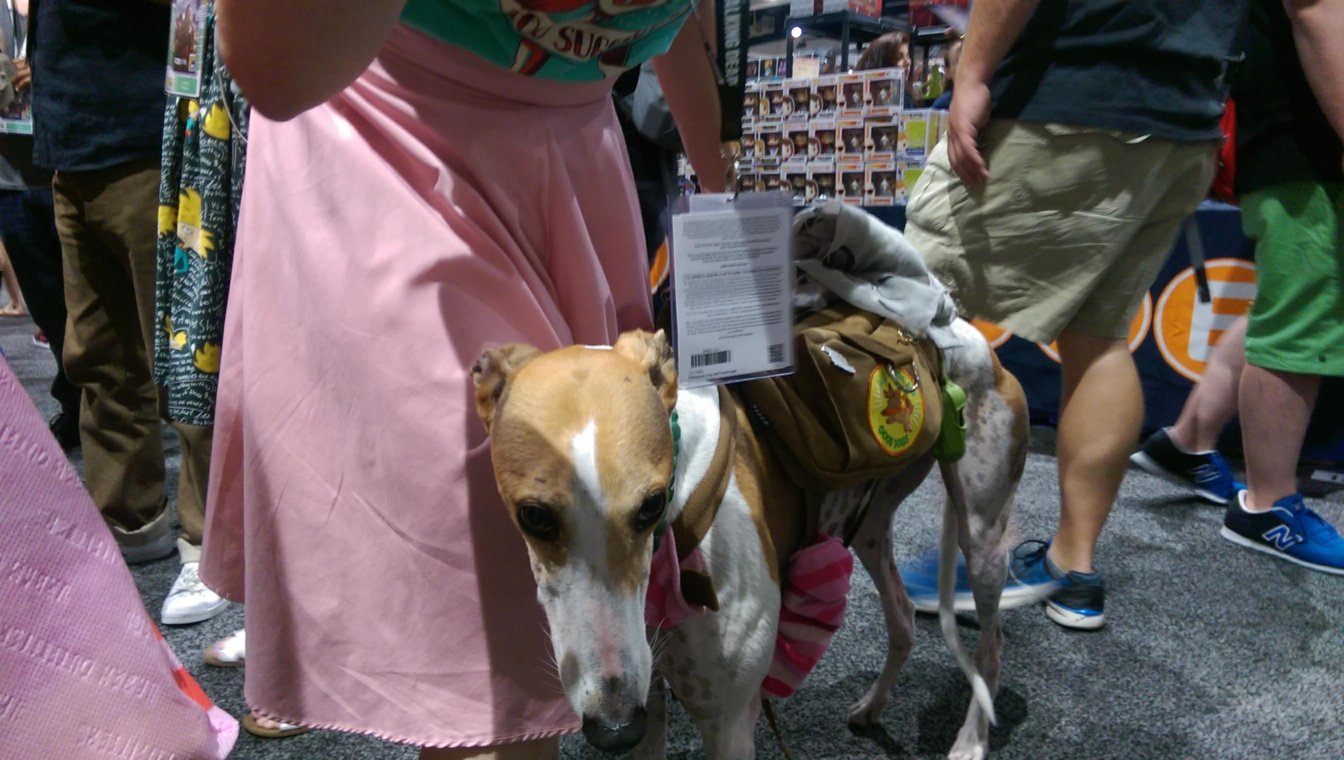
Cosplay started in earnest; early in the day I met an authentically great Squirrel Girl and got her photo; I asked if she’d been to see Ryan North yet and her face lit up — He’s here? I walked her over to the TopatoCo booth and watched the magic happen. Surprisingly, I only saw one King T’Challa, but he exuded great dignity. Less surprisingly, I also only saw one person try to channel Inner Goldbluminity to play The Grandmaster, with a suitably why do I put up with this crap looking companion as Topaz. The best cosplay was probably that of Pepper, a chihuahua who did an amazing job cosplaying as a greyhound².

The day ended improbably, at the top of the Marriott Gaslamp, looking down on Petco Park, at a party sponsored by Webtoon; I ran into Jamie Noguchi and we chatted a bit about Danielle Corsetto³ (we wished she was there), the potential return of Yellow Peril (gotta balance the paying jobs, some of which are ridiculous), our dislike of companies running “contests” for talent searches (as we accepted offers from the plates of sliders and other foods being passed), and how there’s a great comic to be made about the gig economy (which is pretty damn close to both freelancing — the subject of Yellow Peril — and webcomics). We also played who’s actually in comics and who’s invited because they’re very, very pretty and make the party sexier and determined the giveaway was the shoes. Strappy, shiny, elevated shoes that cost as much as 100 Copic markers? Not in comics.

Panels to attend today include:
The Power Of Nonfiction Graphic Novels with Thi Bui, Alex Irvine, Clifford Johnson, Peter Tomasi, Travis Langley, and Abby Howard (who I met yesterday and she’s delightful). Room 32AB at 10:00.

Graphic Novels: From Eisner To Explosion!, which overlaps, but which features Scott McCloud, Jeff Smith, Emil Ferris, and Paul Levitz. Room 24ABC at 10:30.

Autobiography In Graphic Novels with Raina Telgemeier, Jarrett J Krosoczka, and Tillie Walden; coincidentally, I saw all three of these folks on panels yesterday, and they’re great. Lots of writeups to do, may take a while to get them posted. Shiley Special Events Suite, San Diego Central Library at 3:00.

LGBTQ Graphic Novels with Aminder Dhaliwal, Molly Ostertag, and Ivy Noelle Weir. Shiley Special Events Suite, San Diego Central Library at 4:00.

Handling Challenges: Bans And Challenges To Comics with Gina Gagliano, Judd Winick, Charles Kochman, Candice Mack, and David Saylor. Shiley Special Events Suite, San Diego Central Library at 5:00.

I’ve got about 3500 words of rush transcripts from yesterday’s panels to edit down, so look for those sometime today, as time permits.

_______________
¹ There is an exception to every rule; I heard one toy-related merch booth a few dozen aisles to the south managed its exclusives so poorly, creating uncontrollable crowd hazards, and was shut down for the day by the showrunners. That’s gotta put a dent in your budget.

² Okay, okay, she was a real greyhound, but a small one. And she was a good girl.

³ Whose new comic, Boo! It’s Sex, is on Webtoon, so it all ties together.

Shaking Up The Comix Biz

I got to speak with some ladies about big changes coming in comics.

  • comiXology had a press conference yesterday, trotting out the creators of the first tranche of the creator-owned line they’ve put together; Kel McDonald was kind enough to chat with me about some of it. She’s working up a story illustrated by Tyler Crook called The Stone King, and she’s in good company: folks like C Spike Trotman, MK Reed, Hope Nicholson, Rob DenBlyker, KC Green, David Malki !, Branson Reese, Katie Shanahan, Kris Straub, Kris Wilson, and Kris Zach Weinersmith are also on tap (Nicholson editing all those folks whose names come after hers on the list in a collection called Hit Reblog: Comics That Caught Fire, which is a biographical treatment of comics that went viral).

    McDonald wasn’t able to answer a lot of my questions, either because details aren’t public, or because the decisions haven’t been taken yet, but the fact that comiXology (which is to say, Amazon) is moving hard into this has the potential to shift things in the market. To be seen over the next bit:

    What conditions will make them expand this first foray into a general program of creator-owned publishing? And where do the rights reside? From here, it looks like a form of publishing that could equally peel people off of, say, Line Webtoon (digital quasi-publisher, but can’t possibly pay what Amazon could) and, say, BOOM! (which pulls heavily from indie and web folks, and is widely perceived to screw them sideways on getting paid, which is not an approach that Amazon could take¹).

    And, crucially, what about print? comiXology is all about digital, but right now I’ll tell you that no matter how great all of their proposed books look, I won’t buy digital comics that I don’t get to own. Somebody’s slinging a PDF on Gumroad? I’m all over that. But comiXology is part of Amazon, and Amazon has depublished books and removed them from devices for their own contractural reasons. I will not buy a license to read a comic from anybody (but especially not an Amazon-owned company).

    Anyway, Old Man Grumpus over here will be watching all of this very closely. I don’t know that it’s as big a change-maker as, say, Kickstarter has been, but it’s early days.

    Kel McDonald can be found most times during the show, at Small Press table M-12.
    C Spike Trotman can be found wandering the floor, on panels or at the zoo, not stuck behind a table like a chump.
    MK Reed can be found at various panels and signings.
    Rob DenBlyker can be found most times during the show at Cyanide & Happiness, booth 1234.
    David Malki ! can be found most times during the show at TopatoCo, booth 1229.

  • There are no certainties in life, and certainly not in comics, but there is one thing that is close enough to be mathematically indistinguishable from certainty: Gina Gagliano is going to succeed. She is universally beloved and respected in graphic novel publishing, and there is a not a person that can say an unkind thing about her. Consider: a major publishing conglomerate does not start a new imprint on a whim, or without planning, approval, and confidence at the executive level. More to the point: Random House sought her out to head up this new direction.

    Gagliano’s looking to accomplish huge things — at :01 Books she was part of a publishing schedule of 20 books per year, that ran up to more than double that over a period of less than two years; look for Random House Graphic to want to jump into this space with both feet and leverage her past proven abilities, with a publishing schedule at least that ambitious.

    And since we’re talking about a massive corporation, they’ll want to see revenue as soon as practical given the lead times in production and printing² if there’s stuff in the production cycle now, 2020 would just barely be possible for first releases (and honestly, I’d think 2021 far more reasonable, given that she’s starting from scratch and getting ready to put together a marketing plan for books that won’t exist for at least 18 months, lacking a staffed-up office). That’s amazing.

    As I told her, the comics world has huge expectations, but also great confidence. If she accomplishes 60% of what I think she can, it’ll be a runaway success; if she gets to everything I think she can, it’ll be a seismic shift to the industry not seen since … well, since she handled marketing and publicity as her last gig.

    Gina Gagliano can be found on a panel at the San Diego Central Library at 5:00pm Friday, and the rest of the time she’ll be talking to the people that will help her revolutionize graphic novels. If you can help her do that, no doubt she will find you.

_______________
¹ Yes, Amazon is a giant bestriding commerce, but I think that fact counterintuitively acts as a brake on them. This is purely speculation on my part, but given the stories I’ve been told about BOOM! not honoring contract provisions, I think their size is the only thing that lets them get away with it. They’re larger than the individuals who’ve complained, but too small for their bad behavior to carry over to where there’s real money.

If comiXology (that is to say, Amazon) didn’t honor contract provisions or got grabby with rights in the ways that I’ve been told BOOM! has, it would have repercussions far beyond digital comics. It’s the sort of thing that would cause large corporations to ask Could this happen to me when I host my stuff on Amazon Web Services? Better play it safe and shift to Azure, and that has the potential to affect about five-six orders of magnitude more money than some electronic funnybooks.

² Which may be even greater if Screamy Orange Grandpa ramps up the trade war with China.

A Trade And A Scoop

It just occurred to me that the two people I’m talking about here occupy far ends of the human size spectrum. I have to try to get a photo of them together.

  • When you walk down the aisle in Artists Alley and see where Shing Yin Khor is supposed to be set up and see only blank space? Don’t panic. Because if you walk by again two-three hours later, you’ll see an immersive table set up, looking like an apothecary of weird and wonderful things, and no sign of the proprietor because she’s gone someplace better for the remaining six hours until show opening.

    A transplant from a slightly confused alternate future, Khor does art from small artifacts to big installations, and you should go see her stuff. The easiest way to find her is to make it known you know where a roadside Paul Bunyan statue may be found and she’ll find you, but I hear that this year’s XOXO Fest will be a good bet.

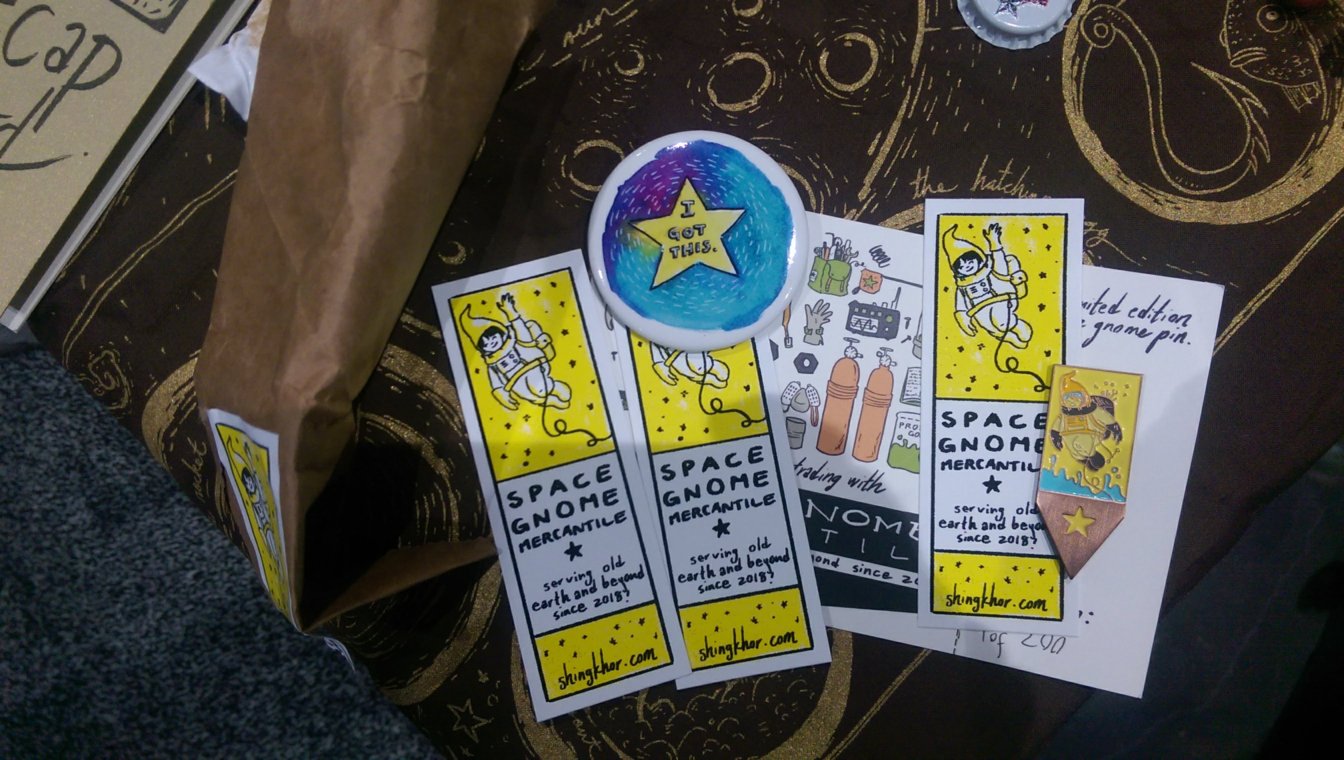
    As previously mentioned, Khor has a trade-only set of goods at her booth this year, and I was pleased to be the first person to make a trade with the Space Gnome. You can only make the trade for one (or more, I suppose) of:

    1. A cool rock
    2. A story about your favorite roadside statue
    3. A handmade ceramic vessel
    4. A compliment, in iambic pentameter or limerick.

    And no lie, I actually dreamt a limmerick about Khor last week. It declared both Khor’s stature to be slighty but also the Space Gnome to be Paul Bunyan-mighty.

    I received several stickers, a mystery item (which turned out to be a badge reading I Got This), and a beautiful enamel pin; I noticed later that at some time while we were talking, she managed to inscribe a personalization on the back of the card it came on. It’s marked as 1 of 200, so get to scrounging rocks, vessels, roadside statue stories, and verses; there’s about 194 of them left. Khor is also providing fortunes, beautiful watercolor miniprints, and I received one reading:

    THE SHARP TALON
    desire, anger, retribution

    The fight you know is on the horizon is long and arduous, but you are prepared for it.
    Your instincts are sharp, and your skills will be called upon to create a better future for you and yours.

    Shing Yin Khor can be found at the Center For Otherworld Studies most times during the show, Small Press table O-04.

  • Ryan North is a smart, funny man, one that towers over all he surveys both figuratively and literally. We spent some time chatting about his forthcoming book, How To Invent Everything (an Amazon-avoiding Kickstart for which is running now, with exclusive cool stuff), and he let me in on an exclusive story — appropriate for a book about changing history — of what could have been.

    In the book, he tells you how musical notation works, and provides the sheet music for some of the great works of the Western canon (Pachelbel’s, specifically, along with some Mozart and Bach), which if you’re in the past you can write down before they do and be the greatest composer ever!

    But one masterwork eluded him. Because while Mozart, Bach, and Pachelbel are in the public domain, the fourth Greatest Song In History is not, and he was unable to get to the rights to include the music in the book. The rights administrator was confused — it’s not a mechanical reproduction as in a cover version recording, that’s got an easy, established process. North offered to do the arrangement himself, and the administrator kept asking, Is this for a textbook?, not really getting that it’s a general science book about time travel and humo[u]r.

    In the end, they were not able to come to an agreement, and so if you are ever trapped in the past, you will sadly not be able to retroactively teach the world to Shoop before Salt-n-Pepa do. Our futurepast culture will somehow have to survive. North did get an appropriate alternate fourth Greatest Song In History for inclusion, but I promised I wouldn’t spoil it. You’ll just have to get the book yourself and see.

    Ryan North can be found at TopatoCo most times during the show, booth 1229.

A Busier Preview Night Than One Would Have Expected

And, in a way, slower that usual. The shift to much of the exclusive merchandise being available by pre-assigned lottery seemed to reduce the madness of the crowds somewhat. The other big shift of the year was the vaunted closing of the Harbor Drive, which fronts the San Diego Convention Center; it wasn’t in evidence at the times I was coming and going, however. The fact that the convention center is raised above Harbor Drive and has limited access points (one set of stairs in the middle, walking on at either end) seems to offer a limited benefit for reducing drag. Word is today that badge check will happen outside, away from the actual convention center doors, so maybe that will be an improvement.

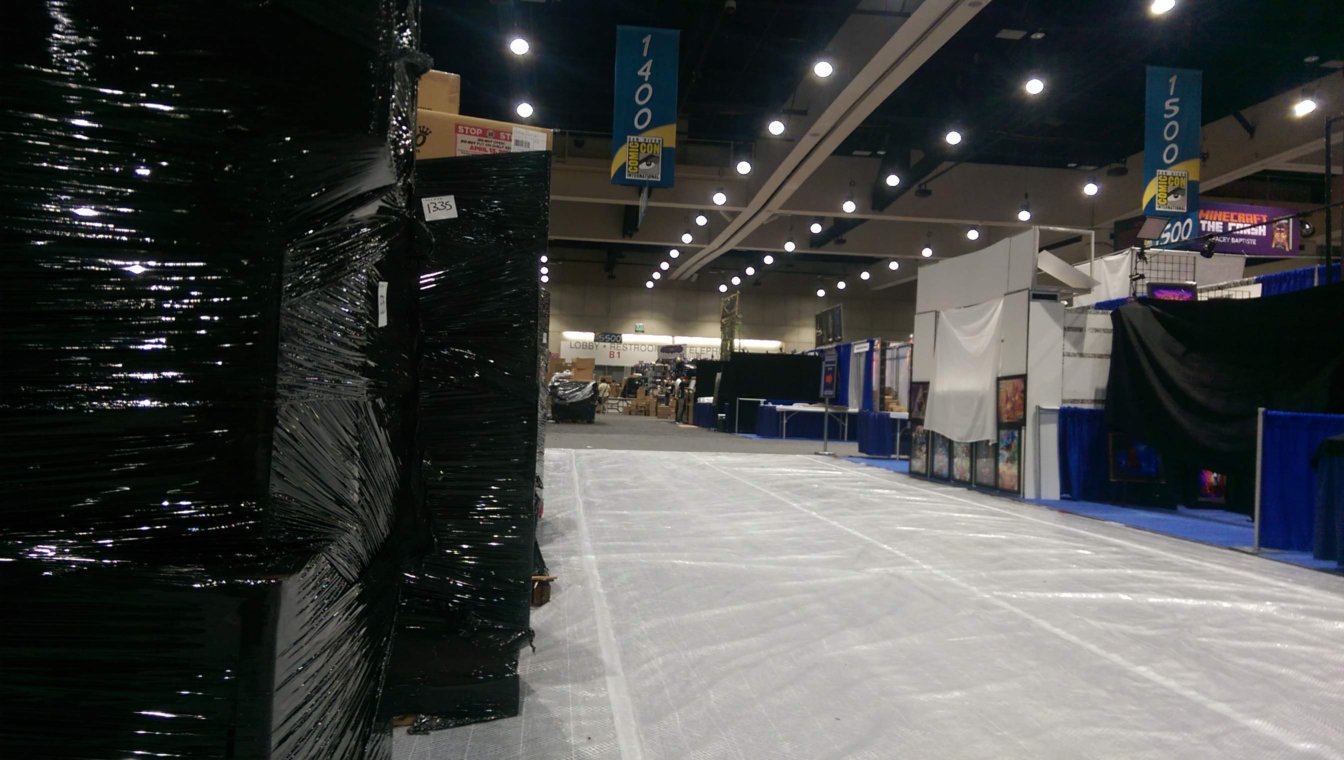
Build out was the usual dance of frantic and calming, with admonishments over the loudspeakers this year that Exhibitors are not allowed to photograph or take video of booths before the show opens, with the crime of posting visuals of the show floor prior to opening subjecting one to possible expulsion. There’s one photo of setup, but honestly? It looks the same from year to year.

It’s in the interest of changing things up that instead of doing a large round-up post, I’ll do a brief summary, and multiple posts of interesting things interspersed. There will be one or two short bits of ephemera here, along with a preview of the day’s panels and the best cosplay photos once that gets underway.

The best ephemera was I met the editor of the new Nancy, and I told her it’s my mission to ask every cartoonist I meet if they are are, individually or jointly, Olivia Jaimes; I also asked her if she, personally, was now or every had been Olivia Jaimes. She informed me that my best guess as to Olivia Jaimes’s identity was wrong, that Jaimes is a single person and not a team, that she’s a woman, and that she’s not telling me who it is.

Fair enough, and I let her know that Nancy is now brilliant, and never more so than in those first couple weeks of Jaimes’s tenure, when the Sunday strips of her predecessor Brad Gilchrist were still running, and the contrast in style — not to mention level of funny! — was shockingly obvious. Last week, I laughed out loud at a newspaper strip for the first time in at least a decade because Olivia Jaimes is so very, very good at her job.

Also, Winter McCloud if heading to grad school, so if you were wondering if you’re getting older, the answer is yes.

Panels to watch for today include:
YA Comics FTW! with Jen Wang, Scott Westerfeld, Molly Ostertag, and Tillie Walden. Room 4 at 3:30.

Superstars In Children’s Graphic Novels with Molly Ostertag Nina Matumoto, Jarrett Krosoczka, Aron Steinke, Ian Boothby, and Jeff Smith. Room 26AB at 5:30.

It Is Way Too Early And I Am Way Too Tired

But I’m awake, and there’s wifi, and the day stretches out before us. Let’s do this. Posts throughout the show as I manage them.

Delayed Travel Day Is Still Travel Day

Ugh, I am going to be getting into San Diego so late.

Reminder that for the next week or so, posts will go up when they go up. You’ll get plenty of them.


Spam of the day:

It’s a fact: people don’t mind scrolling to read an email, as long as it’s relevant and interesting. Make sure your message follows through on the promise in your subject line, and use several short paragraphs if you have a lot to say. When in doubt, challenge yourself to write less and add links that support your topic.

You … you know you’re supposed to take the PR agency’s instructions out of the email template before you use it, right? Right?

Of Course These Drop Just As SDCC Is Heating Up

I mean, I’m not mad, it’s natural to try to get in on the attention that the rest of the press pays to comics this one week of the year, but these deserve to not have their message missed. Wanna see something cool? Of course you do!

  • It’s been announced for months, but next week (or the day after tomorrow, if you go by the Oni booth¹ at SDCC) will be the debut of The Long Con by Dylan Meconis and Ben Coleman (words), EA Denich (pictures), M Victoria Robado (colors) and Aditya Bidikar (letters). It’s the story of what happens when the world ends during a San Diego-alike con, and the convention never ends.

    Oni saw fit to send an advance copy PDF of issue #1 my way, and although I’d been planning on buying the series, I am doubly resolved now because this story is off to a very, very good start. There’s a thousand little touchstones that congoers will recognize, from lines to cosplayers² to the very culty behavior of the hardcore fans. Neither the attendees of Long Con 50 nor the outside world knows that the other survived, and the culture clash when contact is re-established is going to be cuttingly hilarious as well as deflating of pretensions all around.

    Bonus points to Meconis for naming the city where the convention is held Los Spinoza — a nod to the philosopher who’s all over her Enlightenment-era vampire and werewolf stories³ — and to the entire team for creating a 60s-era TV show that perfectly captures the feel not just of Star Trek, but everything else SF of the time, in sensibility, design, color scheme, and silliness masked with seriousness. It’s all going to tie together and it’s going to be a heck of a ride getting there.

  • Speaking of announced for months but just now breaking out with the details, Ryan North has launched the co-Kickstart for his next book. How To Invent Everything will be in bookstores everywhere in September, so why a Kickstart? Two reasons: exclusive stuff and supporting local bookstores. Let’s take the second one first:

    This book is already being printed, and it’ll be available in bookstores on September 18th… but these days most book orders happen online. That’s great, but it would be MORE great if you could support independent booksellers! That’s where this Kickstarter comes in: all the books ordered through this Kickstarter will be funneled through indie bookstores.

    By buying the book through this Kickstarter, you not only get the exact same book you’d get from a giant online bookstore, but you also get it signed by the author (that’s me!), PLUS you get the time traveler’s bandanna, PLUS the stretch goals we unlock (see below) — all for the same price you’d pay at retail. It’ll be shipped direct to your door on the release day, and you’ll get to feel good about supporting cool indie bookstores like:

    The Strand in NYC
    BookPeople in Austin Texas
    The Beguiling in Toronto, Canada

    It’s thanks to these amazing booksellers that we can offer the book at a price low enough to give you all these exclusive goodies on top!

    And that’s the first part there as well — there’s a set of postcards from the future, and a bandanna version of the famous t-shirt for time travelers with a broken time machine that inspired this book in the first place. Stretch goals will unlock vignettes from North as he is stuck in various points in time, with postcards produced (and added to the order) for each goal reached.

    Given that the campaign is about 55% of the way funded in its opening hour (38 minutes ago, Kicktraq tells me, it was at 11%), that’s going to be some considerable postcards. And in the time it took me to write that sentence, funding jumped to 59%.

    Got a pre-order already with Amazon? Cancel it and go through the Kickstarter. You might not always have the book with you if you get hurled through time, but you can carry a bandanna with you at all times, and Amazon ain’t getting any bandanna, folks.


Spam of the day:

In order to get help we are interested in helping the animals. Could you be interested in hearing details?

Bonus points for appealing to my sense of altruism instead of my sense of greed. Still not biting, though.

_______________
¹ That would be number 1833.

² And cosplayer outrage at being asked to compromise their vision, man.

³ Speaking of which, I am desperate to give you money in exchange for new Family Man print collections, Meconis.

Long Week, Next One Will Be Longer

Getting things ready for SDCC next week, and the many words that will accompany. Please forgive if posts are sporadic for the next 10 days or so.

[Said In A T-Rexian, Uninflected Monotone] What.

They use the phrase "a rising tide lifts all boats", but it seems to me that the battleship and the little dinghy are both raising about half a millimeter and it's making no difference to either.

This is definitely one of the weirder Look at this awesome thing we’re doing! emails I’ve ever gotten. Usually, those emails are garbage from start to finish, from creators or companies that haven’t really accomplished anything, desperately trying to get attention and grab traction; maybe it’s an interesting and worthwhile project, and the announcer is just not skilled in the subtle arts of self promotion. Sometimes it’s damage control. Sometimes it’s fluff.

And sometimes, I can’t tell what they’re trying to do, which is all the more puzzling in this case, because it’s from BackerKit. You know, the after-campaign pledge manager app that lets your crowdfunding folks modify their rewards? It just works like it’s supposed to? Nice part of the modern creative community’s infrastructure. It starts out reasonably:

The BackerKit team is proud to announce the official launch of The Creative Fund! We believe awesome ideas come from everywhere and everyone.

They link over to a post at Medium about what their new venture is attempting to do:

A driving force for independent creators over the past decade has been crowdfunding platforms like Kickstarter, which provides a space for ideas to get funded. However, we believe there is room for the online creative economy to become more diverse and accessible to all creators, especially those just starting out. This is why we are launching The Creative Fund, which supports the entrepreneurial spirit of all independent creators, one dollar at a time.

I get it so far — a fund that supports crowdfunding projects, which contributes to the health of the ecosystem and coincidentally may prompt some campaigns/creators to reach a size where they need BackerKit. Win/win, right? But that last line? They mean it literally. From the email again:

The Creative Fund supports every independent creator that launches a Kickstarter project for one dollar.

Or, per the Medium post, more precisely:

After carefully considering what was in our ability to support creators on Kickstarter, we decided to pilot The Creative Fund by pledging $1 to each and every project on the platform. After one month and thousands of heartfelt responses, we felt the need to make this pledge a reality.

One dollar to each project on Kickstarter. Wow. I just … what?

One dollar is not going to be the make-or-break for anything. A bunch of no-hope projects that are poorly conceived will see BackerKit (they’re big time important!) dropping a buck in and figure they’re doing much better than they really are. It reminds me of the geniuses that think they can game the KS algorithms by all pledging a buck to each other’s projects in a ring of mutual success, all suddenly getting elevated to the front page as widely funded, or newly popular, or whatever.

And I’m not sure it’s as simple as one project = one buck. Back to Medium:

Now, we are kicking things into high gear and we invite everyone to join us in making a difference. That is why we are launching The Creative Fund on Patreon, so supporters like you can easily join the cause. For every $2,000 we raise, we will pledge an additional dollar to each new project. 100% of the funds raised goes towards independent creators around the world.

Okay, there’s a possibility to actually have an impact here, where if they make absolute amazing bank on Patreon, they could be contributing potentially tens or hundreds of dollars to KS projects. Not sure what that’s going to accomplish, honestly, if everybody gets that much as seed money, it doesn’t help to distinguish worthy or interesting projects from chaff. In any event, they aren’t making amazing bank on Patreon. As of this writing, the Patreon is currently getting US$192¹.

I mean, giving a buck to a project that’s already succeeded (since non-successful projects will have the pledges returned) is a kinda nice gesture, but that’s all it is. And if it ever does become an amount that a creator might notice/appreciate², it’s not because BackerKit/The Creative Fund is doing so, it’s because they’ve convinced a bunch of other people to give their money not to specific projects or creators, but to the idea of Kickstarter.

It feels like they’re trying to get some feel-good PR off of the contributions of other people. At least they’ve got some guidelines so that if you decided to participate, your money isn’t helping to (in a small way) support a projects that’s (their words here) not evil.

Anyway, the Medium post is here, the website is here, the Patreon is here; I can’t help but think I’m overlooking something pretty basic, because honestly, I can’t see what this effort accomplishes, except to move money around in very small increments at some considerable effort. If I’m radically misunderstanding things, please let me know.

_______________
¹ On the Patron page, this make it clear they mean US$2000 per month, not US$2000 raised.

² Say, an extra twenty, with no reward to fulfill, meaning you can get a couple pizzas for your friends that are helping you with a pledge mailing party? Nice.