The webcomics blog about webcomics

Ten Down And Tomorrow’s Toys

Conratulations today to Owen Dunne on 10 years of The Kid, Jethro, The Poz, and the rest of the You Damn Kid cast. Having gone through much of the archives this morning in honor of the occasion, I can only hope for Dunne’s sake that the strip isn’t too autobiographical.

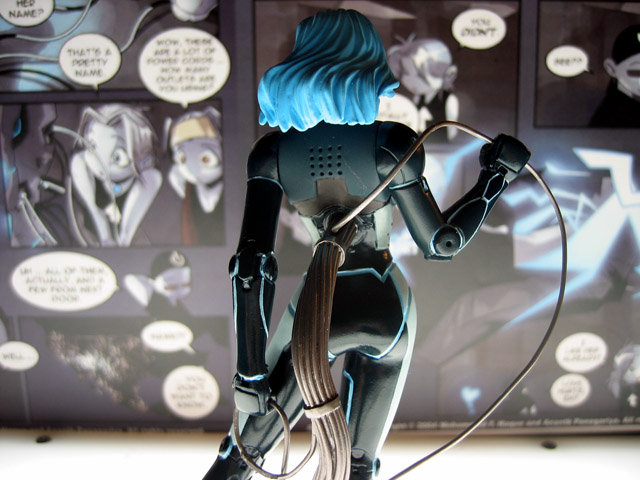
Turning from the sepia-toned Sixties to the near future under a bruise-colored sky, check out what Hawk & Ananth have been working on. There is something distinctly Shirowesque about that bundle of cables in the back — I like it. No definite plans to go to production yet, but if enough people stand up and say they’ll buy one, it could happen. And hey, I like webcomics toys, so count me in.

Standards

This page has previously spoken of standards in webcomics presentation, with prior discussion revolving around things like search text and portability of websites between service providers.

Today, Colonel Joey kickstarts the discussion by bringing the CBR “standard” (I’m not sure it’s used widely enough to lose the quotes) to the Modern Tales family of websites, at least for long-form works. From the Talk About Comics posting:

Today I’m happy to announce that the Modern Tales family of websites (Modern Tales, GirlAMatic, serializer and Graphic Smash) is the first major webcomics network to embrace the downloadable CBR format for full-length, high-resolution digital comic books.

… Unlike traditional webcomic strips, Comic Book Reader files are complete issues of “comic booksâ€? or even full-length “graphic novelsâ€? in digital form, released all at once, downloaded onto the fan’s hard drive and consumed at his/her leisure, with crisp graphics and immediate page-loading.

Like MP3 files, CBR’s first gained prominence in the file-sharing world. Apparently there are a lot of comic book fans out there who enjoy scanning their collections (or even the comics they just bought this week) and sharing them with their friends. I don’t necessarily approve of this activity, but I have a lot of respect for the way that P2P and filesharing systems often stand at the forefront of innovation when it comes to media formats and user-friendly ways of doing things.

I’m trying to figure out if the “file sharing’s bad, but it makes good tech” stand is ethically defensible or not, but I suspect I’ll be going back and forth on it for a while. There’s more in the post regarding what’s available in the CBR format and how to read it. So what do you say? Are you willing to read long-form works on the screen, or does this have the same theoretical-if-not-practical appeal as electronic books?

It’s International Women’s Day! (or at least it was when I wrote this)

fleen-pudle.gif
In honor of International Women’s Day I decided that this week I’d cull suggestions from the folks I know who read webcomics. I was specifically looking for something created by someone who identifies as female that felt pro-equality to me without necessarily identifying with the f-word, which I know makes some people nervous (but it really shouldn’t), and had interesting things to say about gender. The immediate option was Alison Bechdel’s Dykes to Watch Out For but even though it is available online, I have difficulty thinking of it as a webcomic because for so long it’s been a print-oriented piece, either through syndication or through trade paperbacks.

The search raised an interesting issue, one I plan to consider in a future column: there are lots of webcomics out there with strong, smart female characters who don’t look like the stereotypes of women in comics (you know exactly what I’m talking about here, folks). They’re complete characters who make their own choices about life, and work, and sex. They hold a range of different jobs, from coffee baristas to mayor’s aide and saving the world from the devil to working in the sex industry.

And many of these webcomics are created by men, which is not a surprise given the arc of the industry. Many of these creators are, in fact, very attuned to equality and don’t hesitate to respectfully call fans out for sexist comments on messageboards or blogs as well as to actually use the word “feminism” in their webcomics without making it too much of a glib punchline (sometimes, anyway. See again Diesel Sweeties). And I think that’s worth noting.

But I’m lately interested in learning more about women in the industry especially since what’s so great about webcomics—easy access to cheap-ish publishing without editorial boards and so forth—should, in theory at least, lead to less of a potential divide than we’ve seen in the history of the comic book up until about Sandman and Love & Rockets. (I’m skimming the surface, obviously, but if you want to read more on the topic, there’s lots out there– Trina Robbins, Friends of Lulu , and Sequential Tart are three which pop immediately to mind).

Where I landed was reading In the Puddle by Cique Johnson. It’s a mostly-auto-bio webcomic (it’s described as “functioning as a personal diary”) about the life of Cique and her boyfriend Axe, who work in Philly and live in Delaware (a quirky fact I relish as a native Delawarean myself) with their flying fox bat, Atreau. The webcomic follows these characters in and out of goth clubs and work situations and discussions ranging from everything from ethical sluttery to RenFairs, from pirates to babies and so forth. Cique describes the plot as “Together these devout Pastafarians brave mosh pits, exploding tomatos, hot bikinied women and epic battles! Thus is life in Phildelphia and Delaware.” (If my time in graduate school in Delaware had been more like ITP, I would have had a hell of a lot more fun.).

Initally, I found In the Puddle a little hard to follow, primarily because the coloring in it is different from what I’ve gotten used to in webcomics. Often, only a character’s hair will be colored, which at first made me stumble a little in reading (it sort of altered my visual flow in a way I wasn’t expecting. But it grew on me). In the Puddle has a very quirky sensibility to it, one that’s smart and respectful and distinctive. There are guest strips and innovative clothing uses and I’m just finding it a lot of fun to read. I’ve very much been enjoying sifting through the archives and I think it’s a webcomic worth mentioning.

Enjoy! & see you next week…

Circles Of Friends

Lots going on in webcomics that addresses the ideas of “collectives”. First off, you have a thinky piece by Gilead Pellaeon over at Comixpedia about what makes a collective. There’s been a range of opinion about his conclusions, both in the comments (scroll down), and in a group interview with Blank Label Comics (or at least 7/9ths of Blank Label). The lads hold forth on what their group identity means, plans for the future, and how they feel about each other (hint: look for Kris Straub and Howard Tayler to get in a knife fight soon)

The print edition of Wizard is an unreadable morass of comic fanboy stereotypes, but they’re doing some interesting interviews on their website. Case in point: at the recent New York Comic Con they spoke with Steven Cloud and Jon Rosenberg of Dumbrella; it’s an interesting contrast of philosophy reading about how Dumbrellists seem themselves as a group, versus how Blankers do.

Nor is collective behavior always predicated on ongoing relationships; sometimes all you need is a one-off, sorta-collaboration to make a gag work. By way of example, take one part xkcd, which is published under a Creative Commons license. Add one part Help Desk, and bingo: a derivative work (fancy legalese for ‘mash up’) that’s funnier than it has any rights to be.

It works with complete strangers as well: as Ryan North tells us in the newsbox for March 8 (read it quick, because it’ll scroll away in a few days), one of his cartoons inspired somebody named Dr McMuffin to compose an opera. There’s sheet music there, but Dr McMuffin’s contribution is not merely compositional; the good doctor has added some defining characteristics to our favorite dinos — namely, the fact that T-Rex is a tenor (and Dromiceiomimus a soprano, Utahraptor an alto and raccoons a chorus; I wonder what the tiny woman is?).

Lastly, we at Fleen wish to announce that we are enlarging our community a bit. Anne Thalheimer has jumped on the Guest Columnist program with brio, and since she keeps writing stuff that sparks conversation, we’re just making it official. Welcome aboard, Anne.

Update: And in other collectives/network news, Little Gamers announced late yesterday that they’re now part of the National Lampoon Humor Network, along with such luminaries as White Ninja and Superman Is A Dick.

Really Real

Got an email detailing an interesting new role for webcomics — museum outreach. On the Lower East Side of Manhattan one will find tenements — block after block of sometimes improvised housing that served the vast waves of immigration since the days of the Civil War. It’s where you will find the Tenement Museum, which seeks to document and inform on the immigrant experience. And now they have a webcomic.

For Real is a webcomic documentary about the lives of three modern-day teens, their lives, their families, and their ambitions. It’s sort of a journal, sort of a biography, sort of an interview, sort of a Studs Terkel book, but what it reminds me of most is David Isay’s StoryCorps oral history project in pictures instead of audio (appropriately, one of the original StoryCorps StoryBooths is located in Lower Manhattan).

For Real is credited to Marianne Petit and Tracy White; the comics have a single visual style that, while not credited seems in line with White’s Traced. Traced uses a mixture of panels, text, and digital tricks (the kind that make McCloud all warm & fuzzy inside) to tell her stories, and while For Real has a similar approach, it seems to be relying mostly on the illustration. The home page promises that For Real will include stories of immigration from the past century, so keep an eye out for updates.

And how’s this for a wacky coincidence? The Tenement Museum was once the place of employment of a woman named Lynda, who has been somewhat related to webcomics herself. And while it’s been a while since she’s made an appearance, her influence on webcomics is significant (in that her providing of beer was a major influence on the development of Goats).

On the off chance you really don’t care about immigration history and personal history, how about memes? Hooray for the Basques!

Edit: See? Basques are the new hot thing!

Press Release Day

Señor McCloud’s Happy Fun Comics Talking rolls into Indianapolis tonight, and to celebrate the local daily talks webcomics. One reader-submitted comment that caught my eye included this bit of encouragement:

Here’s to the new freedom of the web, where success isn’t measured by corporate suits, but by the quality and creativity of the cartoonists willing to work hard for their fans.

It’s mostly a surface discussion (and highlights the Star‘s predilection for finding a local angle in everything), but it’s also probably the first time that a lot of people have heard of webcomics, so yay.

In other news, it’s Press Release Day ’round here:

The lads at Unshelved, perhaps taking a cue from their fellow Washingtonians, have become the second (to my knowledge) (edit: looks like third, at least — see comments for more info) webcomic to get themselves a dedicated business strategist. No electronic version I can find, but the short version is:

Jim Demonakos brings a variety of experiences to this newly created position. Most recently he was Public Relations and Marketing Coordinator for Image Comics…. Demonakos is also organizer of Seattle’s immensely successful Emerald City ComiCon, and owner of the Comic Stop chain of comic book stores in the Seattle area.

I’m guessing this means that Unshelved gets a good booth at Emerald City.

Next up, Howard Tayler lets us know that his next book will go back to the early days of Schlock, when his art was, um, rougher than it is today. Thus, he’s looking to pretty things up a bit:

I’m looking for guest artists for the next Schlock book. I know that lots of webtoonists might be interested in this opportunity. I make no promises about inclusion, obviously. Still, the way I count it there is room for at least 20 guest pieces, including a full-page piece or two (assuming something worthy shows up.) The details are here.

At Onezumi, there’s a new art blog called Onezumiverse. And over Ugly Hill way, the previously-referenced Medieval Friday t-shirts have made an appearance. In fact, they may be sold out by the time you read this, so be certain to let Paul Southworth know if he needs to do another print run.

Jazz, XTC, Zappa, Pynchon … Webcomics?

So I was sitting at SPX a couple of years ago, talking with Harvey Pekar about jazz (he called me “man” twice — I’ve never been cooler in my entire life). He’s passionate about it, something that I’ve seen in all committed fans of the art. Part of that jazz afficionado passion comes from feeling a bit beseiged — you know all about this stuff that’s absolutely great, and the Unwashed Masses could give a shit, and no, Kenny G doesn’t count, goddammit. The potential defensiveness is matched only with an evangelistic fervor that if only you listened, you’d see how brilliant this stuff is.

Funny thing is, the most fervent of the persecuted geniuses seem to be those who are most knowledgeable in their respective fields. I spent enough time in radio during my college days to develop an XTC habit, but my passion for them pales next to my sister’s boyfriend, an audio engineer who’s worked with a lot of acts — we expound on the virtues of the boys from Swindon at Thanksgiving to a generally disinterested family. Every time I read a quote about Frank Zappa (my favorite: “This guy was self-educated in composition, but he wrote music so complex that you have to be a virtuoso to play it, you have to have a Master’s in music theory to hear everything you’re supposed to, you need a PhD to understand it, and all anybody ever remembers is Don’t Eat The Yellow Snow.” I think there was a goddammit! in there, too), I’m astonished by the converatory credentials of the speaker. Eminent scholars of literatures are still seething over the inexplicable decision of the Pulitzer trustees to not give an award for fiction in 1974 after the literature prize committee unanimously selected Thomas Pynchon for the honor. Mind you, they didn’t just not give the award to Pynchon, they opted to not give the award to anybody (apparently, the ruling body had a problem with a poo-eating scene about 236 pages into Gravity’s Rainbow).

Seems like anytime you get enough people creating in an art, you get those works of genius at the fringes that casual fans of the genre may not appreciate, but the people who’re well-versed with the breadth and depth of the art all seem to concur — there’s something there. Which leads to the logical question for you, who know your way around webcomics: What’s the genius-level masterwork out there? What is it that will never make sense to most people, but has a richness and special meaning for those patient enough to dig for it. Let’s get quibbling.

Blargh Jetlag

Typing this while I can keep my eyes open.

  • For those of you with entirely rational fears, a solution: grape juice and supersoakers.
  • Dunneworld is getting spiffy, what with Beevnicks video and new You Damn Kid both announced for next week. Both sites have a visual overhaul today, too.
  • And famed webcomic BFFs Kurtz & Straub will be working more closely together. If you can think up a name for the new collaboration without using the word Studio, let ’em know. I wonder if Dick & Fart, LLC is taken yet. Either that, or Kurtzilu Productions.
  • Gotcher Clever Title Here, Bunky

    Million things to do before I get on a plane tomorrow; next week’s updates at odd times due to time zone shifts.

    Fleen Guest Column: Anne Thalheimer In, “Closer Than You Might Think”

    Editor’s note: I think I’m going to have to put her on staff.

    In preparing to table at the Boston Zine Fair next month and in trying to more closely consider my current webcomics reading as part of this ongoing series, I’ve spent some time thinking about the relationships between minicomics and webcomics. This is also kind of tied in with continuing to think about David Malki !‘s recent article (we disagree; I don’t think an association with comics or comix is the death knell of webcomics, by any means. I’m still parsing through the particulars of what and why, though, so some of this piece is going to feel like thinking-out-loud). So I thought it might be worth considering minicomics and webcomics, which feel a little more closely related, maybe, than “comic booksâ€? or “comic book cultureâ€? with all their negative connotations (even though considering “comic stripsâ€? and “webcomicsâ€? might also be an interesting parallel).

    Obviously there are certain, immediate similarities between the two. Both can be very cheap for readers to access. Both are—for the most part — free of publishing strictures (quick, nobody think “Patriot Act!â€?). Though webcomics seem generally easier to get than minicomics (even with having to remember to click onto the page for updates), that isn’t a hard and fast rule, and though webcomics may be more immediate in their readers’ responses, audience participation is not a “characteristic native to the Internetâ€? as evidenced by the sheer numbers of folks creating their own minicomics and zines, letters back and forth between creators, collaborations, and so forth. It’s slower, but it’s still there.

    In all honesty, I have a great love of minicomics as well as zines. I’ve been publishing one since 1995, and am involved in a number of other projects, like reviewing for these folks. I also have a great love of paper, as previously established, and I’m kind of an indie comix geek (I wrote a dissertation about comix; it doesn’t get too much geekier than that), though, like Malki ! I’m not a fan of the negative aspects of “comics culture� (Who is, really? We all laugh a little too self-referentially at the Comic Book Guy from The Simpsons, right?). And I don’t think of webcomics and minicomics as so radically different from one another that a new, separate word that doesn’t have “comics� in it warrants coining to replace webcomics.

    That said, I was pretty excited to find this fact while poking around the internet, because it sort of parallels my experience — it’s comics that got me into webcomics, not the other way around. (Still, there must be readers who do have that experience of reading webcomics and then getting into print-only comics. Or getting into webcomics which are then only made available in limited ways, like book collections, such as Mom’s Cancer). But I’m also really into certain webcomics, even though the actual reading itself is so different from reading minicomics. There’s a whole lot of webcomics out there, the same way there are loads of minicomics and zines. Minicomics are, in many ways, kind of a subdivision within zines, which have their own long, storied history.

    Like comics do. And that’s a history to which, I think, webcomics refer, however indirectly or inadvertently. David Malki !’s recent article notwithstanding, I think severing webcomics from “comicsâ€? in general isn’t possible right now. Maybe in the future, when we’re two generations in to those readers who, y’know, grew up online, but not now. Webcomics are still kind of new-ish, in the proverbial big picture (maybe in their awkward teen years?), and “comicsâ€? (in all its permutations) have not always been regarded as illiterate kiddie fare (and, by the way, isn’t this a decidedly American sentiment?), and the cultural worth of “comicsâ€? has arguably risen in recent years. Webcomics, by many accounts, if I’m getting my history right, first started gaining force in early 2000 or so, even though many webcomics appeared online long before that date (I mean, ten years of Goats?!), and if we’re using the most open definition possible — a description of the delivery system only, with nothing to do with the content — surely there are others earlier even than 1986. Right?

    And no, I’m not talking exclusively about Watchmen here, but it isn’t a bad book, and, like the other books usually uttered in the same breath — Maus and Batman: The Dark Knight Returns, functions fairly well as a gateway drug for showing folks that there’s more to comics than comic strips or the stuff in the spin rack at the drugstore. Arguably, webcomics can do something similar, perhaps in part due to some of that immediacy we just talking about.

    Like I said, I’m still thinking through this stuff….

    Anne, how do you feel about occasionally-free beer?