The webcomics blog about webcomics

Change Is The Essence Of … I Dunno, Something Profound

Big changes coming up in some webcomics, for varying reasons:

  • Over at PvP, it looks like it’s wedding season! It’s been half a decade that Brent & Jade have been in a holding pattern (the year-long arc where they were split up was Scott Kurtz’s most interesting work), so making such a fundamental shift could be fraught with danger. But Kurtz pulled it off once already, with the complete alteration of the Robbie & Jase dynamic. Having heard him (back in July, yo) riff live onstage about how shaking characters out of their comfort zones can lead to hearty laugh-chuckles, I’m very interested to see how this plays out.
  • I come to praise PC Weenies, not to bury it. That is, the Mark I version of PCW is now a permarchive, while the new Mark II incarnation has migrated to the wilds of the .net TLD. At the same time, Krishna Sadasivam has shifted to a mix of panel gags and stripping. Along with the change in comickin’ style, there’s a nifty new layout, courtesy (once again) of Tyler Martin‘s Comicpress (in the absence of any new Northian tools in 2007, I’m going to declare Comicpress to the be neat webcomics infrastructure thing of the past year).

    Anyway, PCWv2 joins Uncubed under the umbrella of the Random Nerds Comic Group, which is as good a name as you could come up with for a one-person collective. If changing the site design of two comics and building a new brand identity for them both seems a little ambitious, well, I suppose we can cut Sadavisam a little slack for feeling somewhat creative these days. I know that I said I was sick of all the webcomickers spawning this year, but dang — that’s one cute kid, K.

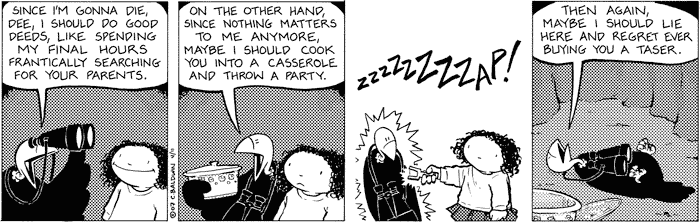
  • Finally, Karen Ellis will have to deal with change as well — for after today, she can never again say, “I’ve had fewer than 500 updates to my journal comic”. Considering that those 500 updates occurred in the space of less than two years, I’d say that’s pretty impressive. Also impressive? Cartoon Karen makes a surprisingly cheerful Supergothgirl, especially with the bunny slippers.

Resolutions Are So Much Easier On New Year’s Day

Much bigger response to yesterday’s call to arms that I anticipated; lots of good input from all who have commented. I particularly wanted to highlight something Bill Barnes wrote a little bit ago:

Honestly the $10 number seems completely arbitrary. Yes, it’s $100,000 divided by 10,000. But those are both also arbitrary numbers too.

Absolutely true; I was thinking in terms of numbers because I was mulling over Jon Rosenberg‘s Law of Webcomics Merch (first stated during one of the fights over micropayments): any reader that’s going to buy something will spend up to $20, so you’re better off trying to sell them a $20 item than a $2 item, because they feel equally satisfied either way.

Honestly, what I considered the most important part of the post wasn’t the number, wasn’t the suggestions of specific merchandise, it was this:

… if you’re thinking about doing this for a living, you have to be willing to work it at least as much a regular job.

And that was just kind of easy to wrap up in the quick thought of “Go get your tenner”. If it’s an overly ambitious goal, well that’s better than one that’s too easily achieved.

I am privileged to know a lot of webcomickers, a significant number of whom are making their livings at it. I also see a vast wave of newcomers to the game, a larger number every year, for whom there has never been a world where there weren’t people making their living from webcomics. They are not, I fear, aware of the incredible range of talents it takes to succeed in this fashion — basically, everything that isn’t writing and drawing.

Five hundred years ago, being an artist meant finding a patron and tying your fortunes to his; it also meant that your job was to rehabilitate or glorify your patron’s image rather than expressing your vision. Today, being a profesional webcomicker means you can follow your muse as you wish, but it also means you have to run a small business with varying degrees of daring and skill depending on how many readers you can develop in your niche.

I have a feeling that Webcomics = Business is going to be a recurring theme for me in 2008, but it’s because I want you to succeed as a professional creator. It won’t be easy, but hopefully (for both of us), it’ll be a lot of fun. So let’s restate yesterday’s conclusion this way —

2008 is the year you decide to go pro; how are you going convince the rest of us to help you stay there? You don’t have to tell the world, but you do have to set the goals and make the plans and be ready to change along the way.

I Want My Ten Dollars!

Ten dollars.

That’s a number that’s been running around my head. If you’re a webcomics creator, it’s a number you should be thinking about, hard. It’s not very much — a sandwich, a refreshing beverage, a slice of tasty pie — that’s probably more than ten dollars right there. As I am constantly reminded by the year-end pledge requests from my local NPR station, it’s less than 2.8 cents a day when spread out over a year.

If you want your webcomic to be your job, it’s the amount of money you want to make off of each of your readers in the coming year. Doesn’t sound like very much, does it? But this time last year I was wondering if 10,000 regular readers were enough to support a webcomic creator, and it occurs to me that if that theoretical creator can get ten dollars off of each of those 10,000 readers, then the answer falls pretty strongly in the Hell, yes category.

Now you aren’t going to make ten dollars off of each and every reader; you probably won’t get more than a hard core of readers — say 10 to 20% — to give you anything. But those most loyal fans are going to make up for the slackers.

By way of example: 2007, I bought three originals from a particular creator who charges an entirely reasonable $40 a pop. That means that I covered 11 non-contributing readers, minus a bit for shipping. Call it me plus nine others once you subtract the cost of Bristol and ink.

Chances are the same is going to happen next year, which means that Our Hero doesn’t have to entice all that many more people to have purchasing habits equivalent to mine, and he’s a goodly way to his goal. Add in a percentage of the readership that buys a book or poster and he’s closer still. Tack on a bit of advertising, and even the deadbeats are contributing.

The point is, the average reader of webcomics will blow through ten bucks without thinking of it. It will take some effort to figure out what will separate that particular reader from ten bucks, and how many increments are needed, but everybody reading your comic is willing to purchase something.

  • T-shirt buyers tend to be repeat purchasers — sell ’em three with a $3.50 margin, and they’re covered.
  • Posters are a nice high-margin item — you should be able to clear $5 profit per without trying.
  • Originals! Physical artifacts created as part of the production of your strip are as close to free money as you can possibly get. Even if you don’t produce finished inked-and-lettered originals (and most of you don’t), the pencil or blue-line sketch that got scanned, along with a decently-printed version of the final artwork, is worth placing up for sale.

    If you don’t work from scanned artwork, you can still do a pencilled rough of what you’re going to draw on the tablet; it’ll take you five minutes, and somebody in your readership will value it at ten dollars, guaranteed. Everybody not named Ryan North should be able to exploit this.

Does all this take a lot of creativity and time? Oh my yes, but you’ve got creativity coming out the ears or you wouldn’t be a webcomicker, and if you’re thinking about doing this for a living, you have to be willing to work it at least as much a regular job. Is stuffing an envelope and standing in line at the post office fun? I promise you it’s more fun than my commute.

Ten dollars per reader in 2008 is your goal … go get it.

Webcomics In Review: 2007

Hey, did you know that there were some significant things to happen in the world of webcomics in 2007? Well, it turns out that there were, and here are some of them. Despite the fact that they’re numbered, these are in no particular order of importance.

0 — The number of entries in the past-strips archive of Skin Horse, which launched a few hours ago. Why am I calling a completely new strip that has no track record a significant event for the year? ‘Cause it’s from Shaenon Garrity, homes.

1 — Achewood‘s position on the list of Top Ten Graphic Novels of the year, according to Time blogger Lev Grossman. He’s done a lot to raise the visibility of webcomics to the wider world this past year.

3 — Number of apparently very smart people involved in the Modern Tales/ComicSpace merger. We hope to bring you an interview with principals Joey Manley, Josh Roberts, and Alan Gershenfeld once everybody’s back from the year-end travelganza.

4 — Number of days until the start of the 2008 convention season, with Randy Milholland putting in an appearance at Ohayocon. Likely winner of cons in 2008? Ironwoman Jennie Breeden, with 43 days already planned, and the back third of the year still open.

6 — Wowio came on the scene, offering free downloads of books (including [web]comics) in exchange for statistical information to consumers about readers, and the promise of payouts to the creators. Judging from the checks that were cut back in the Fall, the creators I’ve spoken to seem more than satisfied with their end of the arrangement, but the question remains as to how long Wowio can continue its burn rate.

As for me, I’m pretty philosophically opposed to the trafficking of information about me (whether I remain individually identifiable or no), so I’ve not taken advantage of Wowio’s offer. So why is this item #6? Because I am not a number, I am a free man.

10 — As in “ten bucks”. A brutally important number. Come back tomorrow to find out why.

15 — Days you still have to catch Infinite Canvas: The Art of Webcomics at the Museum of Comics and Cartoon Art in New York. What are you waiting for?

47 — The number of people creating webcomics that, off the top of my head, are making their livings (at least in significant part) from their webcomics. You can get into all kinds of trouble here, playing games like “Do I count the people on the Penny Arcade payroll that aren’t Jerry and Mike?” and “What about infrastructure providers like the aforementioned Manley and Roberts and Phillip Karlsson and the people packing t-shirts for Topatoco?”

In the end, I made it a judgement call and just started counting writers and artists on my fingers. I’m sure you could come up with a completely different list, but what’s important here is that there’s probably as many people on this list, as you could find on the list of top-tier syndicated strip cartoonists. And I’ll bet $20 right now that the number at least doubles over the next two years.

1200, 1300, 1400 — Aisle numbers at the San Diego Convention Center where the (to date) largest concentration of webcomickers in history gathered for Nerd Prom ’07. Variations on this theme have occurred in prior years, of course, but this year seemed to represent a turning point of sorts. There’s been a marked decrease in Teh Drama and a corresponding increase in the collegiality of those who create webcomics, which seemed to have really started around the time everybody promoted the hell out of each other.

2,000 — The amount of money that a Zudawinner needs to be paid every four years to keep the rights from reverting back to the creator. Significant mostly because Zuda (which has proven to have a clumsy, heavyweight interface, and not really be about webcomics at all) sparked a general discussion of rights and ownership among the webcomics set, which is always a good thing.

5,000 — The reported going price (in US dollars) for a piece of gallery art that bought Todd Goldman some very bad publicity. By the time the storm had settled, there was a particularly telling quote from Goldman’s art dealer:

Solomon said that several galleries stopped showing Goldman’s work. And the wholesalers who buy Goldman’s posters canceled their orders and asked for refunds for unsold stock.

“I lost the three biggest poster distributors in America,” Solomon said. He wouldn’t say how much money he and Goldman may have lost.

17,000 — Circulation of the Rutgers University student newspaper, The Daily Targum. A new webcomicker of my acquaintance started a strip over the summer and has been working on his skills at a steady rate. Taking a piece of advice from the Webcomics Weekly podcast, he started writing to college papers, offering his strip, and TDT was one that bit. In the coming year, he’ll jump immediately from dozens of readers to thousands, and be just a bit closer to that dream he’s had of doing a comic strip since he was six years old. I’ll introduce you to him in the coming year.

1,135,000 — Amount of money, again in US dollars, donated to Child’s Play so far this season. Or if you prefer, there’s the even more impressive $3,324,000 to date since the inception of Child’s Play a few years back.

2008 — The most important number on the list. It’s been a hell of a year for webcomics, and next year promises more of the same. Come on back tomorrow and we’ll talk some more.

Don’t Think Of It As A Slow Week, Think Of It As Awesomeness Concentrated Into Fewer Items

The final word on Women In Refrigerators, by Randy Milholland. I’m starting to think he’s got a better grasp on the fundamental idiocies of the superhero genre than anybody else on the planet.

And new meme! Go here, and add your drawing of a bear in an ill-fitting hat (special thanks to The Strike-Breaking Dreamcrusher both for the tip-off, and for showing his skills of an artist).

Yep, It Became A Meme

Love Is … four webcomic sightings last week and two more since then. Per my entirely arbitrary standards, that makes it official.

Yeah, pretty thin today. Everybody’s off this week.

Post Christmas Crash

Hey everybody. I see the piece that I wrote up and scheduled to post yesterday monrning didn’t actually, but it’s long and now you get an extra one for today, so everybody wins. In fact, I just wanted to point out some of my nicer presents today.

First up, you may recall that about a month ago, my wife arranged for a rather special birthday present for me. What with my birthday falling on a Tuesday, one of the intended gifts was delayed a day, but there I was — barber to ninjas. I got to thank Chris Hastings in person with beer and cheesecake about two weeks back, and he never let on that the original of that page was already in the mail to me. “Sneaky”, “underhanded”, and every other word that might apply to ninjas also applies to Chris and his partner, Kent Archer.

Next, arriving on the 24th and just in time for Christmas, DJ Coffman sent me an unexpected gift — a hardcover copy of his Hero By Night miniseries (prompting one of my nephews to notice it on my desk and say, “Cool, I didn’t know the hardcover was out yet.” I don’t see him often and didn’t know that he read HBN, so yay to Coffman for bringing families together).

I was going to pick up the trade of HBN, even though I have the individual copies, as it both saves space on my shelves and allows me to donate the individual issues to people that might not be able to get comics easily (this week I’ve got two boxes to send to Chris Tarbassian at Operation Comix Relief, who will send any and all donated comics to US troops on deployment). So I get a handsome hardcover for my collection, my nephew feels a little less like the only geek in the family, and some troops get a diversion from their crappy immediate surroundings sooner than they would otherwise? That’s a win for all involved.

Two weeks ago, Jeff Rowland ran what I think is one of the funniest episodes in the history of Overcompensating; having missed out more than once on the chance to buy particularly funny originals of various strips by waiting too long, I emailed Jeff right away.

He told me that the original had been water damaged, and he couldn’t in good conscience sell it to me. It showed up in today’s mail, with three little water spots away from the main image, along with a mess of stickers and temporary tatoos and a Band-Aid™ brand adhesive bandage. All of these gifts, especially the Band-Aid™, are going to be treasured parts of my collection of webcomics art.

So to Jeff, DJ, Chris and Kent, and all the terrific creators that I’ve met in the past two years of fumbling my way through this pseduo-journalistic hackery, thank you. It’s no exaggeration to say that being around so many creative, funny people has made my life richer, and I’m going to keep trying to spread the word about the great work that all of you do.

Fleen Book Corner: Holiday Special

So we’re full into the holiday season; whatever tradition you may follow, there’s an excuse to get well-fed and well-boozed with friends and/or family about now, plus or minus ten days. And at these times, we generally try to find the best things about ourselves, and today I have two books to share that I believe reflect the best of [web]comicry talent.

First up, The Kids’s Book Project, a benefit for the Make-A-Wish Foundation, spearheaded by Mike Rouse-Deane, and with more contributors than you can shake a stick at (I wrote ’em all up here last month, and I ain’t doing it again so make with the clicky).

Rouse-Deane gave each of his 50+ contributor’s one thing to look at: the page before the one they would be drawing, and the one after. One group of creators started at the forward and worked forward, the other at the end and worked back, and from there it’s an exercise in wandering digression that somehow comes back to a resolution of the original story.

Without giving too much away, I’ll note that the previously released image comprises page three, and that the story (at least at first, and then again at the end) concerns a pair of children named John Alexander Petdander Orlean and Susie James. It’s a fun ride, with much flipping to the back of the book to confirm who drew what. In fact, there’s only one thing missing and that may be the most important thing:

Mike Rouse-Deane has neglected to list his name anywhere in the book. Title page, intro, credits at the back, nothing. I suspect that he’s trying to not steal focus from the creators or the cause, but I’m calling shenanigans on that modesty. You put together a hell of a good project, Mike, and you ought to take a bow.

Secondly, something that I didn’t think I’d get to read yet. The always clued-in JRo let us know that the major booksellers moved up the street date of Kazu Kibuishi’s Amulet; two hours later I was in the local Barnes & Noble (who appear to be shelving it in the children’s section) and breaking out my wallet.

Forget a body of work that spans the achingly wonderful Copper, the spare and unexpected Daisy Kutter, and sitting in the driver’s seat of the brilliant Flight anthologies. Kibuishi has just left those projects in the dust and announced himself as one of the premier talents in comics with Amulet Book One: The Stonekeeper.

If not for the fact that he’s still alive, I’d swear that Kibuishi was the reincarnation of Hayao Miyazaki, because Amulet reminds me of nothing so much as a Miyazaki story. All of the Ghibli touches are there: characters with open, simple, but incredibly expressive faces; the choice of the young girl (not quite ready to be a woman) as the protagonist; the stylish, otherworldly, and lovingly-crafted flying machines; the landscapes and critters that clearly come from a dream world that isn’t all rainbows and lollipops.

Into this mix are thrust Emily and her younger brother Navin; their mother has been taken from their new home by a nightmarish menace made of tentacles and teeth. When you’re a girl who’s already lost her father these circumstances demand you do whatever you need to do to get your mother back. In this case what needs to be done means accepting the help of a mysterious and long-lost great-grandfather, and taking on the powers and burdens of a magic stone in the titular amulet.

An amulet which, as it so happens, has its own views on things; at more than one point, the reader is left wondering exactly what price Emily will have to pay to save her family. With barely the initial setup to the story finished, it’s clear that this isn’t one of those happily ever after kinds of stories … it’s one of those nobody said getting what you wanted will make you happy stories, or maybe one of the sadder but wiser kind. It’s a new kind of all-ages literature, of a sort with BONE, and sure to please anybody you might choose to gift it to.

And best of all? If Book One released early, maybe that means that Books Two through as many as we can get Kibuishi to write will release early, as well. Right now, I’m ready to curl up with about a thousand more pages of Amulet.

Fleen Book Corner: The Tub Of Happiness

Webcomics can save your life. Want proof? From the Introduction of Schlock Mercenary: The Tub Of Happiness by Howard Tayler:

In December of 1999 I had a heart attack.

Here I am, almost eight years later. I suspect that those chest pains were a clarion call. Less than three months after the ripping of that final, hairy bandage, I found myself telling Sandra, “I think I’ll pick up doodling as a hobby.” A week after that the first Schlock Mercenary character drawings were emerging, and within two weeks I was writing and illustrating strips.

Hold that thought, we’ll be coming back to it shortly.

Reading SM:TTOH, some notice that Tayler’s trying to play fair with the rules of his hard sci-fi universe; others note the art that rapidly progressed from its very rough original form to its present, less-rough form; many focus on the funny (with a hefty side order of BLAM). Me, I notice how reprehensible most of his characters really are.

They are mercenaries. Their defining motivation is there in the second panel of the first strip:

We’re a crack company of space mercenaries. We do “hurting people” and “breaking things”.

So we’ve got Good Guys whose stock in trade is murder and destruction and extortion — not for defense of their homes or grand ideals, but for money. They are not so very different from the union thugs portrayed in the storyline on pages 175 to 177, who are portrayed far less sympathetically than Our Heroes. By the time the book is done, they’ve directly caused a spasm of war that lays waste on a multiple-planetary scale and laid the groundwork for a broader conflict that will kill billions of sentients.

And yet, that war and those uncountable deaths somehow disturb us less than the fact that all that death and destruction was provoked by the act of spamming 30% of the galaxy’s population.

So Tayler’s working on some pretty dark thoughts, making us laugh at them, robbing those less social corners of his own soul of some of their power. I know that it’s working, because hanging out with Howard Tayler, he’s absolutely the sort of person I’d take to the town picnic and introduce to my neighbors as a friend, and totally not a societal danger that spends his days trying to convince me to care about mass murderers. Because dammit, I do care about them, and they do make me laugh.

Letting out the blackness between the parts of ourselves that we show the rest of the world has got to be a good thing. In Tayler’s specific case, that process (via cartooning) has had a salutary effect on his health. To recap, in the form of the famed Harper’s Index:

  • Heart attacks suffered by Howard Tayler prior to becoming a webcomicker: 1
  • Heart attacks suffered by Howard Tayler since becoming a webcomicker: 0

QED, people.

Music:=Webcomics?

Got tipped off by the always clued-in Rich Stevens about a piece by David Byrne in the latest issue of Wired; he’s talking about the management of musical careers (vis-a-vis, how much do you want to give away to other people in exchange for their help). It’s designed as a comment on the music industry, but it’s really applicable to any kind of creative endeavor, such as webcomics.

Particularly interesting is his breakdown of six different models (with examples) of how to get your music (webcomic) out to the listening (reading) audience:

  1. The 360° or equity deal; the creator is a brand that’s owned entirely by the publisher lock, stock, barrel, and they manage the entire thing for you (or without you)
  2. The standard deal; ownership of the creation goes to a publisher, and the creator gets paid by them (after costs)
  3. The license deal; the creator retains ownership, and a publisher has the rights to market/exploit the material for a period of time, after which they revert to the creator who can then exploit or shop them around
  4. The profit-sharing deal; minimal upfront cash to the creator (who retains ownership), publisher performs marketing and distribution, and they split the proceeds
  5. The manufacturing and distribution deal; the creator does everything except make and ship the final product, and the publisher is pretty much reduced to fee-for-service
  6. Not a deal, but self-distribution — the creator does it all, but just as importantly, keeps all the money; with digital distribution costs of music approaching zero, look for this to be much more popular in the future

Right now, the traditional syndication of comic strips exists somewhere between 1 and 2;, comic book work-for-hire and Zuda-type deals straddle 2 and 3; I’d like to see the new ComicSpace do something like 4 or 5 (which would be the Aduz model of publishing); and most self-supporting webcomics artists live in zone 5 or 6 (depends on whether they ship themselves, or farm out fulfillment to someone like Topatoco).

It’s a fascinating read, and if we envision the models on a y-axis (arbitrarily, we can put 1 at the bottom and 6 at the top), I fully expect to see musicians and non-independent [web]comickers climb up to the webcomics end of the scale. As the worlds of music, comics and movies all start to merge into a general art from digital tools, I hope that we’ll make newcomers to the world of self-managed creation feel welcome.